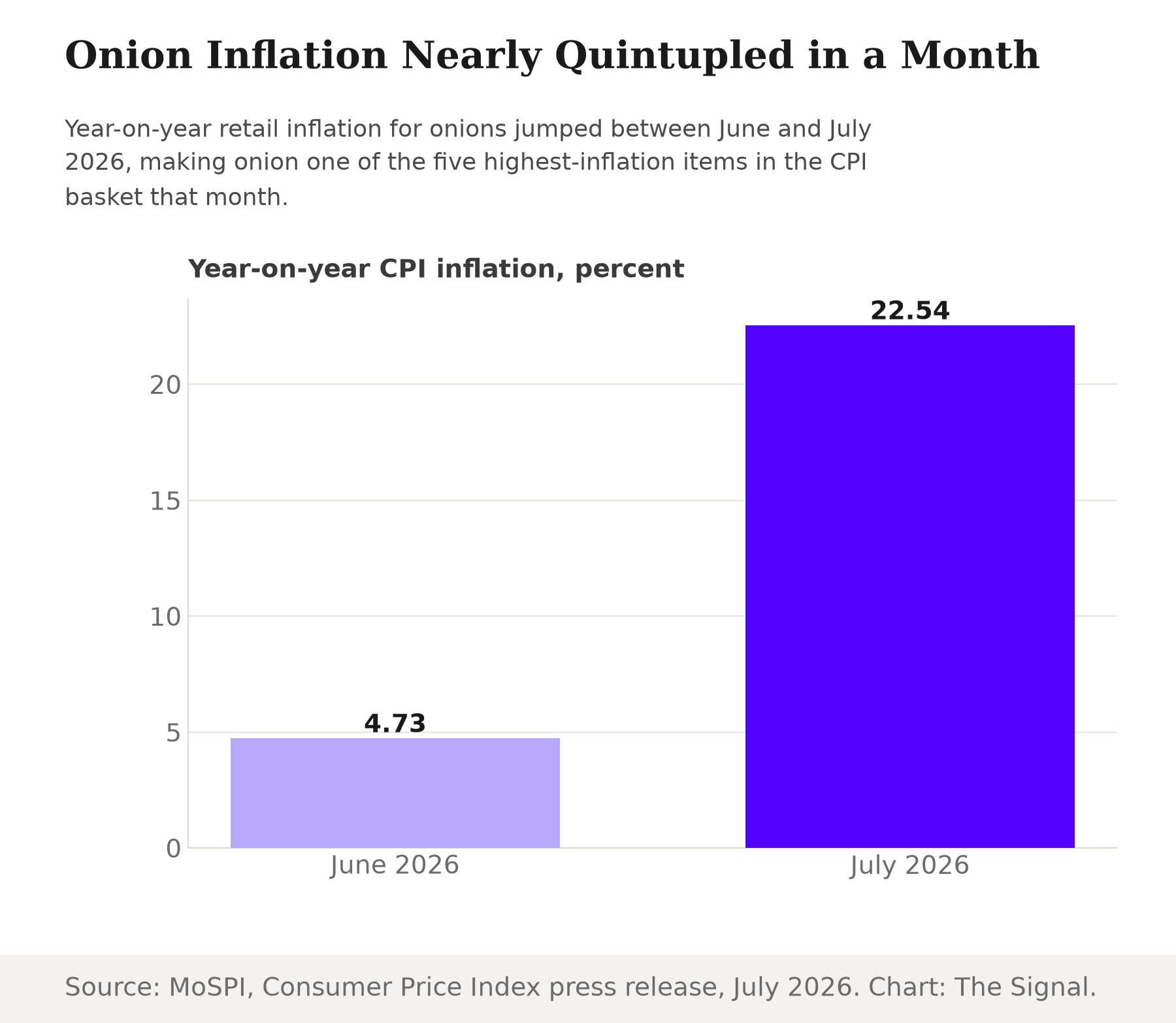
India's July 2026 inflation print put one vegetable at the top of the list of price shocks. Retail onion prices rose 22.54 percent year on year in July 2026, up sharply from 4.73 percent just a month earlier, making onion one of the five highest-inflation items in the entire consumer price basket that month, according to the National Statistics Office's Consumer Price Index release.
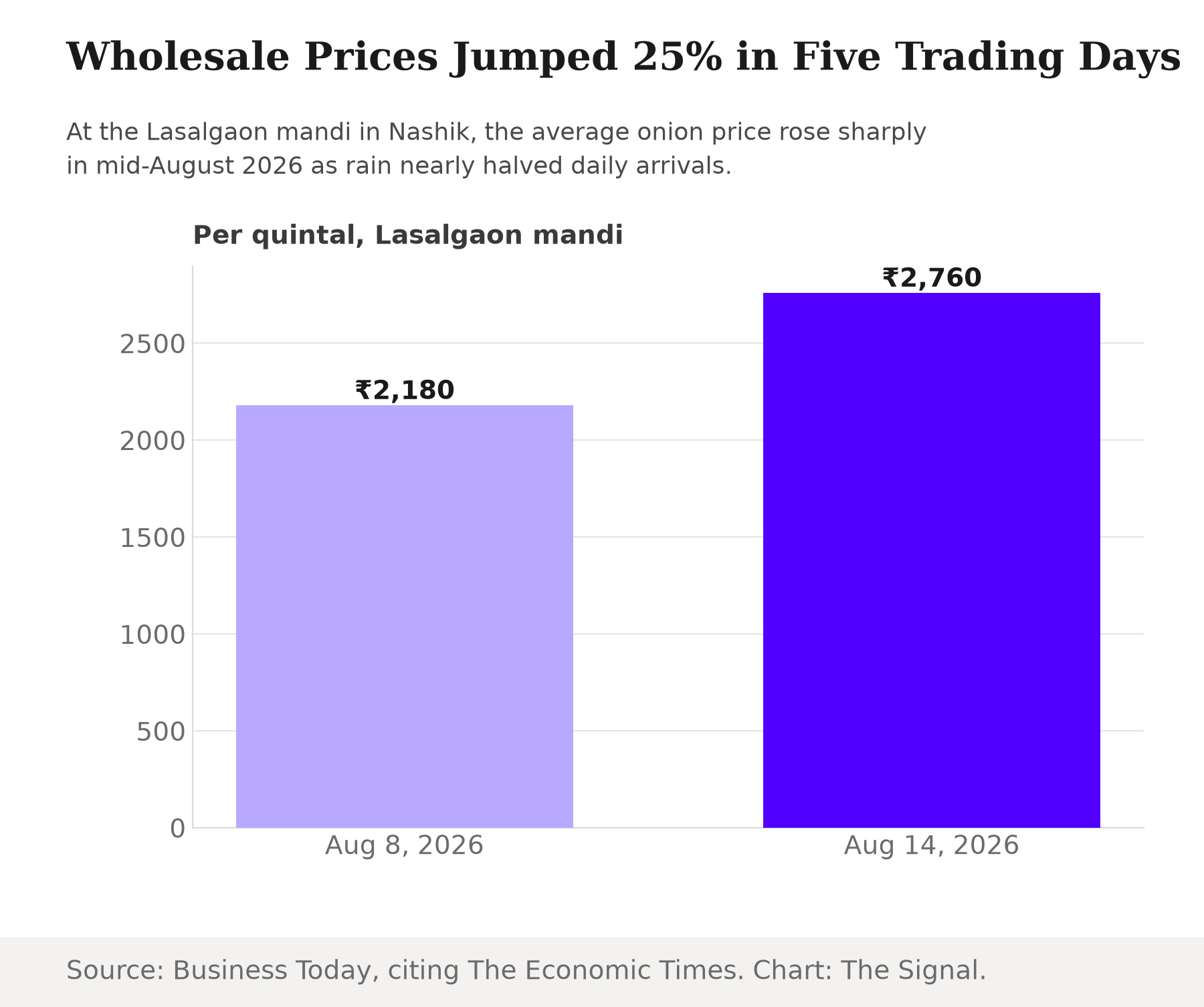
The wholesale market told the same story a few weeks later. At the Lasalgaon Agricultural Produce Market Committee in Nashik, India's benchmark onion mandi, the average price jumped 25 percent in five trading days in mid-August 2026, from Rs 2,180 to Rs 2,760 per quintal, as daily arrivals nearly halved after rain. The explanation writes itself: the monsoon disrupted supply, prices spiked, and the government will likely reach for the tool it always reaches for when onion prices move this fast.
It is worth slowing down on that reflex, because the tool has a long track record and it is not a good one. In September 2020, the government banned onion exports after the all-India average retail price rose 114.96 percent above its five-year average, from Rs 25.87 to Rs 55.60 per kg. It happened again in December 2023, when a full export ban was imposed citing delayed Kharif arrivals and trade restrictions from rival suppliers Turkey, Egypt and Iran. That ban's associated duty and minimum export price curbs were not fully unwound until April 2025, by which point mandi prices had already fallen 39 percent from their peak: the policy outlived the emergency it was built for by roughly sixteen months.
Every recent onion price shock has ended in the same reflex: ban first, unwind later.
The crop is not the problem
The number that actually explains why this keeps happening sits nowhere near an export ledger. Approximately 30 to 40 percent of India's onion crop is lost during post-harvest storage to rotting, sprouting and weight loss, according to a 2026 paper on IoT-based onion storage from researchers at Manipal University Jaipur. That is not a shortfall in what farmers grow. India is the world's second-largest onion producer, and within India, Maharashtra alone, the state that includes both Nashik and Lasalgaon, accounts for 44.07 percent of national output. The crop exists in volume. A third to two-fifths of it simply does not survive the gap between harvest and sale.
That single fact reframes every spike above. India does not run short of onions so much as it fails to hold onto the ones it already has through the weeks when arrivals dip, whether because of rain at one mandi or the normal lag between one crop cycle and the next. An export ban does nothing to fix that leak. It only decides which buyer gets first claim on whatever survives.
Why the leak never gets plugged
Storage capacity is exactly the kind of investment a reactive export-ban regime discourages. The trader or cooperative that holds onions through a lean patch is betting that, by the time arrivals recover, the price will have risen enough to cover the storage cost and the loss rate. Every time the government has moved to cap that upside with a sudden export ban, most recently in December 2023 and before that in September 2020, it has shortened the payoff for exactly the kind of storage bet that would smooth the next cycle.
The government's own substitute for private storage is not closing that gap either. For the 2026-27 season, the Price Stabilisation Fund set a procurement target of 2 lakh tonnes of Rabi onion, with procurement beginning in mid-May through NAFED and NCCF; by late August 2026, only about 1.21 lakh tonnes, just over 60 percent of that target, had been procured.
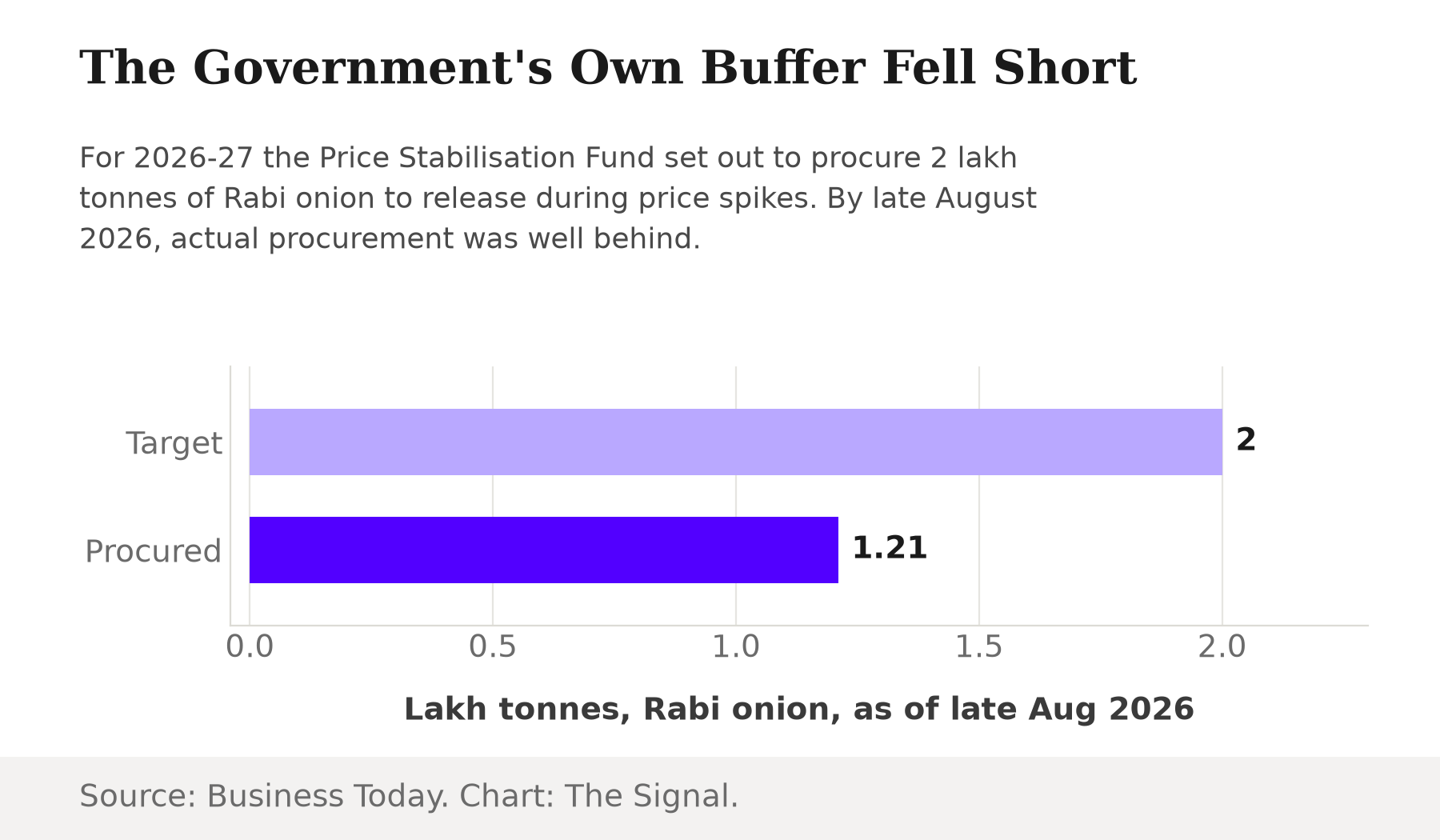
That shortfall lands at the worst possible moment: buffer stock exists precisely to be released when a mandi like Lasalgaon loses half its daily arrivals to rain and prices jump 25 percent in five trading days, and the fund meant to do that this season is running behind its own target heading into the festive demand months.
The honest objection
The strongest case for the export ban as a policy tool is that it is the one lever the government can pull immediately. Storage infrastructure takes years and real capital to build; a notification banning exports takes a day and stops supply from leaving the country while the domestic shortfall is acute. Rain at Nashik is also genuinely unpredictable. No storage system built to date fully insulates a crop against a week of bad weather at the one mandi that sets the national benchmark price.
That case is real, but it does not explain a loss rate that recurs every single year regardless of the weather. Rotting, sprouting and weight loss in storage are not rain-specific events; they are what happens to onions held in ordinary sacks and open godowns for weeks at a time, in a good monsoon or a bad one. A functioning storage and cold-chain system would not eliminate a rain-driven arrival dip at one mandi, but it would cut into the 30 to 40 percent baseline loss that recurs whether or not it rains. And the government's own buffer fund, the tool explicitly designed to substitute for that missing private storage, is behind its own target in a year with no unusual shock beyond the normal one. The constraint is not that India lacks a policy tool. It is that the tool it has built for this exact job keeps arriving short.
That the loss rate is not fixed is visible in the government's own numbers. Onion recovery in the Price Stabilisation Fund's buffer stock has risen from 49 percent in 2022 to 54 percent in 2023, 63 percent in 2024, and an estimated 72 percent in 2026, the Consumer Affairs Secretary said, as storage management has improved. When the government actively manages storage for its own buffer, the recovery rate climbs. The 30 to 40 percent loss rate on the rest of the crop is not a law of nature; it is what happens when nobody is doing that work.
The Signal
Every onion price spike in India gets covered as a supply emergency, and every time, the response is the same: restrict exports, wait for the next harvest, and quietly unwind the restriction only after the market has already corrected on its own. That pattern has now run in 2020, in 2023-24, and it is being written again in 2026. The number worth watching this time is not the CPI print or the mandi price, both of which will move with the next rain and the next harvest regardless of what Delhi does. It is the gap between the Price Stabilisation Fund's procurement target and what it actually buys as the festive season approaches. If that gap closes, the government is finally building the buffer the storage system does not provide on its own. If it does not, expect the same ban, the same delayed unwind, and the same July print a year from now. An export ban can stop onions from leaving the country. It cannot stop them from rotting inside it.
Reporting basis: the July 2026 CPI inflation figure for onions is from the National Statistics Office's (MoSPI) Consumer Price Index press release. The Lasalgaon mandi price move and the 2026-27 Price Stabilisation Fund procurement figures are as reported by Business Today, the former citing a report in The Economic Times. The 2020 export ban and its price trigger, the December 2023 export ban, and the April 2025 unwinding of the associated duty and minimum export price curbs are each from separate Press Information Bureau releases issued by the Ministry of Consumer Affairs, Food & Public Distribution. The post-harvest storage loss estimate is from a 2026 arXiv preprint by researchers at Manipal University Jaipur. India's production rank and Maharashtra's output share are from APEDA. The onion recovery rate in the government's buffer stock, from 2022 through this year, is from remarks by the Consumer Affairs Secretary as reported by ThePrint. The sixteen-month gap between the December 2023 ban and its April 2025 unwinding, and the just-over-60-percent procurement share against the 2026-27 target, are The Signal's calculations from those figures.