On July 7, 2026, the Competition Commission of India cleared upGrad's takeover of Unacademy, the test-prep platform once counted among India's most valuable startups. By September, the all-stock deal had closed: upGrad agreed to acquire Unacademy in a deal worth about ₹2,055 crore, roughly $218 million, valuing the company about 90 percent below its 2021 peak. Read as a headline, this is one more entry in a long list of Indian startup consolidations: a well-capitalised platform buys a smaller peer, a regulator waves it through, everyone moves on.
It is worth slowing down on that gap. Corporate statements about "consolidation" and "synergies" are built to obscure exactly this kind of number. Unacademy's own co-founder did not let that happen.
Munjal put a number on it, on the record
Gaurav Munjal, Unacademy's co-founder and chief executive, told reporters plainly: "We raised at a peak, but sold at a fraction of that. I'm not going to dress these facts up." That sentence is unusual. Founders selling below peak almost never say so this directly; the standard move is to talk up strategic fit and go quiet on price. Munjal's admission turns an M&A footnote into a data point: the deal price is not spin, it is the number the seller himself is willing to own.
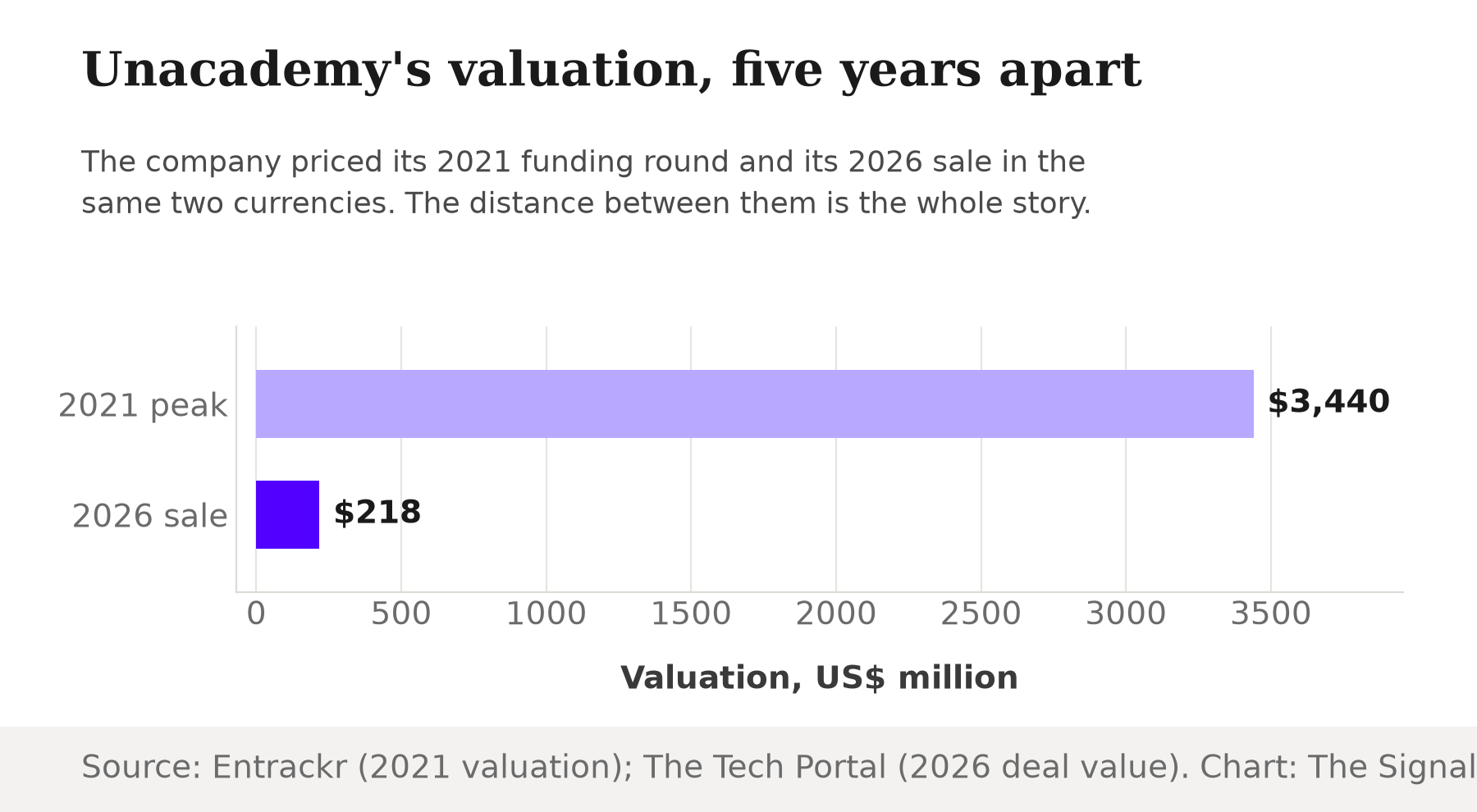
Unacademy's 2026 sale valued it about 90 percent below its 2021 funding peak.
Source: Entrackr (2021 valuation); The Tech Portal (2026 deal value). Chart: The Signal.
Unacademy last raised money at $3.44 billion in an August 2021 Series H round led by Temasek, a jump of more than 70 percent from its valuation eight months earlier. Measured against that figure, the ₹2,055 crore deal is not a discount. It is a different order of magnitude.
The business was not the problem
The company was not a shell being sold for parts. At the time of the 2026 sale, Unacademy had annual revenue of around ₹400 crore, held about ₹900 crore in cash, and most of its business segments were either profitable or close to it. A company generating real revenue, sitting on close to a billion rupees in cash, and largely break-even is not a distress sale in the conventional sense. What collapsed was not the underlying business. What collapsed was the price the market was willing to pay for a share of it.
That break-even state was not automatic. Unacademy's total job cuts reached about 2,000 since the second half of 2022, across multiple rounds of layoffs, the cost side of the same repricing that eventually showed up in the sale price. Unacademy had raised a cumulative $854.3 million across 13 funding rounds since its 2015 founding, backed by SoftBank, Tiger Global, General Atlantic and Peak XV Partners. The roughly $218 million that upGrad paid values the entire company at about a quarter of the capital that had gone into it over a decade. That gap says nothing about how the money was spent. It says something about what a dollar of 2021 venture capital turned out to be worth in 2026.
Not just one company
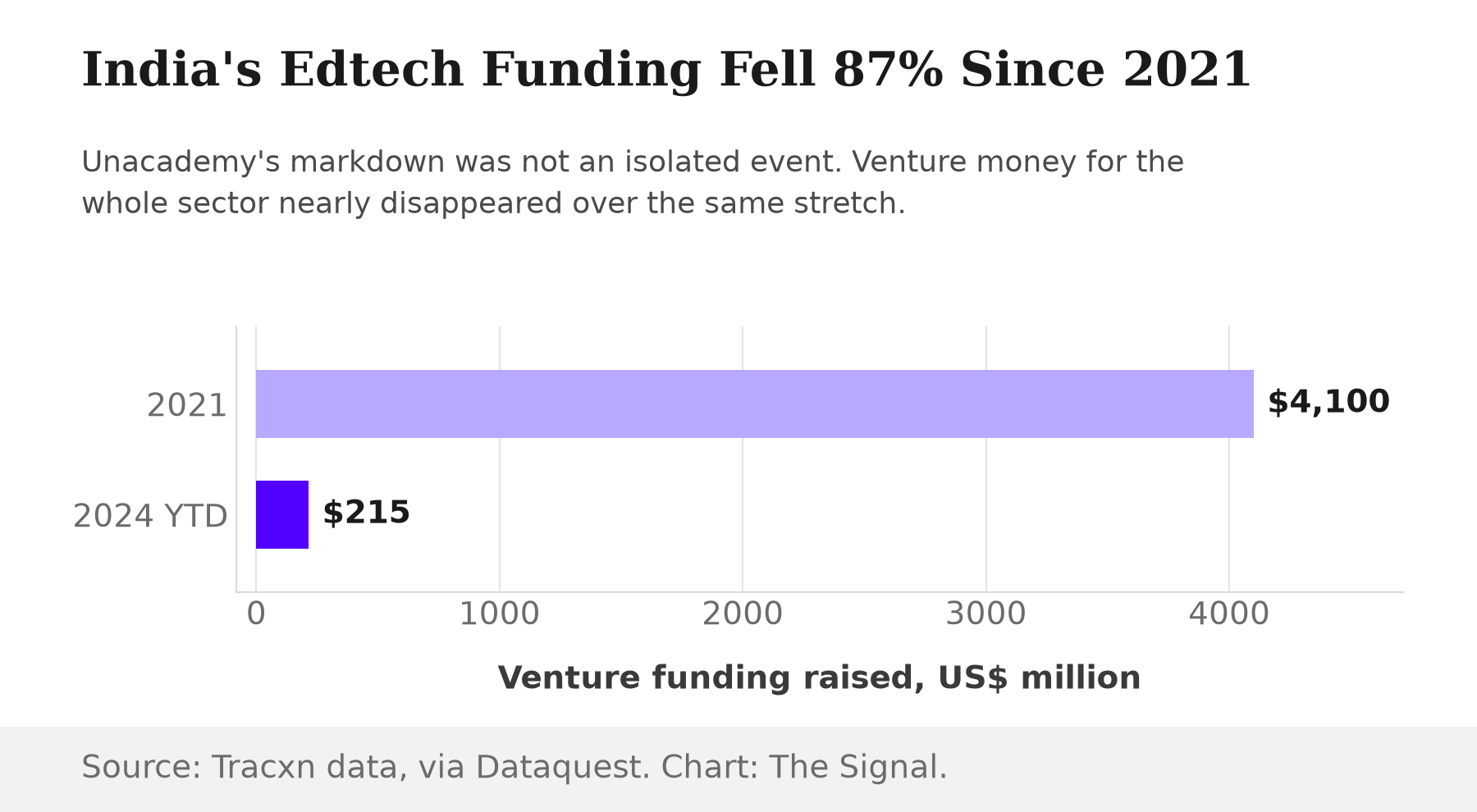
Unacademy's markdown sits inside a wider repricing. India's edtech sector raised $4.1 billion in 2021 but only $215 million in the first nine months of 2024, an 87 percent collapse in venture funding. Unacademy's deal is not an isolated data point about one founder's negotiating position. It is a single, unusually explicit instance of a repricing that has been running quietly across the sector for years, mostly without anyone naming a number out loud.
Indian edtech venture funding fell 87 percent from 2021 to the first nine months of 2024.
Source: Dataquest, citing Tracxn. Chart: The Signal.
A second unicorn, marked to zero without a buyer in the room
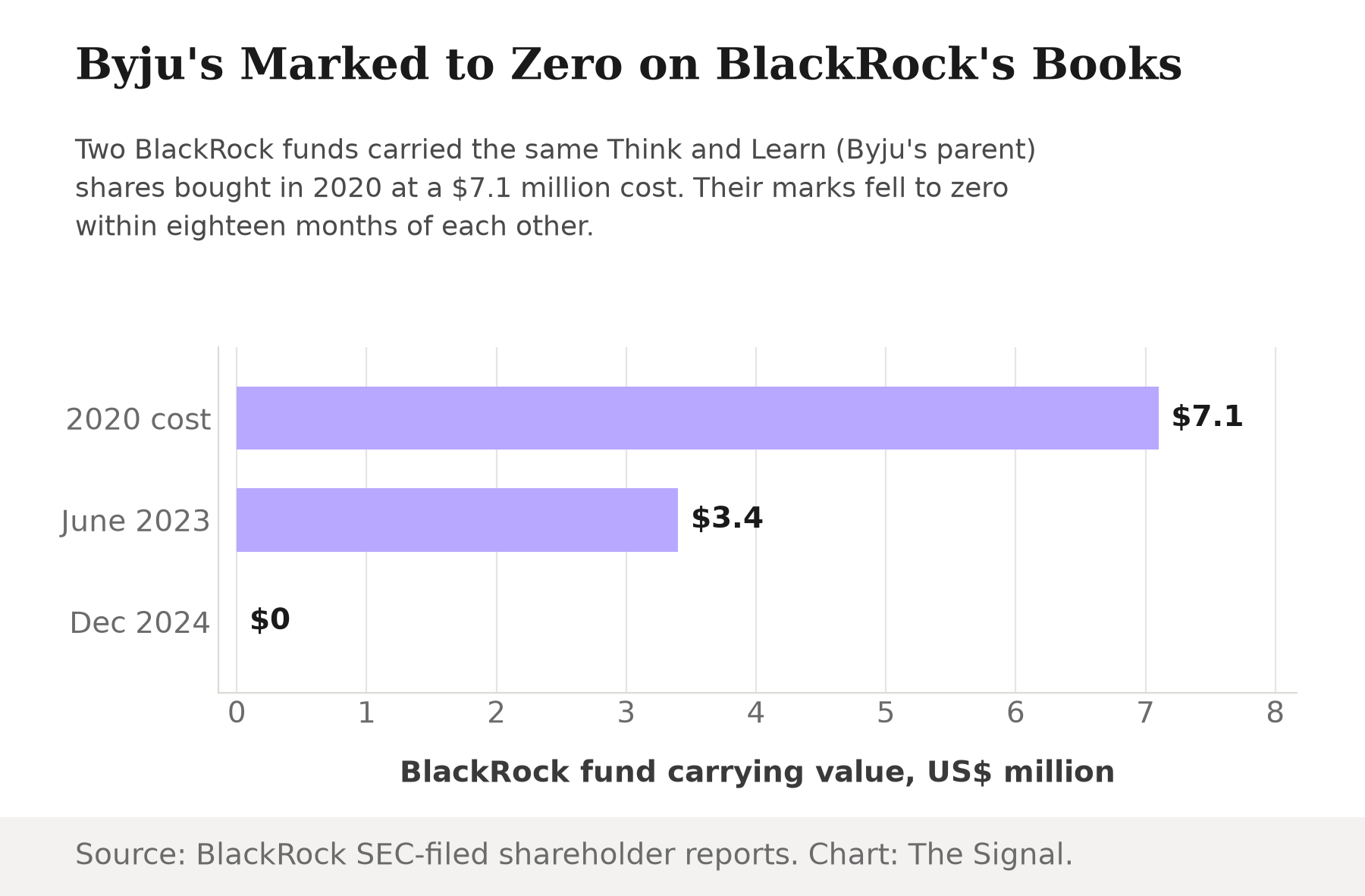
The clearest confirmation of that repricing does not come from Unacademy at all. It comes from BlackRock's own regulatory filings on a rival test-prep giant, Byju's parent company Think and Learn. Think and Learn had itself been valued at $22 billion in a March 2022 funding round, led by founder Byju Raveendran's own $400 million investment in the company, a peak even higher than Unacademy's. As of June 30, 2023, BlackRock's Energy and Resources Trust valued its Think and Learn shares at $3.4 million against a $7.1 million cost basis, roughly 48 percent of cost. By December 31, 2024, BlackRock's Science and Technology Term Trust valued its Think and Learn shares at zero.
BlackRock's own filings marked Think and Learn shares down from a $7.1 million cost basis to zero.
Source: BlackRock Energy and Resources Trust filing; BlackRock Science and Technology Term Trust filing. Chart: The Signal.
These are not press quotes or a company's own framing. They are line items in BlackRock's own SEC-filed shareholder report, filed because US fund-reporting rules require a mutual fund to mark its holdings to fair value every reporting period, whether or not a buyer is anywhere near the table. No one negotiated Think and Learn's price down to zero. A fund's own valuation process did.
A negotiated sale and a compulsory filing arrived at the same conclusion.
| Unacademy | Think and Learn (Byju's parent) | |
|---|---|---|
| Starting point | $3.44 billion valuation, August 2021 | $7.1 million cost basis, 2020 purchase |
| Latest recorded mark | $218 million, 2026 upGrad deal | $0, BlackRock fund filing, December 2024 |
| How the number was set | Negotiated all-stock acquisition | Compulsory SEC shareholder-report filing |
Sources: The Tech Portal; Entrackr; BlackRock SEC filings. Table: The Signal.
upGrad's own repricing points the other way
The buyer's own valuation moved in the opposite direction. upGrad itself was valued at about $1.73 billion (₹16,500 crore) in a fresh 2026 funding round, around the same time as the Unacademy deal, on the back of a return to profitability. Reaching profitability, not raising the biggest round, is what earned upGrad a higher mark. Unacademy's own operations were also mostly profitable or close to it, by Munjal's own account above, yet the company still sold at a steep discount to its 2021 price. The difference is not operating performance. It is that upGrad's valuation was freshly set by investors pricing today's numbers, while Unacademy's old $3.44 billion figure was a number nobody had tested again until this deal forced the question.
The honest objection
The strongest case against reading any of this as a clean market verdict is that neither number was set by an open auction. upGrad negotiated the Unacademy price as an interested acquirer with every incentive to pay as little as it could; a founder with no better options might describe almost any deal as "not dressing up the facts" simply to control the narrative on the way out. BlackRock's marks are one asset manager's internal judgment, not a market-clearing trade either.
That case has real force, but it does not explain why two entirely different mechanisms, a negotiated sale at one company and a compulsory fund disclosure at a competitor, landed in the same place. upGrad had every reason to lowball its offer; BlackRock had no counterparty to negotiate with and nothing to gain from the number it reported. If the true value of an India-anchored edtech unicorn were still close to its 2021 valuation, one of these two very different processes should have found it. Neither did.
The Signal
For years, the paper valuations that India's startup boom minted in 2021 sat undisturbed on capitalisation tables, because nothing forced anyone to test them. A funding round only prices the shares being sold; the rest of the company keeps whatever headline number the last round implied, real or not. What upGrad's acquisition and BlackRock's filings share is that both are events that forced an actual test: one because a deal had to close at an actual price, the other because a regulator required an actual number. Tested, both came in far below the peak. The number to watch next is not another edtech deal. It is which other 2021-vintage unicorns, in India or anywhere else, have never yet had their valuation forced through a test like this one. Until they do, their headline number is a claim, not a price.
Reporting basis: the upGrad-Unacademy deal value and its discount to peak are per The Tech Portal's report on the agreed terms; the deal's completion and Gaurav Munjal's on-record quote are per Inc42. Unacademy's revenue, cash and profitability at the 2026 sale are per Free Press Journal, citing Munjal. The 2021 Series H valuation is per Entrackr's contemporaneous report, and upGrad's own 2026 valuation is per a separate Entrackr report on its fresh funding round. Unacademy's cumulative fundraising total is per TechCrunch, citing PitchBook. The Competition Commission of India's clearance date is per Storyboard18. The Indian edtech sector's funding decline is per Dataquest, citing Tracxn. Think and Learn's valuation on BlackRock's books comes from two separate BlackRock funds' own SEC shareholder-report filings, the Energy and Resources Trust's semi-annual report and the Science and Technology Term Trust's annual report, both primary regulatory filings. Think and Learn's $22 billion peak valuation is per TechCrunch's contemporaneous report on the March 2022 round. Unacademy's cumulative layoffs since 2022 are per TechCrunch's report on the latest round of job cuts. The one-quarter comparison between Unacademy's cumulative fundraising and its sale price is The Signal's calculation from those figures.