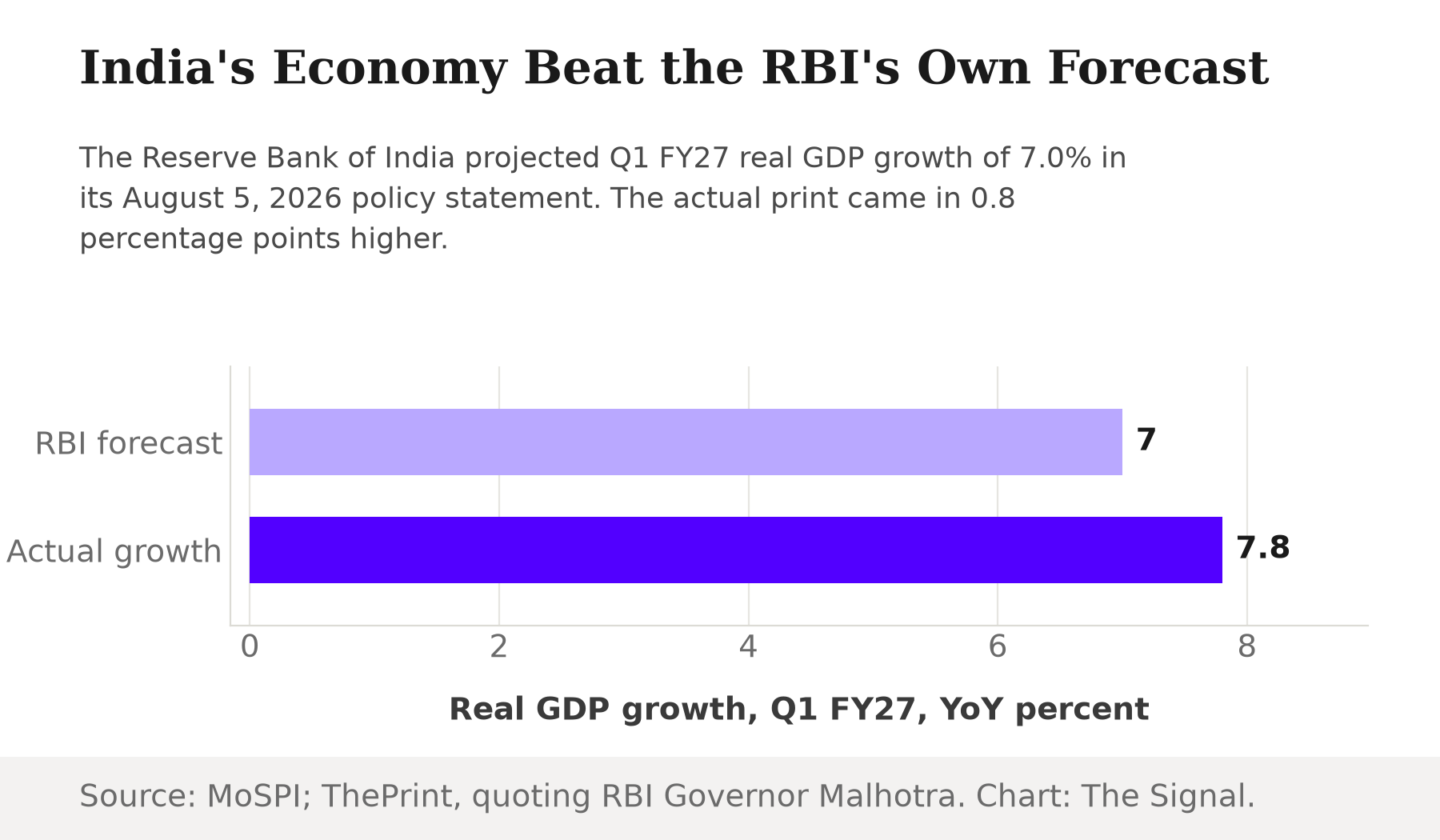
India's National Statistics Office reported that real GDP grew 7.8% year-on-year in the June 2026 quarter, up from 6.9% growth in the same quarter of FY26, and the number beat every recent official yardstick. The Reserve Bank of India's own August 5, 2026 policy statement had projected Q1 FY27 growth of just 7.0%, 0.8 percentage points below what actually printed. Government finances told a similarly flattering story the same week: the Centre's fiscal deficit for April-July FY27 stood at 26.8% of the full-year budget target, narrower than 29.9% in the same period of FY26. Read the two releases together and the obvious conclusion writes itself: the economy is outrunning even the central bank's expectations, and it is doing so while the government keeps its own books tighter than a year ago.
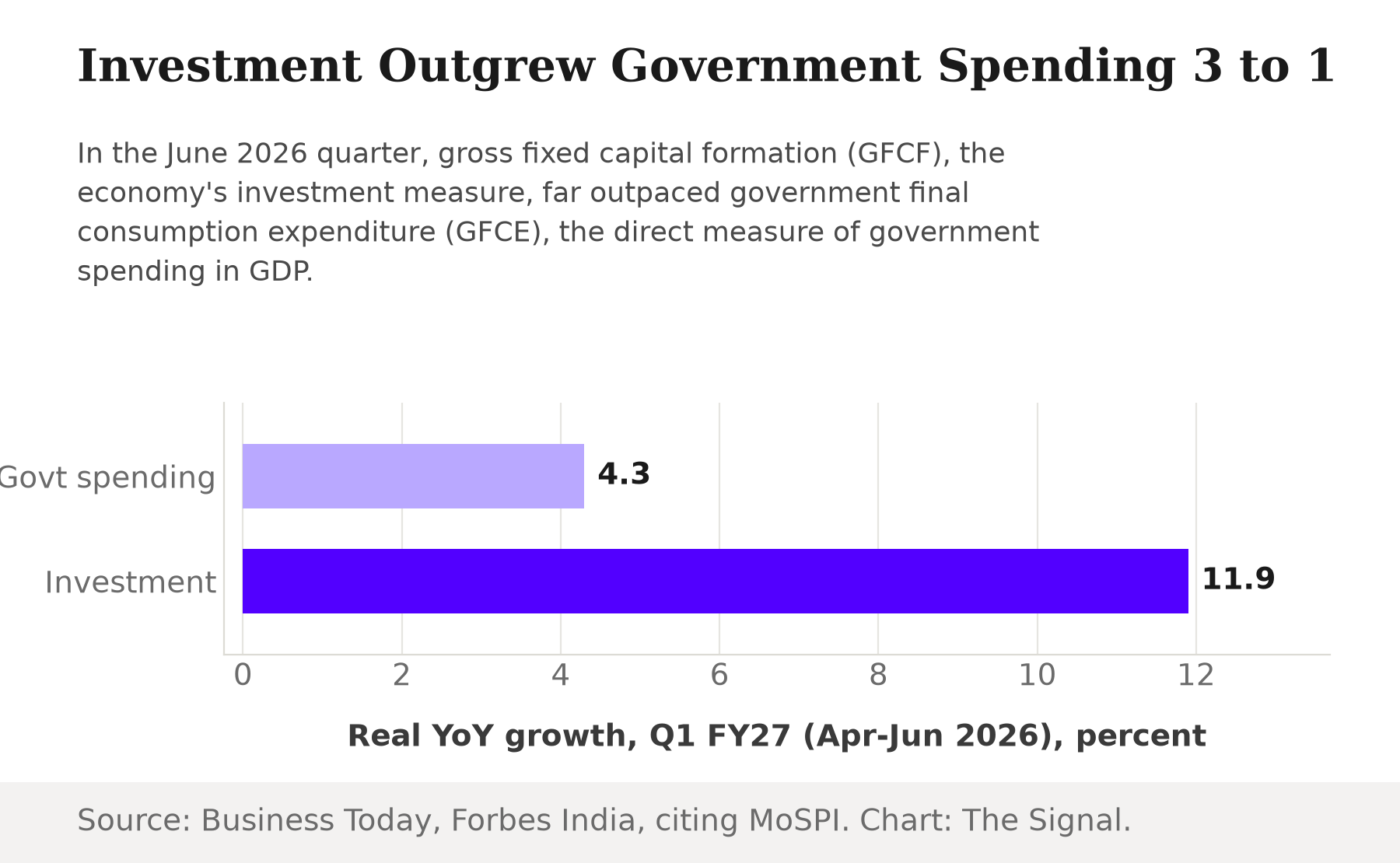
It is worth slowing down on that pairing. A narrower deficit and a growth beat, arriving in the same release cycle, invite the assumption that the government spent more, more efficiently, and got a bigger number for it. The expenditure-side breakup of the same GDP data shows something closer to the opposite. Government Final Consumption Expenditure, the direct national-accounts measure of government spending, grew just 4.3% in Q1 FY27, the slowest of the economy's three main expenditure engines. Over the same quarter, Gross Fixed Capital Formation, the economy's investment measure, grew 11.9% in real terms, and its share of nominal GDP rose to 34.3% from 31.4% a year earlier. The third engine, Private Final Consumption Expenditure, the households' own spending, grew 7.1%, a slight moderation from 7.5% in the prior quarter. That pace was comfortably ahead of government consumption, but nowhere near investment's.
Investment grew nearly three times faster than the government's own consumption spending in the same quarter.
What "government spending" means in this arithmetic
In expenditure-side GDP accounting, government spending and investment are counted separately by design. GFCE captures the government's current, day-to-day outlays: wages, subsidies, running services. GFCF captures capital formation, the money spent building assets that keep producing for years, whoever owns them. When GFCE is the laggard and GFCF is the outperformer, the plain reading of India's own national accounts is that the growth beat sits on the investment side of the ledger, not on the government's current-spending side.
That is a real distinction, but it should not be mistaken for "the state pulled back altogether." The Centre's own capital expenditure, the budget line that funds roads, ports and railways, rose to Rs 4.5 trillion in April-July FY27 from Rs 3.5 trillion a year earlier, even as its consumption spending grew only 4.3%. That is a rise of nearly a trillion rupees in four months. But capital expenditure counts toward investment, not government consumption, in the national accounts that produced the 4.3% and 11.9% figures above. The state's own money did not disappear from the growth arithmetic; it moved from the GFCE column to the GFCF column, funding roads and railways rather than running costs.
The tighter deficit was not a coincidence
The fiscal numbers reinforce that this was not simply more money moving around inside a bigger budget. The April-July FY27 fiscal deficit was Rs 4,55,144 crore, or 26.8% of the full-year FY27 target of Rs 16.96 lakh crore (4.3% of GDP). That share of the target is narrower than the same period ran a year ago. A government that was simply spending more to buy the growth beat would show the opposite pattern: a deficit running hotter, not cooler, against its own plan.
| Metric, April-July | FY26 | FY27 |
|---|---|---|
| Fiscal deficit, % of full-year target | 29.9% | 26.8% |
| Central government capex, ₹ trillion | 3.5 | 4.5 |
Source: Deccan Chronicle, citing Controller General of Accounts data; Reuters, via Investing.com.
Put the two facts side by side and the picture is a reallocation inside a tighter envelope, not a spending push. The Centre raised capital outlays, held the line on current spending hard enough that GFCE stayed the slowest of the economy's three main expenditure engines, and still finished the four months with more fiscal room left against its own target than it had a year earlier. That is a specific, deliberate mix, and revealed preference says more about a government's actual priorities than a budget speech does: this government's spending choices, in practice, favoured capital formation over current consumption while tightening the overall envelope.
The honest objection
The strongest case against reading this as a private-investment story is that a meaningful share of the GFCF surge could be the state's own capital spending relabelled, not private companies breaking ground on new factories and warehouses. Government capex alone rose by nearly a trillion rupees in four months, to Rs 4.5 trillion from Rs 3.5 trillion. If that increase, scaled to the full quarter, accounts for a large share of the 11.9% investment growth, the "beat" is still substantially a government-funded one, just booked under a different national-accounts heading than GFCE.
That case has real force, and the data here cannot rule it out: the matrix of available figures does not break GFCF down into its private and public shares for this quarter, so no claim about which side did more of the work would be honest. But the objection does not undo the central finding. Whatever the split between private and public capital spending within the 11.9% figure, the growth beat traces to the investment side of the expenditure account, and the government still finished the period with a narrower deficit against its own full-year target than a year before. A government funding a larger part of the beat through a reallocation toward capital spending, inside a tighter overall envelope, is a different and more disciplined story than a government spending its way to a good headline number, even if both produce the same GFCF line.
The Signal
None of this settles how durable the beat is. The IMF's July 2026 World Economic Outlook projected India's calendar-2026 growth at just 6.5%, well below the 7.8% pace India actually posted in the June quarter. The RBI's own August policy statement, even after being proven too cautious on Q1, still projects growth easing to 6.4% in the September quarter, 6.5% in the December quarter and 6.8% in the March quarter, for a full-year FY27 average of 6.7%. If capital spending, government and private combined, keeps growing near double digits, those forecasts will look as conservative in a year as the RBI's 7.0% call already looks for Q1. If the capex line that lifted this quarter's GFCF fades once the government's own outlay growth normalises, the 7.8% print was a fiscal-calendar effect, not a new investment cycle. The number to watch next is not GDP growth itself; it is whether GFCF keeps outrunning GFCE, or the two engines converge back toward each other.
Reporting basis: the Q1 FY27 GDP growth rate is from MoSPI's official Q1 2026-27 GDP press note, with the GFCE figure as reported by Forbes India, the GFCF figure as reported by Business Today, and the PFCE figure as separately reported by Business Today, all citing the same MoSPI release. The IMF's calendar-2026 growth projection is from the IMF's World Economic Outlook DataMapper. The RBI's Q1 FY27 growth projection and its quarter-by-quarter FY27 outlook are as reported by ThePrint, quoting RBI Governor Sanjay Malhotra's August 5, 2026 policy statement. The April-July FY27 fiscal deficit and its year-on-year comparison are as reported by Deccan Chronicle, citing Controller General of Accounts data. The central government's capital expenditure figures for April-July FY26 and FY27 are as reported by Reuters, via Investing.com, citing government data. The characterisation of the deficit-and-capex combination as a reallocation rather than a spending expansion is The Signal's own analysis of those figures.