On August 25, 2026, the National Company Law Tribunal's New Delhi bench approved a repayment plan for the media baron Subhash Chandra that closes one of India's largest personal-guarantee insolvency cases. Under the order, Chandra pays creditors Rs 6.5 crore against admitted claims of about Rs 22,006.57 crore, a haircut of nearly 99.97 percent, Outlook India reports. Read as a single data point, it looks like the story writes itself: a flamboyant promoter, a tribunal order, and a debt that mostly disappears.
It is worth slowing down on that. Chandra's case is extreme, but it did not happen in a vacuum. The separate legal channel this case ran through, personal-guarantor insolvency, had a track record of its own well before his order landed. Of the personal-guarantor cases that have ever reached an approved repayment plan, just 64 as of June 2026, creditors have recovered Rs 234.56 crore in total, about 1 percent of admitted claims, the Insolvency and Bankruptcy Board of India's quarterly newsletter reports. Chandra's 0.03 percent is not an aberration inside that system. It is the same mechanism, run further in the same direction.
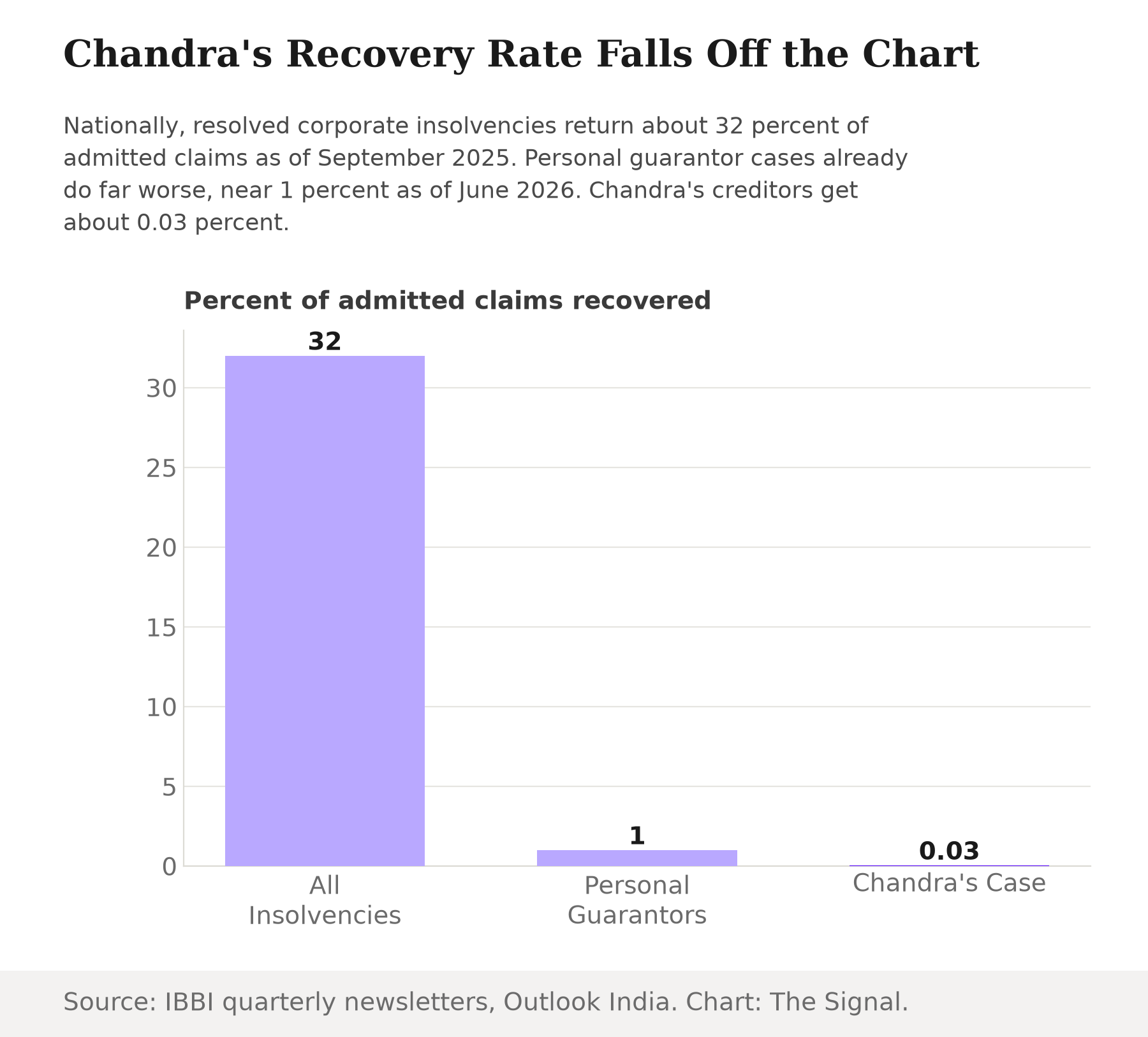
Nationally, resolved corporate insolvencies of all kinds return about 32 percent of admitted claims, a haircut near 67 percent, as of September 2025, the IBBI's quarterly newsletter reports. Personal-guarantor cases already recover roughly 32 times less than that, and Chandra's case recovers roughly another 33 times less than the personal-guarantor average on top of it. Two separate discounts stack: the guarantor track against the ordinary corporate track, and Chandra's case against the guarantor track.
The numbers behind the order
The case began in 2022, when Indiabulls Housing Finance, since renamed Sammaan Capital, moved against Chandra as guarantor after a Rs 170 crore loan it had made to Vivek Infracon turned bad, Bar and Bench reports. The admitted claims against him eventually totalled Rs 22,006.57 crore, spanning obligations across the group he had personally guaranteed.
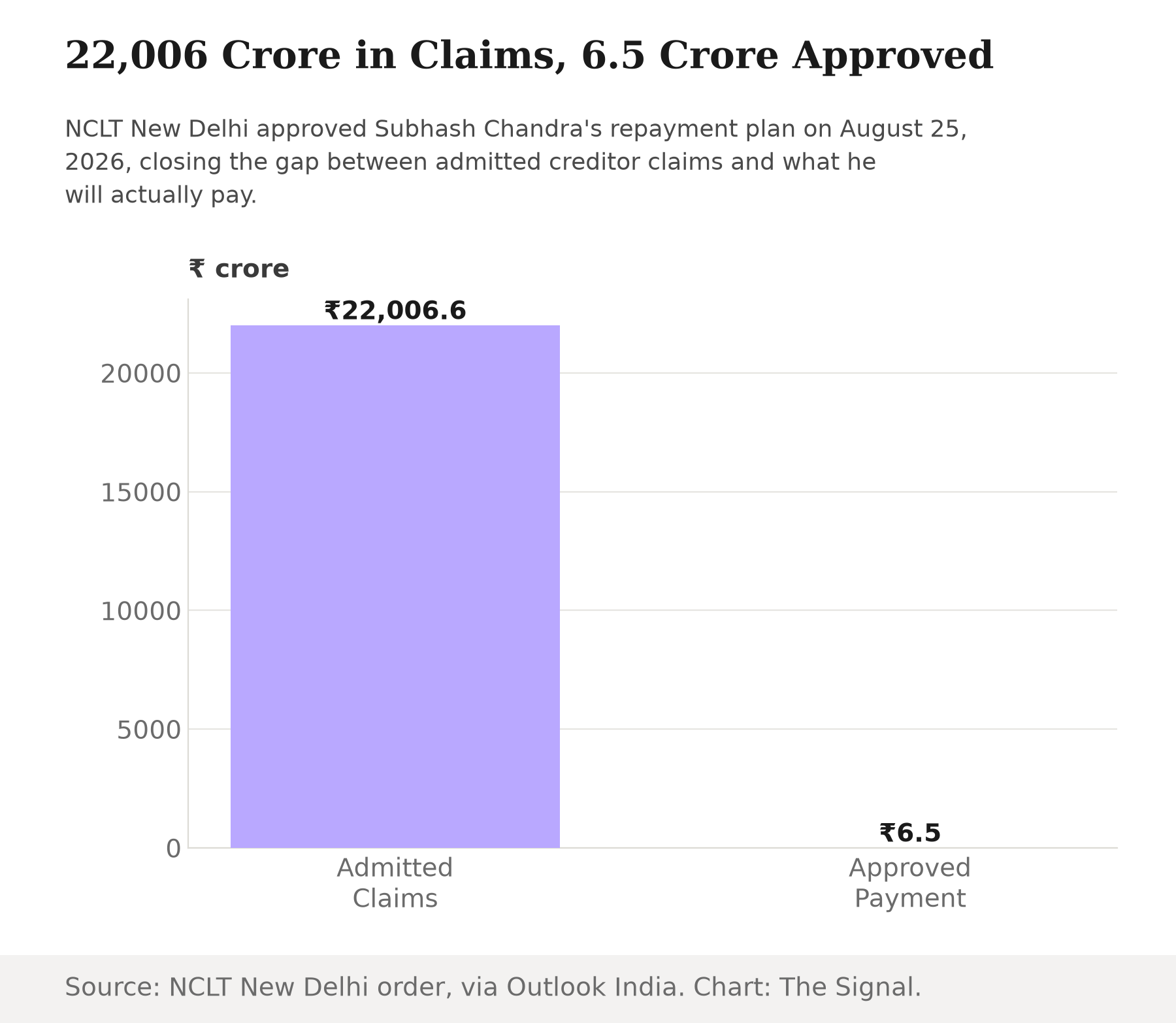
The approved payment of Rs 6.5 crore does not cover even a small fraction of any single one of the larger claims in that pool. The rest of the case follows from that one figure.
How a split verdict got there
The plan cleared the tribunal only after its members disagreed. NCLT New Delhi approved it under Section 114 of the Insolvency and Bankruptcy Code only after a third member, Judicial Member Nilesh Sharma, was brought in to break a split verdict between the bench's original two members and cast the deciding vote, LiveLaw Biz reports.
Before it reached the tribunal, the plan first had to clear a creditor vote. At a meeting in November 2024, 80.814 percent of creditors, by value, voted in favour, even as LIC Housing, HDFC Bank, Axis Bank, Canara Bank, RBL Bank, IDBI Trusteeship, representing the Franklin Templeton fund, and Union Bank opposed it, NewsX reports. A majority of value carried a plan that several of India's largest lenders voted against, and a divided tribunal then had to decide whether that majority should stand.
A net worth that kept shrinking
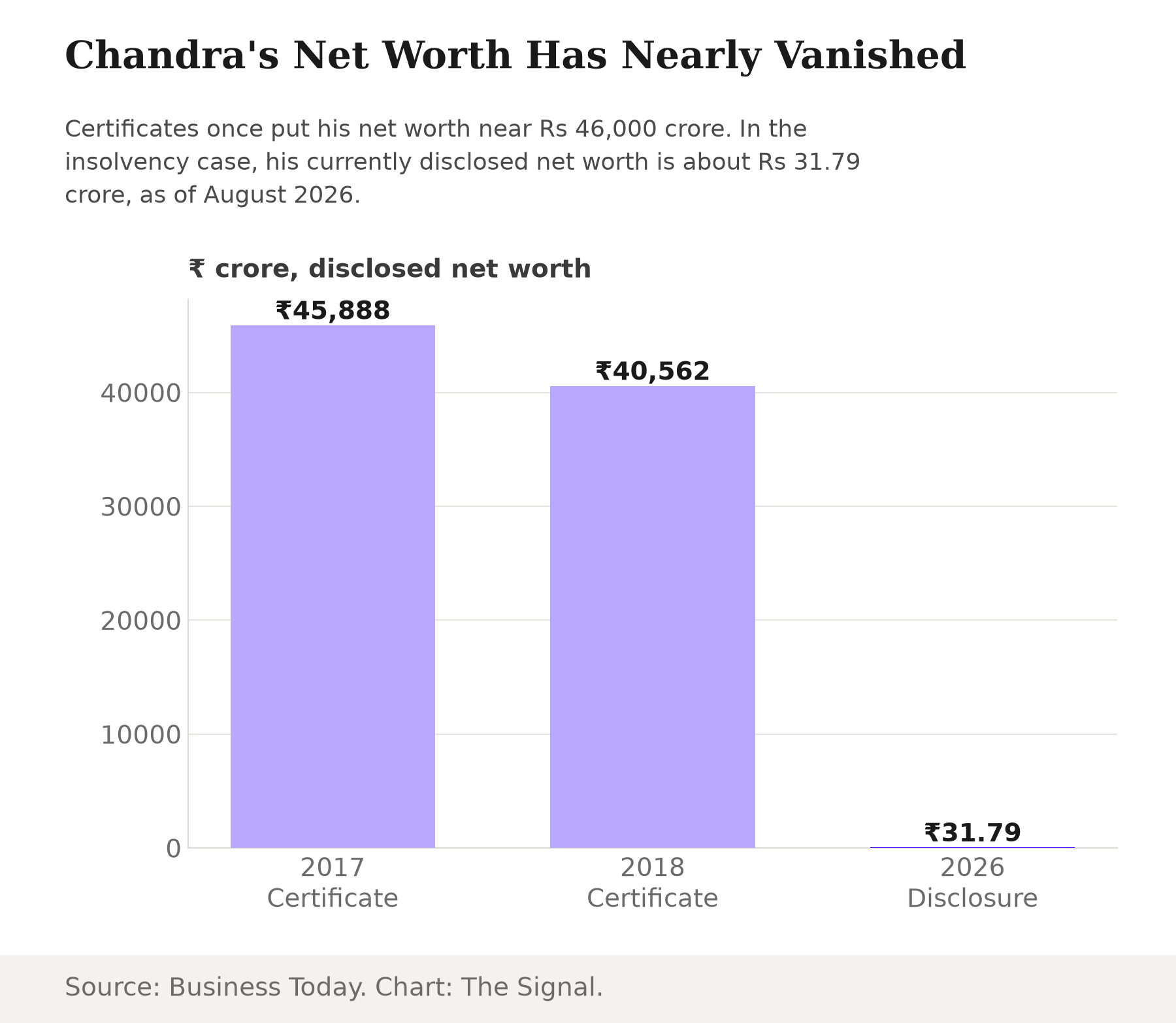
The figure the plan actually turns on is Chandra's own disclosed net worth. His net worth as disclosed in the case, as of August 2026, is around Rs 31.79 crore, a fraction of the Rs 45,888 crore and Rs 40,562 crore that certificates had shown for 2017 and 2018 respectively, Business Today reports. If a person who once guaranteed Rs 22,000 crore of debt is genuinely worth barely Rs 32 crore today, no repayment plan built on his current assets can recover much more than this one did. The dispute among the dissenting lenders is not really about the arithmetic of the plan. It is about whether that net worth figure, and the path from the 2018 certificate to today's disclosure, is one a tribunal should accept at face value.
The mechanism was already broken
This is where the case stops being only about one promoter. A personal guarantee is supposed to give a lender a second pocket to reach into when a company defaults, a promise that outlasts the corporate structure it was attached to. The national data say that promise was already close to empty before Chandra's order arrived. Corporate insolvencies as a class return about 32 percent of admitted claims, as of September 2025, per the IBBI. The personal-guarantor track, meant to be a backstop once the company track fails, returns about 1 percent, as of June 2026, per the IBBI. Chandra's case adds one more data point at the very bottom of a distribution that was already thin.
The honest objection
The strongest case against reading this as a broken mechanism is a selection effect. Only guarantors who are genuinely close to insolvent ever need a court-approved personal-guarantee repayment plan at all; a guarantor with real assets left settles, sells, or negotiates before a case reaches this stage. Of the 64 personal-guarantor cases that have ever reached an approved plan, creditors have recovered about 1 percent of admitted claims, and Chandra's outcome of about 0.03 percent sits inside that same pattern. On this reading, both are not evidence of a broken process. They are evidence that the personal-guarantee mechanism is doing exactly what a last-resort backstop does, arriving only after everything else has already been exhausted.
That case is real, and it explains why recoveries on this personal-guarantor track run lower than the roughly 32 percent national corporate-insolvency recovery rate by design. But it does not explain why Chandra's case fell so far below even that already-low guarantor average, in a case where seven major lenders voted against the plan, where the tribunal needed a tie-breaking vote to approve it, and where the disclosed net worth fell from certificates near Rs 46,000 crore to about Rs 32 crore. A selection effect explains a thin recovery. It does not, on its own, explain why this particular thin recovery split the bench.
The Signal
Personal guarantees are supposed to be the instrument that makes a promoter's promise mean something once the company behind it has already failed. The national numbers say that instrument was already returning close to nothing well before Chandra's case reached its tribunal. What his order adds is not a new problem so much as a demonstration of how far the existing one can run: a near-total haircut, a split bench, and a disclosed net worth that fell by more than 99 percent between the certificates issued in 2017 and 2018 and the figure accepted in the proceeding. The number worth watching next is not Chandra's. It is whether the 64 approved personal-guarantor cases on record ever start recovering meaningfully more than 1 percent, or whether lenders quietly stop pricing the personal guarantee as security worth relying on at all.
Reporting basis: the terms of the NCLT New Delhi order and the scale of the row it triggered are per Outlook India. The origin of the case in Indiabulls Housing Finance's 2022 claim against Vivek Infracon is per Bar and Bench. The split verdict, the third member's tie-breaking vote and the Section 114 basis for approval are per LiveLaw Biz. The November 2024 creditor vote and the named dissenting lenders are per NewsX. Subhash Chandra's disclosed net worth, current and historical, is per Business Today alone, a single-source figure that dissenting lenders in the case have themselves disputed. The national corporate-insolvency recovery rate and the personal-guarantor recovery rate are both from the Insolvency and Bankruptcy Board of India's quarterly newsletters, the primary regulator's own data. The multiples comparing Chandra's recovery rate to the personal-guarantor average, and the personal-guarantor average to the national corporate-insolvency rate, are The Signal's calculations from those figures.