Between August 28 and August 31, 2026, Business Standard ran a five-part "India State Fiscal Health Tracker," working through the Reserve Bank of India's Handbook of Statistics on Indian States. Its 10th edition, released in December 2025, remains the newest cross-state fiscal comparison available. Its starting point looks unremarkable. For the 2024-25 fiscal year (Budget Estimates), Punjab budgeted ₹23,900 crore in interest payments, close to Haryana's ₹25,142 crore and well above Odisha's ₹5,500 crore. A large, established state paying roughly what a similarly sized neighbor pays reads as normal, even boring.
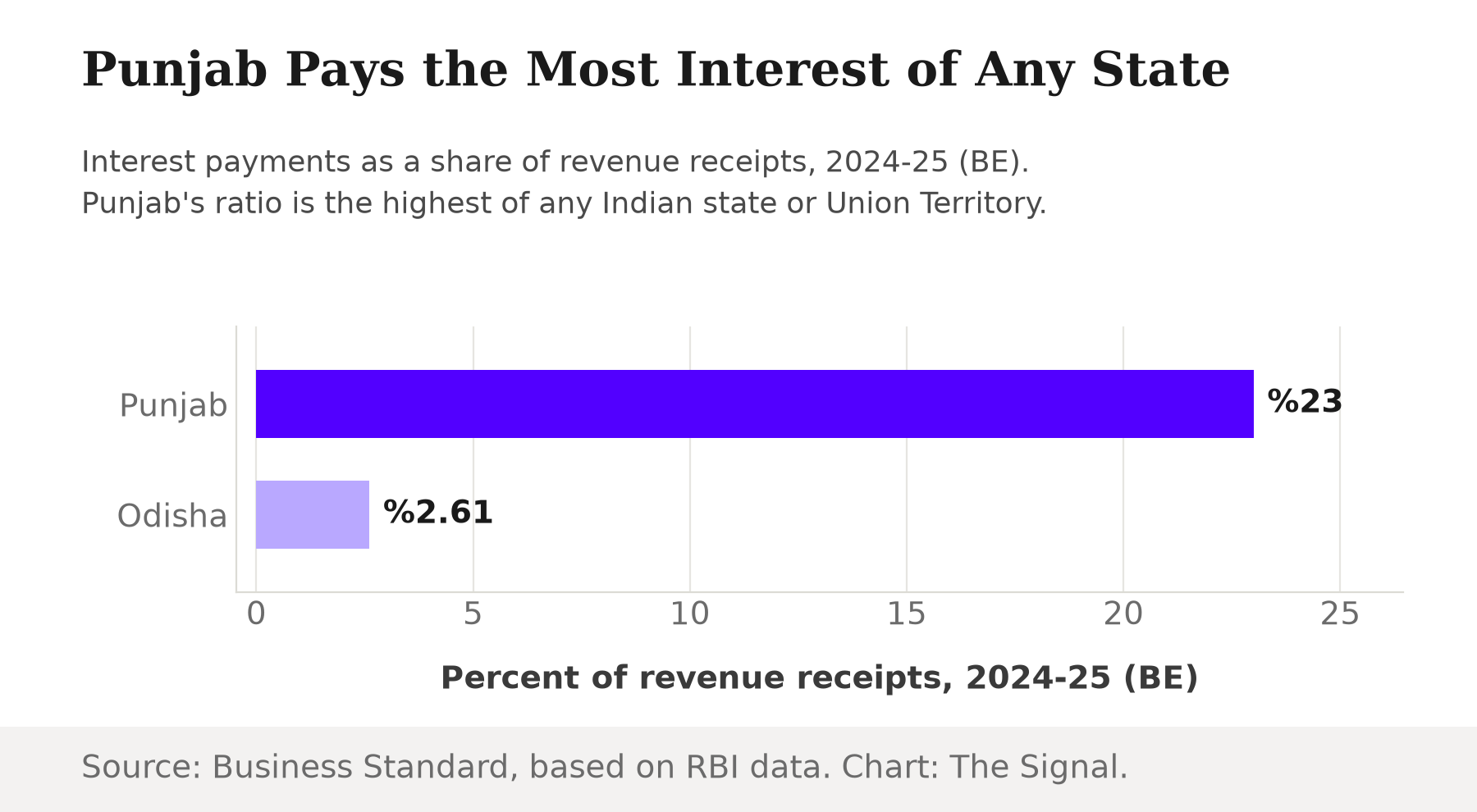
It is worth dividing that number before moving on. As a share of what Punjab actually collects, interest alone consumed 23 percent of the state's revenue receipts in 2024-25 (BE), the highest ratio of any Indian state or Union Territory, against a low of 2.61 percent for Odisha: nearly nine times higher. Punjab's rupee interest bill is not the largest in the country, but relative to its own income, it is the worst, in a state usually associated with Green Revolution prosperity rather than fiscal distress.
Punjab's interest burden is the highest of any Indian state, at nine times Odisha's.
Smaller states are running the surpluses
The pattern holds when the lens shifts from interest to the broader revenue account. Arunachal Pradesh budgeted a revenue surplus of ₹5,335 crore for 2024-25 (BE), while Punjab budgeted a revenue deficit of ₹23,198 crore in the same year. Scaled to the size of each economy, Arunachal Pradesh's revenue deficit ratio was -12.1 percent of GSDP, the largest surplus of any state, while Punjab's ratio was 2.8 percent of GSDP, the worst among large states.
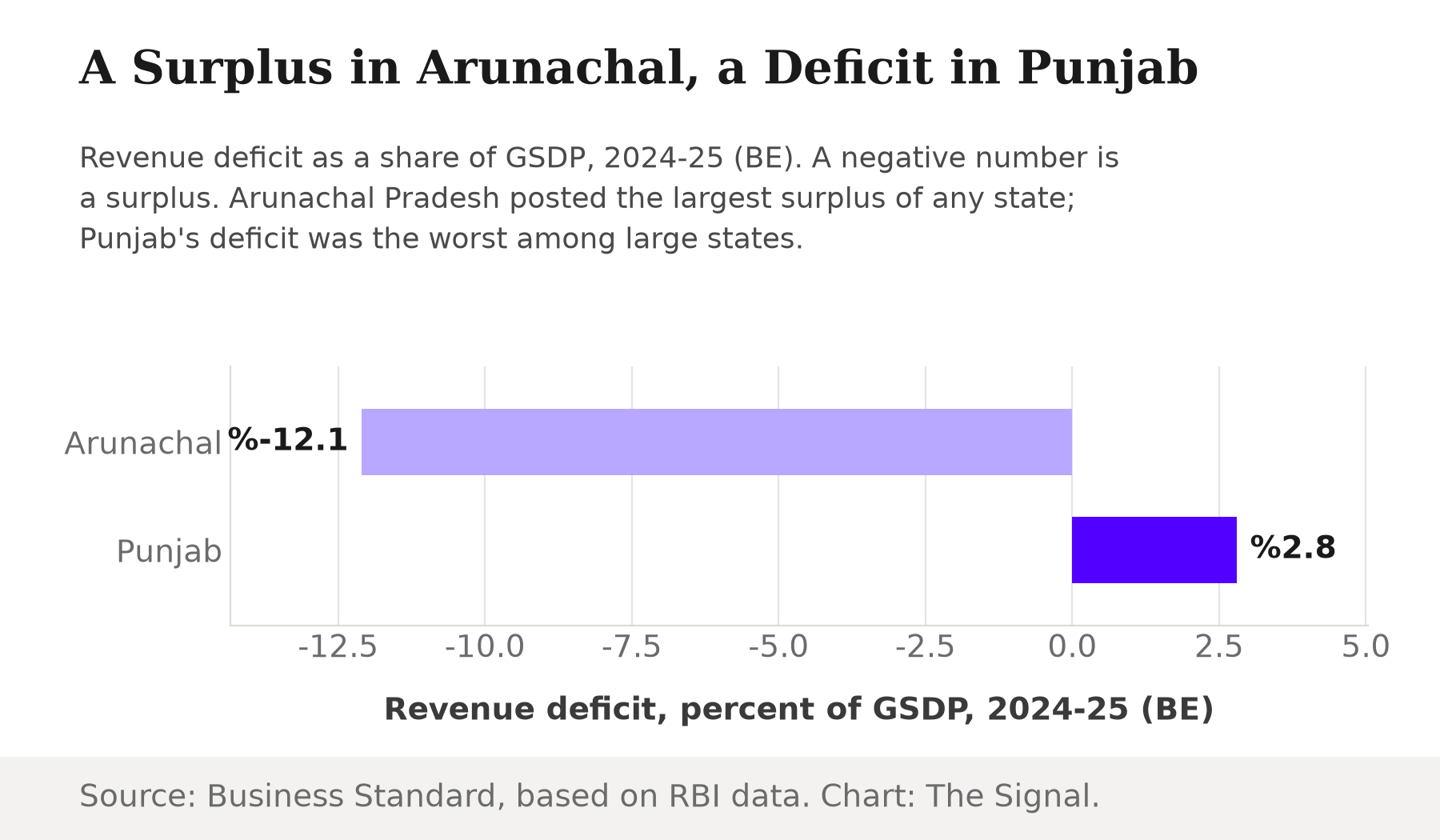
Arunachal Pradesh is a small, hill-state economy with a fraction of Punjab's population and administrative footprint, the kind of state a casual reader might expect to run thinner, more fragile finances. The data say the opposite: it is Punjab, not Arunachal Pradesh, whose current spending is outrunning its current income.
Manipur builds while Punjab pays interest
Capital spending, the money that becomes roads, buildings and irrigation rather than salaries or debt service, shows the same reversal. Manipur budgeted ₹8,616 crore in capital outlay for 2024-25 (BE), more than Punjab's ₹7,445 crore. As a share of what each state actually spends, the gap is stark: Manipur's capital outlay ratio was 28.8 percent of total expenditure, the highest of any state, 25 percentage points above Punjab's 3.8 percent.
Manipur puts nearly a third of its budget into capital spending. Punjab puts less than a twenty-fifth.
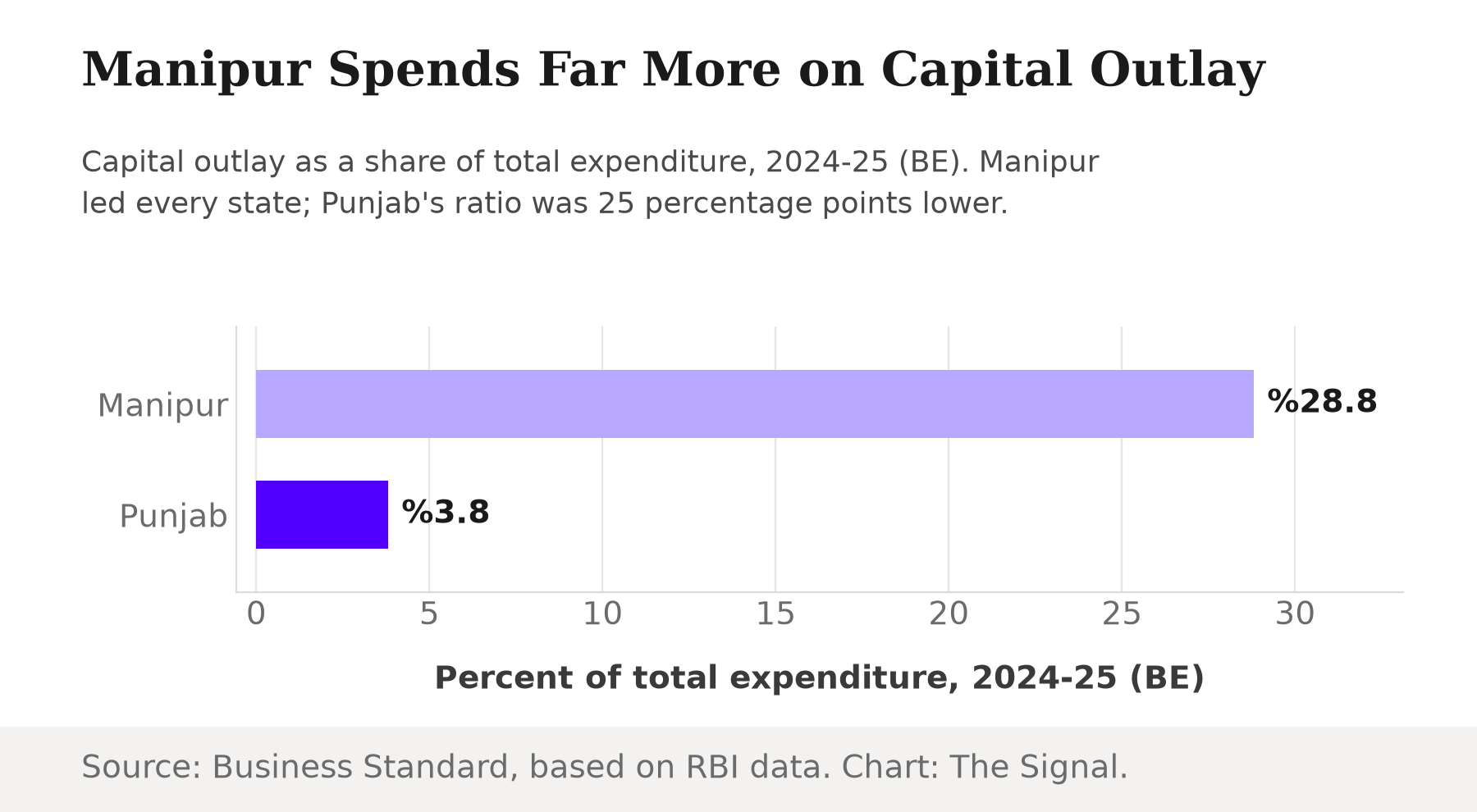
For every rupee Manipur's government spends, more than a quarter goes toward capital outlay. In Punjab, most of what is left after salaries and subsidies goes toward servicing debt already taken on, leaving little room to build anything new.
The debt behind the bill
The interest bill and the thin capital spending both trace back to the same balance sheet. Punjab's outstanding debt stood at 46.6 percent of GSDP in 2024-25 (BE), the second-highest of any state after Arunachal Pradesh's 57.0 percent, while Delhi's was just 1.3 percent. Arunachal Pradesh's debt ratio is high in the same table where its revenue account runs a surplus, a reminder that a heavy debt load and a healthy current budget can coexist if borrowing funds investment rather than plugging an income gap. Punjab's case combines both: a high debt stock and a revenue account already in deficit before a single rupee of investment is made.
Punjab's debt load trails only Arunachal Pradesh's, and dwarfs Delhi's.
| State | Debt as % of GSDP, 2024-25 (BE) |
|---|---|
| Arunachal Pradesh | 57.0% |
| Punjab | 46.6% |
| Himachal Pradesh | 45.2% |
| West Bengal | 39.3% |
| Meghalaya | 38.8% |
| Delhi | 1.3% |
Source: Business Standard's India State Fiscal Health Tracker, based on RBI data.
Delhi's near-zero debt ratio is a special case, a Union Territory with limited borrowing powers and no rural infrastructure mandate of the kind a full state carries. The more useful comparison is Punjab against fellow full states like Himachal Pradesh and West Bengal, which also carry heavy debt loads without Punjab's added distinction of the highest interest-to-revenue ratio in the country.
The honest objection
The strongest case against singling out Punjab is that legacy fiscal stress is not a Punjab-only story. Himachal Pradesh had the highest pension burden of any state in 2024-25 (BE) at 23.6 percent of revenue receipts, followed by Kerala at 20.6 percent, neither of which appears in Punjab's worst-in-class rankings above. Older, more built-out state governments tend to carry larger public payrolls, deeper pension obligations and more entrenched subsidy programs than younger or smaller states, simply because they have been running full-scale administrations for longer. On this reading, Punjab is not an outlier so much as one visible case of a structural pattern across several of India's more established states.
That case is real, but it does not explain why Punjab specifically tops the interest-burden ranking rather than sitting in the same tier as Himachal Pradesh or Kerala. A state can carry a heavy pension load and still keep its interest bill and its revenue account under control, or it can run a revenue deficit while still investing enough to keep its capital outlay ratio respectable. Punjab's revenue deficit ratio was the worst among large states, its capital outlay ratio was 25 percentage points below Manipur's, and its interest burden was the highest in the country, all three at once. Legacy stress explains a high number somewhere in a state's accounts. It does not explain a state that is worst, or near-worst, on every account at the same time.
The Signal
None of this is Punjab's 2026 fiscal position. It is 2024-25 (BE) data, the newest year for which RBI's state-by-state tables allow a clean comparison, revisited over August 28-31, 2026, by Business Standard's tracker series. But a budget plan is not a slip, which makes the pattern more telling, not less: this is the fiscal path Punjab's own government mapped out for itself. A state's development history is no guarantee of a well-run balance sheet, and a small, thinly resourced state is not automatically the fragile one. For anyone pricing Punjab's bonds or setting its next borrowing ceiling, the number that should travel furthest is not the size of its debt. It is the 23 percent of revenue Punjab has already committed to interest before a single school, hospital or road gets funded.
Reporting basis: the state-wise interest payment, revenue deficit and capital outlay figures for 2024-25 (BE) are from the Reserve Bank of India's Handbook of Statistics on Indian States, its 10th edition, released December 2025. The interest burden, revenue-deficit ratio, capital outlay ratio, debt burden and pension burden rankings are from Business Standard's "India State Fiscal Health Tracker" series, published August 28 through 31, 2026, which computes those ratios from the same RBI handbook. Both are treated as a single underlying dataset viewed through two publications rather than two independent sources. The nearly ninefold gap between Punjab's and Odisha's interest burden is The Signal's calculation from the cited ratios.