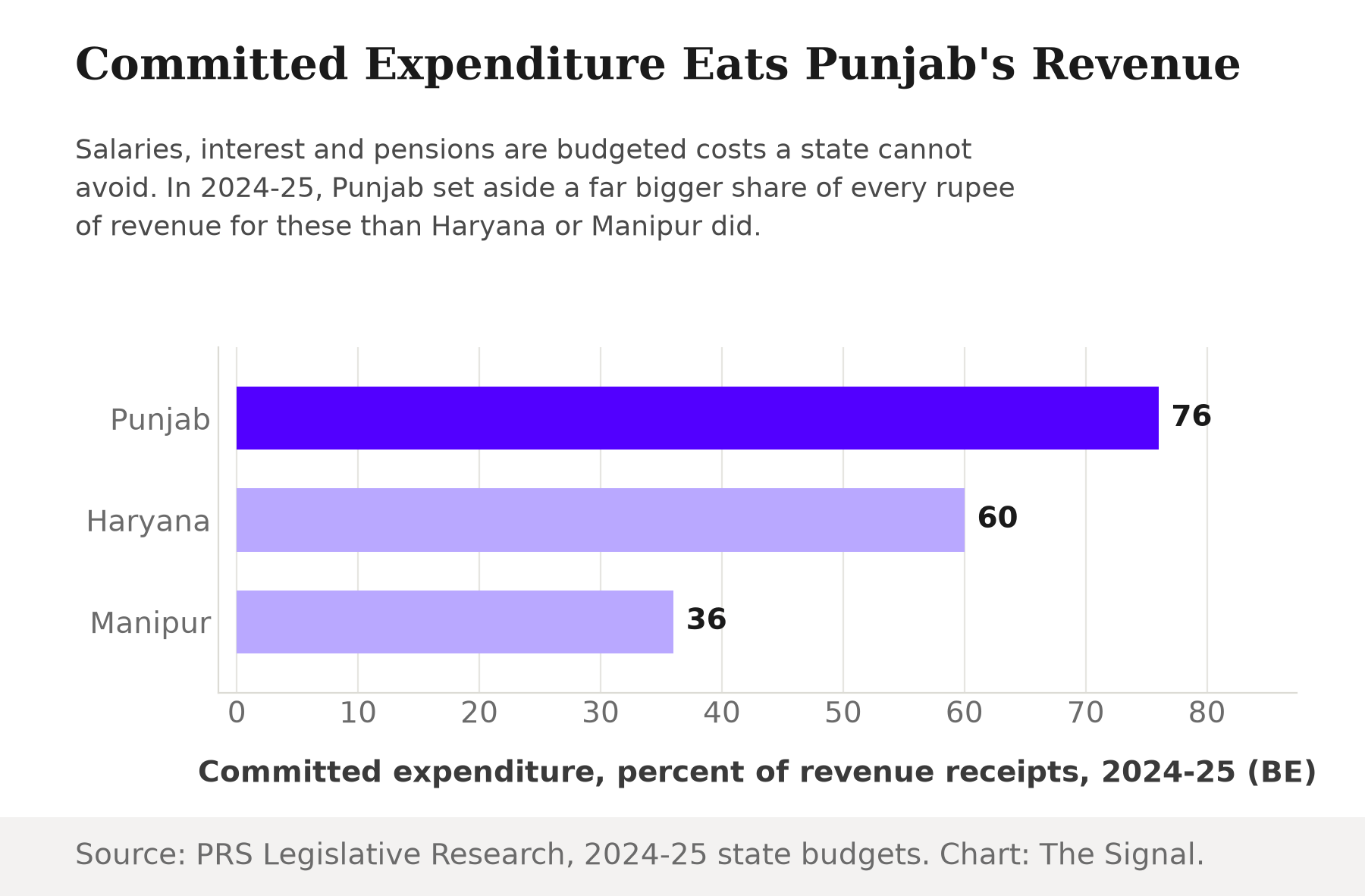
Punjab's 2024-25 state budget reads, on the surface, like an entirely ordinary document. Every Indian state pays salaries, services debt and funds pensions, and Punjab is no exception. PRS Legislative Research's analysis of that budget shows Punjab was set to spend Rs 78,868 crore on committed expenditure, 76 percent of its estimated revenue receipts, split between salaries at 34 percent, interest payments at 23 percent and pensions at 19 percent. Nothing in that breakdown looks unusual by itself. States commit large shares of revenue to obligations they cannot skip.
It is worth putting that 23 percent next to a number the Reserve Bank of India has already worked out for exactly this situation. The RBI's State Finances: A Study of Budgets of 2025-26 report finds that states with a debt-service ratio, interest payments as a share of revenue receipts, above 15 percent run capital expenditure below 2 percent of GSDP. Punjab's interest payments alone, 23 percent of revenue receipts, sit eight points past that 15 percent line. The RBI is not describing Punjab by name. It is describing the mechanism Punjab's own budget happens to sit inside.
Manipur's 2024-25 budget runs the opposite pattern: total committed expenditure of just 36 percent of revenue receipts, with interest payments at only 4 percent, salaries at 21 percent and pensions at 11 percent. Haryana sits in between, with committed expenditure at 60 percent of its own estimated revenue receipts, though PRS's Haryana analysis does not break interest out from that total the way Punjab's and Manipur's figures do. Of the three, Punjab's committed-expenditure share is the highest by a wide margin.
What the RBI's rule predicts, and does not
Manipur's interest burden is just 4 percent of revenue receipts, nowhere near the 15 percent line the RBI ties to a capital-spending squeeze, while Punjab's 23 percent sits well past it. That is a clean mechanism: a heavier debt-service load leaves less budget room for anything discretionary, capital spending included.
What complicates a simple story is Punjab's own recent capital-outlay figure. Punjab budgeted Rs 10,355 crore in capital outlay for 2023-24, an increase of 22 percent over the revised estimate for 2022-23. One year of growth off an unstated base does not show whether that spending is adequate for an economy the size of Punjab's, only that it grew during 2023-24. The RBI's cross-state rule describes where the pressure builds. It does not, on its own, prove Punjab's capital budget has already collapsed.
The same fiscal year, two different outcomes
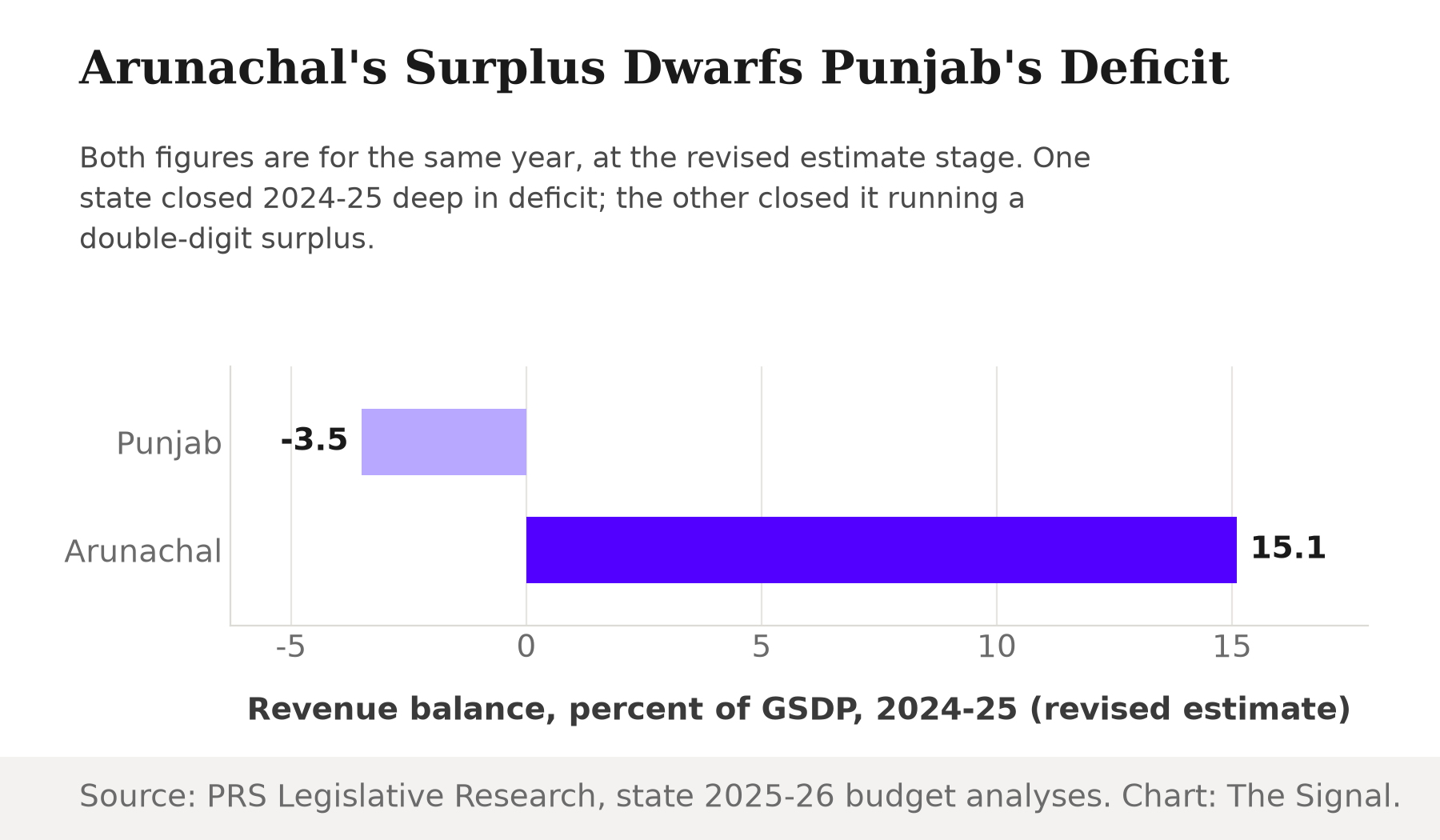
Punjab and Arunachal Pradesh closed the 2024-25 fiscal year in opposite fiscal positions. Punjab's revenue deficit came in at 3.5 percent of GSDP, Rs 28,685 crore, at the revised-estimate stage for 2024-25, before easing to a budgeted 2.7 percent of GSDP, Rs 23,957 crore, for 2025-26 in the same PRS analysis. Arunachal Pradesh, in that same revised-estimate window, ran a revenue surplus of 15.1 percent of GSDP, Rs 7,210 crore, moderating to a still-healthy 9.6 percent of GSDP, Rs 4,581 crore, budgeted for 2025-26. Arunachal Pradesh's surplus in 2024-25, 15.1 percent of GSDP, is more than four times the size of Punjab's deficit, 3.5 percent, measured the same way. That surplus was not a one-off: Arunachal Pradesh's original 2024-25 budget had targeted an 11.2 percent surplus, Rs 5,335 crore, close to the 11.9 percent revised estimate the state posted the year before.
The honest objection: fiscal room is not the same as building
The easy reading of Manipur's and Arunachal Pradesh's numbers is that fiscal restraint frees smaller states to build. Spend less on interest, and there should be more left for roads, schools and hospitals.
That case does not survive Manipur's own latest budget. Manipur's capital outlay for 2026-27 was proposed at Rs 4,716 crore, a decrease of 10 percent from the revised estimate for 2025-26. A state with one of the lightest committed-expenditure burdens in this comparison just cut its own building budget. Fiscal headroom is a precondition for capital spending, not a guarantee of it.
It is also worth being honest about scale. Manipur's entire committed expenditure came to Rs 10,060 crore in 2024-25, against Punjab's Rs 78,868 crore. These are not two versions of the same budget run at different discipline levels. They are economies of very different size, and the share of revenue each spends on obligations it cannot avoid is the fair comparison, not the rupee totals.
The debt is falling. The deficit that feeds it is not
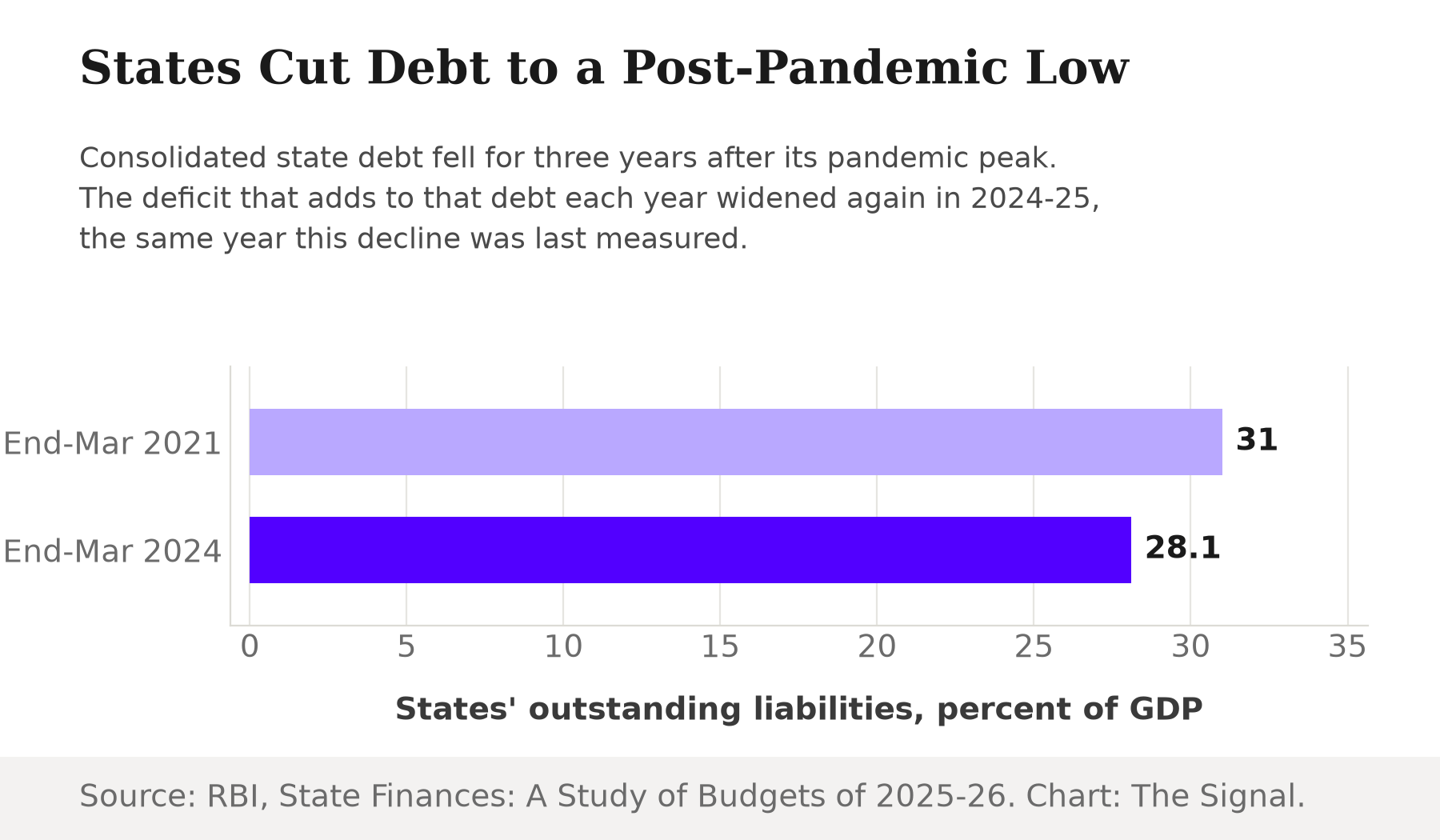
The state-by-state pattern echoes something visible in the national aggregate. India's states cut consolidated outstanding liabilities from a peak of 31 percent of GDP at end-March 2021 to 28.1 percent of GDP at end-March 2024. In that same 2024-25 fiscal year, the consolidated gross fiscal deficit of India's states widened to 3.3 percent of GDP: the flow that adds to that debt each year moved the wrong way in the same window the stock had just posted its recent low. States' own budgets already show where that flow took the stock: outstanding liabilities were budgeted to climb to 29.2 percent of GDP by end-March 2026, a milestone now five months past, up from 28.1 percent at end-March 2024 and 28.4 percent at the end-March 2025 revised-estimate stage. The post-pandemic decline is not just stalling. It is reversing.
The Signal
Punjab's 76 percent committed-expenditure share is not a bad year. It is what a state budget looks like once interest payments cross the line the RBI's own research ties to a capital-spending squeeze, an outcome years of borrowing put in motion long before this particular budget was drafted. Arunachal Pradesh's surplus proves fiscal room exists elsewhere in the federation, on a fraction of Punjab's scale. But Manipur's own falling capital outlay is the reminder that room and building are two different things. The number worth watching in next year's budgets is which of the states with room to spare actually spend it on something that gets built, not which states avoided Punjab's interest bill.
Reporting basis: Punjab's, Haryana's, Manipur's and Arunachal Pradesh's budget figures are drawn from PRS Legislative Research's published analyses of each state's 2024-25 budget, with Punjab's 2023-24 and 2025-26 analyses, Manipur's 2026-27 analysis, and Arunachal Pradesh's 2025-26 analysis providing the additional-year figures; PRS computes each state's committed-expenditure, capital-outlay and revenue-balance ratios directly from that state's own budget documents. The debt-service mechanism, the consolidated fiscal-deficit figure and the consolidated debt-to-GDP figures are from the Reserve Bank of India's State Finances: A Study of Budgets of 2025-26 report. The gap between Punjab's interest burden and the RBI's 15 percent threshold, and the size of Arunachal Pradesh's surplus relative to Punjab's deficit, are The Signal's calculations from those figures.