On August 21, 2026, the government notified the Mobile Phone Manufacturing Scheme (MPMS), a five-year, Rs 62,500 crore program running FY2026-27 to FY2030-31 that pays base incentives of 2.25 to 5 percent on sales, plus up to an extra 1.5 percent specifically for sourcing components and sub-assemblies domestically. It lands on what already reads like a finished success story. As of September 2025, 99.2 percent of the phones sold in India were assembled domestically, up from just 26 percent in 2014-15, and unit import-dependence for handsets had fallen from 75 percent of demand that year to about 0.02 percent. Annual production rose from 5.8 crore units in 2014-15 to 33 crore units in 2023-24, with export value reaching Rs 1,28,982 crore that year. And the PLI Scheme for Large Scale Electronics Manufacturing turned just Rs 10,905 crore of cumulative investment into Rs 7,15,823 crore of cumulative production and 1,39,670 direct jobs by February 2025, a roughly 65-times production-to-investment leverage.
Assembly is basically finished. Value addition is not.
It is worth slowing down on that. Every number above describes how many phones are screwed together in India and how many units cross the border, not how much of each handset's value is actually made here. Component sourcing, the semiconductors, sensors, camera modules and printed circuit boards that go into a modern smartphone, is a different ledger, and it tells a much less finished story.
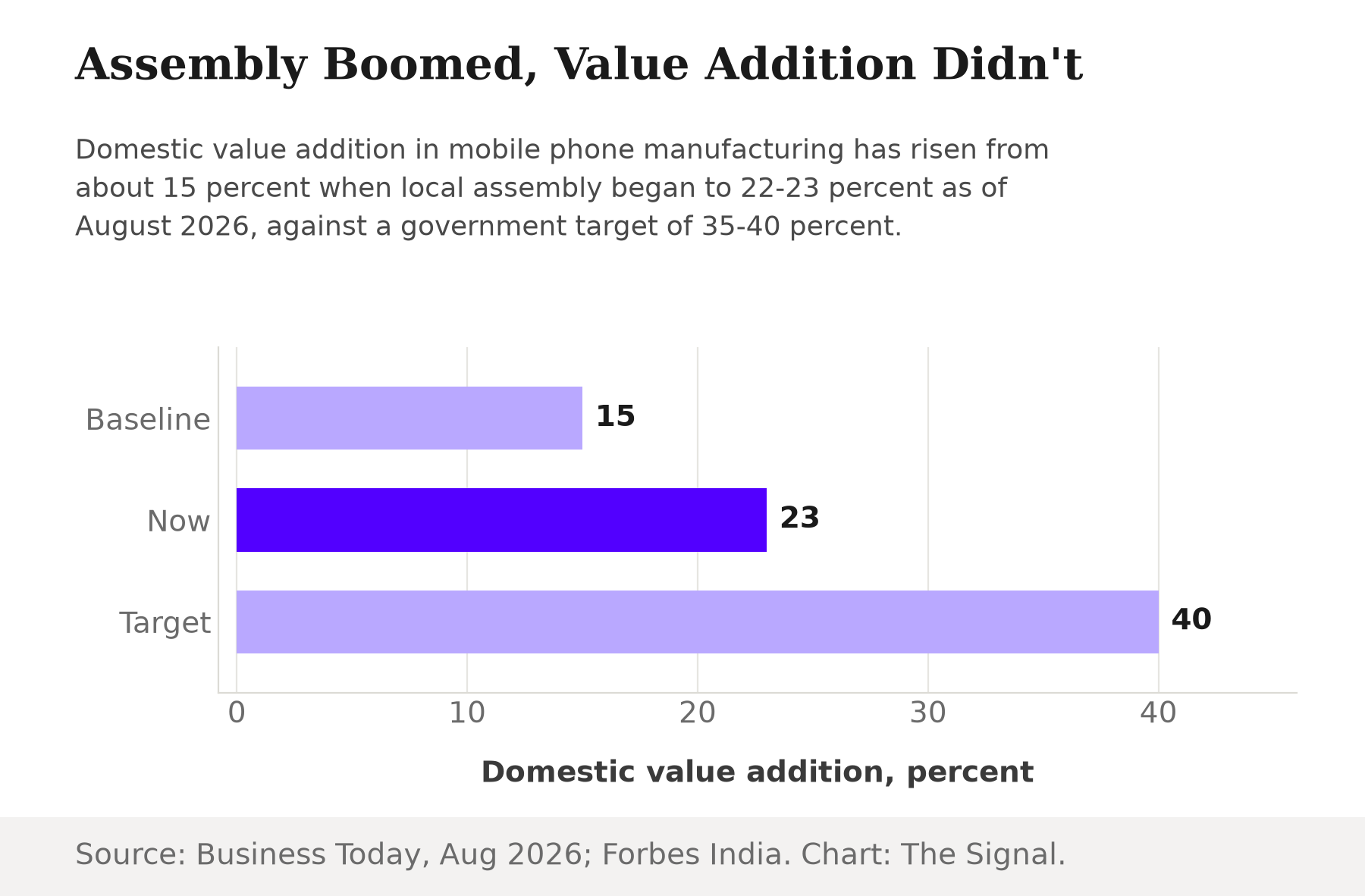
Domestic value addition in mobile phone manufacturing has reached only about 22-23 percent, up from roughly 15 percent when local manufacturing began, against a government target of 35-40 percent, MeitY Secretary S Krishnan said in August 2026. The MPMS notification puts the same trajectory in writing: value addition has risen from about 15 percent to 23 percent, which is why the scheme now pays an incentive specifically for buying components domestically rather than just for selling more phones.
Where the value still leaks out
India's electronics imports rose from Rs 5,49,713 crore in FY2021-22 to Rs 7,27,664 crore in FY2023-24, equivalent to about 76 percent of FY2023-24's Rs 9,52,000 crore in domestic electronics production, barely down from 86 percent two years earlier, a PIB Research Unit backgrounder shows, citing the MeitY Annual Report and the Directorate General of Commercial Intelligence and Statistics. Finished handsets are not the problem: the country builds nearly all of those itself now. What still crosses the border is the electronics inside every device category, phones included: chips, displays, batteries, camera modules, the layers a factory assembles rather than manufactures from raw material up.
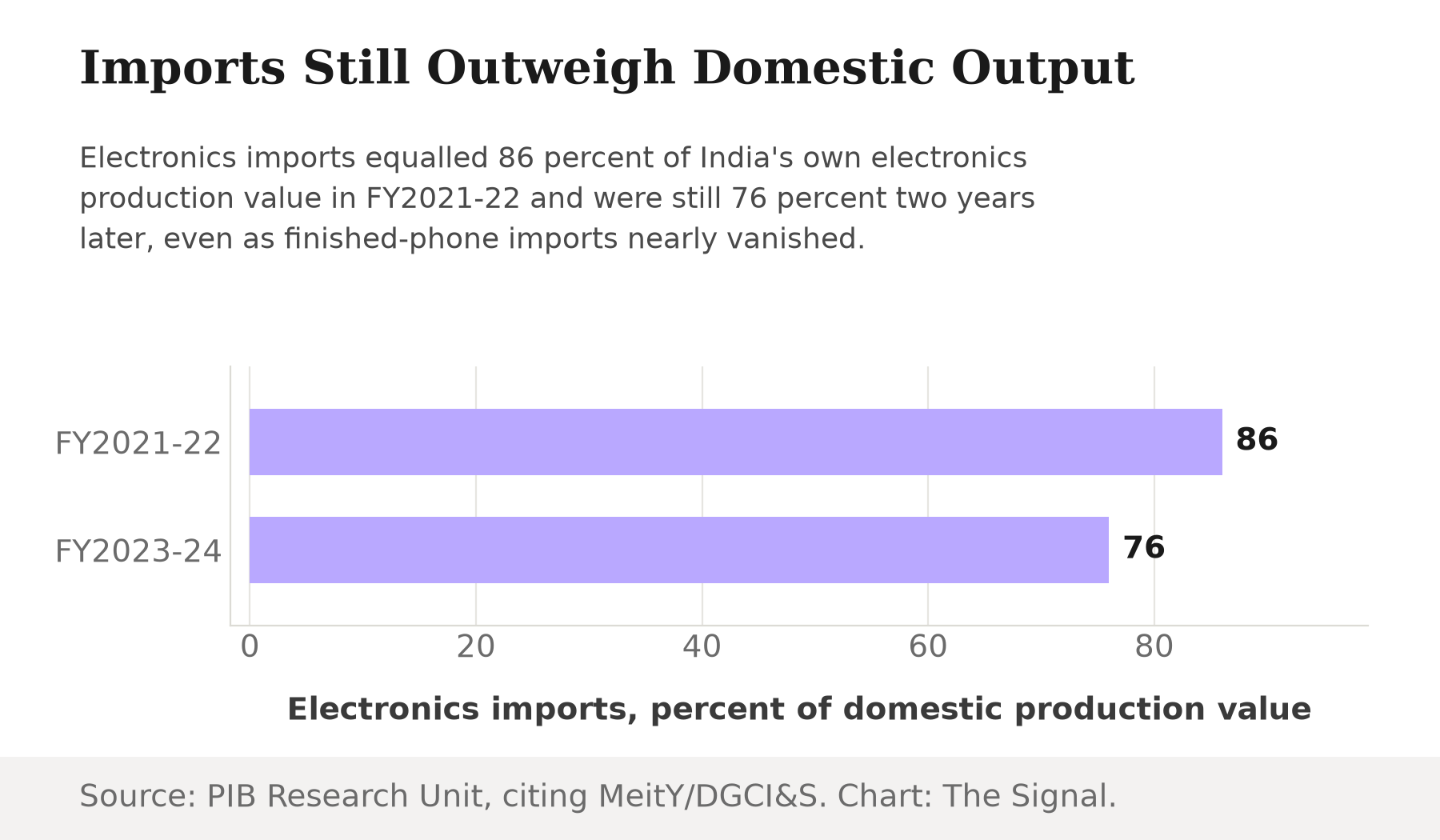
The government's own component-manufacturing push, the Electronics Components Manufacturing Scheme, approved a third tranche of 22 more projects worth Rs 41,863 crore in investment in January 2026, expected to generate Rs 2,58,000 crore in production and about 34,000 direct jobs. That is a fraction of the roughly Rs 7,27,664 crore in electronics India imported in FY2023-24 alone, but it is also the first sign that policy has shifted from subsidising assembly volume to subsidising the upstream layer assembly still depends on.
The boom and the gap sit in the same numbers.
| Metric | Early PLI years | Now |
|---|---|---|
| Phones assembled domestically | 26% of phones sold (2014-15) | 99.2% of phones sold (Sep 2025) |
| Import dependence, phone units | 75% of demand (2014-15) | 0.02% of demand (Sep 2025) |
| Annual mobile production | 5.8 crore units (2014-15) | 33 crore units (2023-24) |
| Domestic value addition | About 15% | 22-23% (Aug 2026); target 35-40% |
Source: PIB backgrounder citing MeitY; Akashvani News, citing MeitY data; Business Today, MeitY Secretary S Krishnan; Forbes India, MPMS notification.
Apple's ramp is the sharpest test case
Apple assembled about 55 million iPhones in India in 2025, roughly a quarter of its 220-230 million annual global output, up 53 percent from 36 million iPhones in 2024, Bloomberg reported, as carried by the Taipei Times. India's share of global iPhone assembly rose from 14 percent in 2024 to 23 percent in 2025 as China's fell from 83 percent to 74 percent, with Counterpoint Research projecting India's share could reach about 26-28 percent in 2026, National Herald reports, citing estimates from Counterpoint Research and Smart Analytics Global.
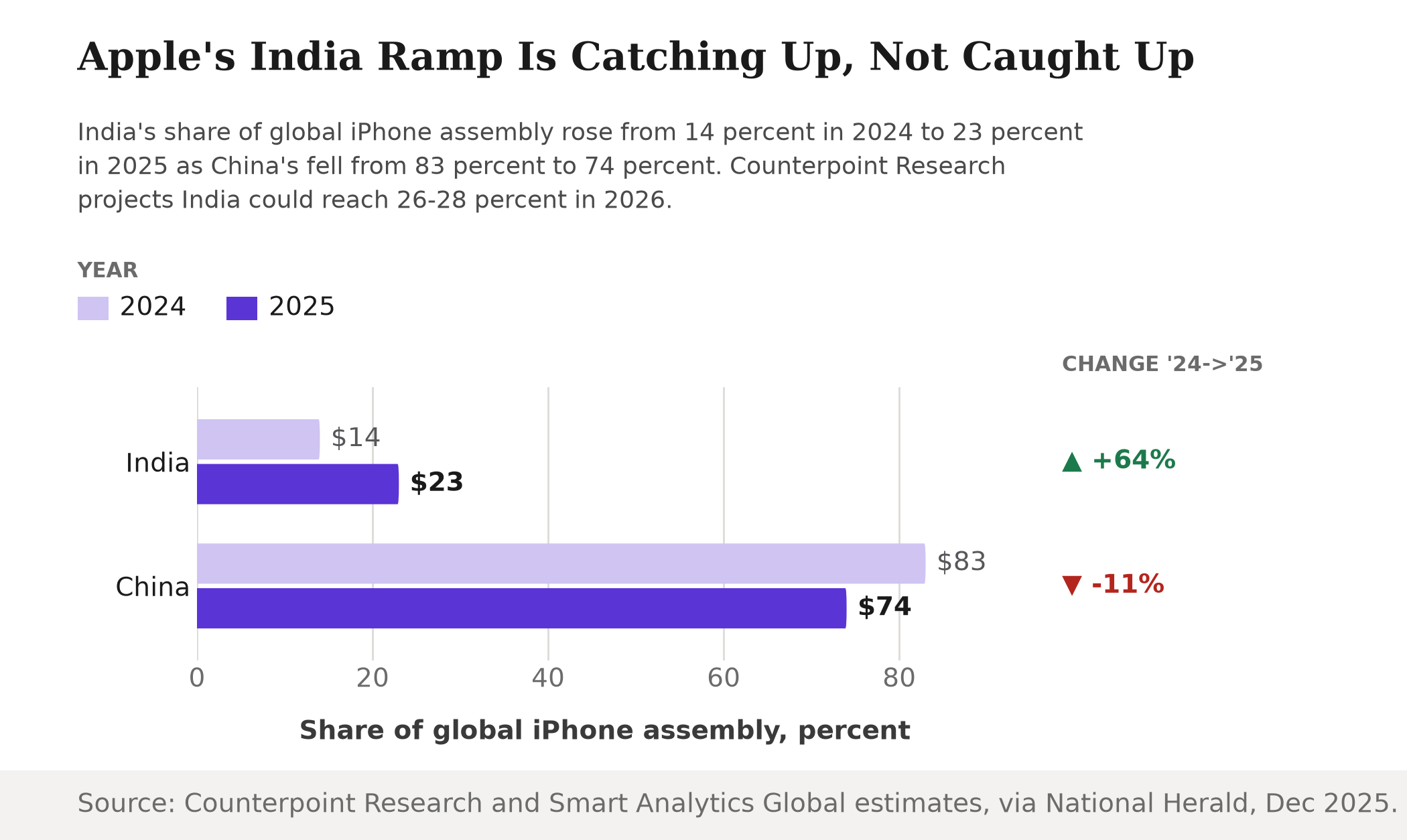
Apple is the cleanest version of the national story: China still assembled 74 percent of Apple's global iPhone output in 2025, even after India's sharp gains. A rising assembly share and a lagging value-addition share can be true of the same factories at the same time, and Apple's India ramp is currently both.
The honest objection
The strongest case against calling this a shortfall is that every electronics manufacturing base builds this way. Assembly comes first because it is the fastest, lowest-risk way to put workers on a line and exports on a ship; the component layer, which needs capital, a domestic supplier base and a multi-year learning curve of its own, follows later, once assembly volume is large enough to justify building it at home. On that reading, 12 lakh direct and indirect jobs generated over the decade to 2025, Union IT Minister Ashwini Vaishnaw said, are not a consolation prize for missing the value-addition target. They are the first stage of a sequence the government is now, with MPMS's extra component-sourcing incentive and the ECMS's third tranche of approvals, deliberately trying to accelerate.
That case is real, and the direction of travel supports it: value addition has moved from about 15 percent to 22-23 percent, not stayed flat. But the gap to the government's own 35-40 percent target has not narrowed on any visible schedule. MPMS exists because the assembly-first approach, on its own, was not going to close it. A scheme redesigned around a new component-sourcing incentive is evidence the target has been hard to reach with the tools already tried, not that it is close.
The Signal
India's mobile-phone numbers are not fake, and they are not merely spin: a country that imported three-quarters of its handsets in 2014-15 now imports almost none of them, and that took real factories and real capital. But "assembled in India" and "made in India" are, in the scheme's own design, two different claims wearing one slogan. MPMS's extra incentive, paid only for domestic components, is the government's own admission that the second claim is not yet true. Watch the value-addition figure, not the unit-production figure, when MeitY next updates its numbers. If it climbs toward the government's own target, the scheme is doing real component work, not just assembly. If it stalls, India will have built the world's newest assembly floor without building the factory upstream of it.
Reporting basis: the electronics trade and production figures are from a PIB Research Unit backgrounder citing the MeitY Annual Report and DGCI&S trade data; the phone-assembly and import-dependence figures are from a separate PIB backgrounder citing MeitY. The unit-production, export and jobs figures are as told by government broadcaster Akashvani News, citing MeitY data and Union Minister Ashwini Vaishnaw. The Electronics Components Manufacturing Scheme's third tranche is also per Akashvani News, and the PLI Scheme for Large Scale Electronics Manufacturing's cumulative investment, production and jobs figures are from Minister of State Jitin Prasada's written reply to the Lok Sabha, the official parliamentary record. The domestic value-addition figures are as MeitY Secretary S Krishnan stated at Business Today's India@100 Summit and as written into the government's Mobile Phone Manufacturing Scheme notification, per Forbes India's write-up of it. Apple's India iPhone volumes are per Bloomberg's reporting, as carried by the Taipei Times, and the India-China iPhone assembly share is per Counterpoint Research and Smart Analytics Global figures, as told by National Herald. The 76 percent and 86 percent import-to-production shares, and the roughly 65-times production-to-investment leverage figure, are The Signal's calculations from those underlying figures.