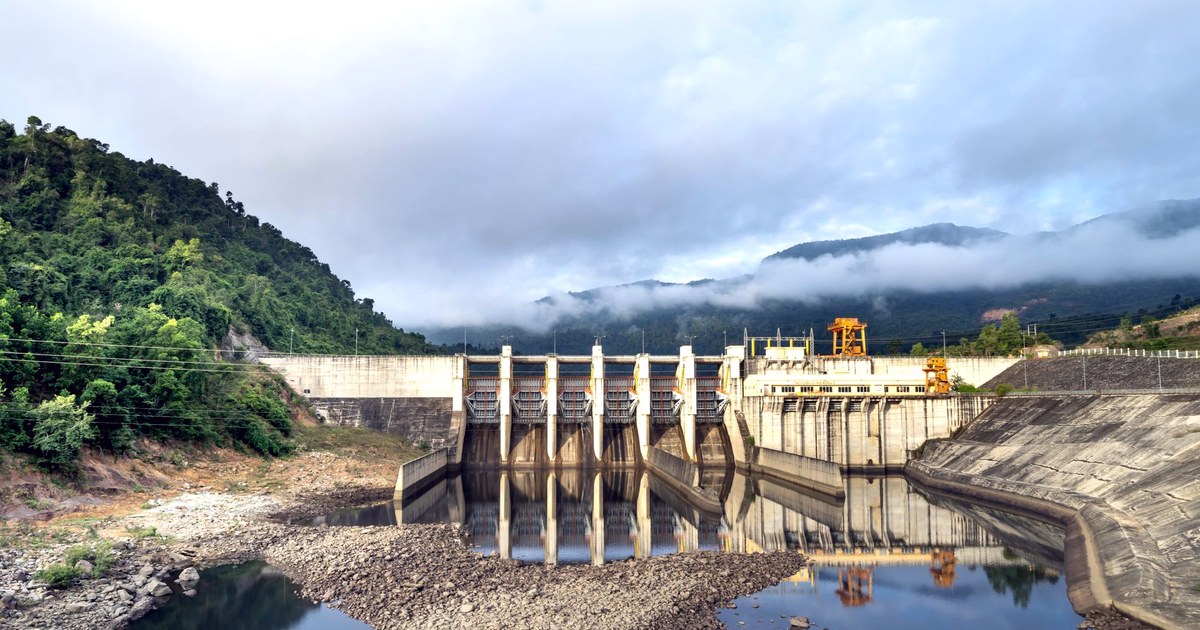
On August 26, 2026, a glacier collapsed on the Nepal-Tibet border and sent a flash flood down the Bhote Koshi and Trishuli river system. Nepal's Ministry of Foreign Affairs reports a "huge loss of lives, widespread displacement and extensive damage to houses, roads, bridges, hydropower facilities and other critical infrastructure." The early read is a familiar disaster story of wrecked infrastructure and a government coordinating relief.
It is worth slowing down on that framing. The flood did not just damage roads and homes. It hit the one asset class Nepal has spent the years since 2021 turning into a major source of cross-border revenue: hydropower sold to India.
The number that reverses the story
Business Today reports, citing Nepal's energy ministry, that the deluge damaged nearly 360 MW of power capacity, predominantly hydro, across nine operational plants in two districts, with five more under-construction projects also hit. Hydropower supplies more than 90% of Nepal's roughly 4,300 MW of total generation capacity, so losing 360 MW is not trivial for a small grid: on our calculation combining those two figures, it is about 8.4% of the country's entire generating fleet. That is why Nepal is now weighing power imports from India, the country it has spent since 2024 selling power to.
The trade the flood interrupted
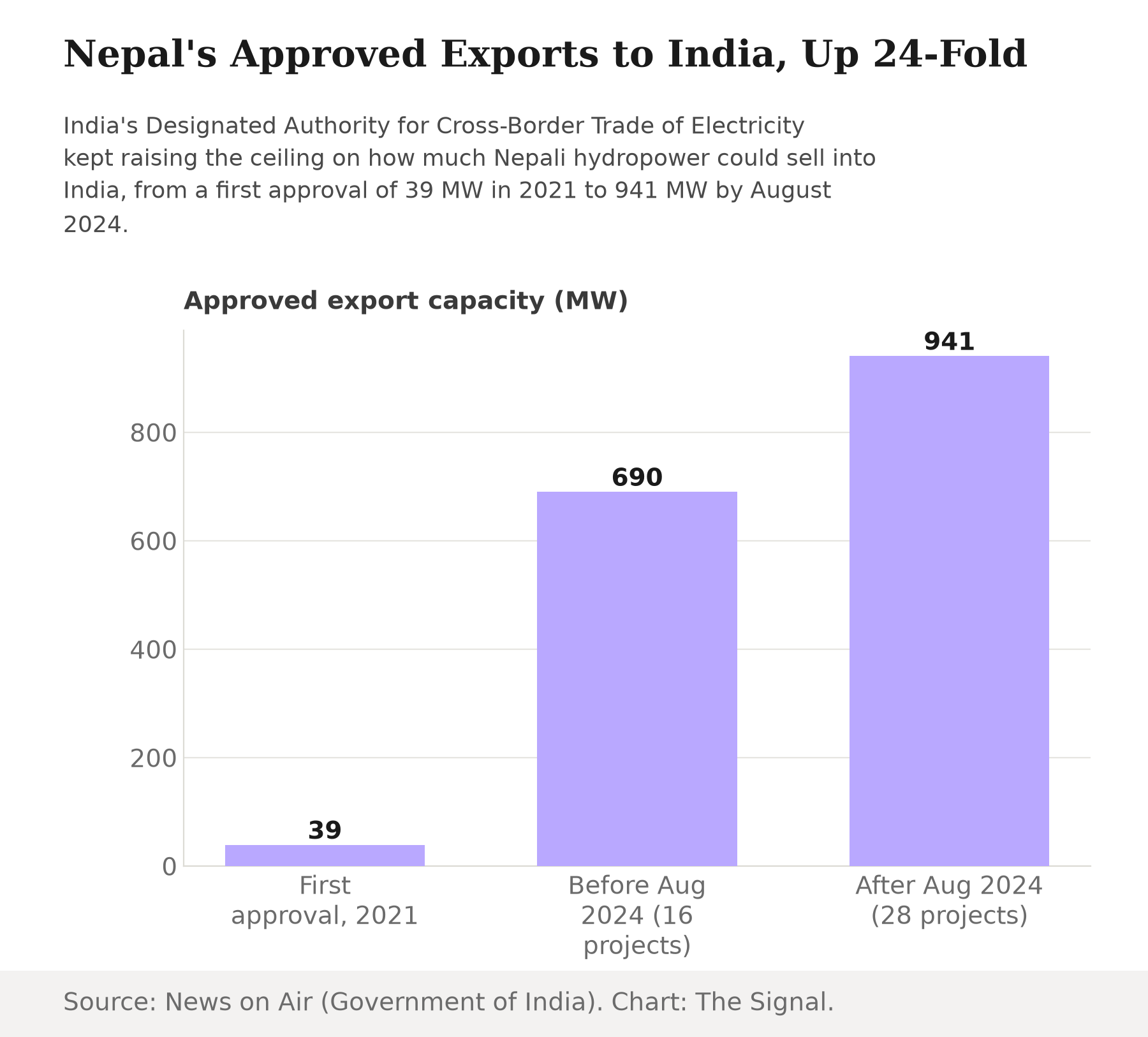
The reversal is sharper once the recent trend is on the table. Nepal supplied India around 600 MW of round-the-clock electricity for six months in 2025 and had planned to add another 500 MW in 2026, before the flood disrupted that outlook. That growth was not improvised. India's Designated Authority for Cross-Border Trade of Electricity approved an additional 251 MW of exports from 12 Nepali hydropower projects in August 2024, taking the allowed total from 690 MW across 16 projects to 941 MW across 28, up from just 39 MW at first approval in 2021: a roughly 24-fold rise in under three years.
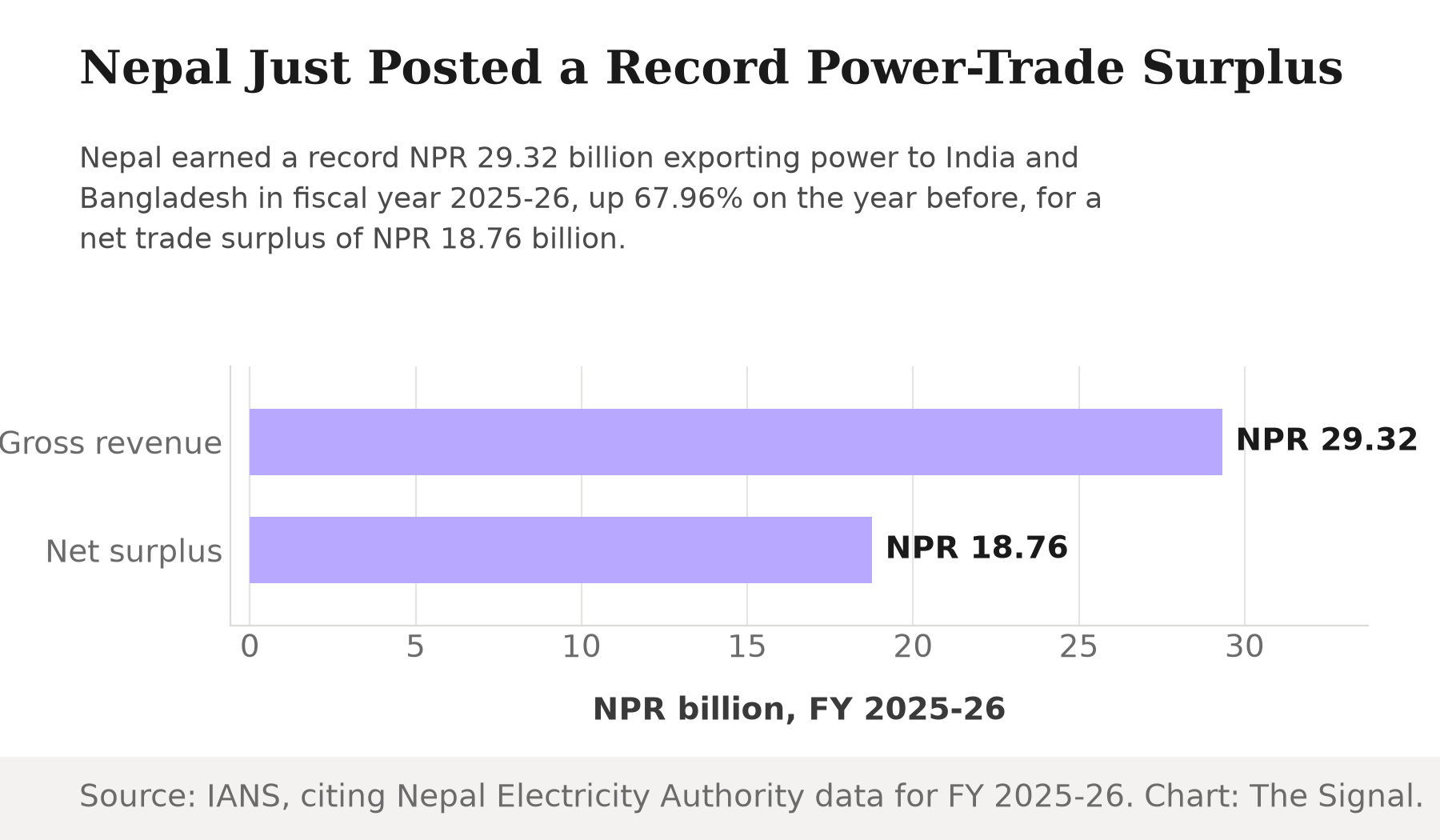
The revenue followed the approvals. Nepal earned a record NPR 29.32 billion from electricity exports to India and Bangladesh in fiscal year 2025-26, up 67.96% on the prior year, posting a net electricity trade surplus of NPR 18.76 billion. That record closed just weeks before the glacier came down.
A risk flagged 15 years earlier
The rivers carrying that export boom are fed by Himalayan glaciers, and glacial lake outburst floods are not a new hazard on them. A 2011 assessment commissioned by the World Bank's disaster-reduction facility and prepared by the regional mountain research body ICIMOD recommended that "infrastructure developers, especially private hydropower developers, are engaged in GLOF early warning and risk reduction activities." That is a policy recommendation, not a prediction of this flood, and it says nothing about any individual project's standards since. But the hazard behind the August 26, 2026 event was on the table for hydropower financing fifteen years before Nepal's export capacity to India multiplied 24-fold.
The stakes are not abstract for Nepal's broader economy either. The World Bank projects Nepal's economic growth will slow to 2.3% in fiscal year 2026 from 4.6% in fiscal year 2025, reflecting the Middle East conflict and lingering effects of September 2025 domestic unrest, with a rebound to an average 4.4% in fiscal years 2027 and 2028 that the Bank expects continued hydropower expansion to help drive. That forecast predates the flood: it assumed the hydropower pipeline would keep expanding on schedule, not lose 360 MW overnight.
India's cushion, and the asymmetry it exposes
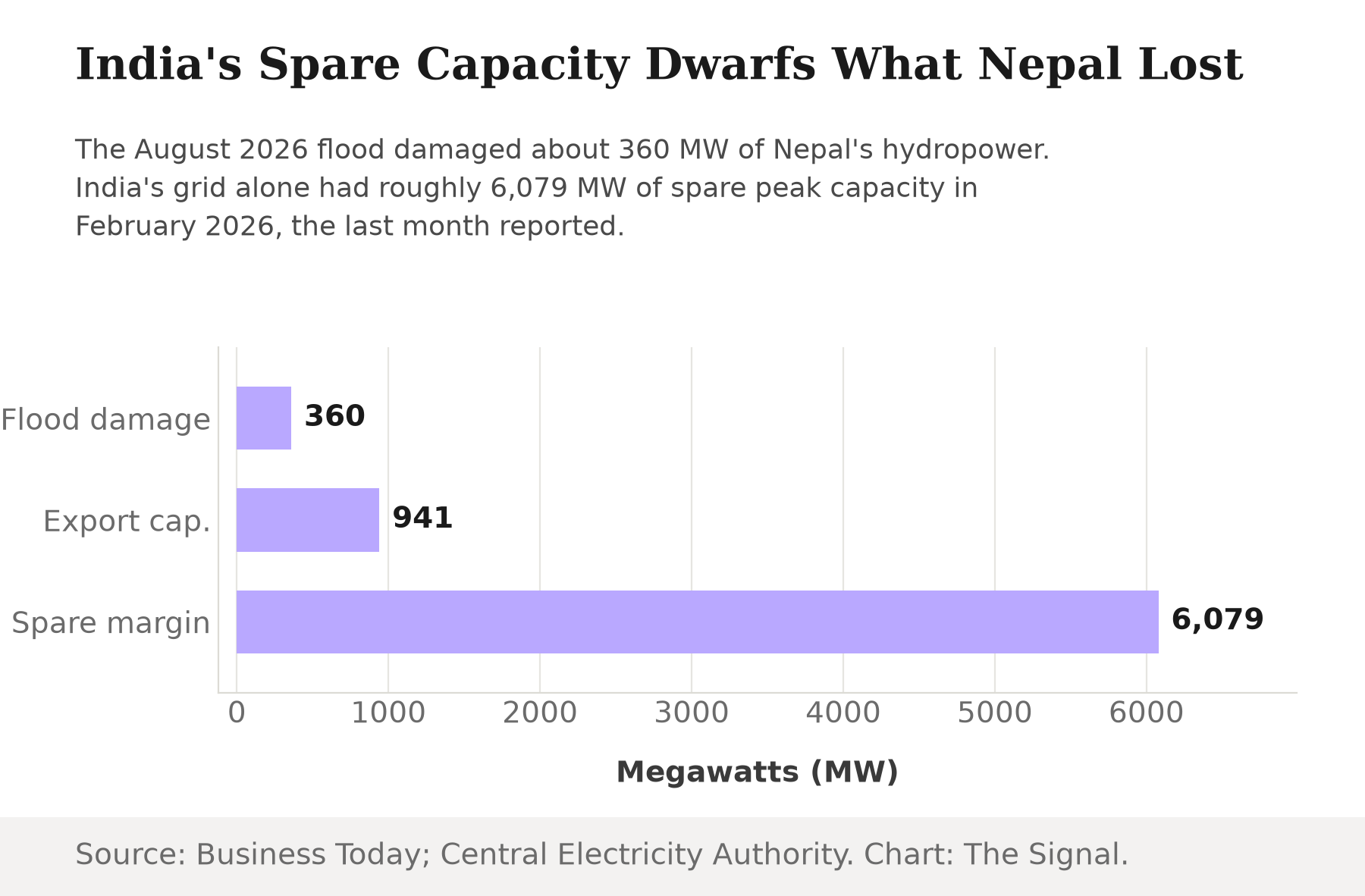
Set against India's own grid, Nepal's shortfall looks small. In February 2026, India's all-India peak power demand of 238,127 MW was fully met with 244,206 MW of peak supply available, a spare margin of roughly 6,000 MW: more than sixteen times the capacity Nepal's flood knocked out, and six times the quantum Nepal is approved to export to India. For India, absorbing a Nepali request for power is a rounding error. Nepal is the one facing the real choice: run its own system, or lean on its neighbor's headroom instead.
That margin is also physically deliverable, not just theoretically available. Nepal and India agreed in July 2026 to raise the cross-border transmission capacity between their grids, letting India send Nepal up to 1,400 MW over the Dhalkebar-Muzaffarpur and Dhalkebar-Sitamarhi 400 kV lines, up from 1,000 MW. That is more than double the roughly 600 MW Nepal drew from India in 2025 and well above the 360 MW the flood knocked out: the wires, not just the megawatts, were already in place before the glacier came down.
Nepal's flood damage is a fraction of both its own export approval and India's spare margin.
The honest objection
The strongest case against reading much into this is scale. A 360 MW loss against Nepal's roughly 4,300 MW fleet, absorbed by a neighbor with roughly 6,000 MW to spare, is exactly what cross-border grid integration should do: smooth a shock nobody could prevent. On this view, the story is a success. Nepal built the export relationship, and when disaster struck, it had India's grid to lean on.
That case holds for this flood alone. It strains once the growth model is added back in. Nepal's own projected rebound to an average 4.4% growth in fiscal years 2027 and 2028 counts on more hydropower coming online, on rivers fed by the same glaciers that just failed. Average annual economic losses from climate-induced disasters in Nepal already run about 0.08% of GDP, roughly NPR 2.78 billion, based on research covering 1971 through 2025, before this flood is added. This flood alone puts a much bigger number on the board: Nepal's Independent Power Producers' Association estimates NPR 25-30 billion in hydropower-project losses, roughly a quarter to a third of the cost of the projects hit, a bill large enough to erase most of the NPR 18.76 billion trade surplus the sector had just posted for the fiscal year. A grid-sharing arrangement that absorbs one bad year is reassurance. A growth plan that keeps building on exposed rivers without a matching answer to a risk flagged in 2011 is a different question.
The Signal
The interesting number here was never the 360 MW the flood knocked out. Nepal's power relationship with India has, so far, only ever flowed as insurance in one direction: India's spare margin covers Nepal's shortfall, not the reverse. Watch two things next: whether India's approved export quota, 941 MW and rising for three years straight keeps climbing despite the damage, and whether Nepal's fiscal 2027 growth reaches the rebound the World Bank penciled in before the glacier came down. If both hold, this flood was a one-off absorbed by a well-built safety valve. If either slips, the risk a 2011 report flagged will have arrived on schedule, fifteen years late.
Reporting basis: the flood's scale and Nepal's official response are from Nepal's Ministry of Foreign Affairs. The 360 MW damage estimate and Nepal's possible power imports are per Business Today and the Free Press Journal, both citing Nepal's energy ministry, and Outlook Business on Nepal's generation mix and separately on climate-disaster losses. India's export approvals are from News on Air, relaying the Designated Authority for Cross-Border Trade of Electricity; its supply-demand balance is from the Central Electricity Authority. The 2011 flood risk assessment is the original World Bank GFDRR/ICIMOD report. Nepal's trade revenue is per IANS, citing Nepal Electricity Authority data, and its growth outlook is from the World Bank's April 2026 Nepal Development Update. The July 2026 transmission-capacity increase is per Khabarhub, reporting on the Nepal-India Joint Steering Committee meeting in Pokhara, and the hydropower repair-cost estimate is from The Kathmandu Post, citing Nepal's Independent Power Producers' Association. The fleet-share and margin comparisons are The Signal's calculations.