Reliance Jio's own numbers, read on their own, tell a growth story. In the quarter ended June 2026, Jio Platforms added 8.9 million net subscribers, grew its base 7.1 percent year on year to 533.3 million connections, and told investors it had filed its Draft Red Herring Prospectus with SEBI, the formal step toward its long-awaited public listing. Read only that release and the company looks exactly like what it has been since 2016: the operator every rival is still chasing.
It is worth slowing down on that framing. TRAI's Telecom Subscription Data for July 2026 shows Jio holding 39.29 percent of India's wireless subscriber base, 506.03 million of 1,287.92 million connections, against Bharti Airtel's 38.01 percent, 489.49 million. A year earlier, TRAI's July 2025 release put Jio at 41.04 percent and Airtel at 33.65 percent. Jio remains the largest operator by both subscribers and share, but the gap that used to separate it from the field has nearly closed.
Jio's market-share lead over Airtel has shrunk from 7.4 points to 1.3 points in a year.
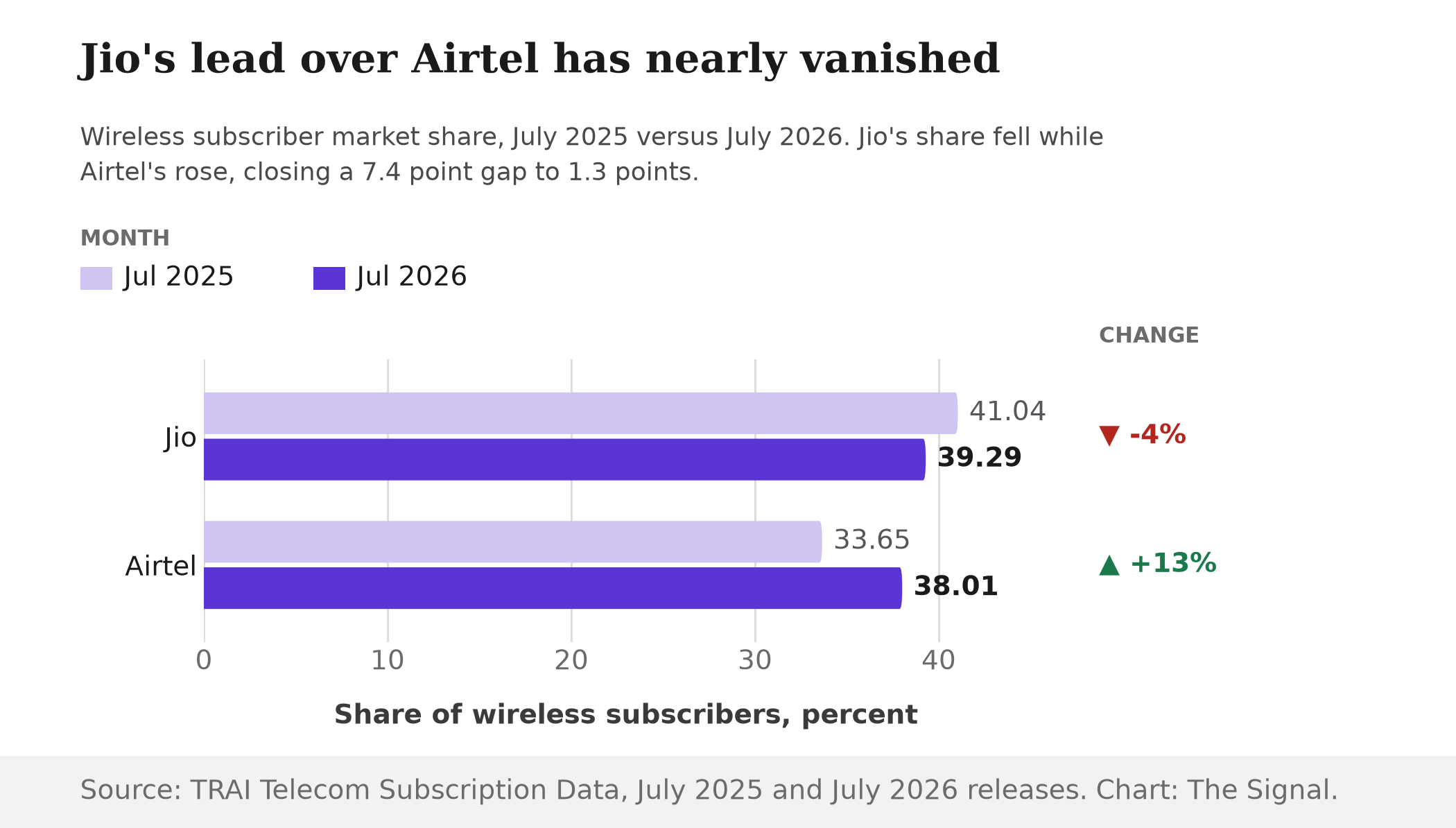
Source: TRAI Telecom Subscription Data, July 2026 and July 2025 releases. Chart: The Signal.
The month Airtel outsold Jio
In July 2026 alone, Airtel added 2,688,348 net new mobile subscribers, more than Jio's 2,446,727. Vodafone Idea added just 240,114 and state-run BSNL added 168,874 in the same month, per the same TRAI release.
Reliance Jio, wireless subscribers, July 2026
| Operator | Subscribers, July 2026 | Share of market | Net additions, July 2026 |
|---|---|---|---|
| Reliance Jio | 506.03 million | 39.29% | 2,446,727 |
| Bharti Airtel | 489.49 million | 38.01% | 2,688,348 |
| Vodafone Idea | 199.06 million | 15.46% | 240,114 |
| BSNL | 93.18 million | 7.23% | 168,874 |
Source: TRAI Telecom Subscription Data, July 2026 release.
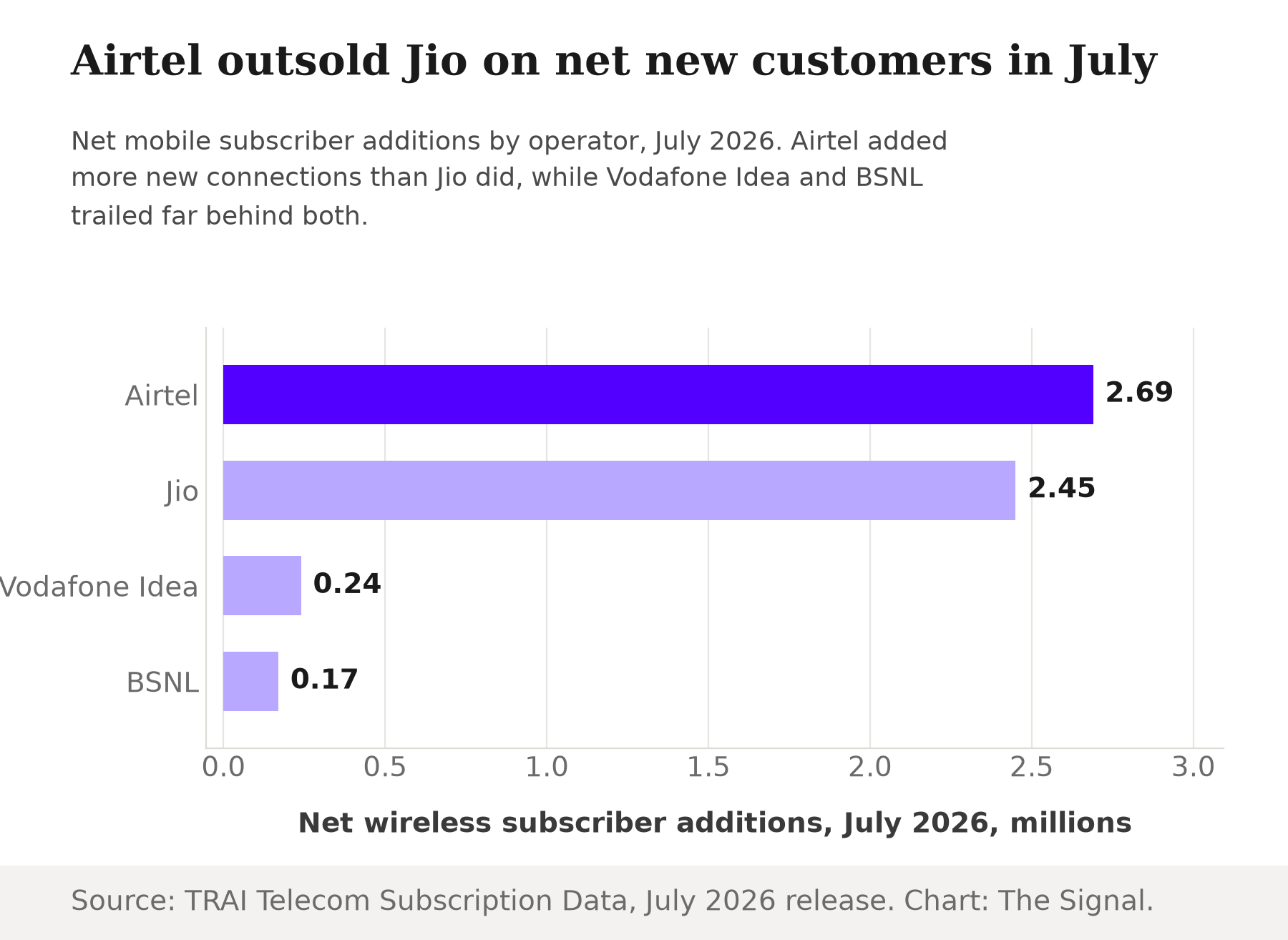
Source: TRAI Telecom Subscription Data, July 2026 release. Chart: The Signal.
Where the market's growth actually went
Over the year to July 2026, India's total wireless subscriber base grew by 124.41 million, from 1,163.51 million to 1,287.92 million. Airtel's own base grew by 98.01 million in that time, a 25 percent jump; Jio's grew by a much smaller 28.53 million. Airtel absorbed roughly four-fifths of the industry's net growth over the year, 78.8 percent, against 22.9 percent for Jio, The Signal's calculation from the two TRAI releases cited above.
That was not simply Vodafone Idea customers switching to Airtel. Vi's own base fell by roughly 4.8 million over the same year, even as the overall market grew. Vi had too few subscribers to lose to explain Airtel's 98 million-subscriber gain on its own; most of that growth came from new connections choosing Airtel over Jio, rather than from an existing Vi customer switching operators.
What Jio chose to do instead
While Jio was adding subscribers more slowly than Airtel, its per-user economics moved in the opposite direction. Jio Platforms' average revenue per user rose to Rs 215.6 a month in the quarter ended June 2026, up from Rs 208.8 a year earlier, a 3.3 percent increase. Bharti Airtel's India ARPU rose faster over the same period, to Rs 264 from Rs 250, a gap of about Rs 48 a month that has widened rather than closed even as Jio raises its own prices.
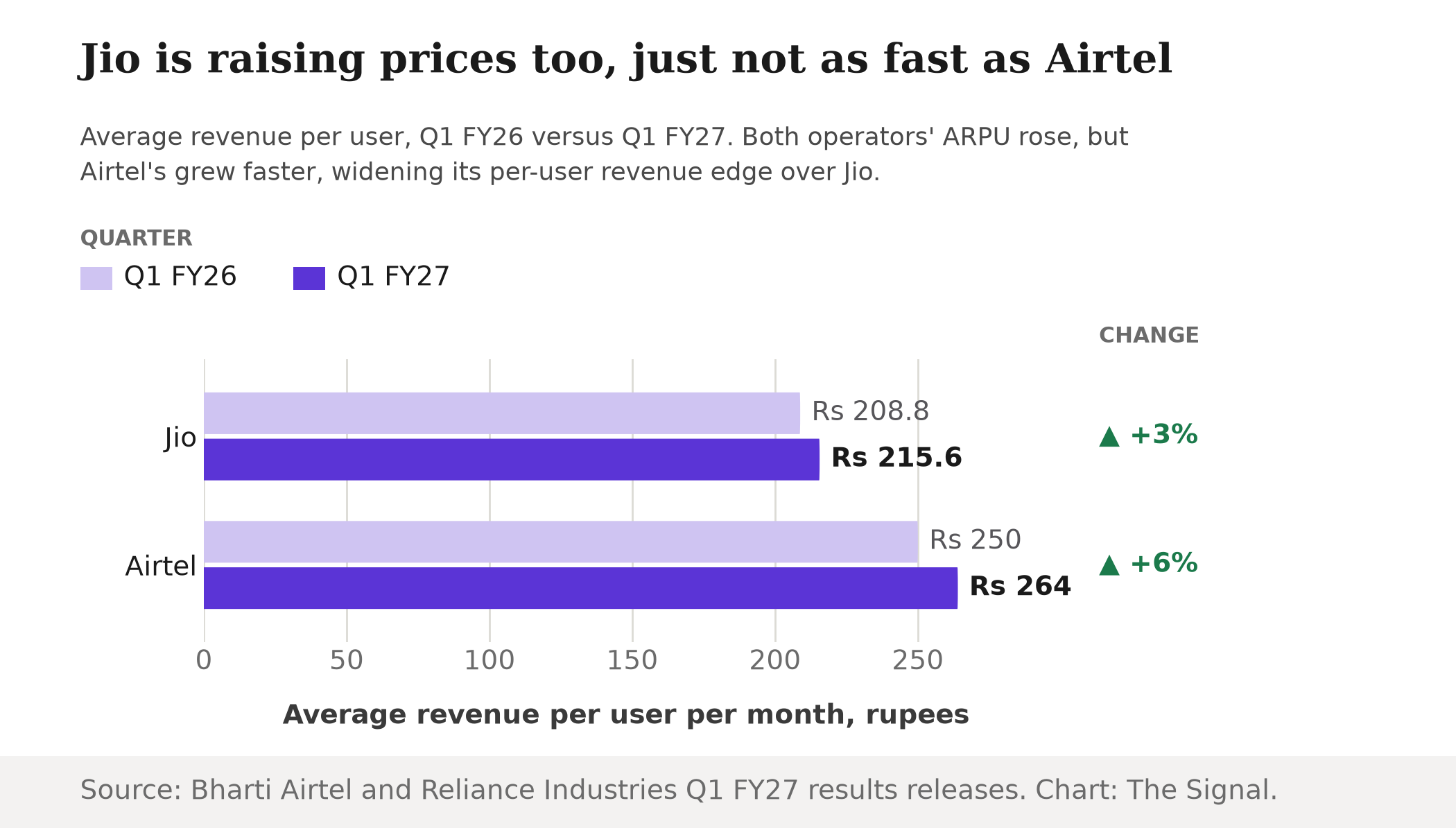
Source: Reliance Industries Q1 FY27 media release; Bharti Airtel Q1 FY27 media release. Chart: The Signal.
The profitability of Jio's core telecom business improved over the same June 2026 quarter. Reliance Jio Infocomm's EBITDA margin expanded to 57.3 percent from 56.0 percent a year earlier. EBITDA rose 13.2 percent year on year to Rs 19,590 crore, on operating revenue growth of 10.8 percent to Rs 34,212 crore. A company losing the fight for new customers to a faster-adding rival would ordinarily cut prices and squeeze margin to defend its base. Jio's own numbers show the opposite happening alongside the share loss, not despite it.
The IPO the numbers are dressed for
The context for that choice is the listing Jio Platforms is now walking toward. In its Draft Red Herring Prospectus filed with SEBI, Jio Platforms reported FY26 revenue from operations of Rs 1,46,885 crore, an EBITDA margin of 51.91 percent, and profit after tax of Rs 30,049 crore. The filing also discloses the issue will be a fresh issue only, of up to 27 crore equity shares with no offer for sale, and that proceeds are earmarked to prepay borrowings at Reliance Jio Infocomm and for general corporate purposes.
A fresh-issue-only IPO whose proceeds pay down the operating subsidiary's own debt is a balance-sheet story: the company is raising equity to delever, not letting an early investor cash out. Filing that kind of prospectus in the same year that RJIL's EBITDA margin hits 57.3 percent looks less like coincidence and more like a business being readied to be priced on profitability and cash generation, not on gross subscriber count.
The honest objection
The strongest case against reading this as deliberate Jio strategy is that Airtel's gains look like a straightforward network story, not a Jio retreat. Bharti Airtel's India capital expenditure was Rs 9,698 crore in the June 2026 quarter alone, Rs 13,386 crore on a consolidated basis, spending that plausibly explains why more new customers are choosing Airtel regardless of what Jio does with its own pricing. On this reading, Jio's 1.3-point lead is still a lead, and one month of Airtel out-adding Jio is not twelve.
That case is real. But it does not explain why Jio's own ARPU and RJIL's EBITDA margin are rising at the same time its share is falling. A company purely losing a capex war would show the strain in its margins as it tried to hold customers. Instead RJIL's margin expanded 130 basis points in the same quarter its parent filed for an IPO built around paying down that unit's debt. Airtel's network investment explains why customers are choosing Airtel, not why Jio is not fighting harder to stop them.
The Signal
Jio is not losing. It is still India's largest wireless operator by both subscribers and share, still adding subscribers, and still generating a wider EBITDA margin than a year ago. What has changed is which number it is optimizing. A company defending market share cuts ARPU and burns margin to hold every customer it can; Jio is doing the reverse while a rival captures four-fifths of the industry's net growth. The DRHP now sitting with SEBI is a bet that public investors will price Jio Platforms on profitability and debt reduction, at the exact moment subscriber count is the metric where a rival is catching up fastest. Watch what happens after the listing prices: if ARPU and RJIL's margin keep climbing while share keeps sliding, this was the plan. If Jio starts cutting prices to defend share once public shareholders are watching the subscriber count too, the plan was never as settled as this quarter's numbers make it look.
Reporting basis: the July 2026 and July 2025 wireless subscriber counts, market shares and monthly net additions by operator are from TRAI's Telecom Subscription Data press releases for those months. Bharti Airtel's ARPU and capital expenditure figures are from its own Q1 FY27 media release. Jio Platforms' and Reliance Jio Infocomm's ARPU, subscriber additions, revenue and EBITDA margin figures are from Reliance Industries' Q1 FY27 media release and analyst presentation. Jio Platforms' FY26 revenue, EBITDA margin, profit after tax and IPO structure are from its Draft Red Herring Prospectus filed with SEBI. The year-on-year change in market-share lead, the absolute and percentage subscriber growth for Jio and Airtel, and Airtel's and Jio's respective shares of the industry's net subscriber growth over the year are The Signal's calculations from those TRAI releases.