On 29 August 2026, FSSAI ordered Everest Food Products to stop selling every variant of its compounded asafoetida, effective immediately. Lab tests on its plain Hing Powder found the alcohol-soluble extract, the standard purity marker for asafoetida, at exactly 0 percent, against a prescribed minimum of 5 percent. The regulator's Yellow and Black Hing Powder variants failed too, at 3.29 percent and 4.4 percent. The same day, FSSAI barred Laljee Godhoo and Company from making or selling its compounded hing and asafoetida, after finding both the finished powder and the raw hing used to produce it sub-standard, with the raw material's starch content exceeding the regulatory cap of 1 percent by weight. The obvious read is straightforward: two well-known kitchen brands got caught selling fake or diluted hing, and the regulator did its job.
It is worth slowing down on what "fake" means here. The FSSAI standard these brands failed was never a standard for pure asafoetida. It is a standard for a legally sanctioned blend, and that blend was already allowed to be mostly something else before either company opened a bag of it.
The bar was already low
Under India's Food Safety and Standards (Food Products Standards and Food Additives) Regulations, 2011, "compounded asafoetida", known as Bandhani Hing, is defined as one or more varieties of raw asafoetida blended with gum arabic and edible starches or cereal flour. Pure raw hing must show an alcohol-soluble extract, essentially a measure of how much actual resin is present, of at least 12 percent. Compounded hing, the blended product nearly every Indian kitchen actually buys, needs only 5 percent: under half the purity floor set for the raw resin itself. That is not a loophole Everest or Laljee Godhoo exploited. It is the legal baseline every compounded-hing brand in the country has sold against since the 2011 regulation set it.
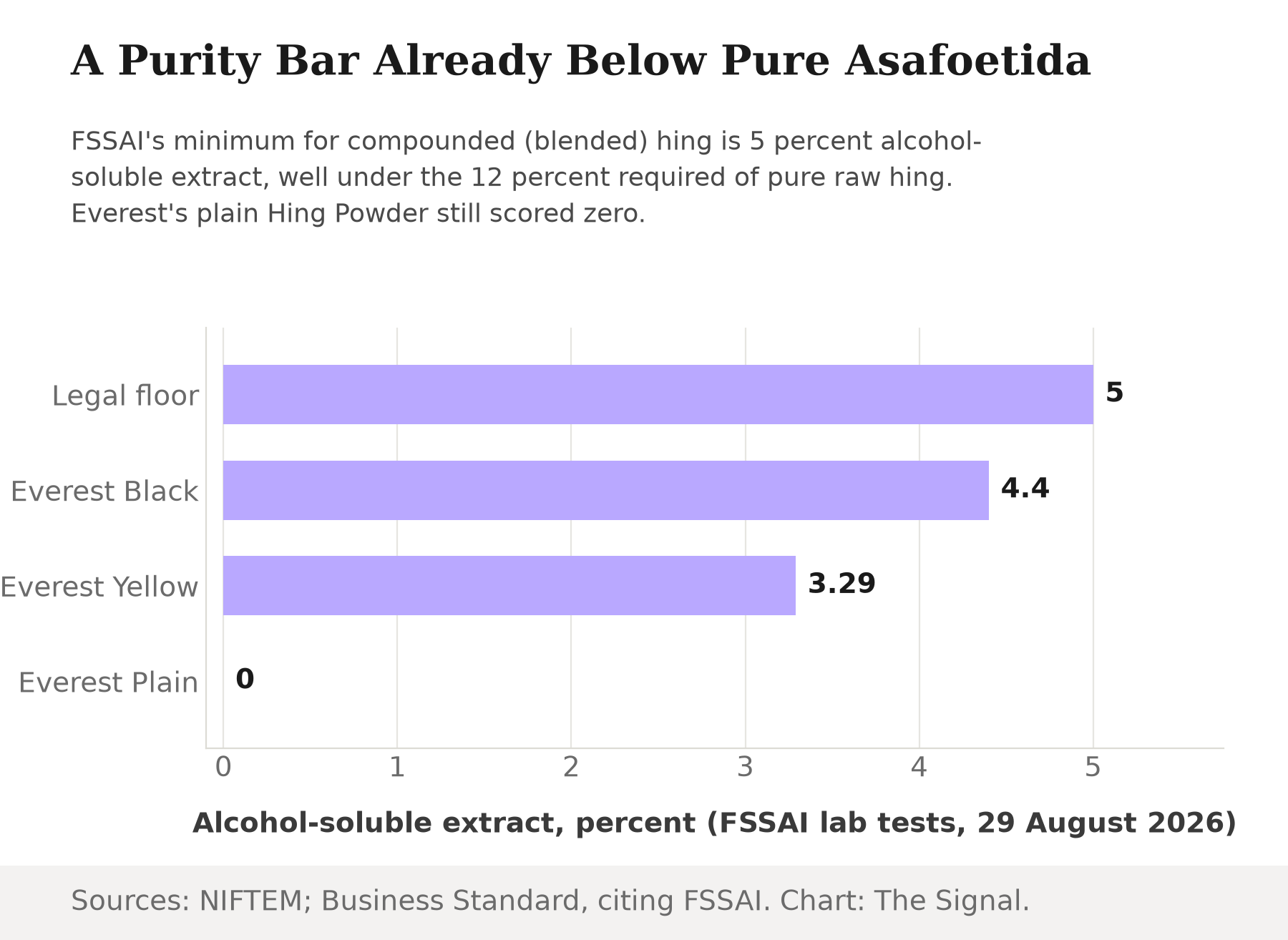
Source: Business Standard, carrying FSSAI's lab results; NIFTEM, for the Ministry of Food Processing Industries. Chart: The Signal.
Against that already-low bar, what the two brands were actually caught doing looks different. Everest's plain Hing Powder returned zero alcohol-soluble extract, missing the diluted standard itself, the more forgiving of the two floors, written specifically to accommodate a mostly-filler product. Laljee Godhoo's raw hing input itself failed on starch content before it was even compounded. Both brands did not get caught blending. They got caught missing the blend's own floor.
Why the blend exists at all
The compounded-hing standard is not a regulatory accident. It exists because India has almost no raw asafoetida of its own to sell straight. As of June 2020, there was no commercial production of raw heeng in India at all: the country was importing about 1,200 tonnes of it a year, worth roughly Rs 600 crore, from Afghanistan, Iran and Uzbekistan.
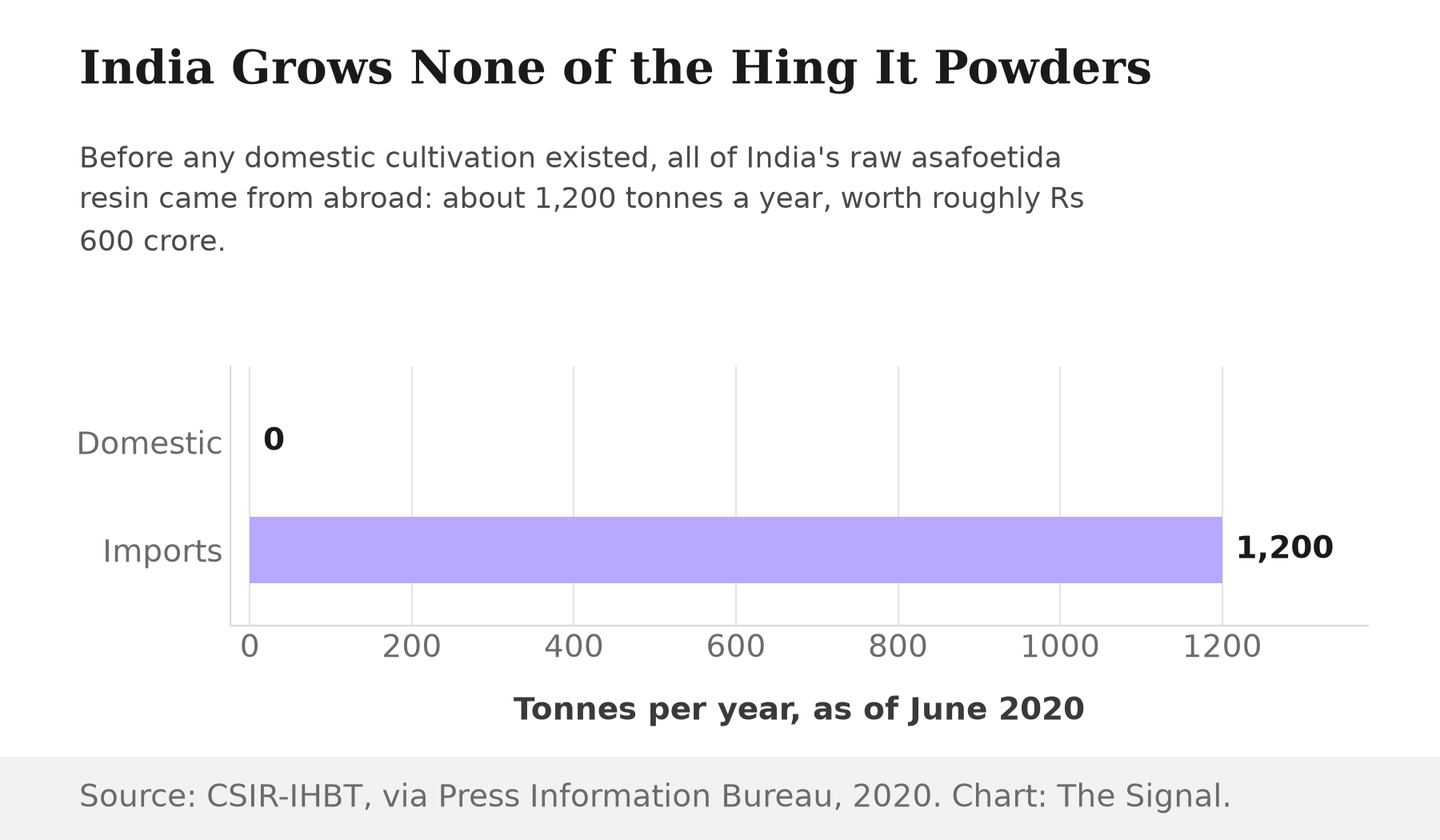
Source: Press Information Bureau, citing CSIR-IHBT. Chart: The Signal.
That import dependence is also concentrated. India consumes 40 percent of the world's total asafoetida supply, a scale no single exporter can fill from a small, resin-tapping crop grown across a handful of arid regions. In FY2017, about 92 percent of India's raw asafoetida imports came from Afghanistan alone.
Almost all of that scarce supply passes through one country.
| Metric | Figure | As of |
|---|---|---|
| India's share of world asafoetida consumption | 40% | FY2017 |
| Afghanistan's share of India's raw asafoetida imports | 92% | FY2017 |
India's asafoetida supply, by the numbers. Source: The Dollar Business, citing FAO trade data.
Compounding, cutting scarce, expensive resin with gum arabic and starch, is the mechanism that stretches a limited, single-corridor import into a mass household spice. The 5 percent floor is not a cynical concession to industry. It is what makes hing affordable and available at all when the raw material barely exists inside the country's own borders.
A first, small attempt to grow it at home
India has tried to change that dependency since 2020, modestly so far. CSIR's Institute of Himalayan Bioresource Technology planted the country's first-ever asafoetida seedlings on 15 October 2020, in a farmer's field in Himachal Pradesh's Lahaul valley. The seed stock came from six accessions imported from Iran in October 2018. ICAR's National Bureau of Plant Genetic Resources confirmed it was the first attempt in three decades to introduce asafoetida seed into the country. That pilot marks the starting point of domestic cultivation, not its conclusion. In May 2025, those Himachal Pradesh plants flowered for the first time, a real milestone toward domesticating the crop. But asafoetida needs about five years from planting before its roots yield harvestable resin, so that flowering is still a sign of life in the pilot, not a harvest. Six years on, the country's asafoetida supply still runs, as it has for decades, through the same narrow import corridor the 2020 planting was meant to eventually loosen.
The honest objection
The strongest defense of the current standard is that compounding is not a cover for fraud, it is ordinary food processing. Pure asafoetida resin is pungent and impractical to cook with directly; blending it with starch and gum is a centuries-old, declared practice, not a hidden one. Everest's and Laljee Godhoo's products were sold as "compounded asafoetida" on the label, not as pure hing, so buyers were told exactly what they were getting. On this view, FSSAI banning two brands for undershooting even the diluted standard is proof the system works: the floor exists, and enforcement caught two products that sat below it.
That case holds for the labeling. It does not explain the size of the miss. A brand landing at 3.29 percent against a 5 percent floor might be a manufacturing or storage failure. A leading, decades-old brand's flagship product testing at zero is not a marginal shortfall against a generous standard, it is a product that, by the regulator's own measure, contained no detectable asafoetida resin at all. The honest objection defends the existence of a diluted legal category. It does not defend selling something that fails even that category's own, already-low bar.
The Signal
The ban is a story about enforcement, not about a scandal-proof standard. FSSAI's compounded-hing rule already concedes that almost none of the raw resin in a jar of Indian hing originates inside the country, and it built a purity floor around that scarcity rather than eliminate the blend. That floor is thin, and thin floors depend entirely on the honesty of whoever is filling the jar, because the gap between "legal blend" and "adulterated fake" is a single lab test on a resin sourced almost entirely from one unstable overseas corridor. Watch what happens next to that corridor, not just to Everest and Laljee Godhoo: if Afghanistan's or Iran's supply tightens further and India's own cultivation experiment stays a single Himachal field, the temptation to cut the resin fraction again will not have gone away. It will just be waiting for the next lab test.
Reporting basis: the FSSAI prohibition order against Everest Food Products, including its lab results, is per Business Standard, carrying FSSAI's statement via PTI. The Laljee Godhoo order is per THIP Media, carrying an IANS wire of FSSAI's statement. The compounded-asafoetida purity standard is drawn directly from the Food Safety and Standards (Food Products Standards and Food Additives) Regulations, 2011, as reproduced by NIFTEM for the Ministry of Food Processing Industries. India's import volumes and the absence of domestic production are from a Press Information Bureau release carrying CSIR-IHBT's statement, and the first asafoetida planting in Himachal Pradesh is from a separate Press Information Bureau release from the same institute. The May 2025 first-flowering milestone is from The Tribune, carrying CSIR's own statement. The consumption-share and Afghanistan-origin import figures are from a single 2017 feature in The Dollar Business citing Food and Agriculture Organization trade data and are the only source for those two numbers. No figure in this piece is a Signal calculation.