On August 29, 2026, HDFC Bank told shareholders, in an exchange filing, that Sashidhar Jagdishan, chief executive of India's largest private-sector bank, had decided not to seek reappointment as MD and CEO. He is due to retire on October 26, six years after he succeeded Aditya Puri as MD and CEO on October 27, 2020. The bank said its board tried to persuade him to reconsider, and that he reiterated his decision anyway. Read on its own, that is an unremarkable transition: a six-year run, a board that asked him to stay, a chief executive who said no regardless. Bank CEOs retire. This looks like an orderly handover.
It is worth slowing down on that framing. This is not HDFC Bank's first departure from its top table this year. Five months earlier, on March 18, 2026, part-time chairman Atanu Chakraborty resigned with immediate effect, writing that "certain happenings and practices within the bank" over the prior two years were "not in congruence with my personal Values and Ethics," without naming what those practices were. The RBI approved Keki Mistry as interim part-time chairman the same day. The market did not treat that as routine. HDFC Bank's American Depositary Receipts fell 8% and its market capitalisation dropped by more than Rs 61,000 crore during the week Chakraborty quit. Two of the bank's most senior positions have now turned over within five months.
HDFC Bank's stock did not treat the chairman's exit as routine.
| Metric | Change, week of March 18, 2026 |
|---|---|
| HDFC Bank American Depositary Receipts | Down 8% |
| HDFC Bank market capitalisation | Down more than Rs 61,000 crore |
Source: The Quint.
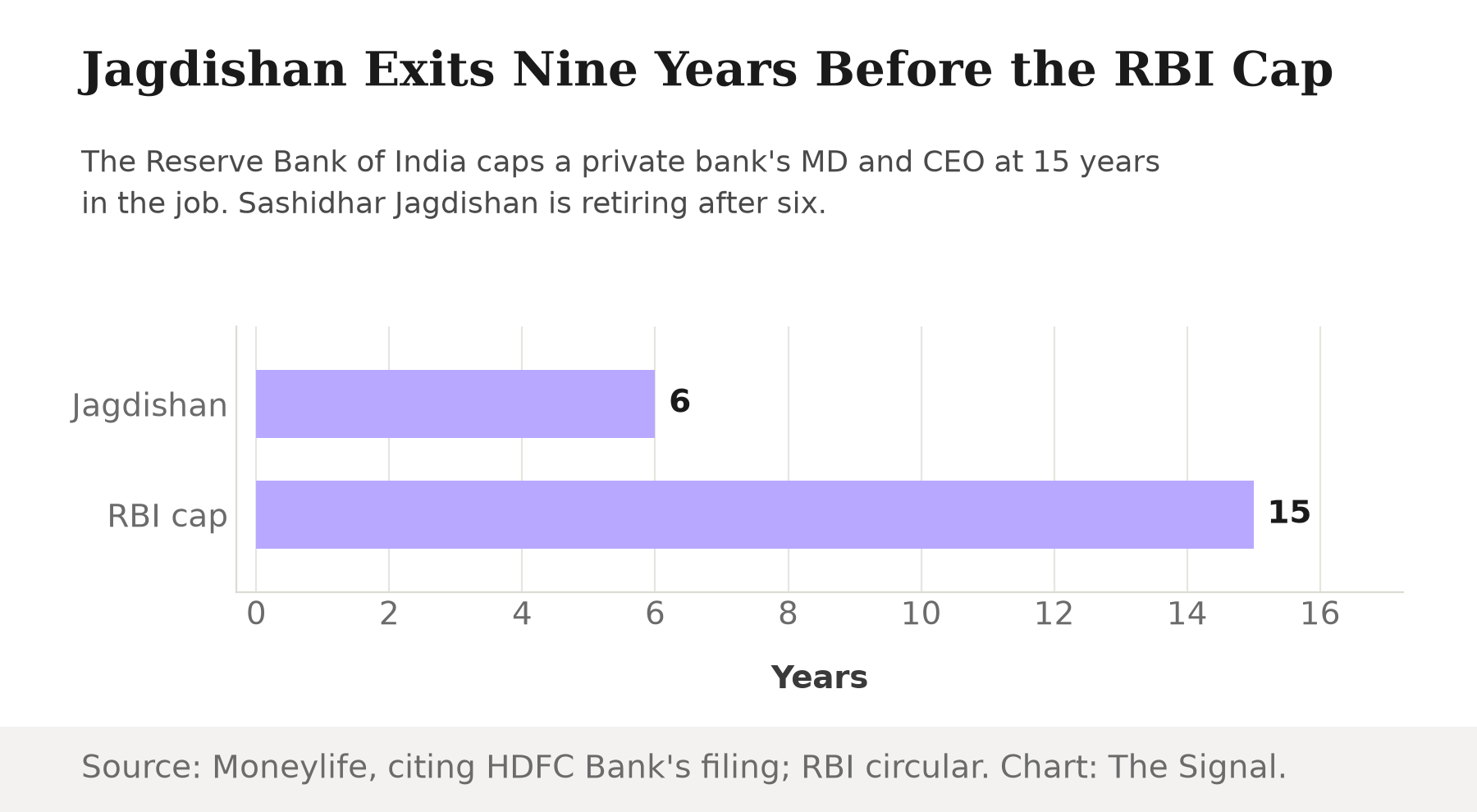
The easiest explanation for Jagdishan's exit, that a regulatory deadline forced his hand, does not survive contact with the numbers. The RBI caps a private bank's MD and CEO at 15 years in the job, 12 years if the incumbent is also a promoter or major shareholder, and bars anyone from continuing past age 70. Jagdishan is not a promoter; the 15-year clock is his. He is stepping down after six years, nine short of the ceiling that would actually apply to him. He is 61, nine years short of the age-70 bar too. Neither RBI rule was close to binding.
If the RBI's clock is not what is pushing Jagdishan out, the more useful question is what is.
The merger left a margin problem behind
HDFC Ltd, India's largest housing financier, merged into HDFC Bank, the largest private-sector bank, with the combination effective July 1, 2023. The deal was sold as scale: a home-loan book bolted onto India's largest bank-branch network. It also changed the bank's funding mix overnight, adding a wholesale-funded mortgage book to a balance sheet that had been built on cheap retail deposits.
In the quarter right before that merger took effect, HDFC Bank's standalone net interest margin was 4.1%, and its cost-to-income ratio was 42.8%. In its most recent results, for the quarter ended June 2026, net interest margin had fallen to 3.26%, even as gross advances grew 15.4% year on year. Margin fell 0.84 percentage points, from 4.1% to 3.26%, a relative decline of roughly a fifth (our calculation). The bank is lending noticeably more and earning less on every rupee it lends. That is not a story of an undisciplined cost base: the bank's own core cost-to-income ratio was actually lower in the same June 2026 quarter, at 39.2%, than the 42.8% it ran before the merger. The pressure sits specifically in the margin the bank earns on its lending book, not in how it spends on itself.
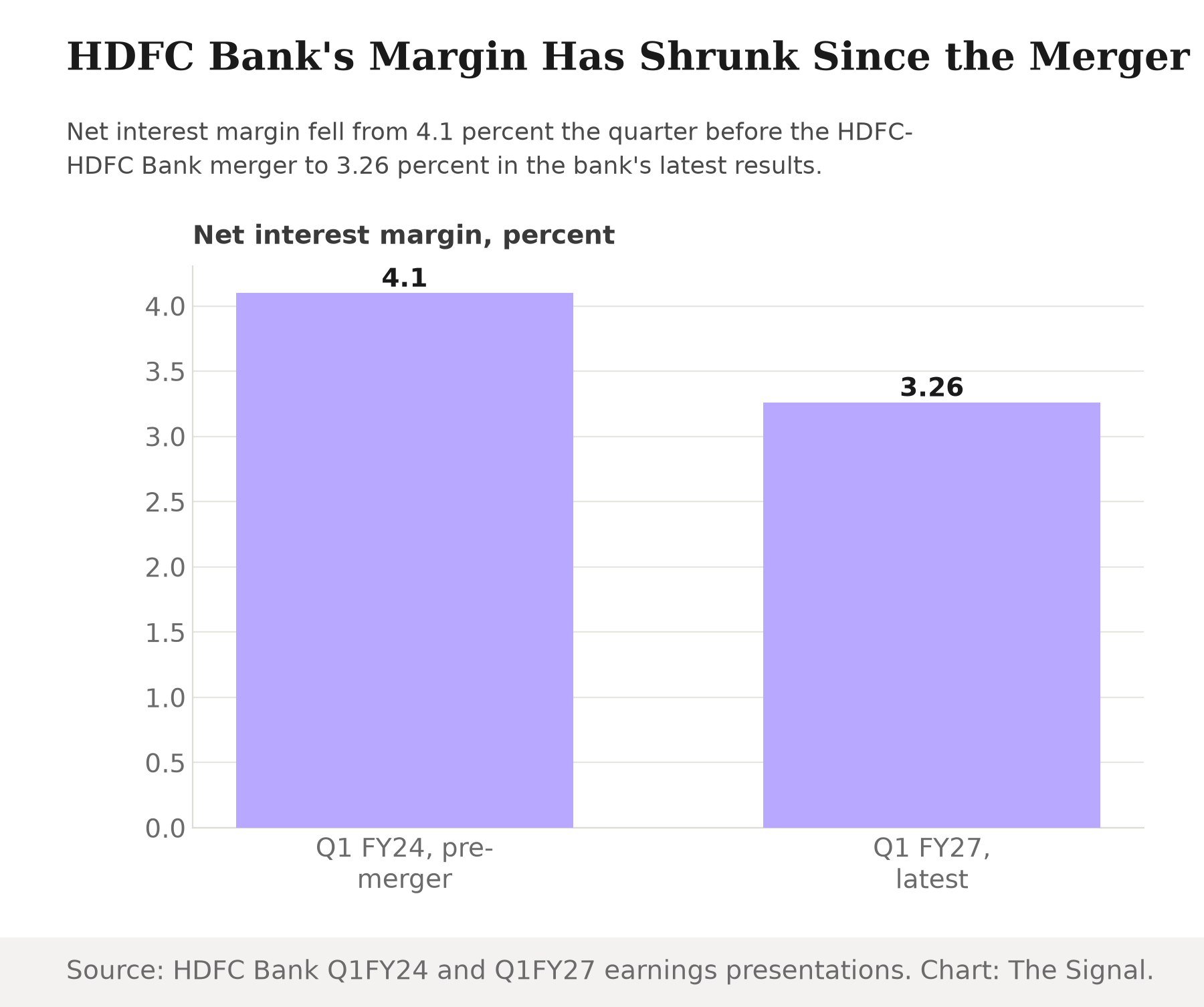
That is not a scandal. It is the kind of grinding, multi-year integration cost that shows up in a bank's numbers long after the announcement has faded from the news. But it is exactly the pressure a merger integration puts on the desk of the sitting chief executive, and it gives HDFC Bank's board a concrete, numeric reason to want new leadership even without any wrongdoing on Jagdishan's part.
A CEO who was already under discipline
The clearest evidence that this was not a clean handover is not about Chakraborty at all. On July 23, 2026, five weeks before Jagdishan said he would not seek reappointment, HDFC Bank's own board fined him. Along with chief financial officer Srinivasan Vaidyanathan and retail-assets head Arvind Vohra, Jagdishan was issued a warning letter and a monetary penalty over a deposit-pricing arrangement with the Maharashtra State Road Development Corporation. The board concluded the conduct was "business overreach" rather than any mala fide action, personal enrichment, or improper motive, and it reported the outcome to the RBI. That finding clears Jagdishan of dishonesty. It does not erase that India's largest private bank's own directors put a formal, RBI-notified penalty on its sitting chief executive's record a little over a month before he chose not to extend his own tenure.
A chairman's letter that names no names
Chakraborty's resignation letter is unusual for what it does not say. He did not allege fraud, misstatement, or a specific breach. He cited a values-and-ethics disagreement over unspecified "happenings and practices" observed over two years, then left immediately rather than serving out a notice period. The RBI's same-day approval of an interim replacement suggests the regulator was already engaged before the letter became public. An external legal review the bank commissioned, reported in June 2026, found no evidence to substantiate his claims: the review concluded contemporaneous evidence was inconsistent with his statement and identified no basis for it. Chakraborty disputed the review's process rather than withdrawing his original claim. None of that proves a direct causal link to Jagdishan's later decision. It does establish that HDFC Bank's board spent the first eight months of 2026 processing an unresolved ethics dispute with its former chairman and a disciplinary finding against its own chief executive, before that chief executive also chose to leave rather than stay.
The honest objection
The strongest case against reading these as one story is that Jagdishan's own record argues for a clean exit. He reiterated his decision after the board tried to talk him out of it, which is the posture of someone leaving on his own terms, not someone being pushed. A merger integration is a multi-year project with a natural end point, and six years, the length of Jagdishan's tenure, is not a short run for an Indian bank CEO. The bank's own board went out of its way to say the MSRDC matter involved no mala fide action or personal enrichment, and the legal review said the same of Chakraborty's claims: on the bank's telling, both 2026 proceedings ended without a finding of wrongdoing against anyone. Chakraborty's resignation and Jagdishan's retirement involve two different roles with different responsibilities, and nothing in either filing states that one caused the other.
That case is real, but it does not explain the market's own behavior or the board's own paper trail. Investors trading HDFC Bank stock for a living did not shrug off Chakraborty's exit as routine, they erased tens of thousands of crores of market value in a week over an unexplained ethics dispute. That same board then formally penalised its own chief executive over a deposit matter, and watched him opt out of reappointment five months after the chairman's exit and five weeks after his own penalty, with no RBI deadline forcing the issue. Investors will read those events together whether or not the individual findings absolve anyone. The bank does not get to choose how investors interpret a year with a disputed chairman resignation, a CEO penalty, and a CEO's early exit.
The Signal
Neither the legal review nor the MSRDC finding accuses Jagdishan of dishonesty, and neither needs to for this to matter. HDFC Bank now has to introduce a new chief executive to investors who watched its last chairman leave under a disputed ethics cloud and its sitting CEO get personally fined by his own board. Net interest margin is down by a fifth since the merger that reshaped its balance sheet, even as the bank's cost efficiency actually improved over the same stretch. The RBI's tenure and age clocks gave Jagdishan an easy, deniable off-ramp; neither required him to take it nine years early. Watch the board's next pick, and how directly that person addresses the margin. If HDFC Bank's incoming CEO opens with a plan to rebuild the merger-era margin rather than a governance reassurance tour, the bank is treating this as the numbers problem it actually looks like. Lean on messaging about continuity and stability instead, and the market will keep filling in the gap this year's filings left open.
Reporting basis: Jagdishan's decision not to seek reappointment and its October 26, 2026 effective date are per The Tribune's report of HDFC Bank's August 29, 2026 exchange filing; his age is per a separate Tribune report the same week. His start date, the board's attempt to retain him, and his reiterated decision are per Moneylife's report of the same filing. Atanu Chakraborty's resignation letter, its March 18, 2026 date, and the RBI's same-day approval of Keki Mistry as interim chairman are from HDFC Bank's own stock exchange disclosure, which reproduces the letter. The market reaction to that resignation, the 8% ADR decline and the market-capitalisation loss, is as reported by The Quint and is the only source for those figures. The external legal review that found no evidence for Chakraborty's claims is per Business Today. The July 23, 2026 board penalty against Jagdishan, the CFO, and the retail-assets head over the MSRDC deposit matter is per Free Press Journal. The merger's July 1, 2023 effective date is per Business Today. The net interest margin, cost-to-income ratio, and gross advances figures are from HDFC Bank's own Q1 FY24 and Q1 FY27 earnings presentations. The RBI's tenure and age rules for a bank's MD and CEO are from the regulator's own circular. The nine-year gaps to the tenure and age caps, and the margin's percentage-point and relative decline, are The Signal's calculations from those figures.