Commerce Minister Piyush Goyal returned from Tokyo this week having led India's largest-ever business delegation to Japan, more than 200 representatives spanning manufacturing, semiconductors, clean energy, steel, automotive, financial services, healthcare and start-ups, from 24 to 27 August 2026. The visit builds on a target India and Japan set at their 15th Annual Summit on 29 August 2025: JPY 10 trillion in Japanese private investment into India over the next decade. Read only the headlines and the story is simple: India is chasing Japanese factories, aggressively and at scale, and Tokyo is receptive.
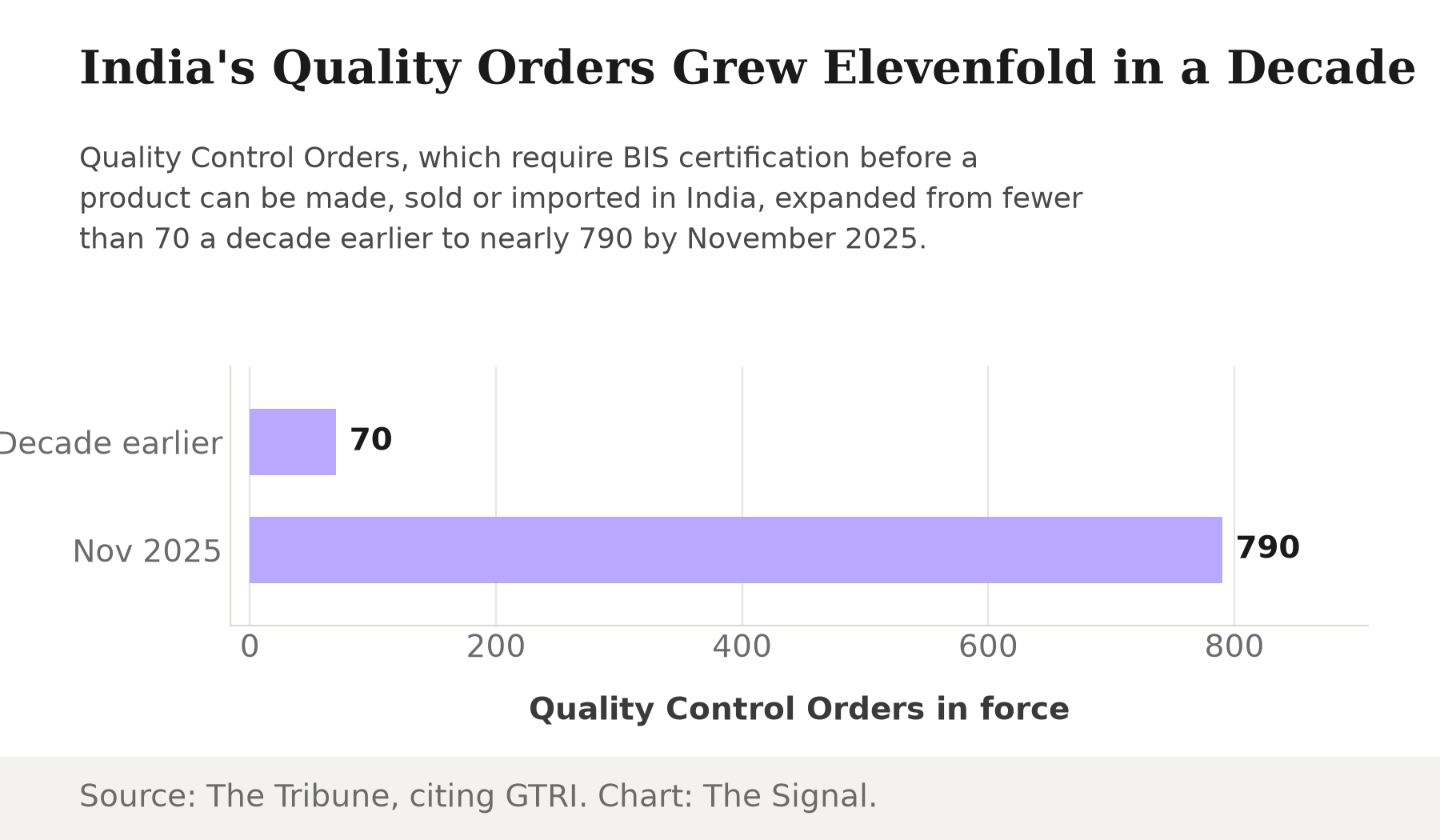
It is worth slowing down on that. While the delegation was packing for Japan, India's Quality Control Orders, the certification rules a product must clear before it can be made, sold or imported, had expanded from fewer than 70 a decade earlier to nearly 790 by November 2025, many of them covering raw materials with no direct safety implications at all. That is the number that matters here. India is not short of ambition to bring in foreign factories. It is short of an answer to why its own compliance regime keeps getting more expensive to clear at exactly the moment it is asking manufacturers to commit.
The rulebook grew as the courtship began
An eleven-fold expansion in a decade is not an accident of bureaucratic drift; it is a deliberate policy to make more products carry a Bureau of Indian Standards mark before they reach an Indian shelf or an Indian production line. The intent behind any one order can be defensible: consumer safety, a check on shoddy imports, a push for Indian manufacturers to meet a common standard. The trouble is what the cumulative weight of nearly 800 such orders does to the exact investors India is trying to recruit.
The Global Trade Research Initiative finds that certification expenses of ₹15 to 20 lakh upfront can make an import commercially unviable for a small or mid-sized firm, with the regime risking pushing MSME importers out of business altogether and leaving the market increasingly dominated by large importers who can absorb the cost. That finding is about importers, not only manufacturers setting up in India, but the mechanism is identical for both: a foreign firm sizing up India has to clear the same testing and certification gate, and a bigger, slower-moving multinational can absorb ₹15 to 20 lakh in upfront testing costs far more easily than a smaller supplier can. The rule that was meant to keep out shoddy goods also keeps out the marginal investor.
A fix that excludes the buyers it needs
Delhi has noticed the friction. The Department for Promotion of Industry and Internal Trade notified the Transition Facilitation (Quality Control) Order, 2026, introducing what a Press Information Bureau release describes as an alternative risk-based compliance mechanism to ease industry's transition while still maintaining quality assurance and consumer protection. On paper, that is exactly the recalibration the GTRI cost findings call for: less blanket testing, more proportionate risk-based checks.
In practice, the fix reproduces the same barrier it was built to remove. Only foreign manufacturers with an all-India representative firm registered under India's Companies Act, 2013 can apply under the new mechanism, and GTRI says this will discourage most foreign firms from using the scheme at all. Most of the companies a trade delegation to Tokyo is trying to persuade are exactly that kind of firm: a foreign manufacturer with no existing India entity. That firm cannot use the transition mechanism precisely because it has not yet made the investment the mechanism is supposed to make easier. The reform fixes the compliance regime for firms that are already inside it. It does nothing for the firms India is still trying to bring in.
The friction is not hypothetical, and it surfaced on this exact trip. In a Tokyo fireside chat on 24 August 2026, Goyal said two large corporations, one seeking to manufacture semiconductor equipment in India and the other in automotive components, had raised concerns of their own, and he pledged India would amend its regulations within two months to accommodate them, on top of a government line that the BIS framework has already been simplified and approval is being eased for suppliers not yet covered by the revised rules. A commerce minister personally promising a two-month regulatory fix to unnamed corporations mid-delegation is not evidence the friction is resolved. It is evidence it is still being negotiated deal by deal, even as the government sells the trip as a success.
What Japan is actually sending
Set that against what Japan is actually putting into India today. Japan is India's fifth-largest cumulative source of FDI, with $48.22 billion in equity inflows between January 2000 and March 2026. In the nine months to December 2025 alone, Japan supplied $3.2 billion, or ₹28,136 crore, of India's $47.87 billion in total FDI equity inflow, a 7 percent share that made it the fourth-largest source that period. Put the two together, by our own calculation, and 6.6 percent of Japan's entire quarter-century relationship with India arrived in those nine months alone.
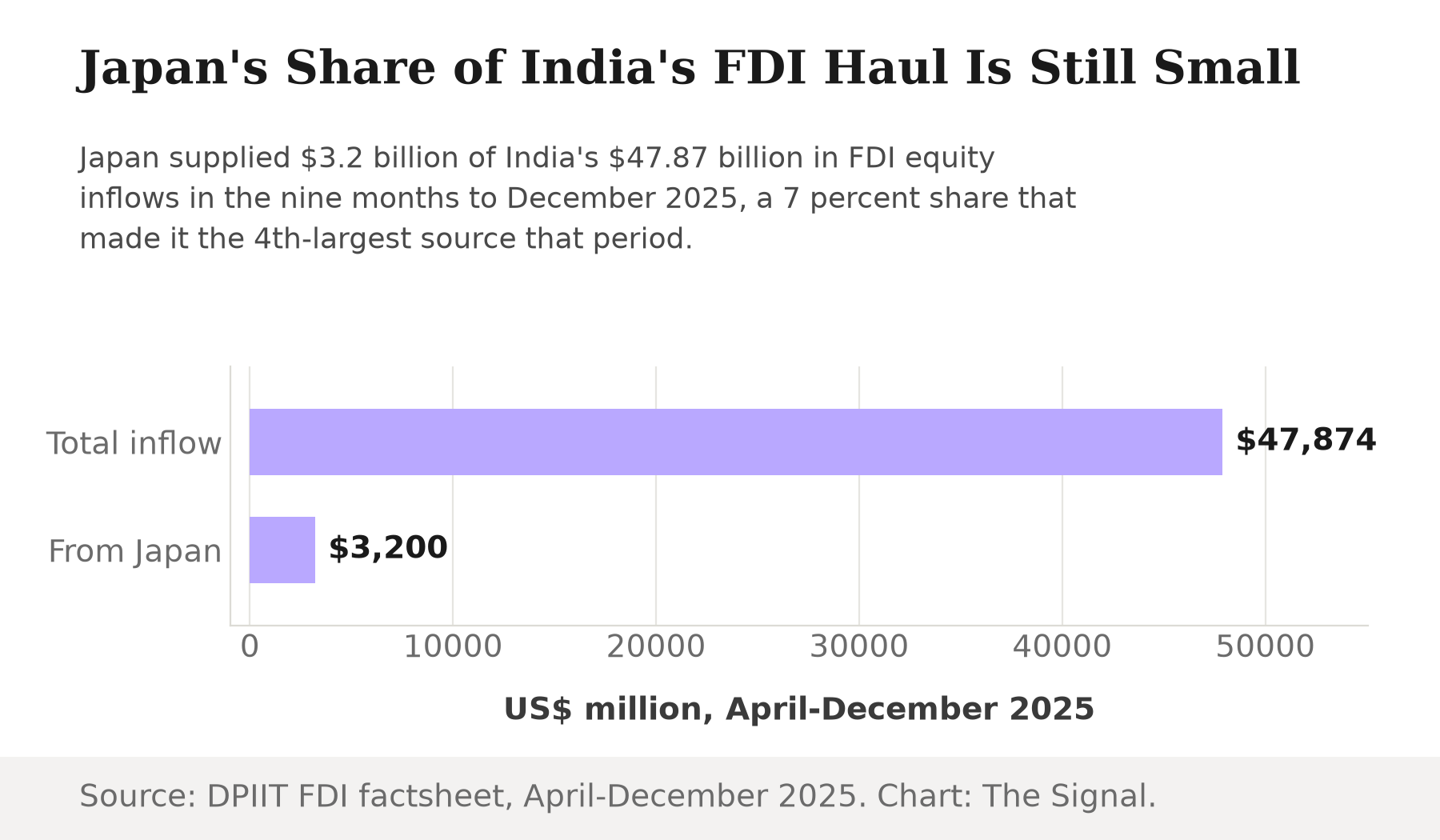
A 7 percent share and fourth place is not nothing, but it is a modest base for the JPY 10 trillion, decade-long ambition behind a record-sized delegation. The gap between the scale of the courtship and the scale of what is actually arriving is exactly where a friction like certification cost shows up: not in a single blocked deal, but in a pipeline of manufacturers who ran the numbers on India's compliance regime before Goyal's plane ever landed in Tokyo.
The honest objection
The strongest case for the current regime is that it is not really about keeping investors out at all. A government moving from fewer than 70 to nearly 790 Quality Control Orders in a decade can plausibly say each one closes a real gap, be it consumer safety, a check on dumped or substandard imports, or a push for domestic manufacturers to meet a common bar. The Transition Facilitation Order is a genuine attempt at proportionality, an alternative risk-based compliance mechanism rather than leaving the old regime untouched. On that reading, the friction is a deliberate, defensible cost of a government finally taking product standards seriously, not a policy accident. GTRI itself is not arguing for blanket deregulation: even as it pushes to cut certification costs, it wants India's trade-remedy authority to run real-time monitoring of import prices and volumes so early signs of dumping trigger swift action. That is a call for targeted vigilance on genuine import surges, not a case against quality rules as such, which makes it a sharper defense of the regime than a blanket consumer-protection argument would be.
That case holds up until the eligibility rule is applied. A risk-based mechanism designed to ease compliance still requires the exact thing an unrepresented foreign manufacturer does not have, an all-India registered entity, before it can be used. A reform that only firms already inside the system can access is not proportionality. It is the old barrier, relabelled.
The Signal
Two things are true about India's manufacturing pitch to Japan this week, and neither cancels the other out. The ambition is real: the largest business delegation India has ever sent abroad, a decade-long investment target set at the highest political level, and a genuine reform effort aimed at the exact compliance costs GTRI has been flagging. And the friction is also real: a certification regime that grew elevenfold in a decade, a fix that still locks out the manufacturers with no existing India footprint, and an actual Japanese contribution that remains a single-digit share of India's FDI haul. The number to watch next is not the size of the next delegation. It is whether the new rules Goyal promised within two months of that 24 August fireside chat drop the all-India entity requirement along with them, or whether Delhi keeps building an easier door, one corporation at a time, that only firms already inside the building can walk through.
Reporting basis: the Quality Control Order count is per The Tribune, citing the Global Trade Research Initiative. The MSME certification cost estimate is per Outlook Business, citing GTRI founder Ajay Srivastava. The Transition Facilitation (Quality Control) Order, 2026 and its stated purpose are from a Press Information Bureau release by the Department for Promotion of Industry and Internal Trade. The eligibility restriction on that order is per Business Standard, citing GTRI. GTRI's call for real-time import monitoring alongside cost relief is per The Tribune. Piyush Goyal's Tokyo remarks on the two corporations and the two-month regulatory timeline are per ThePrint, carrying a PTI report. Japan's cumulative and period FDI figures are from two separate DPIIT releases, the country-wise FDI data table through March 2026 and the FDI factsheet for April-December 2025. The India-Japan JPY 10 trillion investment target is from the Prime Minister's Office's published Joint Vision for the Next Decade. The size and composition of the August 2026 business delegation is per IBEF. The share of Japan's cumulative FDI that arrived in the nine months to December 2025 is The Signal's calculation from those two DPIIT releases.