
India's listed gold lenders are having a blowout year. Muthoot Finance's consolidated gold loan book grew 44 percent year on year to about Rs 1,75,000 crore in the quarter ended June 2026, the company's Q1 FY27 earnings call shows. Manappuram Finance's consolidated gold loan assets grew 98 percent year on year to Rs 57,006 crore in the same quarter, now 82 percent of its total loan book. IIFL Finance's gold loan book surged 114 percent year on year to Rs 58,406 crore, 51 percent of its consolidated assets. Read only the growth lines and the sector looks unstoppable.
It is worth slowing down on that. Every one of those figures describes the size of a loan book on a day when gold was worth more than it is now. Federal Reserve Chair Kevin Warsh's first Jackson Hole keynote, delivered on 28 August 2026, struck a hawkish note: he said inflation progress "has been modest" over the past two years and that the Fed still "has work to do". Gold had touched a more than three month high near $4,700 an ounce just three days earlier, on 25 August 2026. It fell about 3 percent that same day, to roughly $4,454 an ounce, as markets priced in a tougher line from the Fed's new chair. Put the two moves together and gold slid roughly 5 percent in three trading days.
That price move runs straight into a rule most readers have never heard of: India's loan-to-value ceiling on gold loans, the maximum a lender may advance against the market value of the gold it holds as collateral. RBI's Lending Against Gold and Silver Collateral Directions, 2025 cap that ratio at 85 percent for loans up to Rs 2.5 lakh, 80 percent for loans between Rs 2.5 lakh and Rs 5 lakh, and 75 percent for anything larger. The directions require the ratio to be maintained on an ongoing basis throughout the loan's tenor, not just on the day the loan is disbursed.
A loan that met its ceiling in July can breach it in August without a single missed payment.
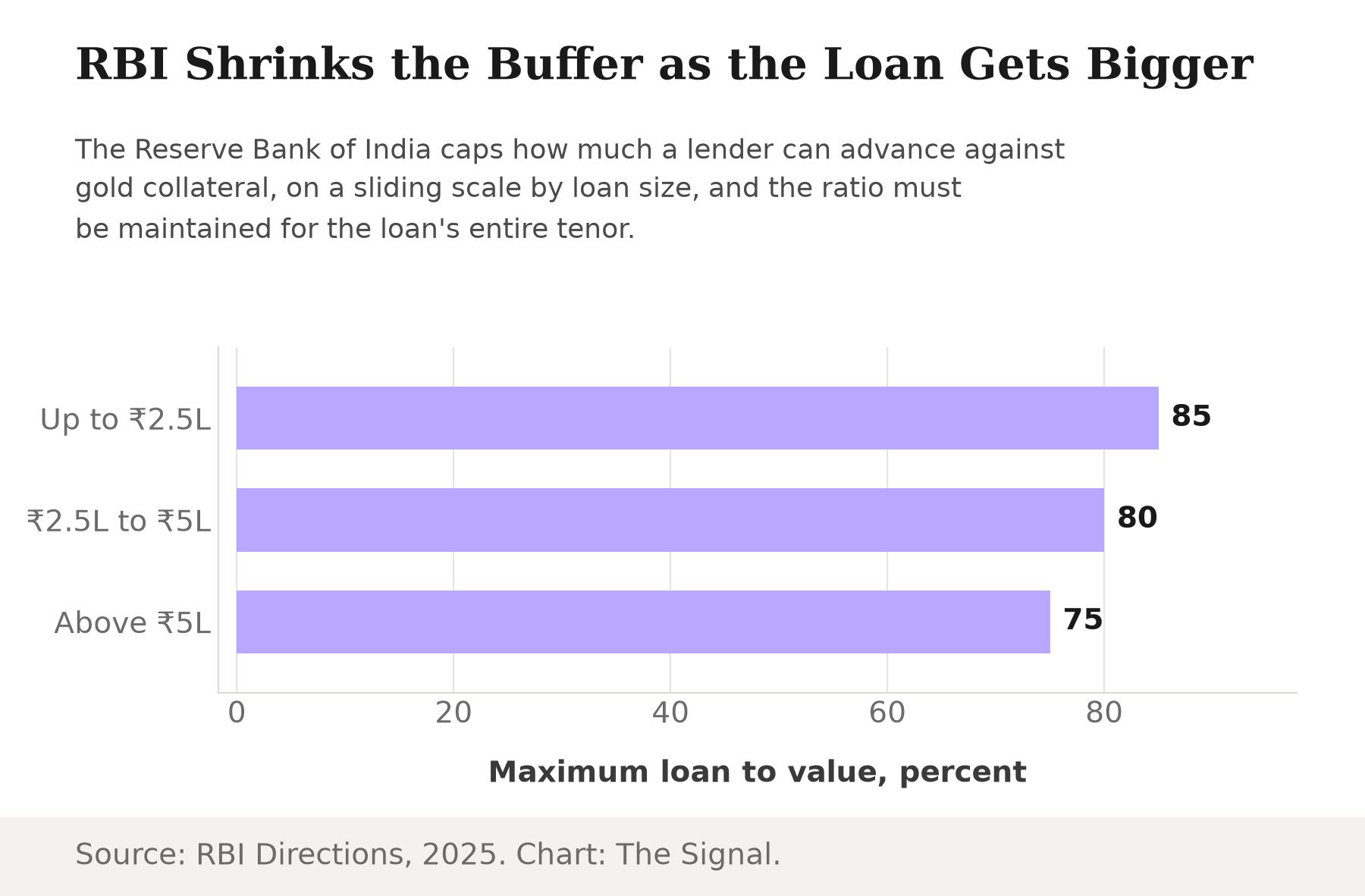
Source: RBI's Lending Against Gold and Silver Collateral Directions, 2025. Chart: The Signal.
The loan amount is fixed at disbursal. The collateral is not: it is repriced every day the gold market trades. When the gold price drops, the same rupee loan represents a larger share of a smaller collateral value. That ratio moves against the lender with no action by the borrower at all, even though RBI requires it to be maintained "on an ongoing basis throughout the loan's tenor". A lender sitting at the regulatory limit has two standard responses: ask the borrower to pay down part of the loan or pledge more gold, or, failing that, sell enough of the pledged gold to bring the ratio back under the cap.
The trigger arrived from Wyoming, not Mumbai
The mechanism above is not new; the RBI's tiered ceiling has applied to every gold loan written under the 2025 directions. What changed on 28 August 2026 is the input. Warsh's Jackson Hole appearance was his first as Fed chair, and it read as more hawkish than the market had priced for going in. Gold had spent the run-up to that speech climbing, not falling: it touched its highest level since May, near $4,696 an ounce, on 25 August 2026, on a soft dollar and continued digestion of a Treasury buyback expansion. The reversal came in a single session, a 3 percent drop to about $4,454 an ounce on the day of the speech itself. India's own domestic gold rate moved the same way in rupee terms: the India Bullion and Jewellers Association's daily reference rate for 999-purity gold fell from Rs 1,62,344 per 10 grams on the morning of 25 August 2026 to Rs 1,58,226 per 10 grams on the morning of 28 August 2026, a drop of about 2.5 percent. This is the number that actually determines an Indian gold loan's LTV, not the dollar quote. A loan written against gold at the 25 August price, at the maximum ceiling for its ticket size, was already testing its limit three trading days later.
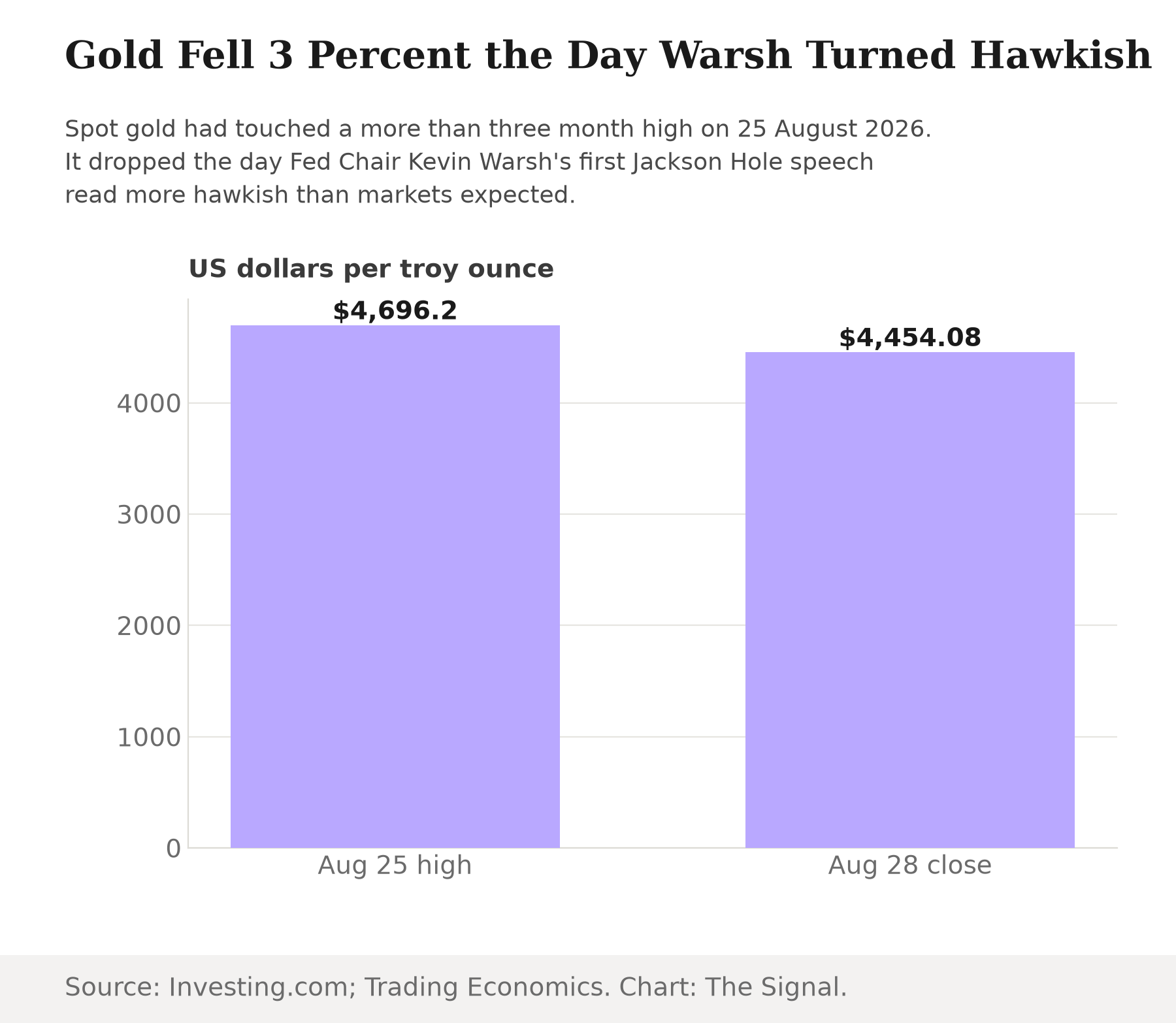
Source: Investing.com market analysis; Trading Economics gold spot price. Chart: The Signal.
Whose books are riding on the price staying up
Every listed gold lender added to its book in the quarter that closed two months before gold's Jackson Hole selloff.
| NBFC | Gold loan AUM, quarter ended June 2026 (Q1 FY27) | Year on year growth | Share of the lender's book | Average gold loan LTV |
|---|---|---|---|---|
| Muthoot Finance | Rs 1,75,000 crore (consolidated) | 44% | Not disclosed in this release | About 65-66%, including accrued interest |
| Manappuram Finance | Rs 57,006 crore (consolidated) | 98% | 82% of total AUM | 65.6%, up from 57.3% the prior quarter |
| IIFL Finance | Rs 58,406 crore | 114% | 51% of consolidated book | Not disclosed in this release |
Source: Muthoot Finance, Manappuram Finance and IIFL Finance Q1 FY27 results and earnings calls, as reported by Investing.com, Investing.com and Investing.com. Table: The Signal.
These are the newest disclosures the three companies have published; none has reported a quarter that includes the 28 August selloff yet, so none has said publicly how much of its book is now sitting above the regulatory ceiling. What the June quarter shows is exposure, not damage: Manappuram now holds gold loans as 82 percent of its entire lending business, and IIFL at 51 percent, meaning a gold price shock does not sit in a side business for either lender. It sits in the main one.
It also shows how little room is left. On Muthoot's Q1 FY27 earnings call, management put the company's overall gold loan LTV, including accrued interest, at around 65 to 66 percent, with only about 3 to 4 percent of disbursements written at the maximum 85 percent tier. Manappuram's average gold loan LTV was 65.6 percent in the same quarter, up from 57.3 percent just three months earlier, a jump the company attributed to the gold price move within the quarter itself. An eight-point rise in one quarter, before the Jackson Hole drop, is the clearest evidence that these books sit closer to the regulatory ceiling than their growth headlines suggest, and that the ceiling moves with the gold price, not with anything the borrower does.
The honest objection
The strongest case against reading a crisis into this is that a single session's move is not a trend. Gold-loan lenders know this rule better than anyone: they have priced-in buffers and standard operating procedures for exactly this scenario, because gold has always been more volatile day to day than the rupee amounts lent against it. A 3 percent drop in one session, even from a fresh multi-month high, is well within the range gold has moved before without triggering a wave of forced sales. Lenders that have run gold-backed books for decades are not caught flat footed by ordinary volatility; margin calls on individual loans that were already close to their ceiling are routine risk management, not a systemic event.
That case holds for a single lender managing an established book. It weakens once you notice how fast these particular books have grown. Muthoot's gold AUM is up 44 percent, Manappuram's 98 percent and IIFL's 114 percent, all in the twelve months to June 2026. A large share of the rupees now exposed to a gold price fall were lent in the past year, near the top of a rising market, not at some long-run average price with years of accumulated cushion. A book that doubled in a year has far less seasoning, and far less room between its average loan-to-value and the regulatory ceiling, than a book built up gradually over a decade.
The Signal
None of this means India's gold lenders are in trouble. It means the sector's headline growth numbers and its regulatory risk now move in opposite directions once gold trades below the level a loan was written at. The more of a book that was written near a price peak, the less room it has before a Fed speech in Wyoming forces a top-up call in Kerala or a gold auction in a small Indian town. Watch the next quarterly disclosures from Muthoot, Manappuram and IIFL to see whether any of them starts disclosing the value of gold auctioned to cure a loan-to-value breach, rather than just the size of the book. A gold loan is only as safe as the day's gold price makes it.
Reporting basis: the RBI's loan-to-value ceiling is from the Reserve Bank of India's Lending Against Gold and Silver Collateral Directions, 2025. Kevin Warsh's Jackson Hole remarks are from the Federal Reserve Board's published transcript of the speech. The 25 August 2026 gold price high is per Investing.com market analysis; the 28 August 2026 price and same-day percentage move are per Trading Economics' gold spot price series. The domestic rupee gold rate for the same two dates is from the India Bullion and Jewellers Association's published daily rate table. Muthoot Finance's, Manappuram Finance's and IIFL Finance's gold loan AUM and growth figures are each from that company's own Q1 FY27 results, as reported by Investing.com. Muthoot's and Manappuram's average gold loan LTV figures are from their respective Q1 FY27 earnings calls, also via Investing.com. The three trading day price move and the characterisation of each lender's exposure are The Signal's own reading of those figures.