In a note that cut its Nifty target from 28,100 to 26,000 and warned of a potential "GFC moment" for India, Bernstein flagged capital-flow and external-sector risk. Its worst case put the index well below 20,000, growth in a 2 to 3 percent range and the rupee weaker than 110 to the dollar. That is a note about markets, not about the composition of GDP. But it lands against a growth print that has drawn its own question: is India's headline expansion resting on genuine private demand, or is government spending doing more of the work than the topline number lets on.
It is worth checking that against what the government's own statisticians actually published, rather than against the general unease. MoSPI's Provisional Estimates put India's real GDP growth at 7.7% for FY2025-26, with nominal GDP growth of 8.9%. Break that headline into its three demand components and the government's own line is the one that grew slowest, not fastest. Government Final Consumption Expenditure, the direct measure of what the state spends on goods and services, grew 5.5% in real terms in FY2025-26, trailing Private Final Consumption Expenditure's 7.7% and Gross Fixed Capital Formation's 8.2%. Government consumption is also the smallest of the three: just 10.1% of GDP, against 55.7% for private consumption and 32.3% for investment.
Government consumption is both the smallest and the slowest-growing of India's three demand engines.
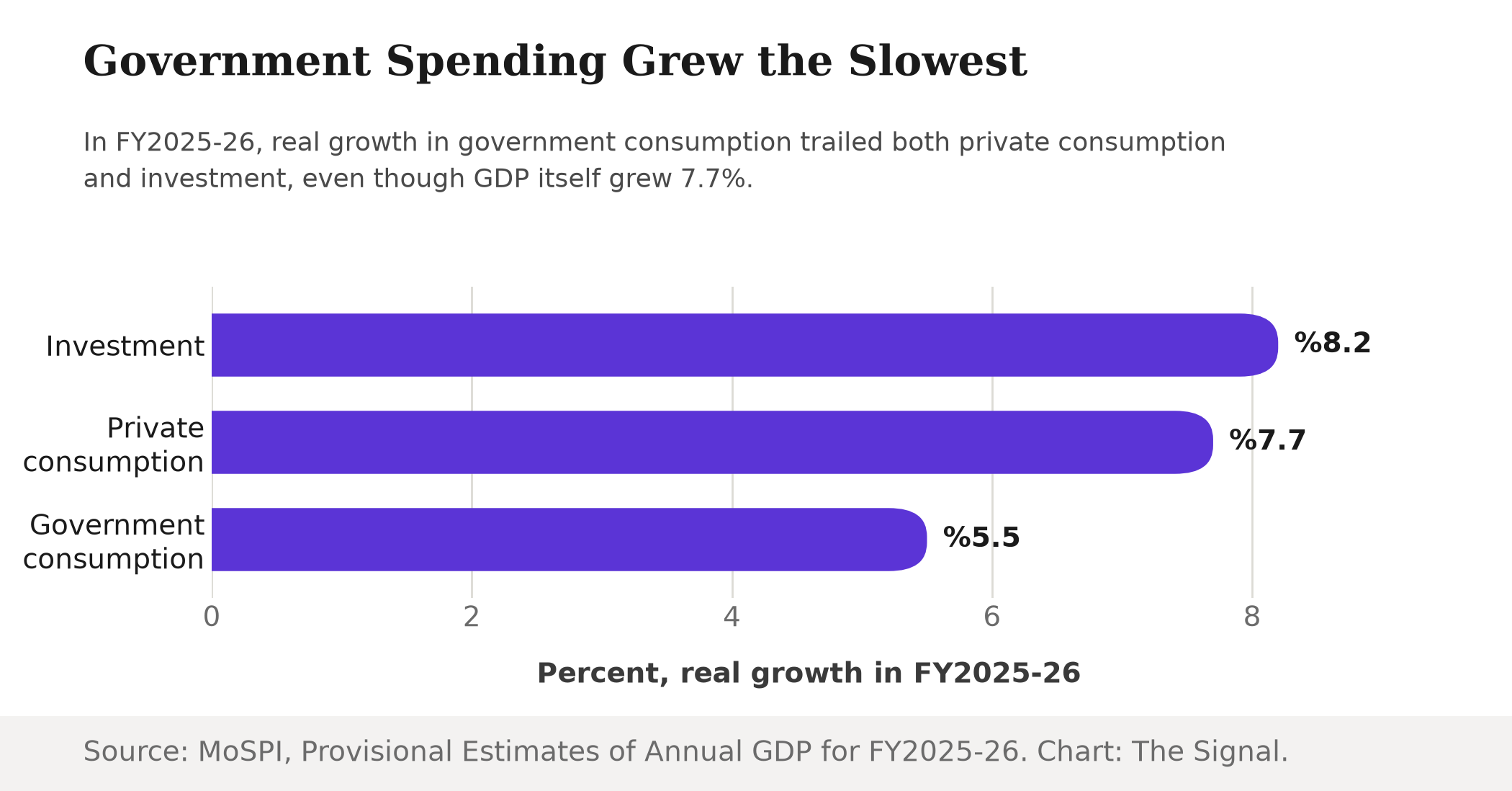
| Demand component | Share of GDP, FY2025-26 | Real growth, FY2025-26 |
|---|---|---|
| Private consumption (PFCE) | 55.7% | 7.7% |
| Investment (GFCF) | 32.3% | 8.2% |
| Government consumption (GFCE) | 10.1% | 5.5% |
Source: MoSPI, Provisional Estimates of Annual GDP for FY2025-26.
The most recent quarter tells a similar story on investment and a noisier one on consumption. In Q4 FY2025-26 (January to March 2026), GFCF grew 10.8% against that quarter's own GDP growth of 7.8%, while PFCE grew 7.1%, a touch under the quarter's headline rate. Investment has been outrunning the headline rate consistently; private consumption's lead over the government's own spending shows up clearly across the full year, less cleanly quarter to quarter.
The capex nuance the topline hides
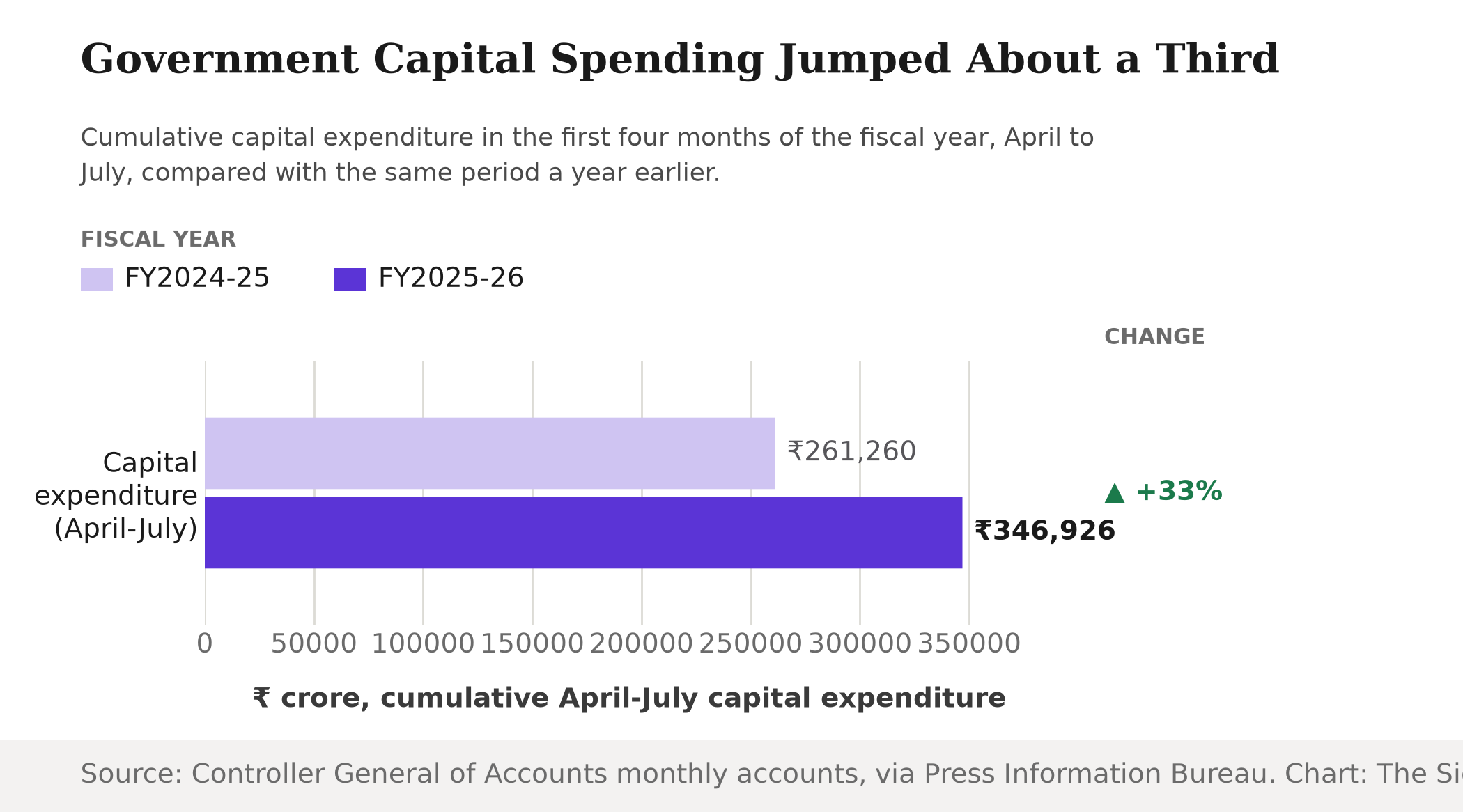
Government Final Consumption Expenditure is not the same thing as everything the government spends. The budget's capital account, the money going into roads, ports, defence equipment and other assets, is booked separately from day-to-day consumption, and in the national accounts it lands inside Gross Fixed Capital Formation alongside private companies' own capital spending, not inside GFCE. That distinction matters because government capital expenditure has been rising fast. The Controller General of Accounts' cumulative figures show capital expenditure of ₹3,46,926 crore in April to July of FY2025-26, part of ₹15,63,625 crore in total spending, 30.9% of the full year's Budget Estimate already committed four months in. A year earlier, over the same April-to-July window of FY2024-25, capital expenditure stood at ₹2,61,260 crore, part of ₹13,00,351 crore in total spending, 27.0% of FY2024-25's Budget Estimate. Capital expenditure is up about 33% year on year (our calculation), while total expenditure over the same window rose from ₹13,00,351 crore to ₹15,63,625 crore, a smaller proportional climb. The government front-loaded more of its full-year capital budget in the first four months of FY2025-26 than it had a year before.
That front-loading sits on top of a longer climb, not a one-year jump. The Economic Survey 2025-26 puts the government's effective capital expenditure at an average of 2.7% of GDP before the pandemic, about 3.9% of GDP after it, and 4% of GDP in FY2024-25. April-July's 33% year-on-year rise is FY2025-26's instalment of a shift that has been building for several years, not a new pattern specific to FY2025-26.
A tightening deficit, not a spending spree
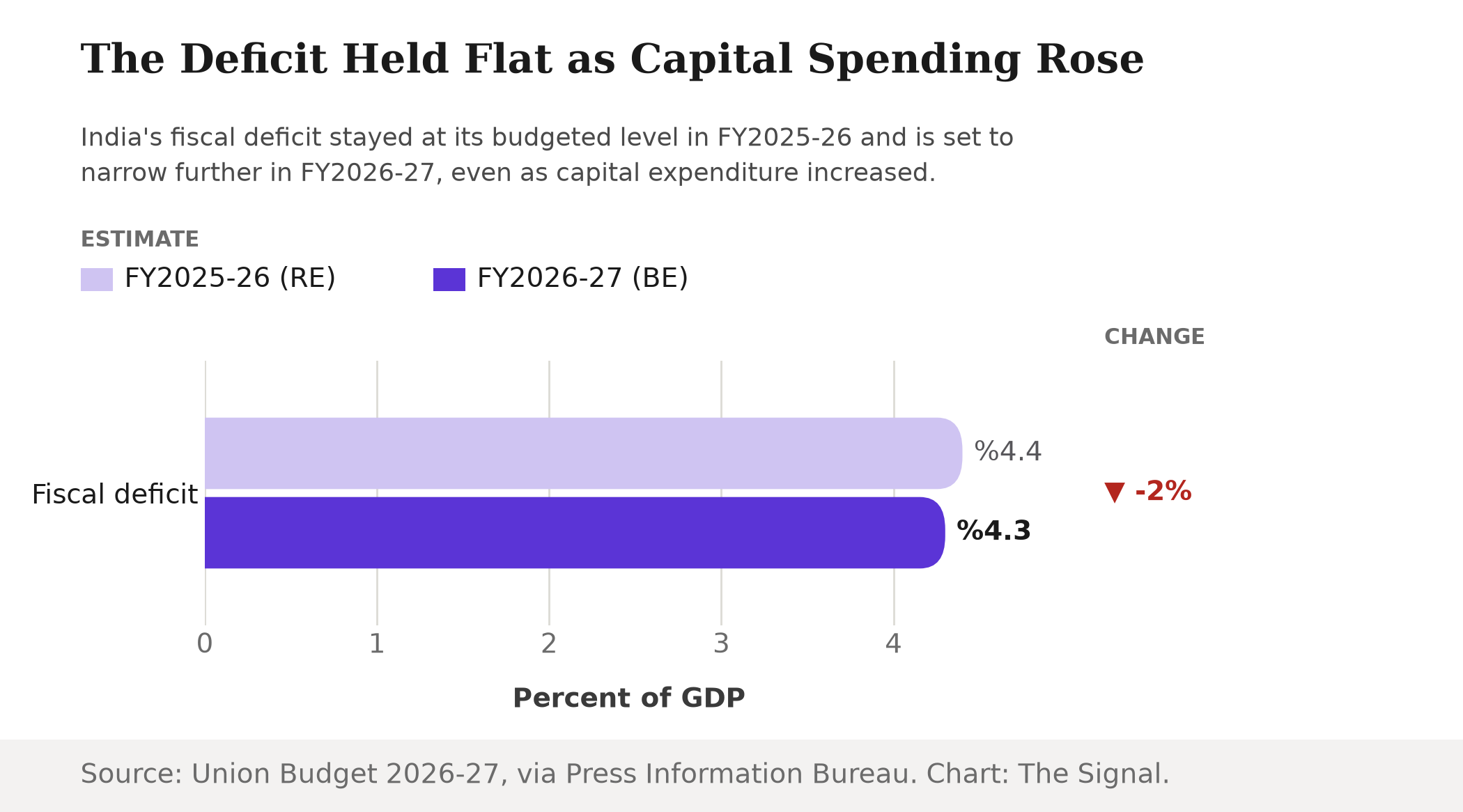
The capex increase has not come from a wider deficit. India's fiscal deficit for FY2025-26 was held at 4.4% of GDP, exactly at the level budgeted, and the FY2026-27 Budget Estimate narrows that further to 4.3%. A government funding more capital expenditure inside a flat-to-tightening deficit path is not the picture Bernstein's capital-flow anxieties usually describe. This reads as compositional front-loading of capital spending within an unchanged fiscal envelope, not fresh borrowing.
The deficit held at its budgeted 4.4% of GDP even as capital spending rose.
The honest objection
The strongest case against reading this as reassuring for private demand is that Gross Fixed Capital Formation is not a private-investment number at all. It is the economy-wide total, blending private companies' capital spending with the government's own capital account. Government capital expenditure is climbing roughly a third year on year while GFCF as a whole grew 8.2% in FY2025-26. Part of that investment growth could be the government's own capex push showing up in a line usually read as a proxy for private capital spending, not proof that private investment specifically is accelerating.
That case is real, and it means the investment number cannot be cleanly split into private and public halves from what MoSPI and the CGA publish here. But it does not rescue the original worry, which was about government spending broadly propping up the growth print. The line that most directly measures the government's own account, GFCE, is real, and it grew the slowest of the three: 5.5% against 7.7% for private consumption and 8.2% for investment. Whatever share of the investment growth is government capex, it is still not government consumption spending inflating the headline number, and that capex is arriving inside a deficit that held flat rather than one that widened to fund it.
The Signal
The composition data undercuts a narrower, more specific worry than the one usually voiced. It is not that government consumption spending is propping up India's 7.7% FY2025-26 growth print. That line grew the slowest of the three and remains a tenth of GDP. What is real is that the government shifted more of its own spending into the capital account, up about a third year on year in April-July, inside a deficit path still narrowing toward 4.3% of GDP for FY2026-27. Watch what happens to that capex pace in FY2026-27. If private consumption and investment keep growing near their FY2025-26 pace without it, the case that India's growth rests on private demand gets stronger. If investment growth fades alongside a cooling capex line, government spending and private investment were never as separable as FY2025-26's numbers made them look.
Reporting basis: the FY2025-26 growth and expenditure-composition figures, including the Q4 quarterly detail, are from the National Statistics Office's Provisional Estimates of Annual GDP, released by the Ministry of Statistics and Programme Implementation. The April-July capital and total expenditure figures for FY2025-26 and for FY2024-25 are from the Controller General of Accounts' monthly accounts of Government of India, each as released via a Press Information Bureau statement. The fiscal deficit figures for FY2025-26 and FY2026-27 are from the Union Finance Minister's Budget 2026-27 statement to Parliament, also via a Press Information Bureau release. Bernstein's Nifty target cut and "GFC moment" warning are as reported by Investing.com, the only source for that note. The capital-expenditure growth figure cited above is The Signal's calculation from the two Controller General of Accounts releases. The multi-year capital-expenditure-to-GDP trend is from the Economic Survey 2025-26, as summarized in a Ministry of Finance press release.