
India's tax department opened a new amnesty window on 16 August 2026. Under the Foreign Assets and Income Disclosure Scheme, FAST-DS, a taxpayer with undisclosed foreign assets or income can come clean and pay an effective levy of around 60 percent, in exchange for immunity from the Black Money Act, as long as the total value stays under Rs 1 crore. A separate, more limited category exists for assets that were already taxed once or acquired while the holder was an NRI, capped at Rs 5 crore for a flat Rs 1 lakh fee. The window runs until 31 December 2026. The framing in the coverage has been straightforward: a compliance-friendly off-ramp for smaller holders who got caught out by rules they may not have fully understood, sized for people whose foreign footprint is genuinely modest.
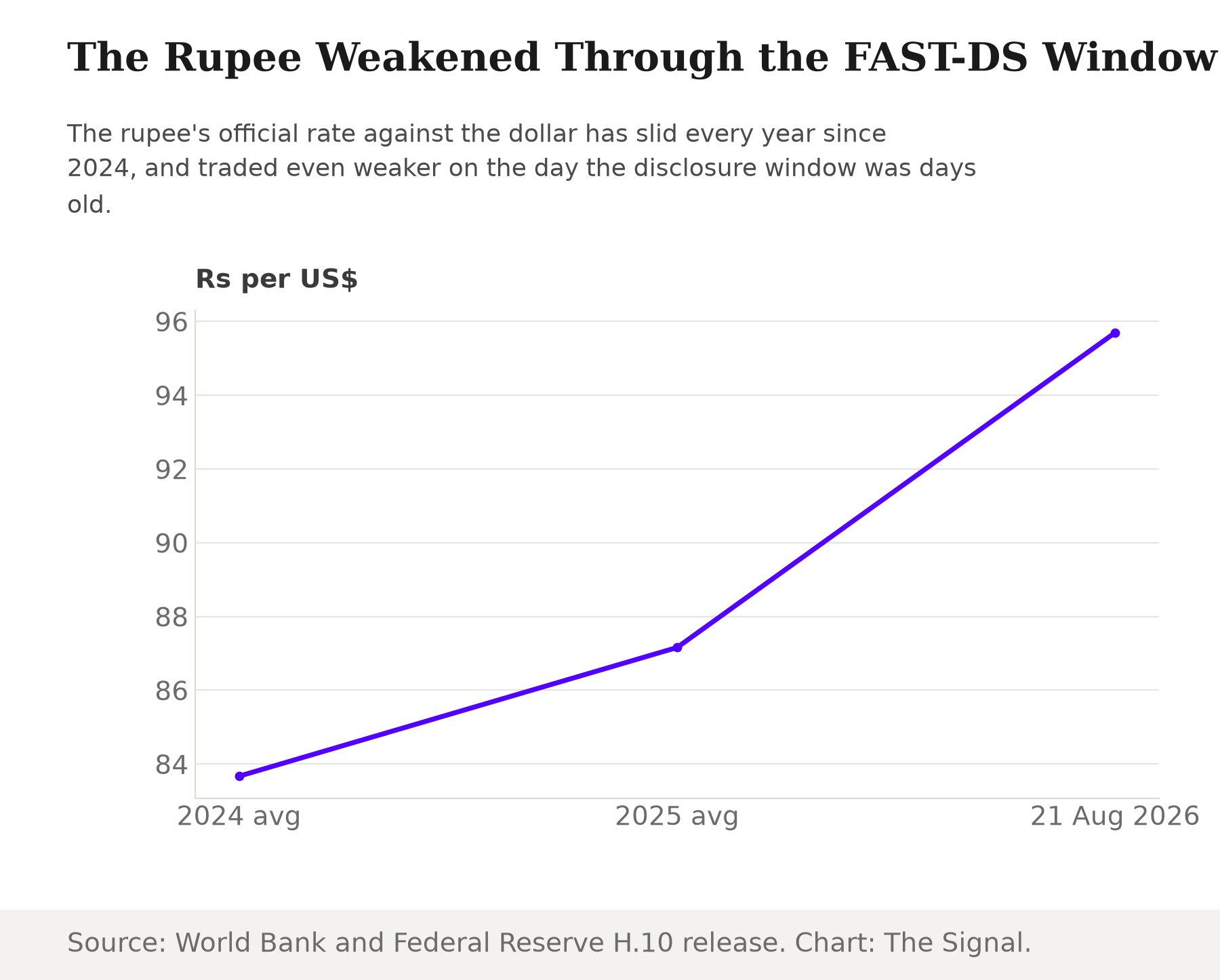
It is worth slowing down on "modest." Rs 1 crore is a fixed rupee number. Nothing in the scheme ties it to the exchange rate, and the rupee has not stood still. It averaged Rs 83.67 to the dollar across 2024, Rs 87.16 across 2025, and by 21 August 2026, days after FAST-DS opened, it was trading at Rs 95.70. A line drawn in rupees does not stay in the same place in dollars when the rupee keeps falling under it.
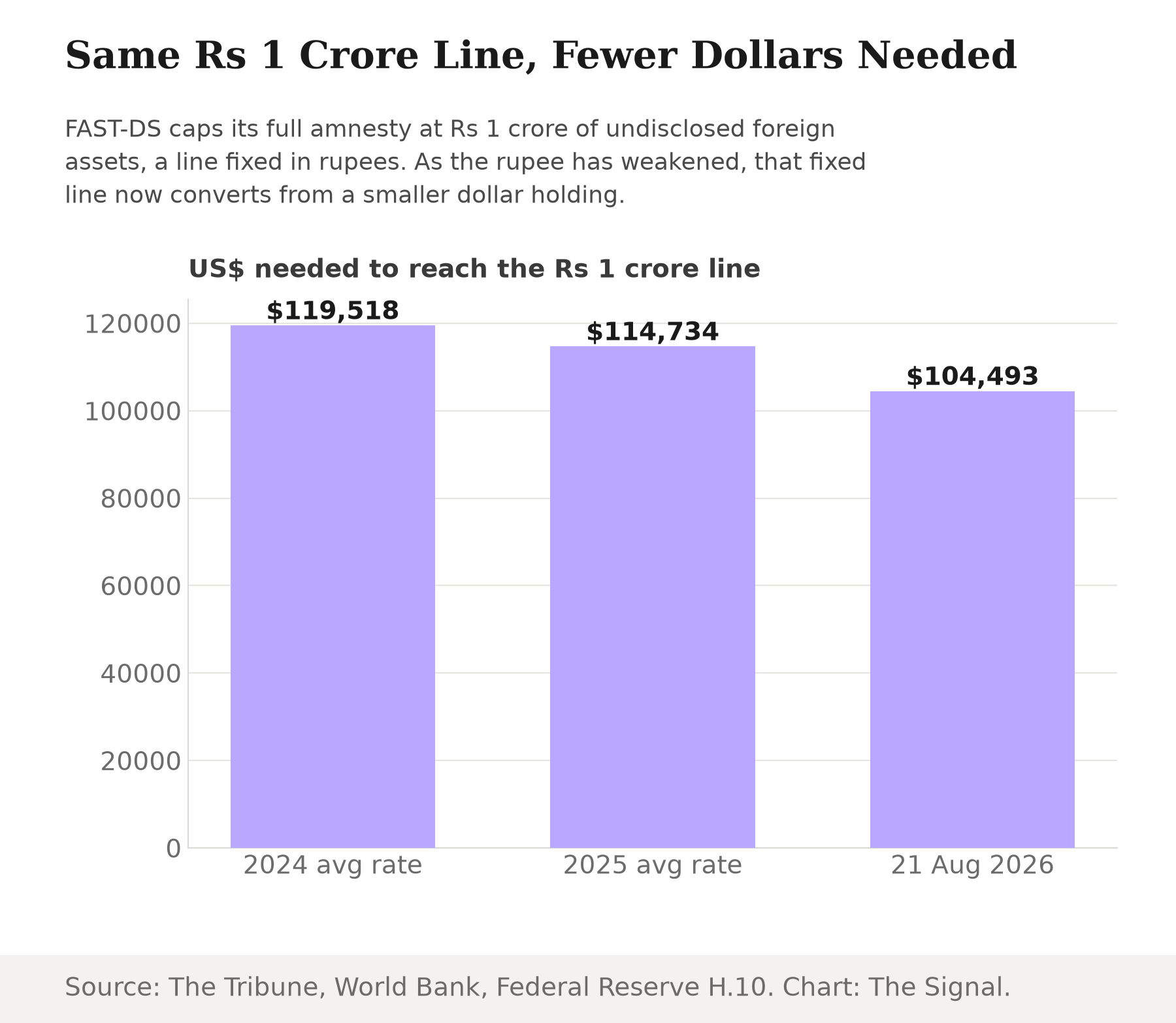
A taxpayer needs about $15,000 less than they did in 2024 to cross the same fixed Rs 1 crore line.
Run the arithmetic at each of those three exchange rates against the fixed Rs 1 crore cap: at the 2024 average rate, a foreign holding needed to be worth roughly $119,518 to breach it. At the 2025 average, that had fallen to about $114,734. By 21 August 2026, it took only about $104,493, a drop of roughly $15,000, or 12.6 percent, from the 2024 figure, without a single word of the scheme changing (our calculation, from the Rs 1 crore cap and the exchange rates above). Nobody voted to lower the bar. The rupee did it by itself.
Three fixed lines, one moving currency
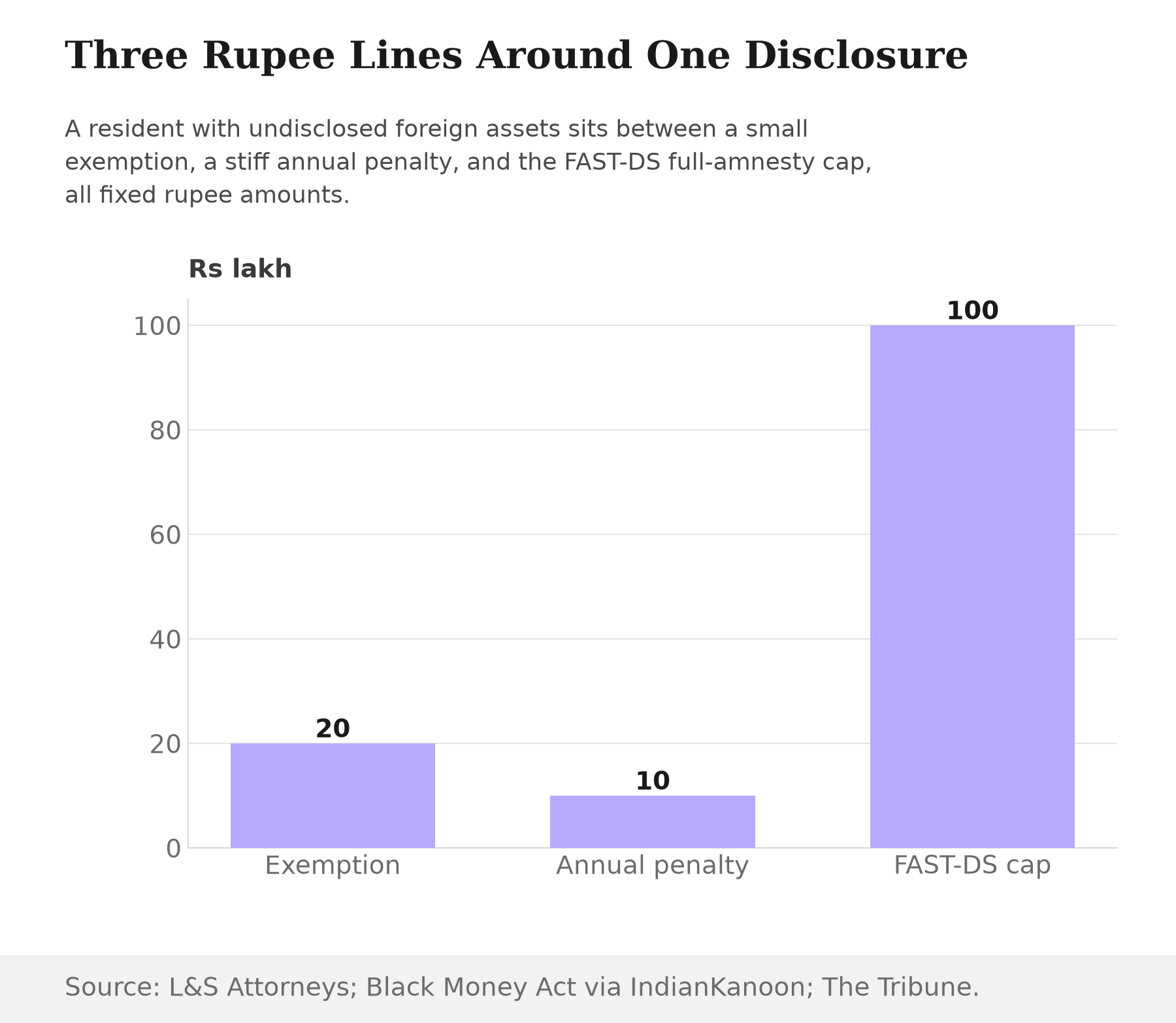
FAST-DS's Rs 1 crore cap is not the only fixed rupee number a resident with unreported foreign assets has to navigate. Section 43 of the Black Money Act, 2015 imposes a flat penalty of Rs 10 lakh for every year a resident fails to disclose, or misreports, a foreign asset or foreign income in their tax return, separate from any tax or the scheme's amnesty terms. There is a floor beneath that: the Finance (No. 2) Act, 2024 raised the value below which that penalty simply does not apply, from Rs 5 lakh to Rs 20 lakh in aggregate, for any foreign asset other than immovable property, effective 1 October 2024. None of these three numbers, the Rs 20 lakh exemption floor, the Rs 10 lakh annual penalty, or the Rs 1 crore full-amnesty ceiling, moves with the currency they are meant to measure.
That is not unusual for tax law, which is built out of round rupee numbers everywhere. What is unusual is pairing a fixed rupee ceiling with a scheme whose entire subject, foreign-held assets, is priced in other currencies and converted back into rupees at whatever rate happens to prevail. A Rs 20 lakh domestic exemption limit does not drift because of currency moves, but a Rs 1 crore cap on foreign holdings does, every single day the rupee trades.
The rupee did the work no rule change did
The rupee's slide against the dollar has been consistent rather than a single shock: down from an average of Rs 83.67 in 2024 to Rs 87.16 in 2025, and to Rs 95.70 by the third week of August 2026, a fall of roughly 14 percent from the 2024 average to that August print. Over that same stretch, a taxpayer who has held a constant dollar sum abroad, one that hasn't grown by a single dollar, has watched its rupee value climb only because of the exchange rate. If that sum sat close to the Rs 1 crore line in 2024, it may sit above it now, and the taxpayer who did nothing differently has moved from the scheme's amnesty side of the ledger toward the Black Money Act's harsher one.
The population this touches is not small
This is not a hypothetical corner case. In a compliance push whose results were disclosed to the Lok Sabha in a government reply reported in March 2025, the tax department had already drawn disclosures of Rs 29,208 crore in previously undeclared foreign assets and Rs 1,089 crore in foreign income from 30,161 taxpayers. That is tens of thousands of resident taxpayers already known to the department to be holding assets abroad substantial enough to draw scrutiny, spread across a wide range of values. A cohort that size sitting anywhere near a Rs 1 crore line is exactly the group a shrinking dollar threshold pulls in, one exchange-rate print at a time, whether or not any of them ever opens a fresh foreign account.
The honest objection
The strongest case against reading this as a stealth tightening is that FAST-DS already has a release valve for larger holdings. A taxpayer whose foreign assets were already taxed once, or acquired while they were an NRI, can use the scheme's second track, capped at Rs 5 crore, for a flat Rs 1 lakh fee, a ceiling five times higher and, in dollar terms, far less exposed to the rupee's day-to-day moves. On that view, the currency drift only bites at the tight end of the scheme, and the government built in room precisely for the taxpayers who most need it.
That case holds only for assets with a paper trail: money that was taxed once already, or built up abroad while its owner genuinely lived overseas. It does not help the taxpayer whose foreign holding was never taxed and was acquired while they were resident in India, because that is precisely the profile the Rs 1 crore full-amnesty track, not the Rs 5 crore one, is built for. Those are the people a falling rupee pulls toward the harder line, and the scheme's own second track was never designed to catch them.
The Signal
FAST-DS closes for filings on 31 December 2026, and nothing in its design revisits the Rs 1 crore figure between now and then even if the rupee keeps falling. The scheme was built to sort taxpayers by the size of an asset. It is actually sorting them, in part, by the price of a currency that has nothing to do with how much wealth anyone holds. Watch what the CBDT does with this number the next time it revises the scheme, and watch whether next year's disclosure count comes in higher than expected for reasons that have nothing to do with newly discovered wealth. A rupee that keeps losing ground to the dollar quietly does what no enforcement drive has to: it moves the line to meet the taxpayer, instead of the other way around.
Reporting basis: the FAST-DS scheme terms, including the Rs 1 crore and Rs 5 crore caps, are per The Tribune, citing the Central Board of Direct Taxes, and the scheme's opening and closing dates are per DD News (newsonair.gov.in). The Black Money Act's Section 43 penalty is from the Act's own bare-act text, via IndianKanoon. The 2024 change to the penalty-exemption threshold is per a client note from Lakshmikumaran & Sridharan Attorneys. The 2024 and 2025 average rupee-dollar exchange rates are World Bank official exchange-rate data; the 21 August 2026 rate is from the Federal Reserve's H.10 foreign exchange release. The prior compliance-disclosure figures, Rs 29,208 crore in assets and Rs 1,089 crore in income from 30,161 taxpayers, are per The Tribune's report of a government reply in the Lok Sabha. The dollar equivalents of the Rs 1 crore line at each exchange rate, and the percentage change between them, are The Signal's calculations from those figures.