
On August 13, 2026, an HDFC Bank investor, Jwalant Natvarlal Soneji, filed a securities fraud class action against HDFC Bank Limited, its CEO Sashidhar Jagdishan and its CFO Srinivasan Vaidyanathan, in the US District Court for the Southern District of New York. The complaint centers on a stock move months earlier: HDFC Bank's New York-listed depositary shares fell $1.02, or 4.1 percent, to close at $23.78 on May 27, 2026, on unusually heavy trading volume. Read on its own, this looks like the ordinary mechanics of US securities litigation: a share price drops, a law firm finds a lead plaintiff, a class action follows.
The class the complaint proposes reaches much further back than that one-day drop: anyone who bought or acquired HDFC Bank securities between July 17, 2023 and May 26, 2026 can join it, a near three-year window. The complaint does not put a dollar figure on damages, leaving that to be proven at trial.
It is worth slowing down on that reading.
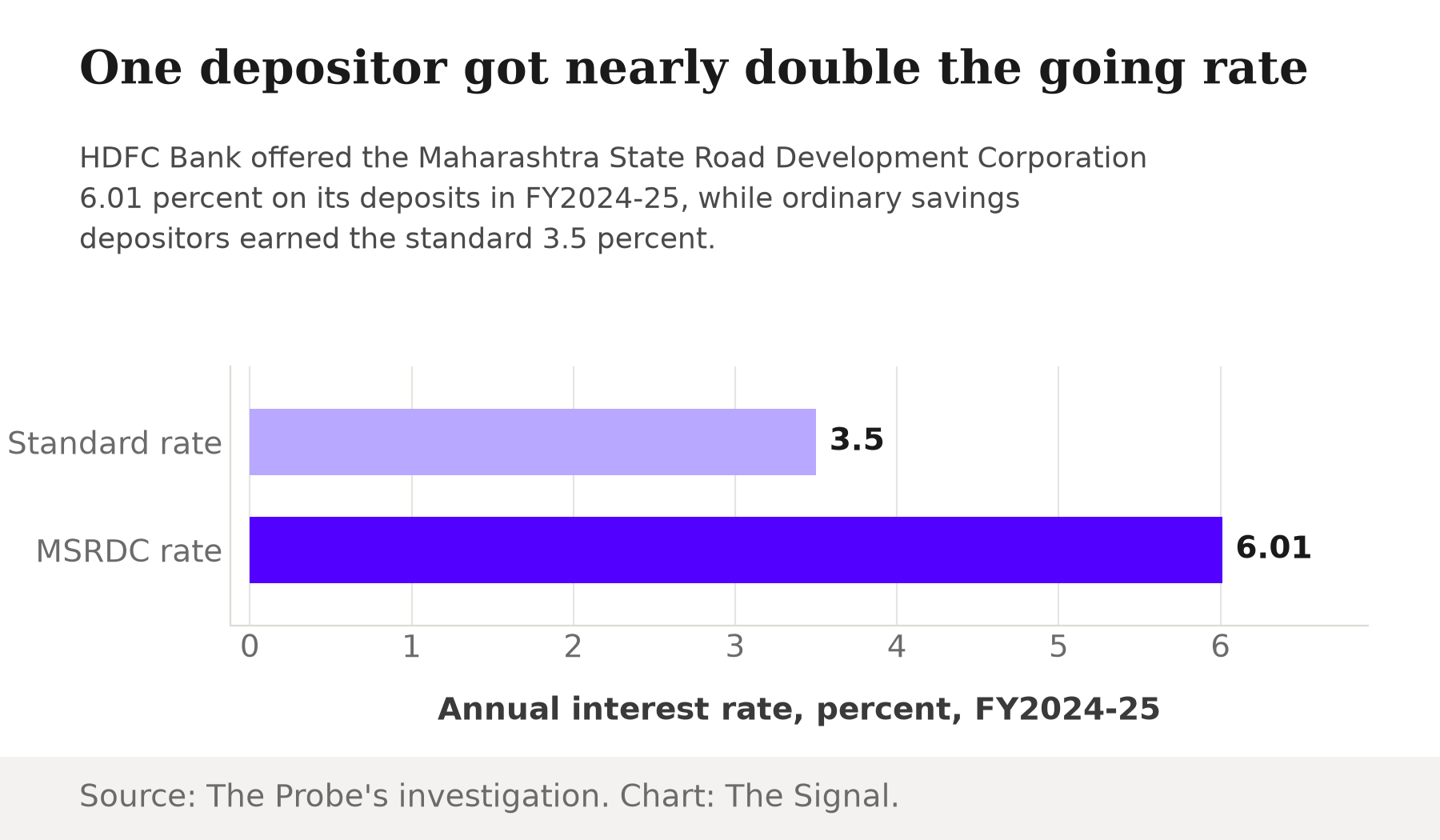
The trigger was an internal investigation into a disguised interest payment. The Probe's reporting found that HDFC Bank had offered the Maharashtra State Road Development Corporation (MSRDC) a 6.01 percent rate on its deposits, 2.51 percentage points above the 3.5 percent standard savings rate paid to everyone else, and covered the gap with roughly Rs 45 crore routed through its marketing department between FY2024 and FY2025, dressed up as sponsorship of a road-safety campaign.
Both the National Stock Exchange and the BSE sought clarification from HDFC Bank on May 27, 2026, the same day its US shares fell, after a media report headlined "HDFC Bank shares fall 2.5% after report on internal probe into Rs 45 crore interest payments," as the bank's own SEC filing later confirmed. Two exchanges asking a bank to explain a stock move, on the same day its board was already sitting on the cause.
The rule the scheme broke
The MSRDC arrangement was not a pricing judgment call. The RBI's Master Direction on interest rate on deposits bars a bank from paying any remuneration, fee, commission, brokerage or incentive on deposits to any depositor, outside a narrow list of exceptions such as door-to-door collection agents. Offering one institutional depositor an above-market rate and burying the difference in a marketing budget line is close to the exact transaction that rule exists to stop.
The board's own verdict
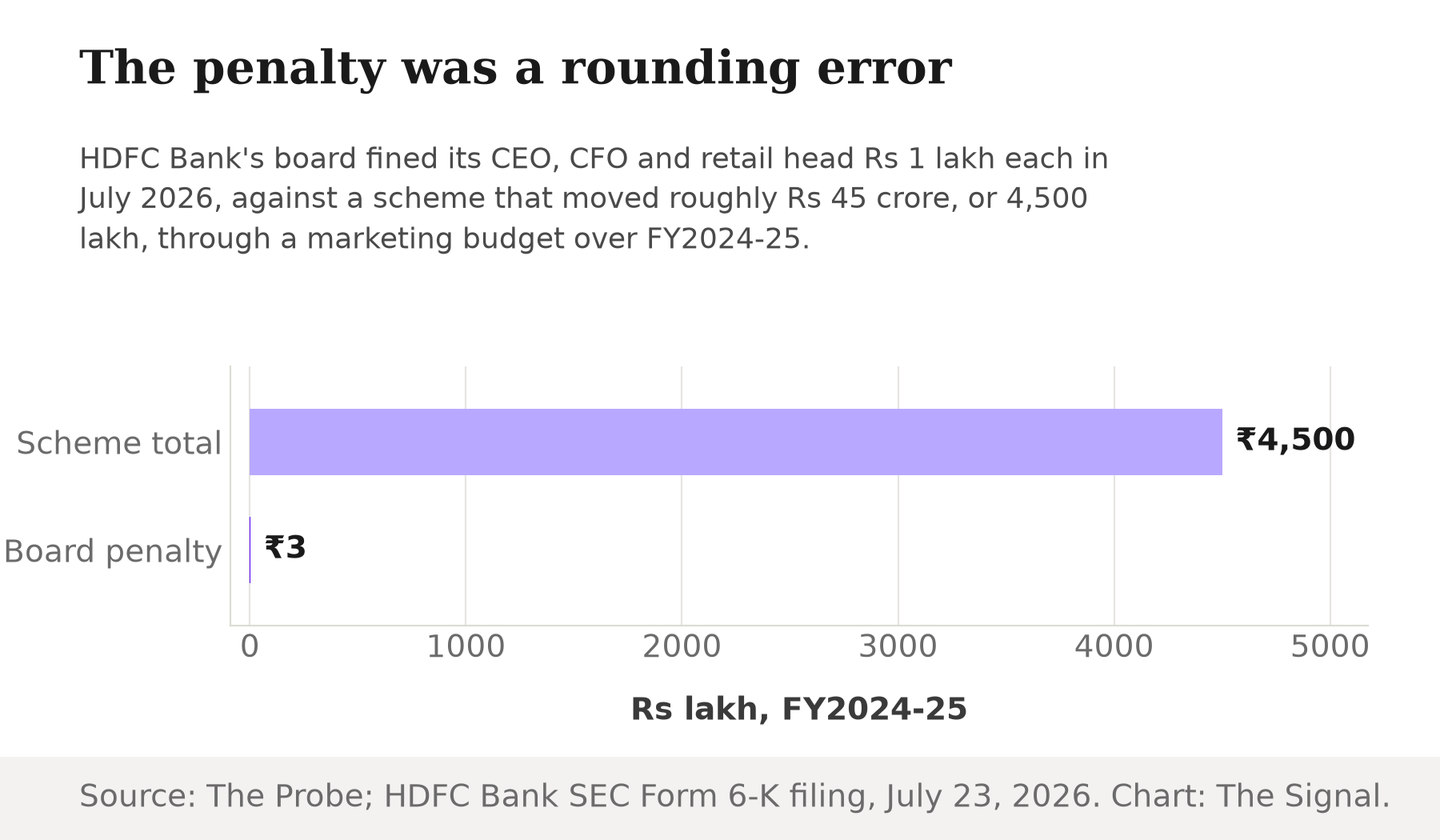
HDFC Bank's board concluded on July 23, 2026 that the conduct of the employees involved constituted "business overreach" rather than any mala fide action, personal enrichment or improper motive, and settled on warning letters plus a monetary penalty of Rs 1 lakh each for the MD & CEO, the CFO and the Group Head-Retail Assets, referring the matter to the RBI.
The board's fine amounted to a rounding error against the scheme.
Add up the board's penalty: Rs 3 lakh, split three ways, against the roughly Rs 45 crore, or 4,500 lakh, that moved through the marketing budget over FY2024-25 (our calculation). That works out to about 0.07 percent of the money at stake. Three Rs 1 lakh fines are not a rounding error in a bank's accounts. They are close to one in the arithmetic of the scheme they were meant to answer for.
The RBI does not look satisfied either
In late July 2026, the RBI asked HDFC Bank to explain how it had calculated the Rs 1 lakh penalty on its CEO, CFO and retail head, and whether the board's move had any precedent. Outlook Business reported that a former RBI deputy governor called it the first instance of a financial penalty imposed on a bank's CEO, CFO and retail head, a marker the regulator considered significant enough to advance its own supervisory review of the case.
The same week, a different door opened in New York
Three days before the HDFC Bank class action was filed, a federal judge in Brooklyn, Nicholas Garaufis, granted the Justice Department's motion to dismiss securities fraud and wire fraud conspiracy charges against Gautam Adani, with prejudice, while refusing to drop two of the counts against five co-defendants and calling the government's own decision-making process "highly unusual." That case had accused Adani, his nephew Sagar Adani and six other executives of a scheme to bribe Indian government officials to secure solar energy supply contracts, in an indictment filed in the Eastern District of New York in November 2024.
The criminal case against Gautam Adani's conglomerate did not end in acquittal or conviction. It ended in the government choosing to stop pursuing it. Days later, private plaintiffs opened a civil case against a different Indian blue-chip, over a different scheme, on a different legal theory entirely: not bribery, but a failure to tell shareholders what its own board already knew.
Two very different India-linked US cases, three days apart.
| Adani (DOJ) | HDFC Bank (class action) | |
|---|---|---|
| Filed | November 2024, indictment | August 13, 2026, complaint |
| Court | US District Court, Eastern District of New York | US District Court, Southern District of New York |
| Underlying claim | FCPA, securities fraud and wire fraud conspiracy | Securities fraud (non-disclosure) |
| Status, August 27, 2026 | Dismissed with prejudice against Adani; two counts remain against five co-defendants | Newly filed, not yet adjudicated |
Source: US Department of Justice; CBS News; Business Today.
The honest objection
The strongest case against reading these as one pattern is that they are simply two unrelated cases sharing a calendar week. Judge Garaufis himself flagged the dismissal process as unusual, which suggests the Adani outcome reflects a specific decision by this Justice Department rather than any broader retreat from scrutinizing Indian corporates. And HDFC Bank's board explicitly found no personal enrichment or improper motive in the MSRDC episode, only overreach, a materially different and lesser finding than the bribery conspiracy the DOJ brought against Adani.
That distinction is real. But the two cases do not need to be the same kind of misconduct for the mechanism shift to matter. A criminal case needs a government willing to keep prosecuting it, and the Adani case lost that. A stock move, an unresolved internal probe and a law firm are all a civil securities class action needs, and none of that requires the government's cooperation. When one route narrows, the other does not.
The Signal
HDFC Bank's board met a Rs 45 crore scheme with three Rs 1 lakh fines and a finding of overreach. The RBI is still asking how that arithmetic was reached, and a New York court will now test whether shareholders accept it too. The Adani prosecution needed the US government's continued will to proceed, and lost it. The HDFC Bank class action does not: a stock move, a board's own finding and a law firm are already enough to keep it alive. Watch two things. Whether HDFC Bank tries to end the New York case early by leaning on its own board's "business overreach" finding, and whether the RBI's supervisory review produces something heavier than a warning letter. If neither escalates, this was one bank's quiet footnote. If either does, the Rs 1 lakh fine that looked like the end of the story was actually the opening one.
Reporting basis: the MSRDC deposit scheme and its FY2024-25 timeline rest on The Probe's investigation alone, a single-source account that the RBI itself is still reviewing; HDFC Bank's own SEC Form 6-K filings corroborate the scheme's existence and timing without independently verifying The Probe's rate and rupee figures. Those SEC filings are the source for the May 27, 2026 exchange queries and for the board's July 23, 2026 findings and penalties. The August 13, 2026 class action complaint and the US-listed depositary share price move are per Business Today's reporting. The class period and the absence of a specified damages figure are per Outlook Business's reporting on the complaint. The RBI's supervisory follow-up and the former deputy governor's characterization are per Outlook Business. The Adani case's dismissal and Judge Garaufis's characterization of the DOJ's process are per CBS News; the underlying November 2024 indictment is per the US Department of Justice's own case filing. The interest rate rule the MSRDC scheme breached is per the RBI's Master Direction on interest rate on deposits. The penalty-to-scheme ratio and the crore-to-lakh conversion are The Signal's calculations from those figures.