On August 25, 2026, NITI Aayog published Reimagining Skilling for Viksit Bharat@2047, its review of the government's decade-long push to train India's workforce. The number it leads with is a big one: since 2014-15, India has trained more than 7.67 crore individuals under its national skilling push. There is real money behind that count, too. The Union Budget for FY2025-26 allocated Rs 34,000 crore in skilling-related expenditure across multiple central ministries. Read only the headline count and this looks like a straightforward success story: a well-funded, decade-long effort to convert India's demographic size into a trained workforce.
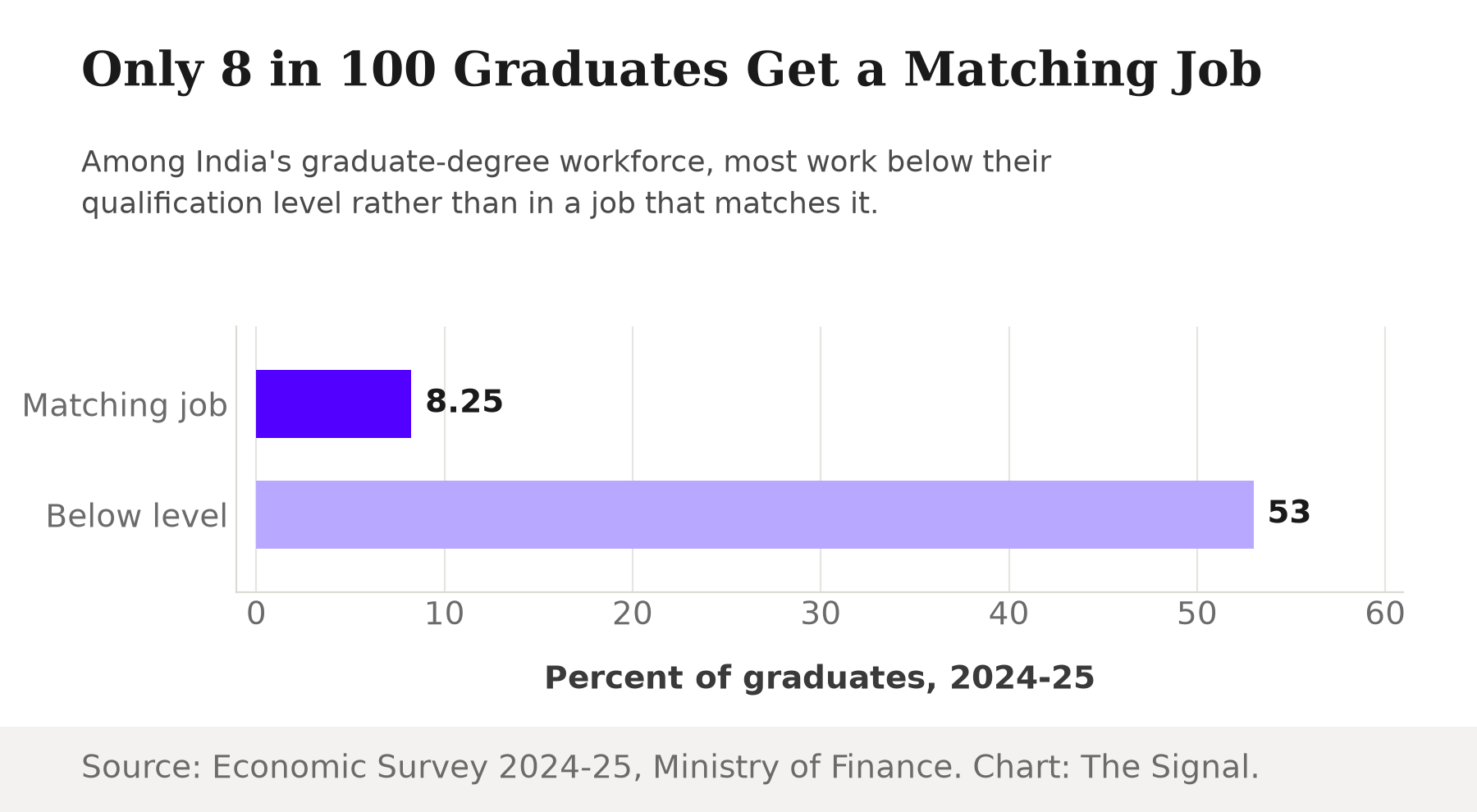
It is worth slowing down on that reading. NITI Aayog's own review is not only counting how many people got trained. It also asks how many of them ended up in a job that fits what they trained for, and that answer is far less flattering. The Economic Survey 2024-25's own education-occupation mismatch matrix shows that only 8.25% of India's graduate-degree workforce is employed in a high-competency-skill job, the tier that actually matches their education level. That is the number that carries this story.
Over 53% of India's graduates and 36% of postgraduates are underemployed, working in roles below their educational qualifications, the same Economic Survey notes. Put the two figures side by side and a pattern appears: the training pipeline is running at full output, and the matching job at the other end is the scarce good.
Source: Economic Survey 2024-25, Ministry of Finance. Chart: The Signal.
The pipeline was never the scarce part
The consensus explanation for numbers like these is the "skills gap": graduates are undertrained, their degrees are irrelevant to the market, and the fix is more skilling. That story gets the direction of the problem backwards. Of the 3.4 crore students enrolled in undergraduate programmes in India, 1.13 crore are pursuing a B.A. alone, and combined B.A., B.Sc. and B.Com enrolment exceeds 2 crore, according to AISHE 2021-22 data cited in the NITI Aayog report. That is well over half of India's undergraduates earning a generic degree with no built-in occupational match, before a single skilling course is added on top. Layering more training onto that pipeline cannot manufacture the high-competency jobs the economy has not built. A trainee who finishes a course still needs somewhere to use it.
A line at the railways
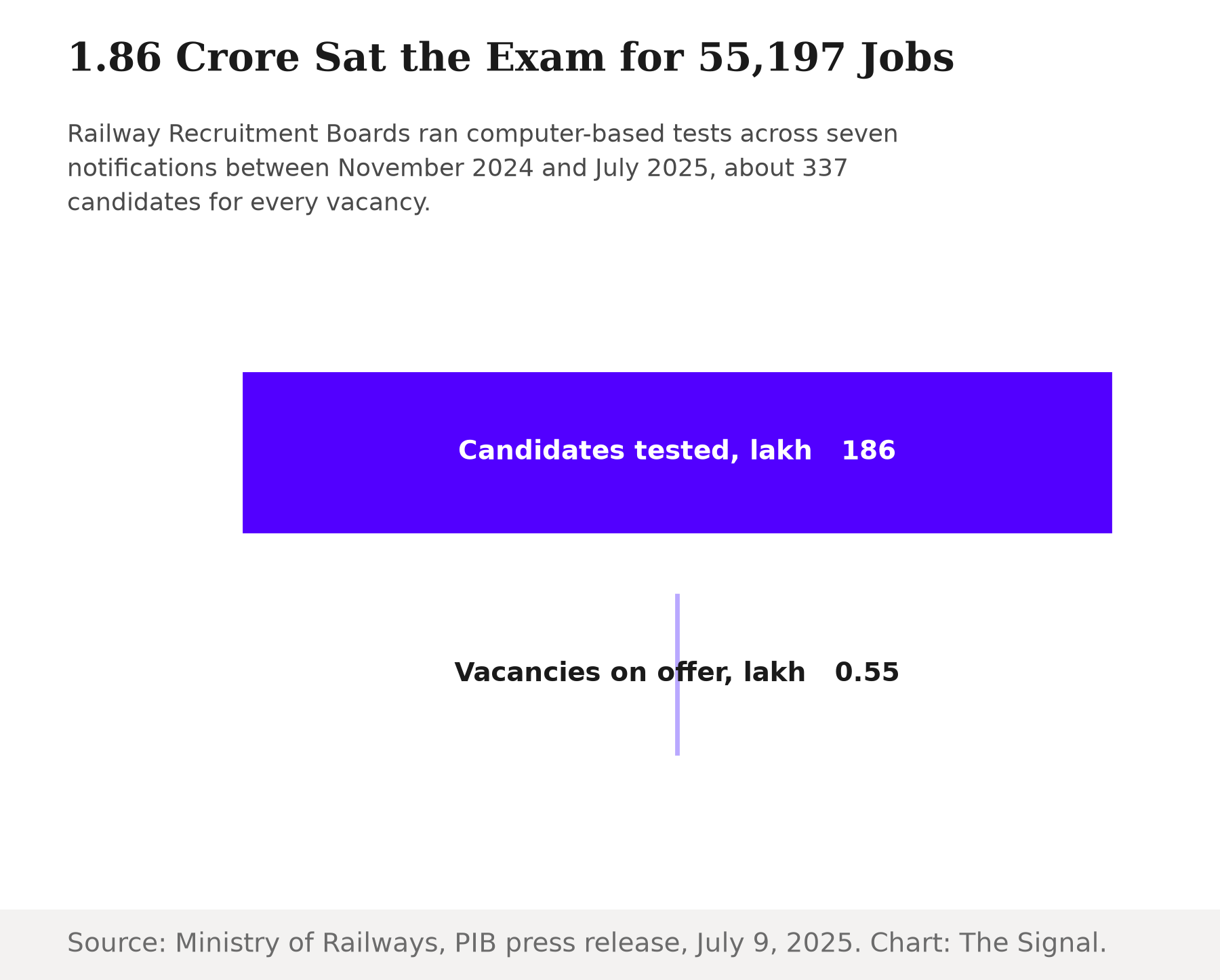
The scarcity is not confined to graduates chasing office jobs. Railway Recruitment Boards ran computer-based tests for more than 1.86 crore candidates chasing just 55,197 vacancies across seven notifications between November 2024 and July 2025, a Press Information Bureau release from the Ministry of Railways states. That is roughly 337 candidates for every open post. When competition for an entry-level government job runs in the hundreds per seat, a training certificate is not what is standing between an applicant and a hire. The count of open seats is.
Source: Press Information Bureau, Ministry of Railways. Chart: The Signal.
The gap widens for women
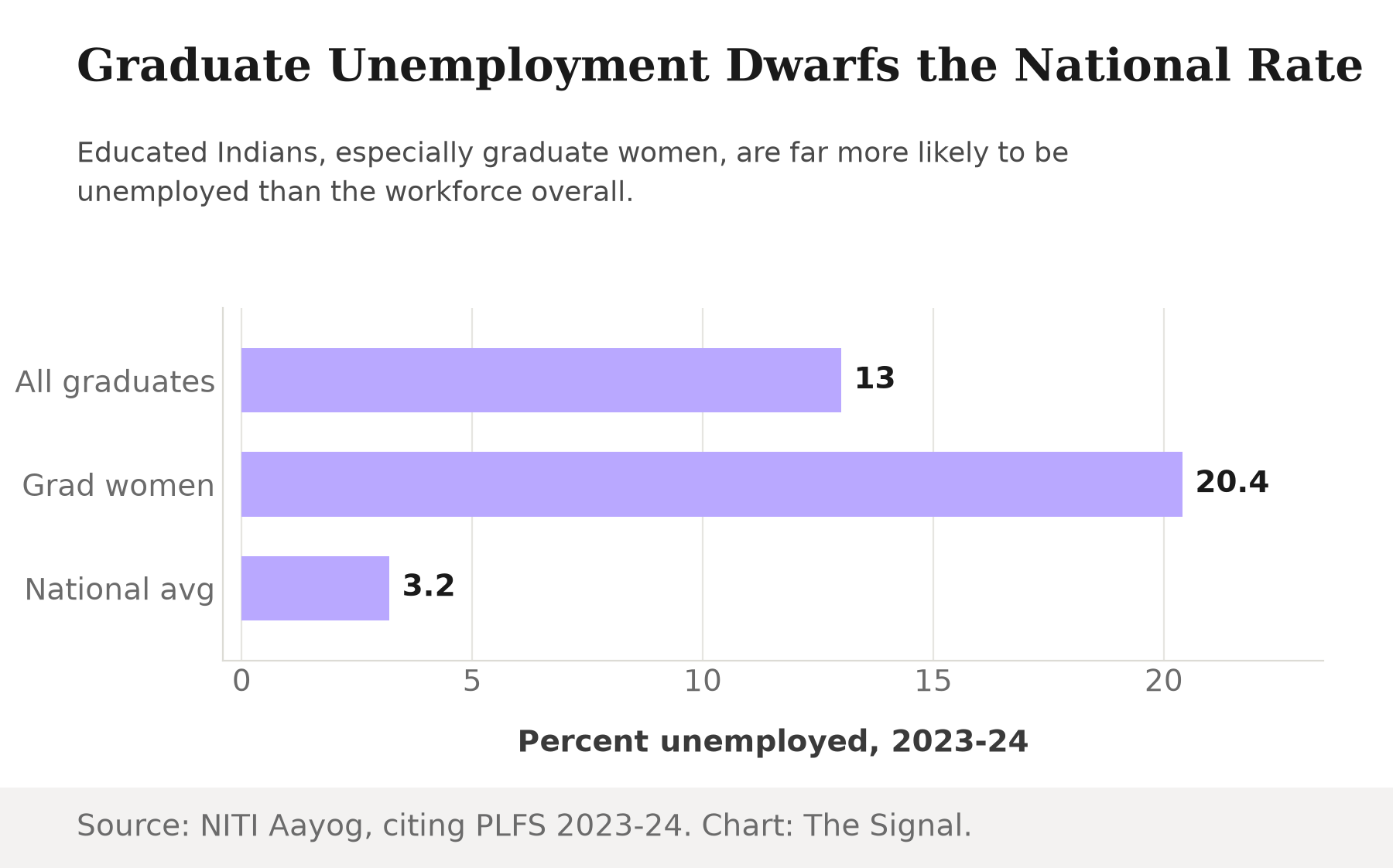
Educated unemployment is also high: 13% of all graduates and 20.4% of graduate women are unemployed, well above India's 3.2% national unemployment rate, NITI Aayog's report states, citing PLFS 2023-24 data. The pattern is starkest for women who do enter the workforce with a degree. Among Indian women, just 3% hold formal jobs while 71% work in informal jobs or fall into the NEET category, not in employment, education or training, the same NITI Aayog report finds. A woman who adds a skilling certificate to her degree is still applying into a formal job market that most of the female workforce never reaches at all.
Source: NITI Aayog, citing MoSPI's PLFS 2023-24. Chart: The Signal.
The honest objection
The strongest case against calling this a demand-side failure is that skilling plainly works for the individual who does it. Generic-degree graduates who also completed a skilling course earn a Rs 29,000 average starting monthly salary versus Rs 22,000 for those without, a gap that compounds to about Rs 9.7 lakh over 10 years, per NITI Aayog's report, citing BCG's Higher Education Survey. Skilling still raises pay for the individual who completes it.
| Without a skilling course | With a skilling course | |
|---|---|---|
| Average starting monthly salary | Rs 22,000 | Rs 29,000 |
| Income difference, compounded over 10 years | baseline | about Rs 9.7 lakh more |
Source: NITI Aayog, citing BCG's Higher Education Survey.
There is also survey evidence that the programmes themselves have design gaps. 82% of NEET youth say a lack of job-interview preparation modules and placement tie-ups is a foundational gap in India's existing skilling programmes, per the Ministry of Skill Development and Entrepreneurship's State of Skills Survey 2024, cited in the NITI Aayog report. Fix that gap, the argument goes, and more trainees convert into hires.
That case is real, but it explains who wins the existing matching jobs, not why so few of them exist. A wage premium for the trained minority is fully compatible with a matching-job pool that stays fixed and small: a skilling course can improve someone's odds in a lottery without increasing the number of winning tickets. Better interview preparation might move a candidate up the queue. It does not add seats to the queue. And the queue keeps getting longer: India's labour force participation rate rose from 57.9% in 2022-23 to 60.1% in 2023-24, MoSPI's Periodic Labour Force Survey Annual Report states, meaning more working-age Indians are entering the job market each year while the share landing a matching job barely moves.
The Signal
Put NITI Aayog's own two findings side by side and the picture is an unintentional admission: the last decade built the supply side of this equation and left the demand side alone. A national training infrastructure now exists at real scale, funded every year out of the Union Budget. The high-competency jobs that infrastructure was meant to feed people into did not keep pace, so more trained and more credentialed Indians are competing for a pool of matching roles that has stayed the same. A bigger training budget fixes only the easy, measurable part of this problem: the headcount. It leaves the hard, structural part, job creation, untouched. The number worth watching next is not how many more people get trained. It is whether the share landing a job that actually matches their degree ever moves.
Reporting basis: the national skilling count, the Union Budget allocation, and the women's formal-versus-informal employment split are per NITI Aayog's August 2026 report, Reimagining Skilling for Viksit Bharat@2047. The graduate-degree skill-mismatch matrix and the underemployment shares are from the Economic Survey 2024-25, published by the Ministry of Finance. The Railways testing and vacancy figures are from a Press Information Bureau release by the Ministry of Railways. The educated-unemployment rates and the labour force participation trend are MoSPI Periodic Labour Force Survey figures, the 2023-24 round, reaching this piece both directly and as cited in the NITI Aayog report. The skilling wage premium is from a BCG Higher Education Survey, and the interview-preparation finding is from the Ministry of Skill Development and Entrepreneurship's State of Skills Survey 2024, both relayed via the NITI Aayog report and not independently re-verified beyond that citation. The candidates-per-vacancy figure for the Railways numbers is The Signal's calculation from those figures.