
By July 2026, India's government was already examining whether to cut its gold and silver import duty again, Free Press Journal reports, citing concerns that higher taxes are pushing imports back through unofficial channels. Read on its own, that looks like a government flip-flopping on tax policy within a single year. It is not. It is a government rediscovering, in real time, a tradeoff it already ran a full experiment on.
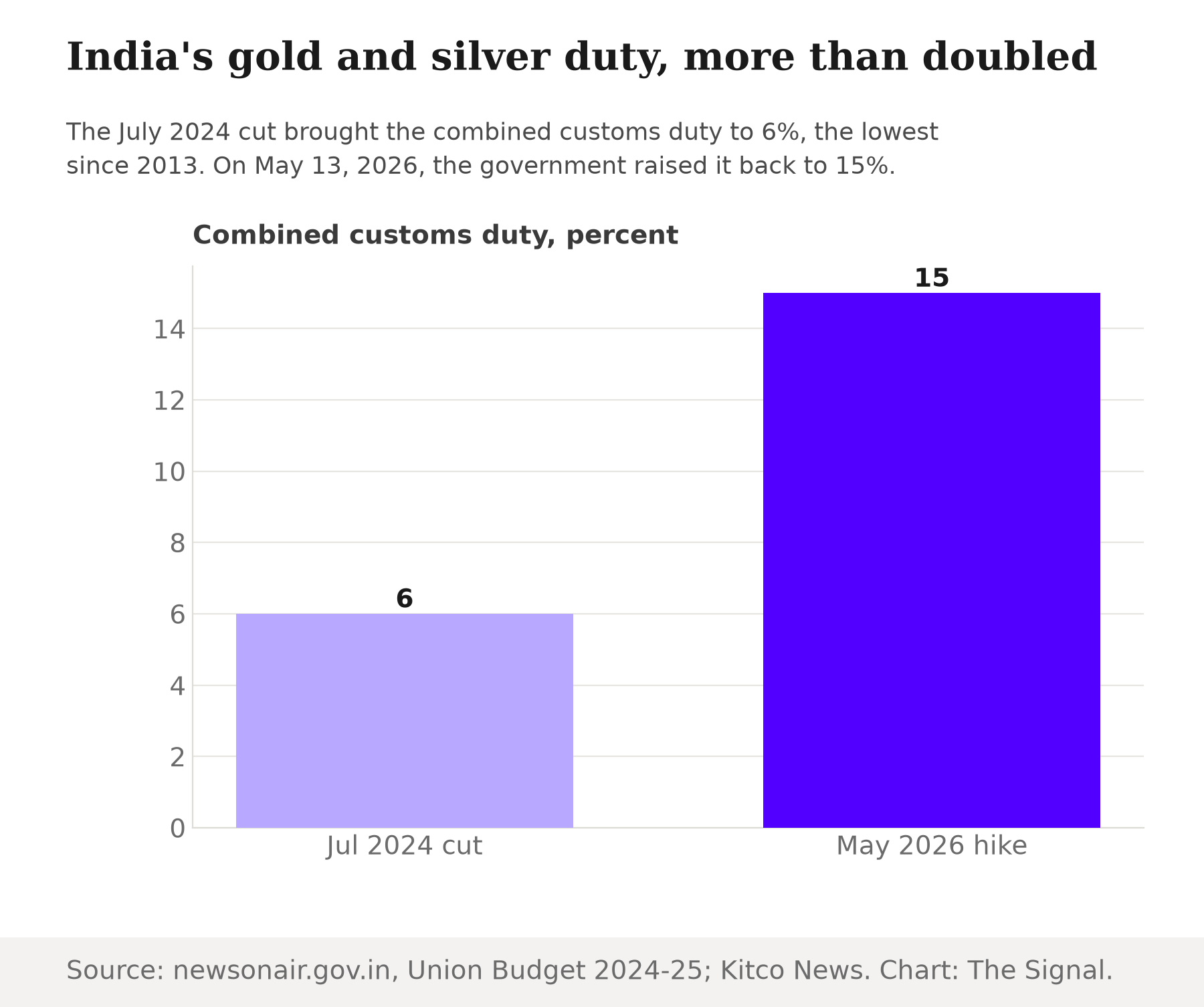
The experiment started in July 2024, when the Union Budget cut customs duties on gold and silver, making the metals cheaper, and the combined rate landed at 6%, the sharpest reduction on record and the lowest rate since June 2013, a move the World Gold Council expected to make gold entering India through unofficial channels unprofitable. It worked almost immediately: World Gold Council research found that after duty was cut to 6% in July 2024, unofficial gold imports fell almost immediately to near zero.
The 2024 duty cut drove India's unofficial gold imports to near zero.
Then, on May 13, 2026, New Delhi reversed course. The government raised the basic customs duty plus a cess on gold and silver back to a combined 15%, up from 6%, to curb bullion imports and support the rupee. The jump is steep. Fifteen against six is two and a half times the rate that had emptied the smuggling routes, reopening exactly the price gap the 2024 cut had closed. The same number appeared before, too: 15% was the exact rate the July 2024 cut reduced from in the first place. May 2026 did not invent a harsher gold tax; it put the pre-2024 rate back in place.
Source: World Gold Council; Kitco News. Chart: The Signal.
The record import bill that triggered the hike
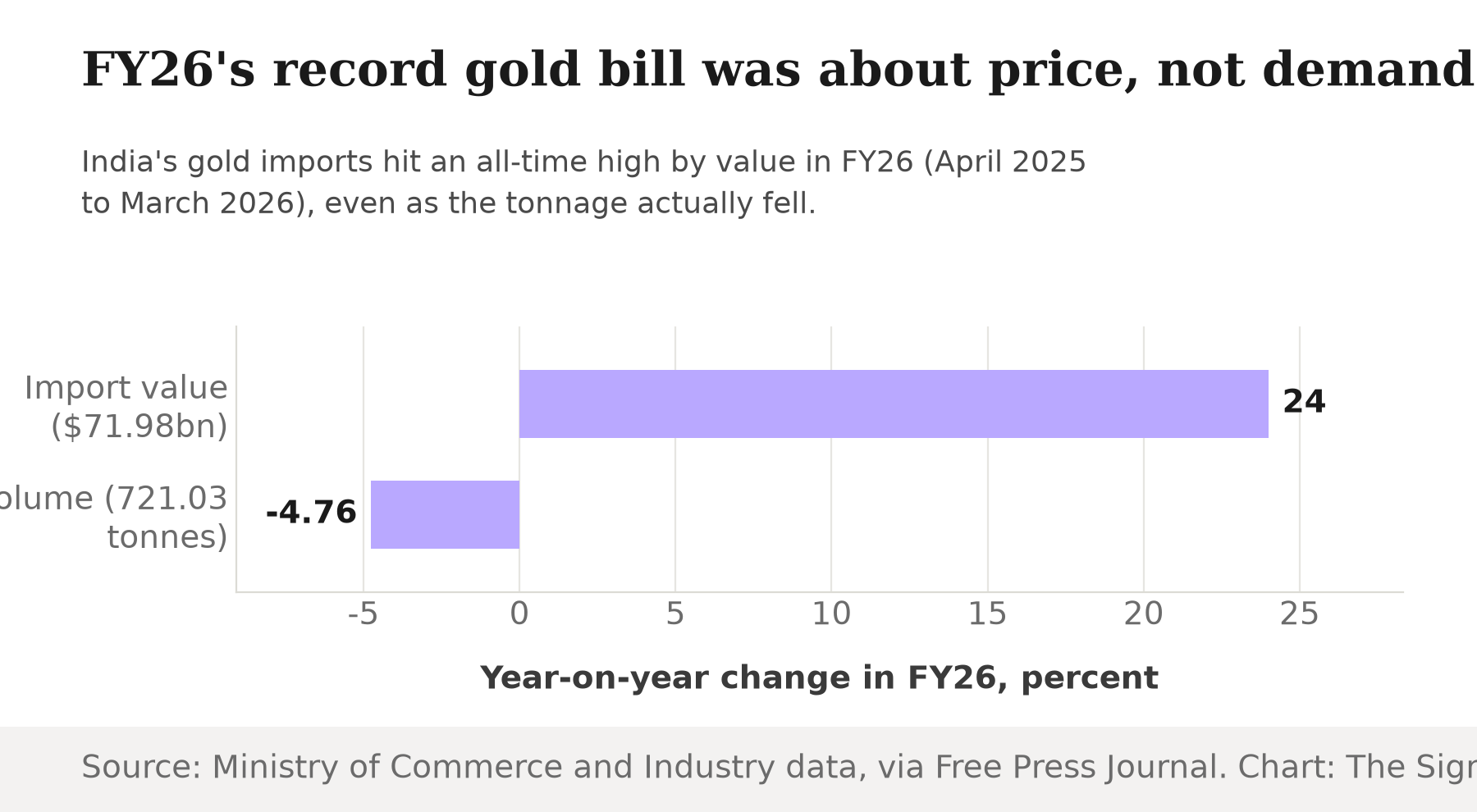
The stated case for the May hike was to curb bullion imports and defend the rupee. The trade data from the year leading up to it does not obviously support "curb imports" as the problem. India's gold imports rose 24% year-on-year to an all-time high of $71.98 billion in FY26 (April 2025 to March 2026), even as the import volume actually fell 4.76% to 721.03 tonnes, according to Commerce Ministry data. India bought less gold by weight in FY26 and still spent a record sum on it, because the price of gold itself rose.
FY26's record gold import bill was a price story, not a demand one.
Source: Ministry of Commerce and Industry data, via Free Press Journal. Chart: The Signal.
It is also worth noting the forex backdrop the hike was framed against. India's current account deficit had already narrowed to $30.1 billion, or 1% of GDP, in April-December 2025, down from $36.6 billion a year earlier, per RBI data: the wider external-balance pressure the duty hike was meant to relieve was easing before the hike, not worsening. A record import bill still drains foreign exchange regardless of whether it is a price or a volume effect, so the government's underlying worry about the outflow is not baseless. But raising the price of legal gold does nothing to change the world price of gold; it only widens the gap between the legal price and the smuggled one; the exact gap the 2024 cut had been designed to close.
The silver clampdown, three days later
The same month, regulators moved on silver too. Silver imports had surged even faster than gold's: India's silver imports rose 149.48% to $12.05 billion in FY26. On May 16, 2026, three days after the duty hike, the Directorate General of Foreign Trade shifted high-purity (99.9%+) silver bar imports from the "Free" category to "Restricted". Gold's duty went up; silver's got a licensing gate. Both moves point the same way: a government trying to slow a precious-metals import bill that had ballooned in value, using tools that raise the cost or friction of buying it through the front door.
The gap reopens, and the review begins
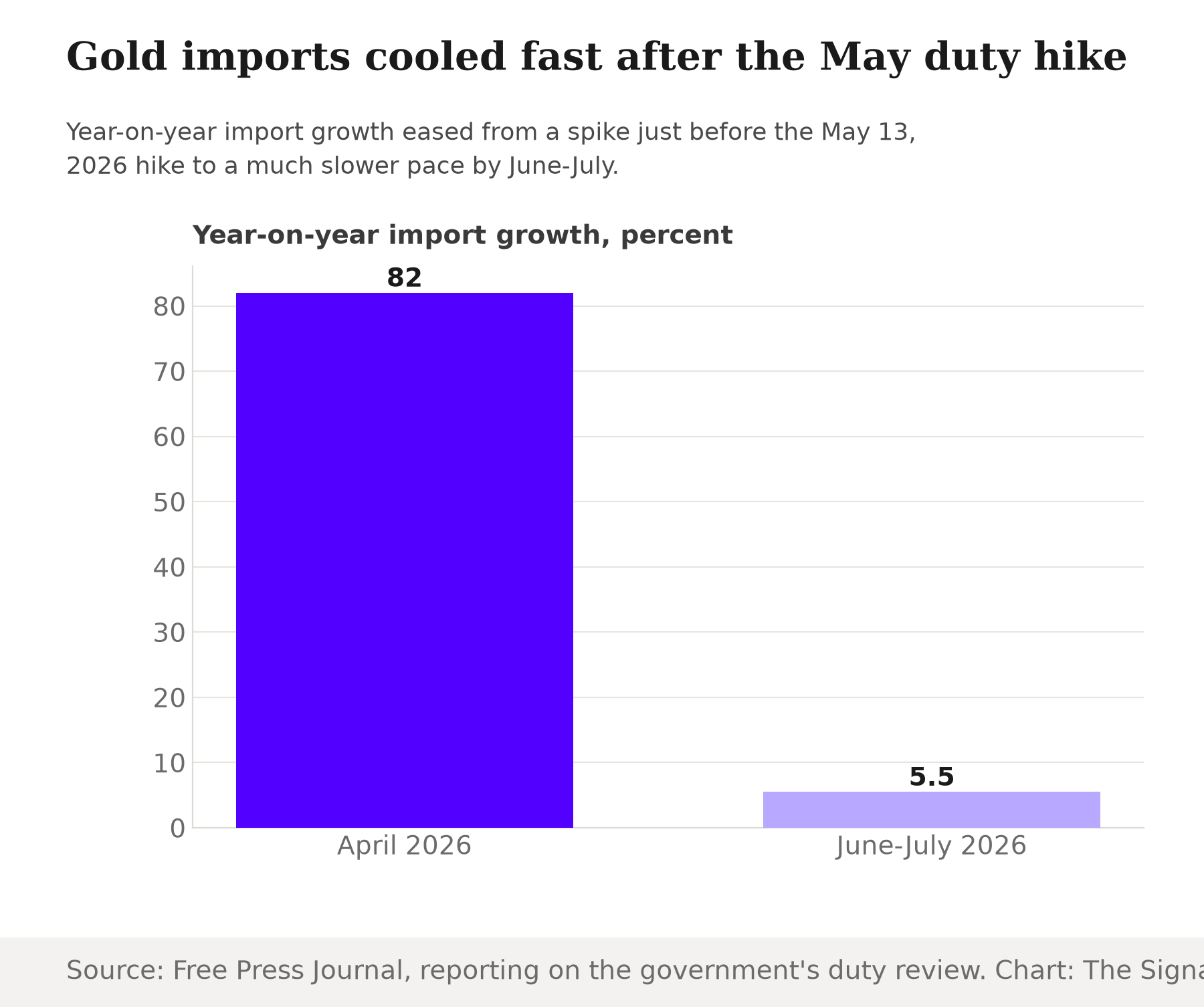
The clearest sign the price gap has actually reopened is not a smuggling statistic. It is the government's own behaviour. Free Press Journal reports that the government is examining another duty cut after industry warned the 15% tax had widened the price gap with smuggled gold, and that the trigger was a swing in the legal import data itself: a nearly 82% year-on-year surge in gold imports in April 2026 eased to 5.5% growth, worth $6.13 billion, by June-July.
Legal gold-import growth cooled sharply in the months after the May duty hike.
Source: Free Press Journal. Chart: The Signal.
That deceleration is consistent with two different stories. One is that higher-duty gold is simply harder to sell at scale through legal channels, so official volumes are settling at a lower run rate, exactly the demand-cooling effect a duty hike is supposed to produce. The other, the one industry is reportedly telling the government, is that buyers are shifting back to unofficial routes now that the legal price carries a bigger markup again. The trade data alone cannot distinguish the two; that is why the claim in front of the government is an industry warning, not a confirmed seizure count.
The honest objection
The strongest case for the May hike does not need smuggling at all. The nearly 82% year-on-year import surge in April 2026 came in the weeks immediately before a well-telegraphed duty increase, exactly when importers had the clearest incentive to front-run it and bring gold in at the old, lower rate. On that reading, the sharp April spike and the slower June-July pace are not evidence of a widening smuggling gap; they are a stockpiling rush followed by a return to a normal run rate, the kind of timing effect any known tax change produces around its effective date, whatever happens to the price gap. And the underlying forex logic for wanting a smaller gold bill is sound even if the bill is price-driven, since dollars spent on gold are dollars spent regardless of the reason gold got more expensive.
That case explains the shape of the import data. It does not fully settle whether the smuggling channel the 2024 cut had shut is now reopening, but there is now an actual seizure count to weigh against it. The most recent smuggling-specific figures on record before the hike were older: the Directorate of Revenue Intelligence's "Smuggling in India" report recorded 1,319 kg of gold seized in FY24 (April 2023 to March 2024), with land routes accounting for 55% of seizures and air routes about 36%, the year before the cut that drove unofficial imports toward zero. Since then, the Central Board of Indirect Taxes and Customs told the Lok Sabha it seized 247.07 kg of smuggled gold and 585.48 kg of smuggled silver during April-June 2026, a window that straddles the May 13 duty hike rather than cleanly separating before and after it. That figure is a wider customs-wide count than DRI's own report and cannot, on its own, isolate how much of it came before or after the hike took effect, so it confirms smuggling did not vanish rather than proving it accelerated because of the hike.
Land routes accounted for the majority of DRI's FY24 gold seizures.
| Route | Share of DRI's FY24 gold seizures |
|---|---|
| Land | 55% |
| Air | ~36% |
Source: Directorate of Revenue Intelligence's "Smuggling in India" report, via Business Today.
The Signal
India's government has now run both sides of the same experiment inside two years: a low duty that provably killed smuggling, and a high duty, reimposed for defensible forex reasons, that industry says has reopened the exact price gap the low duty had closed. The review now underway already has its answer on whether the 2024 cut worked: the World Gold Council's own numbers say it did. What it still has to answer is whether the government values a lower legal price for gold that keeps buyers in the formal system, or a higher duty rate that taxes a formal-channel import bill that is itself vulnerable to leaking back into the channel the tax cannot reach. The next hard number to watch is not the import bill. It is a seizure count for a period squarely after May 13, not one that straddles the hike like the CBIC's April-June figure does, because that is the only kind of number in this story that would actually confirm what the price gap alone can only suggest.
Reporting basis: the July 2024 duty cut and its effect on unofficial imports are per the World Gold Council's own Goldhub research, authored by Kavita Chacko, in two separate publications dated July 2024 and May 2026. The pre-2024 duty rate of 15% is per Akashvani (newsonair.gov.in). The May 13, 2026 duty hike and its stated rationale are as reported by Kitco News. India's current account deficit figures are per Akashvani (newsonair.gov.in), citing Reserve Bank of India data. FY26 gold import value and volume are Commerce Ministry data as reported by Free Press Journal, which is also the sole source for the government's ongoing duty-cut review, the April 2026 import surge and its subsequent easing, all in one report. The silver import surge and the DGFT's May 16, 2026 restriction are per Outlook Money. The FY24 gold seizure figures are from the Directorate of Revenue Intelligence's "Smuggling in India" report, as reported by Business Today. The April-June 2026 CBIC gold and silver seizure figures are from a written Lok Sabha reply by Minister of State for Commerce and Industry Jitin Prasada, as reported by Daily Excelsior (PTI). The two-and-a-half-times comparison between the 6% and 15% duty rates is The Signal's calculation from those two figures.