On August 25, 2026, at a roundtable with Japanese semiconductor and AI executives in Tokyo, Piyush Goyal said India has already secured $200 billion in commitments from global hyperscalers for data centres. In the same appearance, the commerce minister said his ministry would build a framework offering bulk, product or project-based, or company-based exemptions from mandatory BIS certification for high-tech manufacturers. Read together, the pitch is straightforward: money is arriving at a scale India has not seen before, so the compliance regime standing in its way should move too.
It is worth slowing down on the pledge before it does that political work. JLL's India data centre forecast puts the country's operational capacity at 1,123 MW in the first half of 2025, growing 85 percent to 2,073 MW by the end of 2027, a build-out the firm estimates will need about $6.3 billion in capital investment. Set the two numbers side by side and Goyal's $200 billion pledge is nearly thirty-two times the capital the industry's own research arm says is needed to hit that 2027 target.
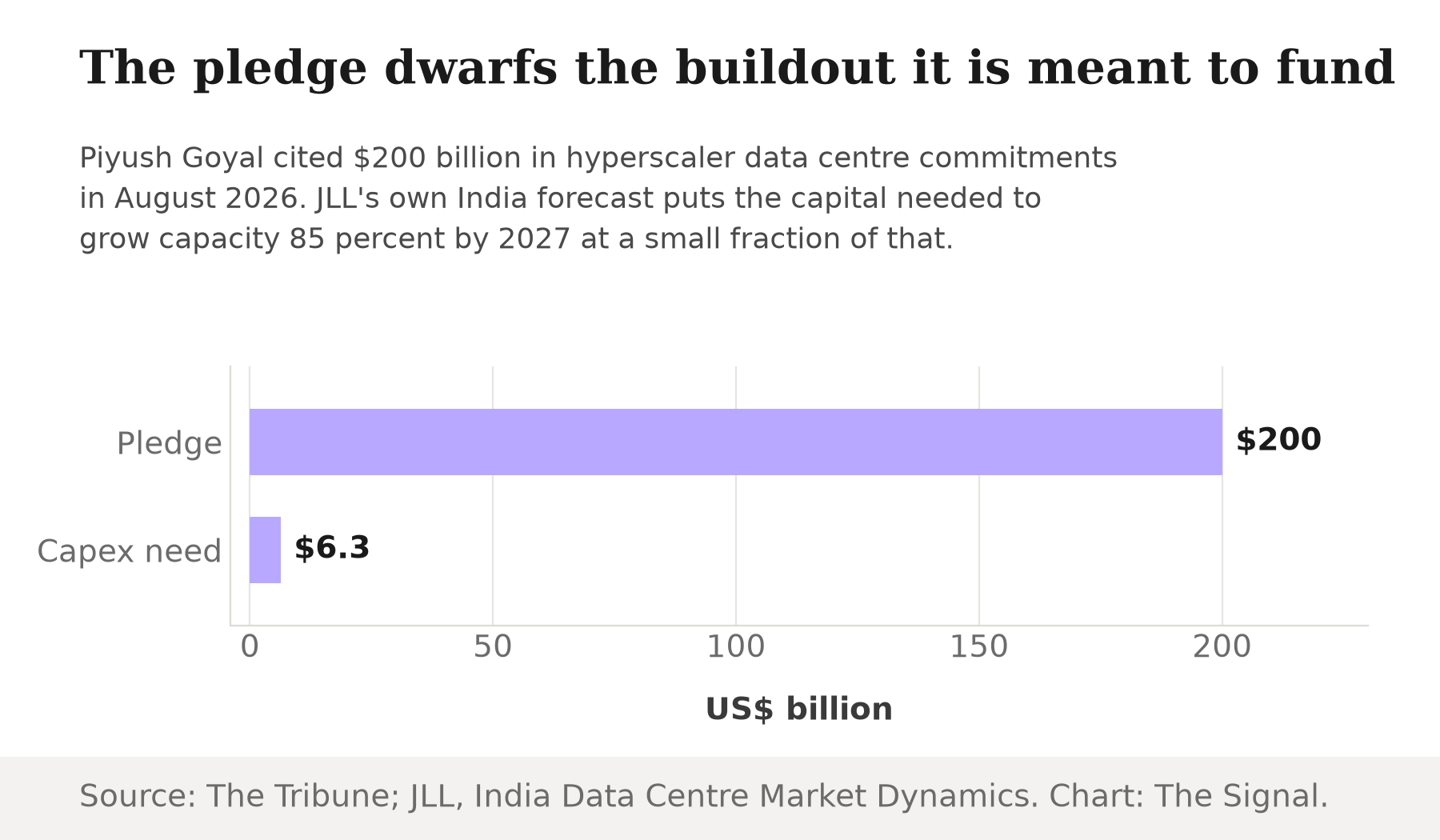
Goyal's pledge is nearly thirty-two times the capital India's own forecast says the buildout needs.
Whatever the pledge is meant to cover, it is not simply a financing plan for the data centre capacity the market itself is forecasting through 2027. That gap does not make the pledge false. It makes it a number to watch converting, not a number to build policy on today.
The $200 billion is also not a fresh count. The same figure was already circulating in February 2026, more than six months before Goyal's Tokyo remarks, described then as a cumulative tally covering Google's $15 billion, Microsoft's $17.5 billion and Amazon's $35 billion India commitments among others, money "in the pipeline" that "New Delhi hopes would flow in" rather than a confirmed sum. Goyal's Tokyo pitch presents a standing aspiration as a new commitment secured.
The exemption is not paperwork, it is oversight
The certification Goyal wants to loosen already does real work. Since 2012, MeitY's Compulsory Registration Order has required mandatory BIS testing and registration of electronics and IT goods, including laptops, wireless keyboards and point-of-sale machines, before they can be sold in India. That regime has already been narrowed once, in 2022, after industry complaints about compliance overlap and delay. That is the mechanism Goyal is now proposing to widen again: not a customs form or a licence queue, but the testing regime that stands between an imported electronic product and an Indian shelf. Goyal told the Tokyo roundtable he would "work on the framework" once back in India and find a solution for bulk, product, project, or company-based exemptions. The framework does not exist yet. The pledge it is being built to reward does not have a delivery record yet either.
Three prior pledges, three underwhelming follow-ups
India has run this play before, and the follow-through has consistently lagged the announcement.
Every one of India's recent flagship investment pledges has converted at a fraction of its headline number.
The Union Cabinet approved Semicon 2.0 with a budget outlay of ₹1,27,500 crore in July 2026, even though only 3 of the 12 manufacturing projects approved under the first Semiconductor Mission, with a cumulative investment above ₹1.64 lakh crore, had reached commercial production. That first mission was itself launched on a large promise: India Semiconductor Mission 1.0, approved by the Cabinet in December 2021, carried a ₹76,000 crore incentive framework offering fiscal support of up to 50 percent for fabs and assembly and testing units. Four and a half years on, a quarter of its approved plants are actually producing chips.
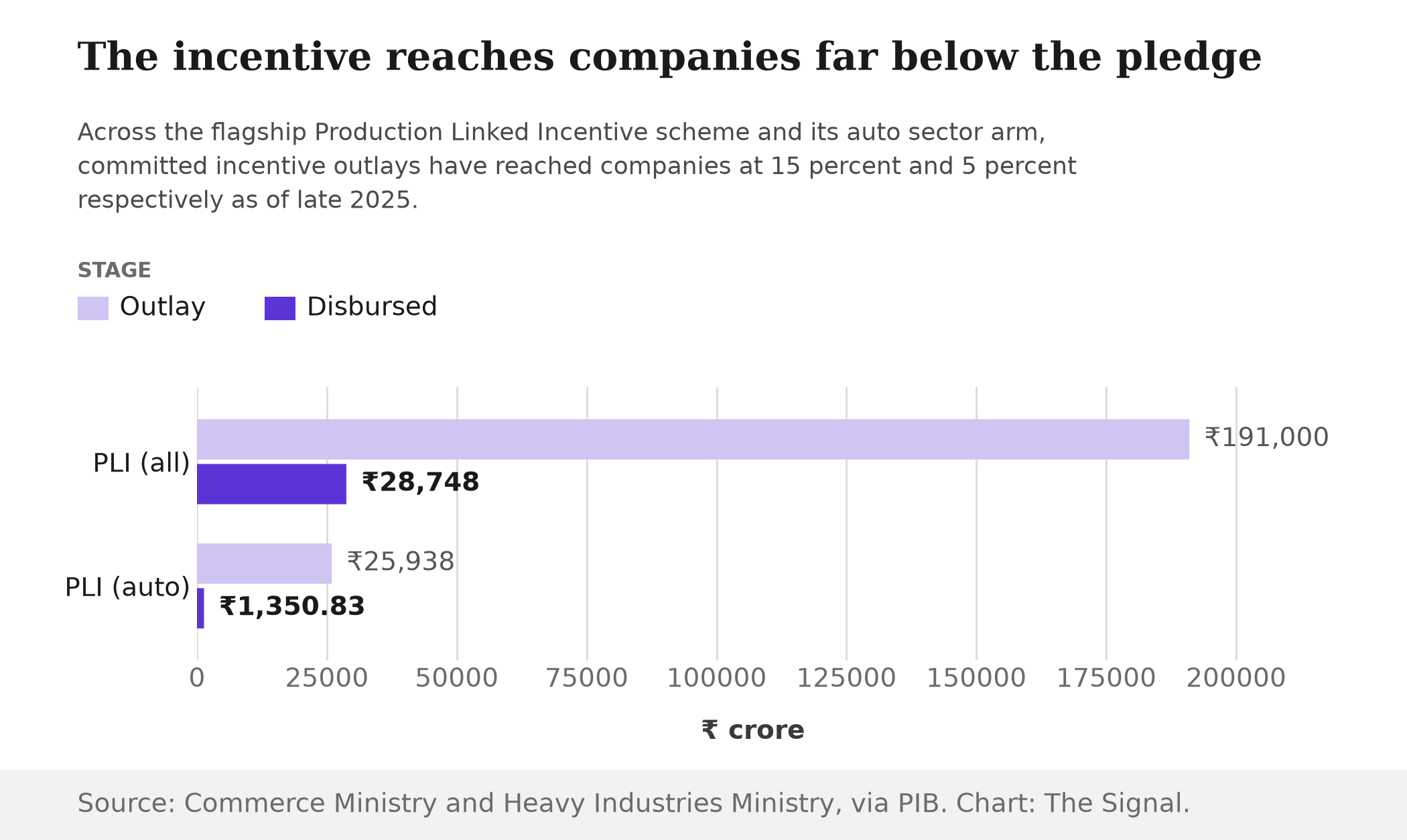
The pattern holds outside semiconductors. Across all 14 Production Linked Incentive sectors, only ₹28,748 crore of the scheme's ₹1.91 lakh crore incentive outlay had actually reached companies as of December 31, 2025, about 15 percent, even as those companies reported ₹2.16 lakh crore of investment. The auto-sector arm of the same scheme has converted even less: only ₹1,350.83 crore of its ₹25,938 crore budgetary outlay had been disbursed as of November 30, 2025. Only ₹32,879 crore of a ₹2,31,500 crore eligible-sales target had been achieved by September 30, 2025.
Coal auctions show the same optimism bias even earlier in the pipeline. Since commercial coal mining began in 2020, India has auctioned 125 mines that are collectively projected, at the time of auction, to attract ₹40,960 crore of capital investment, a forecast made when the mines were sold, not a confirmed, delivered figure.
Pledge-to-delivery track record across India's recent flagship programs. "Share realized" compares the committed or approved total against the latest disclosed disbursement or production figure; the coal figure has no disclosed delivery number to compare against.
| Program | Pledged or approved | Delivered so far | Share realized |
|---|---|---|---|
| PLI, all 14 sectors | ₹1.91 lakh crore incentive outlay | ₹28,748 crore disbursed, as of Dec 31, 2025 | 15% |
| PLI, Auto sector | ₹25,938 crore budgetary outlay | ₹1,350.83 crore disbursed, as of Nov 30, 2025 | 5% |
| Semiconductor Mission 1.0 | 12 units approved, ₹1.64 lakh crore investment | 3 units in commercial production, as of July 2026 | 25% |
| Coal mine auctions since 2020 | 125 mines, ₹40,960 crore capital investment projected at auction | No delivered-investment figure disclosed | not disclosed |
Source: Press Information Bureau releases from the Ministry of Commerce and Industry, the Ministry of Heavy Industries, the Cabinet Secretariat and the Ministry of Coal (see citations above).
The real money is already flowing
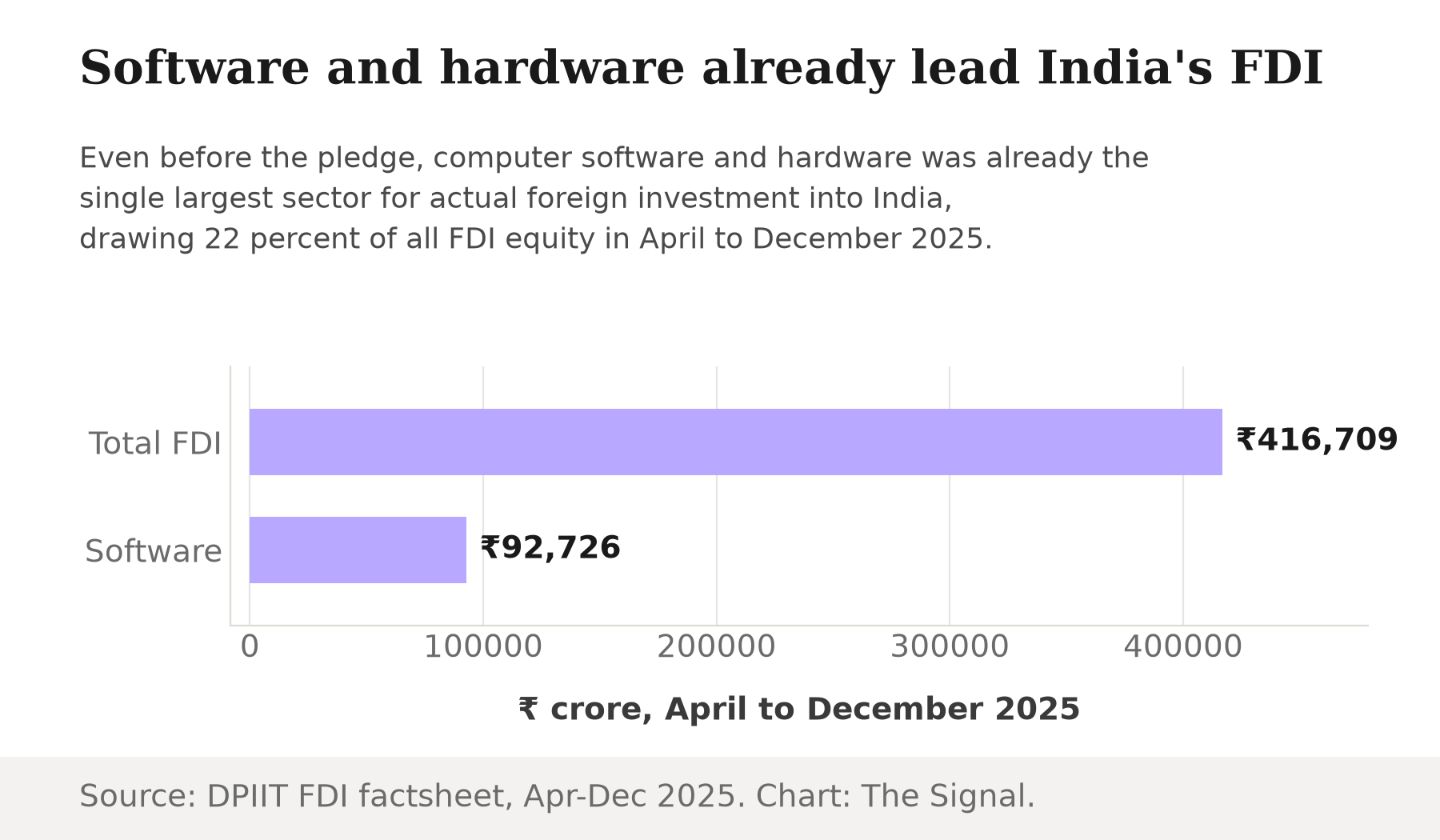
None of this means foreign capital is bypassing India's technology sector. Computer software and hardware was already India's single largest FDI-recipient sector in April-December 2025, drawing ₹92,726 crore, about $10.7 billion, 22 percent of the ₹4,16,709 crore total FDI equity inflow for that period. That is real, disclosed, already-arrived capital, not a pledge awaiting conversion.
The honest objection
The strongest case for Goyal's framework is that the certification complaint predates the $200 billion pledge and stands on its own merits. Global manufacturers have long argued that mandatory testing for every SKU, batch, or facility duplicates checks already cleared abroad, and India has eased this exact regime once before, narrowing the Compulsory Registration Order's scope in 2022 after similar industry complaints. On that reading, this is a routine second round of a known fix, and the $200 billion is a talking point, not the actual justification, so it should not be judged against its own delivery record.
That case is real, but it does not explain the timing. Goyal did not announce a certification review after a stakeholder consultation. He announced it in the same appearance where he cited the hyperscaler pledge figure, to the same room of Japanese executives, as part of the same pitch. A regulatory change proposed on its own merits would need only its own merits stated. Pairing it with an investment number this large, and this far ahead of its own conversion record, invites exactly the reading that the number is doing persuasive work the merits alone are not yet doing.
The Signal
None of India's flagship pledges are frauds. Semicon 2.0 is real money, the FDI flowing into computer hardware and software is real money, and Goyal's hyperscaler conversations may be real too. What the coal, semiconductor and incentive record shows is that the distance between a number cited in a room in Tokyo and a number disbursed in India routinely runs to years and to a fraction of the headline. The framework Goyal promised does not exist yet; when it does, the test is whether it ties exemptions to investment that has actually landed, sector by sector, or whether it is granted against the pledge itself, the same pledge that dwarfs what the market says the underlying build-out requires. Watch the framework's fine print before its headline number.
Reporting basis: Piyush Goyal's August 2026 remarks on the size of the hyperscaler pledge are per The Tribune; his remarks on the certification exemption framework are per ANI, covering the same Tokyo roundtable. The prior circulation of the same pledge figure in February 2026, as a tally still "in the pipeline" rather than a confirmed sum, is per Fortune. The data centre capacity and capex forecast is from JLL's India Data Centre Market Dynamics research. The Compulsory Registration Order details are from a Press Information Bureau release credited to the Ministry of Communications. The Semicon 2.0 approval and Semiconductor Mission 1.0 figures, the PLI and PLI Auto disbursement figures, and the coal auction figures are each from separate Press Information Bureau releases, credited respectively to the Cabinet Secretariat, the Ministry of Commerce and Industry, the Ministry of Heavy Industries, and the Ministry of Coal. The FDI sector breakdown is from a Department for Promotion of Industry and Internal Trade factsheet. The comparison between the pledge and the capex forecast, and the "share realized" column, are The Signal's calculations from those figures.