
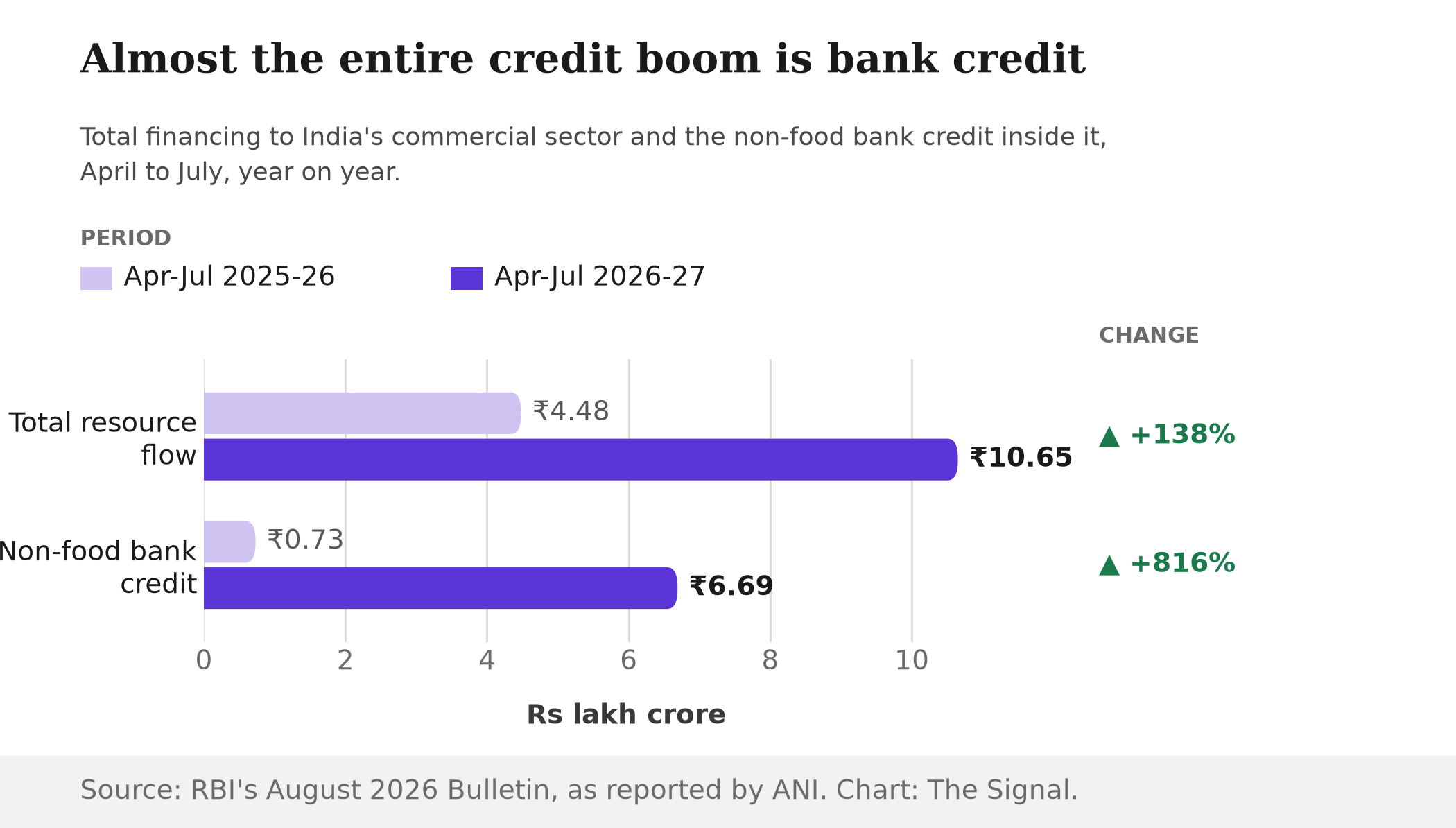
The Reserve Bank of India's August 2026 Bulletin data show that the flow of financial resources to India's commercial sector more than doubled to Rs 10.65 lakh crore in April-July 2026-27, from Rs 4.48 lakh crore in the same four months a year earlier, as reported by ANI. Read only that headline number and the story writes itself: whatever measure of corporate financing you pick, this is a boom year for Indian companies raising money.
That reading fits a narrative the RBI's own officials have been describing for two years, of a financing system rebalancing away from banks. In FY2024-25, non-bank sources (bond markets, share sales, external borrowings) supplied 48.7 percent of all resources raised by India's commercial sector, nearly matching banks, RBI deputy governor Poonam Gupta said, as reported by Business Standard. Set against that baseline, the natural expectation for April-July's doubling is that non-bank finance closed the last few points of the gap.
Bank credit alone accounts for nearly all of this year's financing jump.
It is worth pulling the Rs 10.65 lakh crore apart. Non-food bank credit to the commercial sector jumped to Rs 6.69 lakh crore in April-July 2026-27, from just Rs 72,705 crore in the same four months last year, more than ninefold. Total financing rose by Rs 6.17 lakh crore over the period; the increase in bank credit alone accounts for Rs 5.96 lakh crore of that, or 96.6 percent (our calculation from the two RBI figures above). The doubling is not banks and markets both expanding. It is banks.
Banks accelerated across every sector
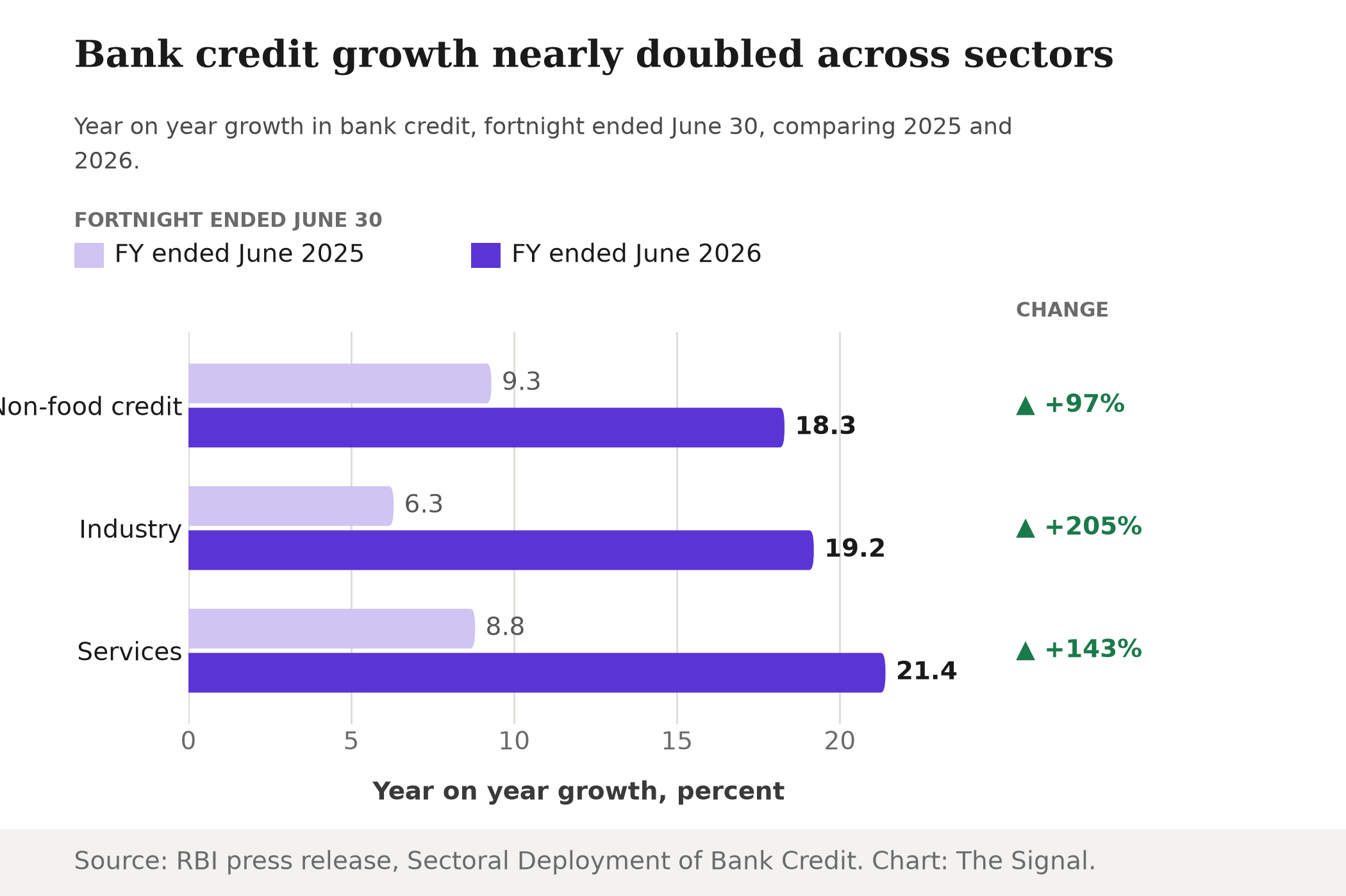
The four-month snapshot is not a one-off release. Non-food bank credit growth accelerated to 18.3 percent year-on-year as of the fortnight ended June 30, 2026, up from 9.3 percent in the same fortnight a year earlier, an RBI press release on Sectoral Deployment of Bank Credit shows. The acceleration was not confined to one line of business: credit to industry grew 19.2 percent year-on-year, against 6.3 percent the year before, and credit to services grew 21.4 percent, against 8.8 percent. Both roughly tripled their prior growth rate in the space of one year.
Bank credit was already outrunning non-bank funding by May.
| Category | Growth, year-on-year | Level, as of May 31, 2026 |
|---|---|---|
| Non-food bank credit | 17.4% | Rs 213.79 trillion |
| Non-bank funding sources | 13.6% | Rs 102.24 trillion |
| Total commercial-sector credit | 16.1% | Rs 316.04 trillion |
Source: Business Standard, citing the RBI's June 2026 Bulletin.
Every non-bank channel went quiet in the same year
The other side of the trade is what happened to the instruments that raise money outside a bank loan. India's corporate bond market, the main non-bank debt channel for large companies, contracted for the first time since 2021-22 in FY2025-26, with fund mobilisation falling 8.4 percent to Rs 9.1 lakh crore even as the number of issuances rose to 1,967, SEBI's 2025-26 annual report states, down from Rs 9.95 lakh crore mobilised through 1,702 debt issues the year before: more issuers came to market, for less money each. Qualified institutional placement fundraising by listed companies nearly halved, to Rs 67,853 crore from Rs 1,35,597 crore in FY2024-25, the same report shows. And fundraising through equity public issues, IPOs and FPOs, was essentially flat, declining 0.9 percent to Rs 1.9 lakh crore even as bank credit surged, matching FY2024-25's own Rs 1.9 lakh crore, itself a 2.8-fold jump from the year before that, almost exactly.
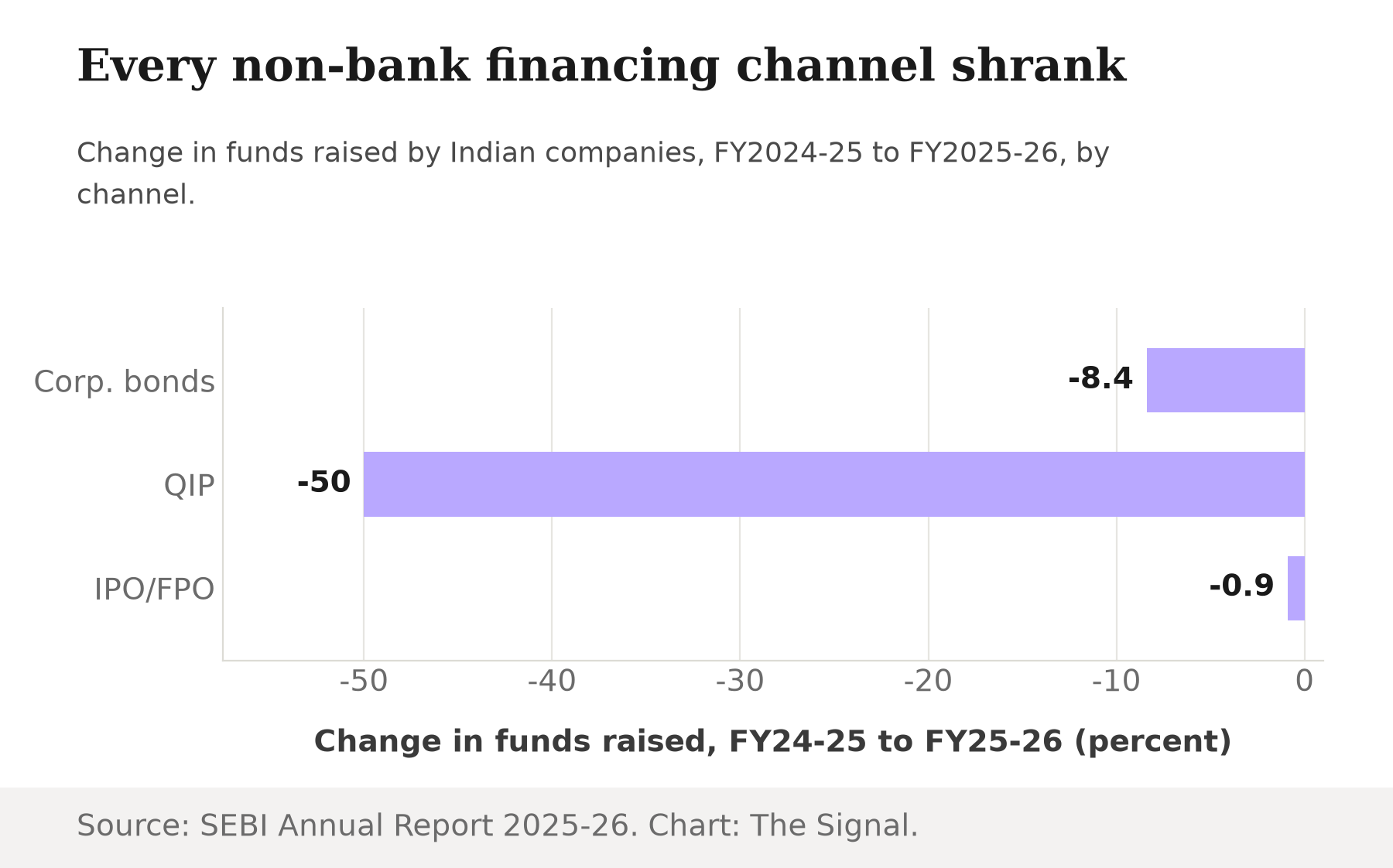
Three separate channels, run by different sets of companies for different purposes, all moved the same direction in the same fiscal year that bank credit accelerated.
The regulatory nudge behind the swing
The timing lines up with a specific rule change. The RBI reversed its November 2023 risk-weight hike on bank exposure to NBFCs, restoring risk weights to external-rating levels effective April 1, 2025, an RBI notification states. The reversal made it cheaper again for banks to lend to non-bank finance companies, which themselves recycle much of that credit into the wider corporate sector. It took effect four months before the start of the fiscal year that produced every number above. The bank-to-NBFC lending line itself shows the same break: credit from banks to NBFCs surged 33.7 percent year-on-year to Rs 20.9 trillion as of May 31, 2026, up from just 1 percent growth in the same month a year earlier. That is not a broad credit boom that happened to touch NBFCs in passing; it is the specific channel the rule change targeted, going from nearly frozen to accelerating within the same twelve months.
The honest objection
The strongest pushback is that base effects are doing real work here. Non-food bank credit in April-July 2025-26 was unusually depressed, Rs 72,705 crore is a strikingly small number for a four-month stretch, so almost any recovery from it would look dramatic. And FY2024-25's non-bank fundraising, especially the Rs 1,35,597 crore raised through QIPs, was itself an unusually strong year that a normal market might struggle to repeat regardless of what banks were doing.
That case has real force for any one number taken alone. It does not explain the pattern across five separate releases from three different institutions, the RBI's credit data, the RBI's sectoral data, and SEBI's own 2025-26 annual report, all describing the same direction of travel in the same fiscal year, immediately after a regulator-made cost advantage for bank lending to NBFCs came into force. A base effect can explain one soft comparison. It cannot explain why bonds, QIPs and equity issues all went quiet in the same twelve months that bank credit accelerated across industry and services alike.
The Signal
For two years, RBI officials described a financing system rebalancing away from banks, with non-bank sources supplying 48.7 percent of everything raised in FY2024-25, nearly matching banks. The RBI's own risk-weight reversal appears to have reopened the tap for cheaper bank credit, and both companies and the banks funding them took the opening: bond issuers, QIP placements and IPO and FPO filers all pulled back in the very period bank credit accelerated. Which channel a large Indian company uses to raise money is no longer only a market call. It is increasingly a regulatory one. The corporate bond market's contraction has already carried into the new fiscal year: Indian companies raised just Rs 1.07 trillion through private-placement corporate bonds in April-May 2026-27, down nearly 58 percent from the year-ago period and the lowest for that two-month window since FY2022-23. If bank credit keeps outrunning every non-bank channel through a second full year, that 48.7 percent non-bank share will look less like a trend and more like the peak of an era regulation chose to end.
Reporting basis: the April-July 2026-27 flow-of-funds figures and the fortnight-ended-June-30 sectoral credit growth data are from the Reserve Bank of India, the first via its August 2026 Bulletin as reported by ANI, the second via an RBI press release on Sectoral Deployment of Bank Credit. The risk-weight reversal is per an RBI regulatory notification. The May 31, 2026 comparison of bank and non-bank funding growth is as reported by Business Standard, citing the RBI's June 2026 Bulletin. The FY2024-25 non-bank funding share is as reported by Business Standard, from a speech by RBI deputy governor Poonam Gupta. The corporate bond, QIP and equity issuance figures for FY2025-26 are from SEBI's Annual Report 2025-26, and the corporate bond and equity-issuance figures for FY2024-25 are from SEBI's Annual Report 2024-25. The May 31, 2026 bank-credit-to-NBFCs growth figure and the April-May 2026-27 corporate bond issuance figures are as reported by Business Standard, the latter citing Prime Database. The increase attributable to bank credit, as a share of the total rise in financing, is The Signal's calculation from the RBI's own figures.