UPI's tenth anniversary this year produced the cleanest data point yet for the digital-India story. Annual UPI transaction volume expanded almost 12,000-fold over a decade, from about 2 crore transactions in FY 2016-17 to more than 24,162 crore transactions in FY 2025-26, the Ministry of Finance says. The momentum kept building through the year: July 2026 alone recorded 2,366 crore UPI transactions, the highest monthly volume in the platform's decade-long history. Read those two numbers together and the conclusion writes itself: India has moved on from cash, and the machines built to dispense it are becoming obsolete alongside it.
It is worth slowing down on that. RBI data tell a narrower, more specific story than "cash is dying," and it starts with a number that has nothing to do with UPI at all.
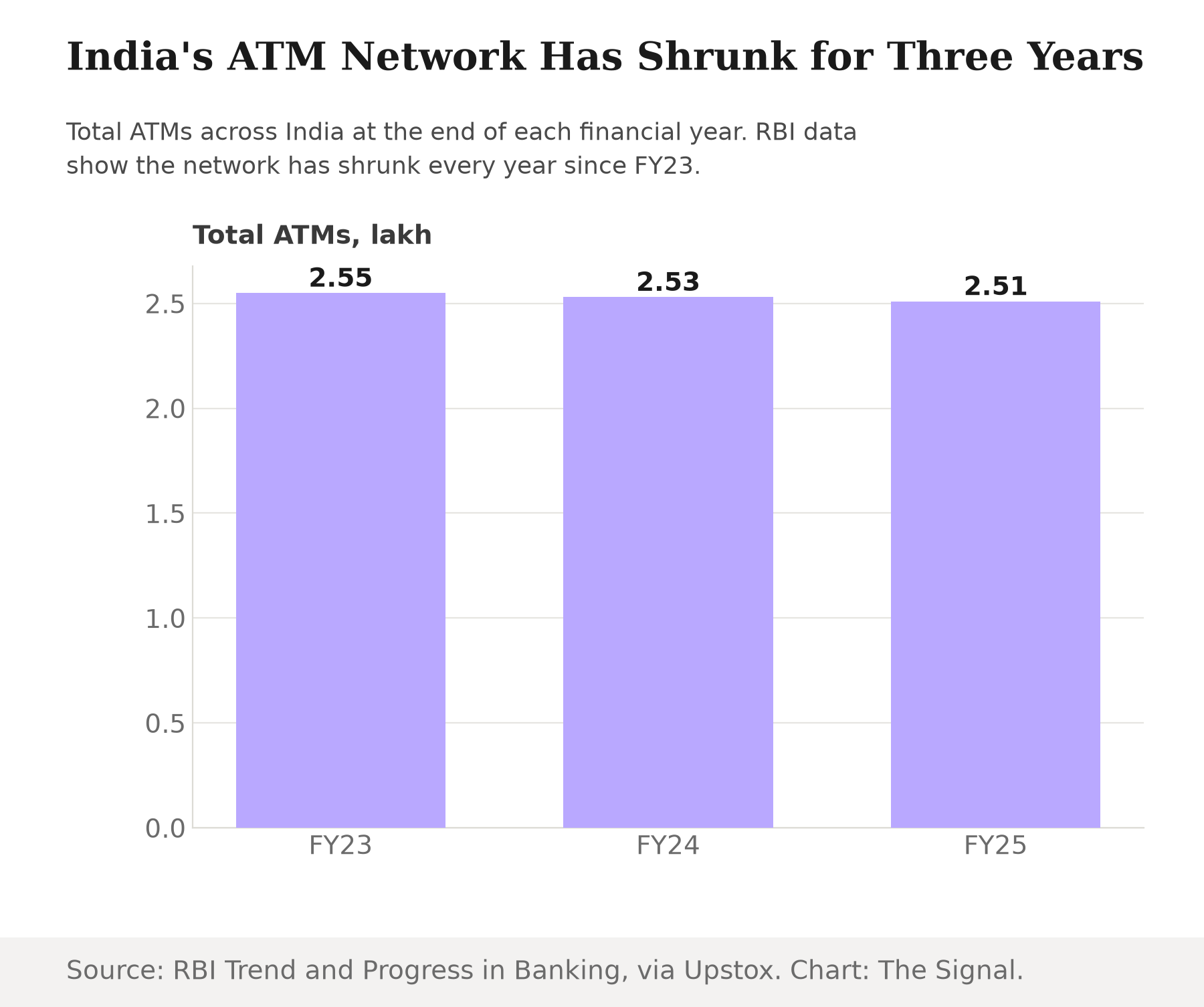
India's total ATM count fell to 2,51,057 at the end of FY25, down from 2,53,417 a year earlier, Reserve Bank of India data show. That is a third straight annual decline: the RBI's own count had already fallen to 2.53 lakh in FY24, from 2.55 lakh the year before, which Business Standard reported as "the second straight annual fall". Three years running, before UPI's July 2026 record was even printed, the national ATM network was already getting smaller.
India's ATM network has shrunk for three consecutive financial years.
The closures are almost entirely off-site
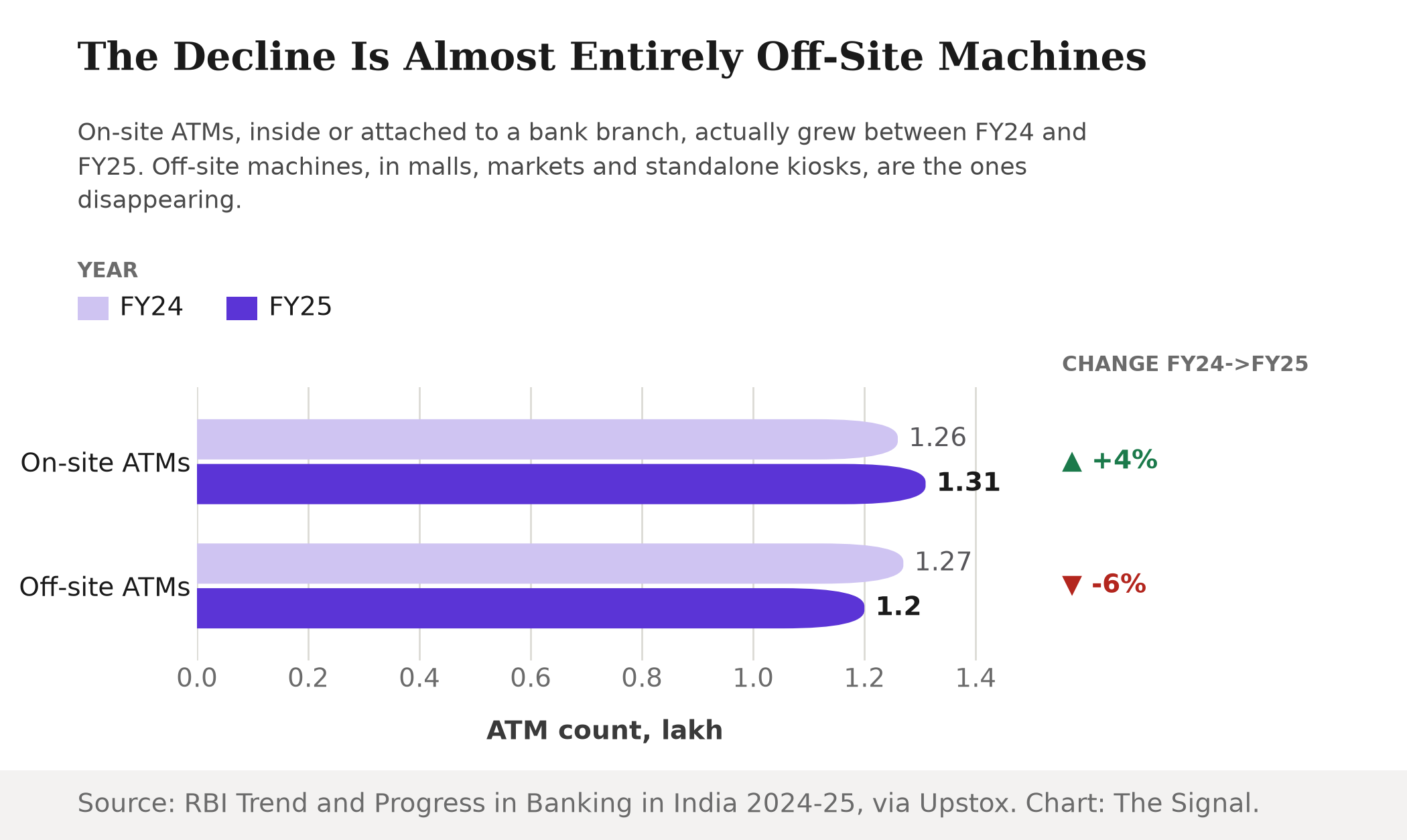
The RBI's FY25 breakdown shows the shrinkage is not spread evenly across the machines. On-site ATMs, the ones inside or attached to a bank branch, rose to 1,31,323 from 1,26,116 over the year. Off-site ATMs, the standalone machines in a market, mall or street corner, fell to 1,19,734 from 1,27,301 over the same period. The network is not simply retreating. It is being reshaped, with off-site machines absorbing nearly all of the loss.
Off-site ATMs, not branch machines, are absorbing the entire decline.
In its FY26 letter to shareholders, CMS Info Systems, India's largest ATM-cash-logistics operator, describes the same pattern from the industry's side: the sector's installed ATM base "has stayed flat" as private banks close down "low-yield off-site machines." That phrase, low-yield, is doing the real work in the industry's own explanation, because it is not the whole story. CMS says currency throughput per touchpoint in semi-urban and rural (SURU) markets now matches metro and urban levels, and SURU machines make up more than half of its own ATM base. The closures read as a cost decision by the banks that own the machines, not a response to falling cash demand where those machines sit.
Rural India has not stopped opening bank accounts
If banks were pulling back from ATMs because rural and semi-urban India were disengaging from formal banking, the timing would make some sense. The opposite is happening. As of 7 March 2025, 55.02 crore Jan Dhan accounts had been opened nationwide, with 36.63 crore of them, about two-thirds, in rural and semi-urban areas, the Ministry of Finance told the Rajya Sabha. By August 2025, that total had grown past 56 crore accounts over the scheme's 11 years, with 67% of accounts in rural or semi-urban areas and 56% held by women, Finance Minister Nirmala Sitharaman said. The base of small, formally banked, rural and semi-urban depositors that PMJDY exists to serve kept growing in the same months the machines meant to give them physical access to their own money kept shrinking.
Jan Dhan accounts, and their rural and semi-urban share, kept growing through 2025.
| Date | Total Jan Dhan accounts | Rural / semi-urban share |
|---|---|---|
| 7 March 2025 | 55.02 crore | 36.63 crore, about two-thirds |
| 11-year mark, August 2025 | More than 56 crore | 67% |
Source: Ministry of Finance, reply to the Rajya Sabha and PMJDY 11th-anniversary statement.
Cash itself is not disappearing either
UPI's growth does not fully explain the ATM retreat, because cash in India is not actually vanishing. Currency in circulation hit an all-time high of about Rs 40 lakh crore as of January 2026, even as monthly UPI transaction value hit a record Rs 28.3 lakh crore, SBI Research reported. What has genuinely fallen is the ATM's share of how that cash reaches people's hands: cash withdrawn from ATMs dropped from 17.5% of GDP in FY19 to an estimated 8.1% in FY26, more than a halving in seven years.
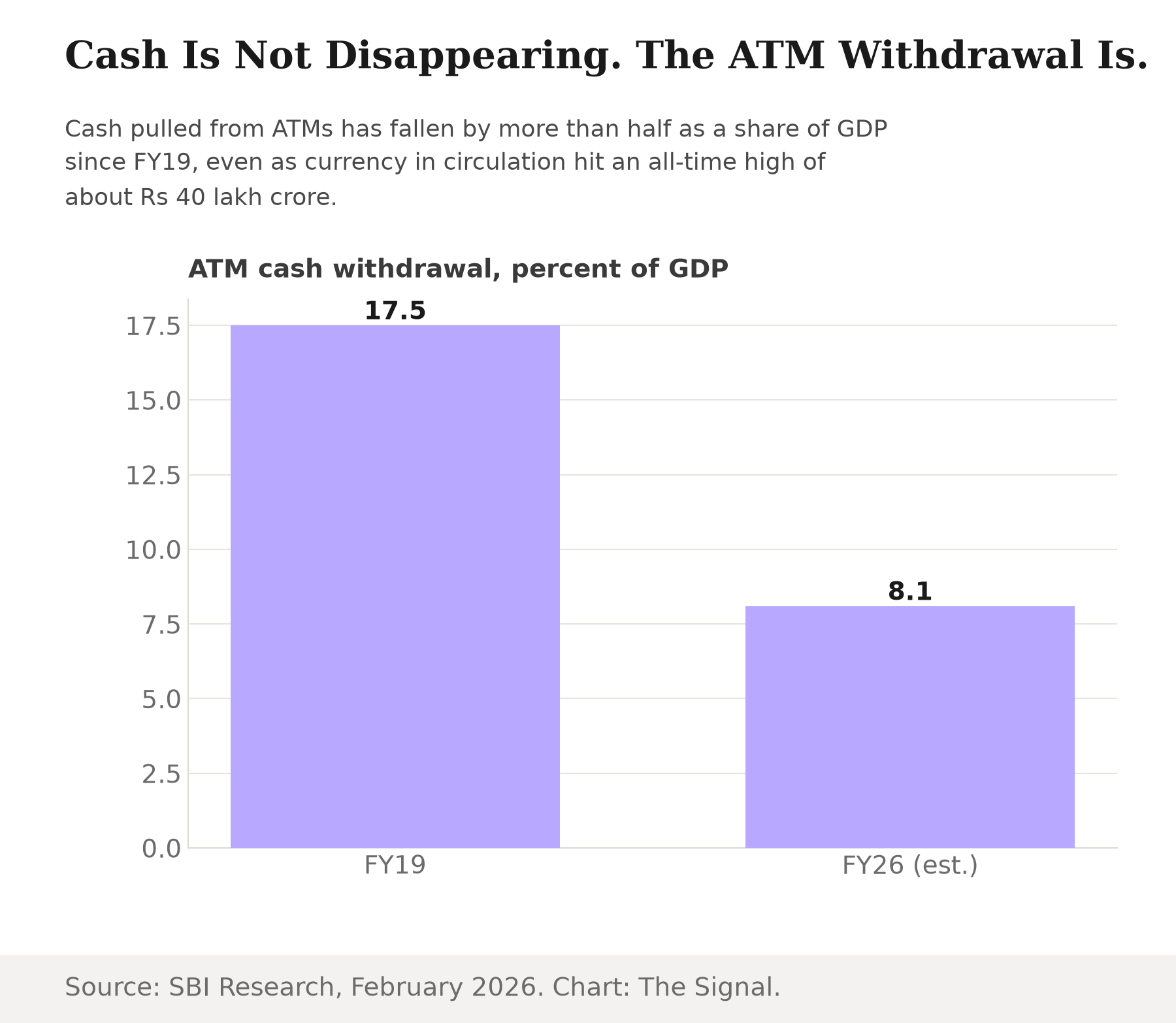
That is a real shift, and UPI is clearly the reason for it: paying a shopkeeper by scanning a code needs no withdrawal at all. But a shrinking withdrawal share is a different claim from a shrinking cash economy, and the two get conflated in the coverage of this data.
Where the pruning lands hardest
The RBI's FY25 report finds that public sector banks keep an ATM presence evenly spread across rural, semi-urban, urban and metropolitan India, while private-sector and foreign banks concentrate their networks in urban and metropolitan centres. On paper, that leaves the public sector banks, above all State Bank of India, as the backstop for ATM access outside the metros. As of June 2026, ATM operators say SBI is instead routing a disproportionate share of cash to Tier-1 city machines, leaving Tier-2 and Tier-3 ATMs short; the Confederation of ATM Industry has sought Rs 100 crore in compensation over the resulting downtime. SBI has the broadest network on paper, but it is not using that reach where the off-site closures have already thinned the field the most.
The honest objection
The strongest case against reading any of this as a squeeze is that pruning off-site ATMs is simply good arithmetic. On-site machines grew in the same year off-site machines shrank, so access at the branches people already visit is not disappearing. And a network that has shed a small share of its machines over three years, from 2.55 lakh to 2.51 lakh, while UPI volume rose almost 12,000-fold over a decade, looks like a bank optimising toward where the transactions already are, not neglecting anyone.
That case holds for the arithmetic but not for the geography. CMS Info Systems' own data shows cash demand in semi-urban and rural markets running as strong as in metro and urban India, so the machines being closed as low-yield are not, on the industry's own numbers, low-demand where it counts. And the case does not explain a live dispute: CATMi's Rs 100 crore compensation claim over Tier-2 and Tier-3 cash shortages is not a hypothetical risk. It is operators saying the shortfall was happening as of June 2026.
The Signal
India's cash story has two separate lines that a single UPI headline number tends to flatten into one. Currency in circulation is at a record high, so cash itself is not going away. And the physical infrastructure for reaching that cash, specifically off-site ATMs, has been shrinking for three straight years, concentrated in exactly the machines the industry itself calls low-yield. Both lines are true at once, and the gap between them is where Tier-2 and Tier-3 India sits. Watch the CATMi compensation claim: if SBI's cash routing changes in response, the even-spread promise in the RBI's own numbers starts to mean something on the ground. If it does not, the next annual count will likely mark a fourth year of decline, and a depositor in a small town will feel that fall well before the national figure ever gets printed.
Reporting basis: the FY25 and FY24 ATM counts and the on-site/off-site split are Reserve Bank of India Trend and Progress figures, as reported by Upstox News Desk and Business Standard; the RBI's finding on public-sector versus private-sector geographic spread is as carried by Storyboard18, via PTI's account of the same RBI banking-trends publication. CMS Info Systems' description of industry-wide ATM economics and semi-urban and rural cash demand is from its FY26 Letter to Shareholders, filed with the National Stock Exchange. UPI's decade-long transaction growth is from a Ministry of Finance statement, and its July 2026 monthly figure is from Business Standard's account of PTI's coverage of the same anniversary. Jan Dhan account totals are from two Ministry of Finance statements, one to the Rajya Sabha and one marking the scheme's 11th anniversary. Currency in circulation and the ATM cash-withdrawal share of GDP are from SBI Research. The Tier-1 cash-routing dispute and CATMi's compensation claim are as reported by Outlook Business, citing CATMi and an Economic Times account of the same dispute. The three-year shrinkage framing and the small-share arithmetic in the honest objection are The Signal's calculations from those figures.