Tata Consultancy Services said this week it will buy MHP Management- und IT-Beratung GmbH, Porsche's IT consulting subsidiary, at an enterprise value of 320 million euros, about Rs 3,574 crore. Alongside the acquisition, Porsche AG signed a five-year AI and digital-work partnership with TCS tied to 1.25 billion euros of work for the automaker. The transaction is expected to close within three to four months, subject to regulatory approval. Read at face value, this is India's largest IT services company writing a nine-figure check to buy its way into AI-native automotive consulting rather than waiting to build the capability itself.
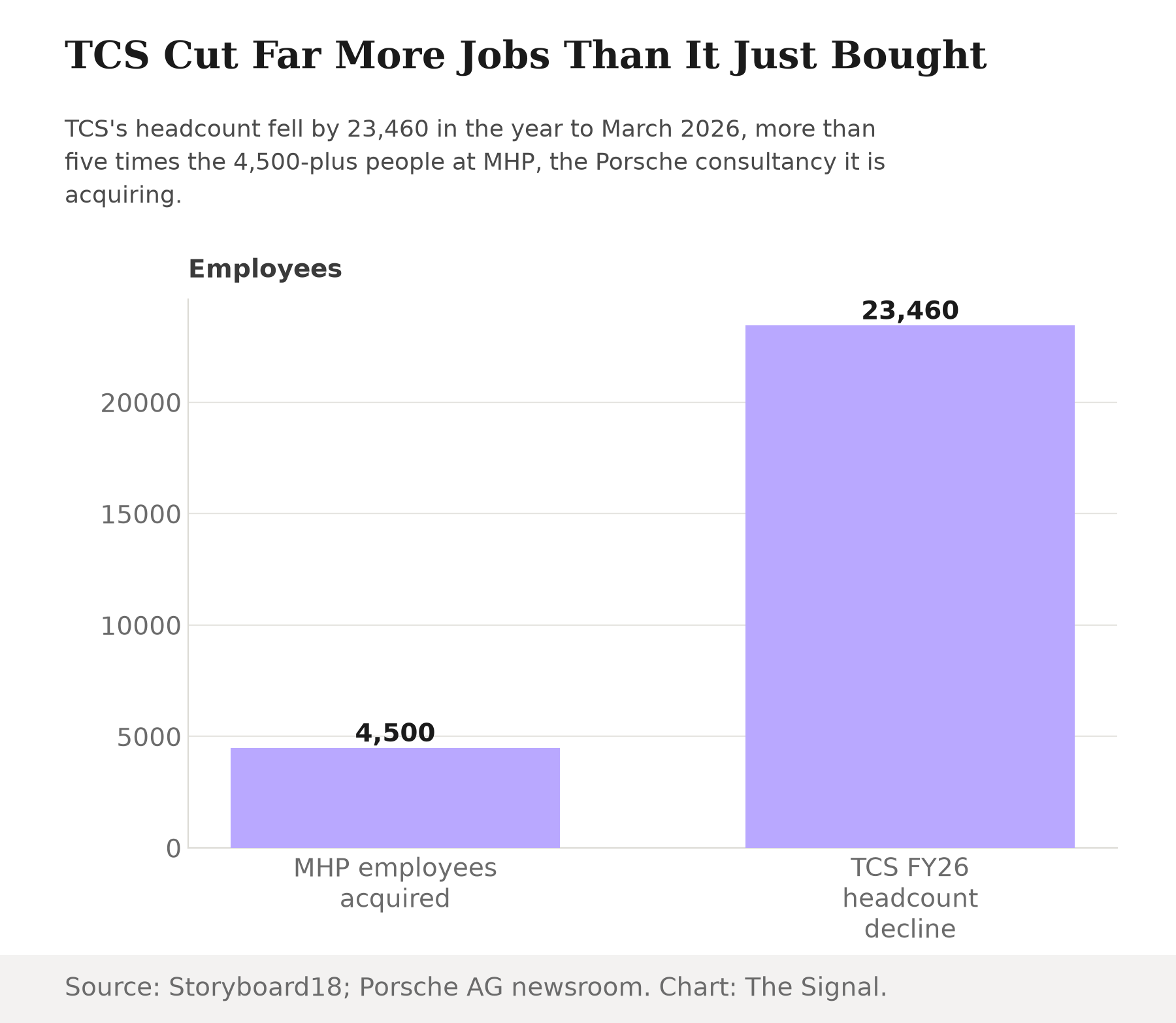
It is worth slowing down on what that check actually buys. MHP employs more than 4,500 people worldwide, doing engineering and digital consulting mostly for the auto industry. Against TCS's own scale, that is not a large number, and the timing makes it a stranger one still.
TCS is acquiring fewer than a fifth as many people abroad as it lost at home in FY26.
TCS's headcount stood at 584,519 at the end of FY26 (the year to March 31, 2026), down 23,460 from 607,979 a year earlier. Set the two numbers side by side and the acquisition looks less like expansion and more like a swap: a company that shed headcount equal to five MHPs in a single year is now paying to add one back, in Germany, at once.
What the deal actually buys
Set the two disclosed figures against each other and the price looks disciplined rather than showy. The 320 million euro enterprise value works out to roughly 71,000 euros per MHP employee, and against MHP's reported turnover of 742 million euros in calendar 2025, TCS is paying under half of one year's revenue for the whole firm. That reading matches how the market has scored it: brokerage Nuvama estimates the deal could add about 3 percent to TCS's revenue top line, calls it EPS-neutral, and retains a Buy rating with a target of Rs 3,000. The stock itself shrugged: TCS shares opened as much as 1.38 percent higher on the day the deal was announced before reversing to close about 1 percent lower, a round trip that reads as indifference rather than conviction either way. This is not a bet-the-company deal. It is a small, contained purchase of a specific capability, priced like one, and the market priced it that way too.
TCS's MHP deal, at a glance
| Deal term | Figure |
|---|---|
| Acquisition enterprise value | 320 million euros (about Rs 3,574 crore) |
| MHP employees worldwide | More than 4,500 |
| MHP turnover, calendar 2025 | 742 million euros |
| Linked AI and digital-work partnership | 1.25 billion euros over five years |
| Expected close | 3 to 4 months, pending regulatory approval |
Source: The Hans India; Business Today; Finimize; Investing.com.
A shrinking asset
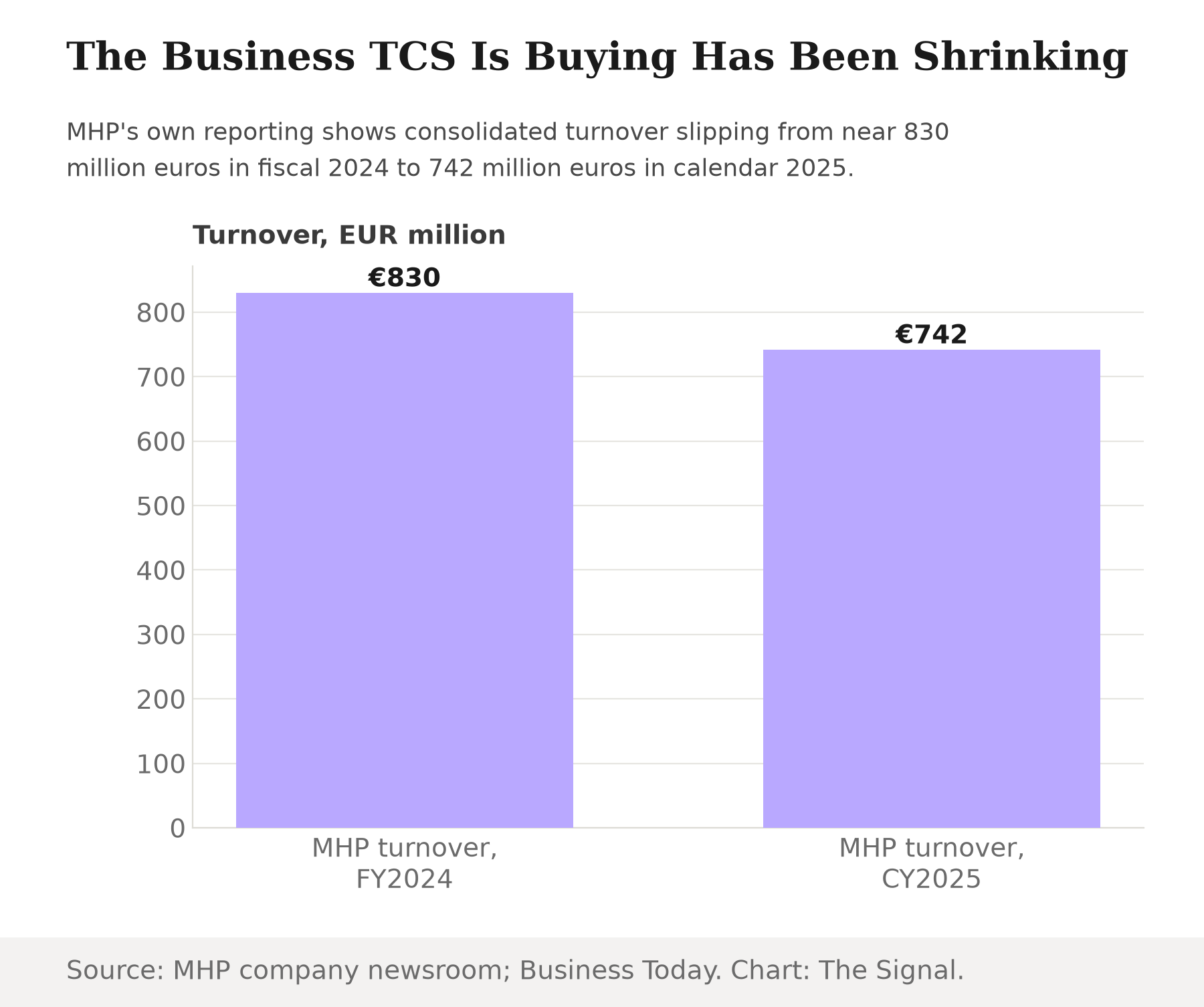
The business changing hands has itself been getting smaller. MHP's own newsroom reported consolidated turnover of nearly 830 million euros for fiscal 2024, roughly flat versus fiscal 2023. By calendar 2025, that figure had slipped to the 742 million euros cited above, a decline of about 10.6 percent between the two periods (our calculation, comparing MHP's fiscal 2024 figure with its calendar 2025 figure as reported by Business Today). TCS is not buying a company at the top of its curve. It is buying a stable, profitable, mid-sized consultancy at a price that reflects that between fiscal 2024 and calendar 2025 it got a little smaller, not bigger.
The wider pattern at home
The MHP purchase lands in the middle of a rough year for TCS's own headcount economics. TCS's full-year FY26 revenue was 30,017 million dollars, down 0.5 percent year-on-year in dollar terms, even as headcount fell. And the company has pulled back sharply on the pipeline that normally replenishes its India workforce: TCS made 25,000 fresher job offers for FY27, down from over 44,000 freshers hired in FY26, a cut of more than 40 percent in a single hiring cycle.
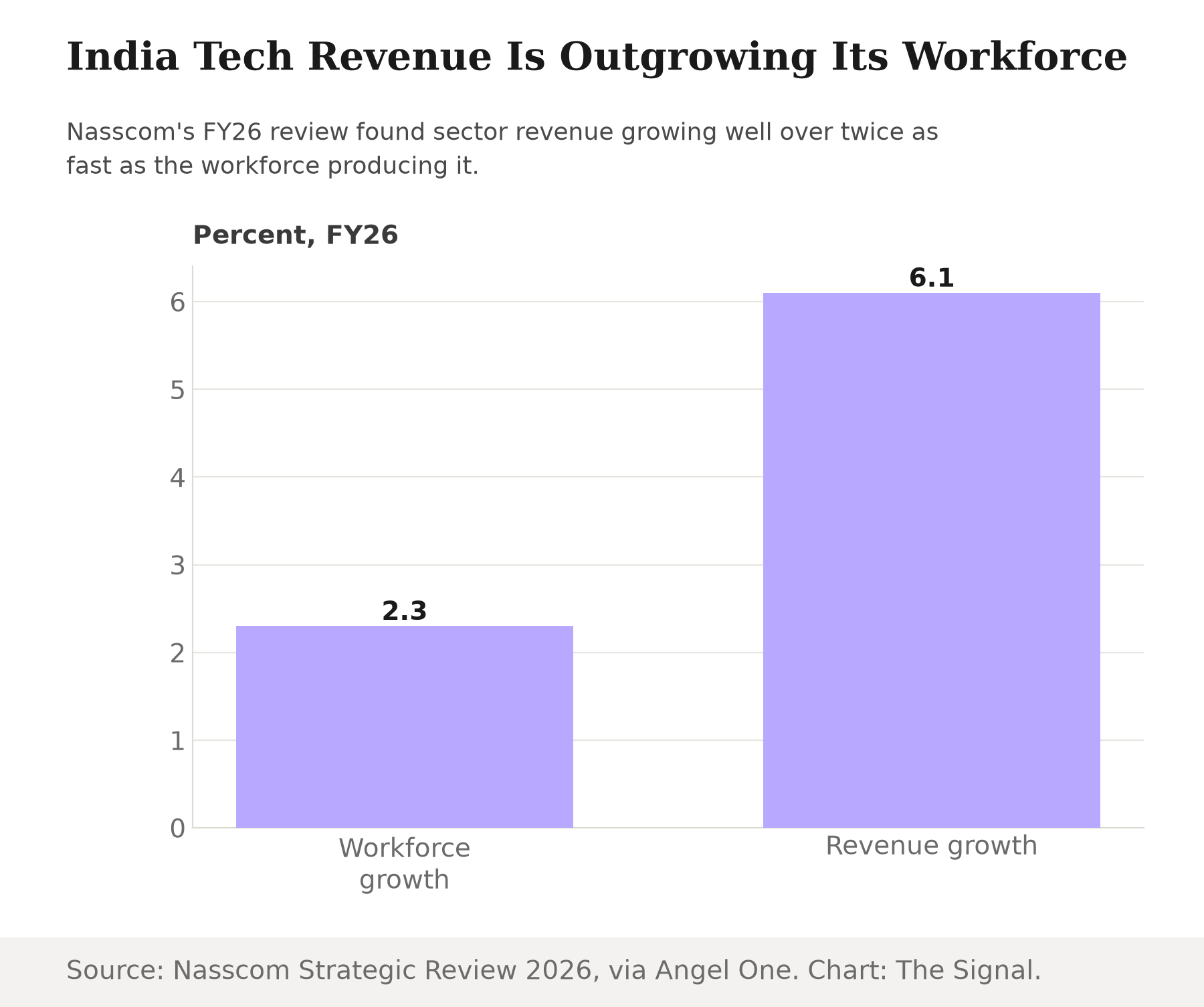
That is not simply a TCS story. India's tech sector workforce grew 2.3 percent to 59.5 lakh employees in FY26, even as sector revenue grew 6.1 percent to $315 billion, industry-wide figures from Nasscom's Strategic Review 2026. Revenue growing well over twice as fast as headcount is now the sector norm, not a TCS quirk. What makes TCS's version sharper is that its own revenue barely moved while its headcount fell outright, a more extreme version of the same decoupling the rest of the industry is only starting to show.
TCS is also not the first of India's large IT services firms to buy this kind of capability rather than grow it. In April 2024, Infosys agreed to acquire in-tech, a German automotive-engineering consultancy, for 450 million euros; in-tech employed around 2,200 people when the 2024 deal was announced. That works out to roughly 205,000 euros per employee, nearly three times what TCS is paying per head for MHP. Buying specialist European automotive-engineering talent instead of building it in India is starting to look like a pattern across the sector's biggest names, not a one-off; TCS's version of that trade is simply the cheaper one, on a per-employee basis, of the two.
The honest objection
The strongest case against reading anything structural into this is that the numbers do not actually connect. MHP is an automotive engineering consultancy bought for its Porsche relationship and European client base, not a domestic hiring decision; Nuvama's own note calls the deal EPS-neutral, the opposite of a company betting its P&L on offshoring AI work. TCS is still bringing in 25,000 freshers in FY27, not zero, and its own leadership has tied the lower number to client demand, not a strategic pivot away from India hiring. A single acquisition of a specialist automotive consultancy in Germany says little about hiring plans in Chennai or Pune.
That case holds for motive. It does not hold for scale. Whatever TCS intended, the acquisition adds fewer people than the company shed in a single year, at a moment its own fresher pipeline is running at little more than half its prior size. Combined with MHP's existing headcount, TCS's own workforce would sit close to 589,000 people; MHP's 4,500 would make up well under 1 percent of that combined base (our calculation, adding MHP's headcount to TCS's reported FY26 figure). A team that small, however AI-native, is not positioned to reshape how the other 99 percent of TCS works unless the company deliberately spreads its methods across the base, which is a choice, not a consequence of the deal itself.
The Signal
TCS did not buy scale. It bought a specific, AI-fluent consulting capability at a price under half of one year of the target's own revenue, and it bought it in Germany rather than growing it in India. The company that once defined itself by adding tens of thousands of campus hires a year just shed more than five MHPs' worth of people and replaced a fraction of them by acquisition instead. Whether that is a one-off, cost-driven correction or the leading edge of how India's largest IT employer builds AI capability from here depends on what happens next: does MHP's headcount grow inside TCS, or does the next skill gap get filled the same way this one was, with a check instead of a class of freshers. Watch the FY28 fresher offer number. It will say more about the future of India's IT jobs than this week's deal size does.
Reporting basis: the acquisition's enterprise value and expected close are per The Hans India and Investing.com's reporting on the transaction; the AI and digital-work partnership figure is per Finimize's reporting. MHP's worldwide headcount and Porsche AG's framing of the deal are from Porsche AG's own newsroom; MHP's calendar 2025 turnover is per Business Today, and MHP's fiscal 2024 turnover is per MHP's own newsroom, its only source. TCS's FY26 headcount figures are per Storyboard18's report of the company's HR head; TCS's FY26 revenue is per Investing.com's report of the company's own results slides. TCS's FY27 fresher-offer number, and the FY26 comparison, are per Business Today, quoting TCS's CEO. India's sector-wide workforce and revenue growth figures are from Nasscom's Strategic Review 2026, as reported by Angel One. Nuvama's analyst estimate on the deal's revenue and EPS impact is per Business Today's report of that note. TCS's share-price move on the announcement day is per Business Standard. Infosys's 2024 acquisition price for in-tech is per Business Standard; in-tech's headcount at the time is per in-tech's own company site. The per-employee acquisition price, the MHP turnover decline, MHP's share of TCS's combined post-deal headcount, and the per-employee comparison with the Infosys/in-tech deal are The Signal's calculations from those figures.