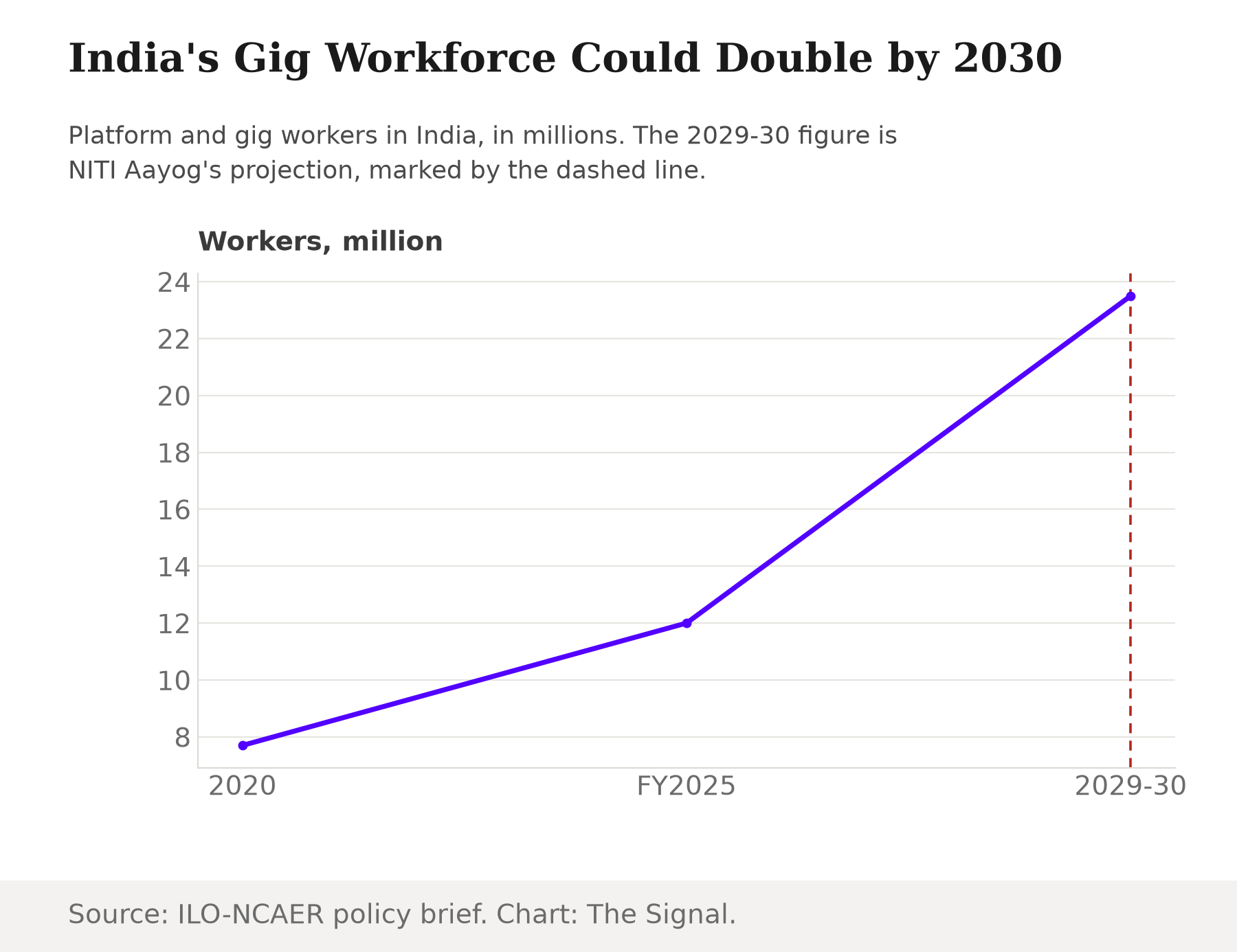
India's platform and gig workforce has been on a steady climb. The number of platform workers rose from about 7.7 million in 2020 to roughly 12 million by FY2025, the year to March 2025, a joint ILO-NCAER policy brief reports, citing India's Economic Survey 2025-26. A 2022 NITI Aayog study projects that workforce will nearly double again, to 2.35 crore (23.5 million) workers by 2029-30, equal to about 6.7 percent of India's non-agricultural workforce, an ILO report on India's gig economy states.
The pitch behind that growth has always been the same one: gig work is the low-barrier door into earning an income. No degree required, no fixed hours, just a phone and a willingness to work. If that door opened evenly, the workforce walking through it should look roughly like India's adult population. It does not.
It is worth slowing down on who actually fills these jobs. Globally, women make up roughly 38 percent of workers on online, web-based labour platforms, but only about 10 percent of workers on location-based platforms such as ride-hailing and delivery, the ILO-NCAER brief notes, citing ILO's 2025 estimates. India's own numbers are starker. A 2025 field study of two-wheeler delivery drivers across India's urban areas found that drivers are predominantly young men, averaging 28 years old, with less than 1 percent of drivers being women. The kind of gig work growing fastest, delivery and ride-hailing, is precisely the kind women are most absent from. India's own web-based gig work tells the same story in miniature: in 2020, women made up 28 percent of India's independent online freelance workforce, against 41 percent in the United States, Oxford Internet Institute's Online Labour Observatory found. Even that admittedly dated, pre-pandemic-recovery figure is worlds apart from under 1 percent. Women in India already cluster in the platform work that asks for a laptop and a login rather than a vehicle and a road; the gap is narrower wherever the entry cost is lower.
That absence is not for lack of a bank account. Women's account ownership in India rose from about 43 percent in 2014 to about 89 percent in 2024, nearly closing the gap with men, who stood at 88 percent that year, per World Bank Global Findex data cited in the brief. If a missing bank account were the barrier keeping women off these platforms, the gender gap in gig work should already be closing alongside it. It has not.
The account gap closed. The skills gap did not
Owning an account and being able to use one for anything beyond receiving a deposit are different achievements. Only 25.2 percent of Indian women aged 15 and older could complete an online banking transaction in the 2022-23 survey year, against 47.1 percent of men, a gap of nearly 22 percentage points, MoSPI's national digital-literacy survey found, as cited in the brief. The rural divide ran wider still that same year: just 17.1 percent of rural women could bank online, against 39.2 percent of rural men.
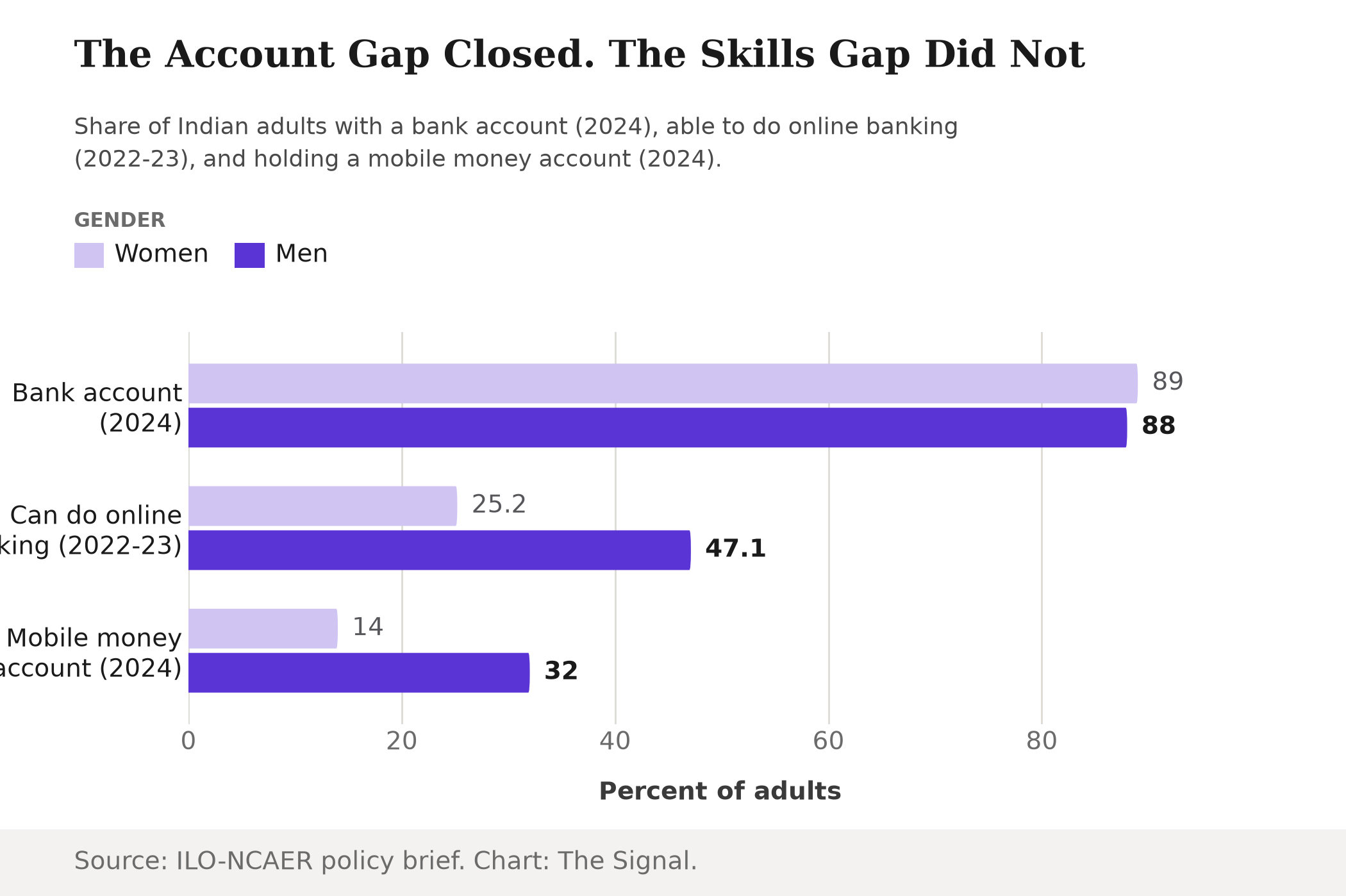
Platform work runs on exactly this kind of skill: an app account, UPI or wallet-linked payouts, and navigating a ratings and routing interface independently. Owning a phone that can run the app is not the same as being able to do any of that. India's gender gap in mobile money accounts, the wallets many platforms use to pay out earnings, was 18 percentage points in 2024, with 32 percent of men holding one against 14 percent of women. That gap is three times the corresponding global gender gap of 6 percentage points. A near-closed account-ownership gap sits beside a wide-open gap in the specific digital tool platform work actually requires.
The capital gap that keeps women off the road
Every rung of the capital ladder into platform work is harder for a woman to climb.
| Barrier to entering platform work | Women | Men |
|---|---|---|
| Lack capital for a platform-entry investment, such as a vehicle (2022) | 52% | 40% |
| Share of outstanding bank credit to individuals (March 2023) | 22.9% | 77.1% |
| Share of sanctioned loan value from digital NBFCs (Dec 2025) | 18% | 82% |
Source: ILO-NCAER policy brief, citing CGAP research, Reserve Bank of India data, and a Fintech Association for Consumer Empowerment report. Men's shares of credit and loan value are the remainder.
CGAP's 2022 research found 52 percent of women report lacking the capital for this kind of platform-entry investment, against 40 percent of men. Credit to close that gap is itself unevenly distributed: women accounted for only 22.9 percent of outstanding bank credit to individuals in India as of March 2023, Reserve Bank of India data show. Even the newer digital lenders, pitched as a faster route around traditional bank gatekeeping, have not closed it: women received only 18 percent of total sanctioned loan value from digital NBFCs, per a December 2025 industry report. A woman who cannot borrow against her income the way a man can is a woman who cannot buy the scooter that gets her onto the platform in the first place.
The honest objection
The strongest case against this reading is that part of the gender gap in delivery and ride-hailing work reflects preference and family pressure, not access: outdoor, informal, late-hour work carries safety concerns and social friction that many households weigh against a woman taking it, regardless of what is in her wallet or on her phone. That case is real, and no figure in this brief measures preference directly, so it cannot be ruled out.
But that case does not explain why these specific, addressable shortfalls, in digital banking skill, in mobile money adoption, in credit access, are each so wide and land precisely on the tools a platform job needs to function. A preference-only story would predict a similar gender gap whether or not a woman already banks online, already holds a mobile wallet, or already has access to credit. Instead, those particular capacities are missing at scale, right where the work itself demands them. Preference may explain part of the gap. It does not explain why the measurable part lines up this closely with the tools gig work runs on.
The Signal
The gig economy's pitch was never really "a phone." It was a phone with a data plan, a bank account a person can actually operate online, a mobile wallet to receive same-day payouts, and enough borrowing power to buy the vehicle the job requires. India has closed only one of those gaps, and NITI Aayog still expects the platform workforce to keep expanding fast this decade. If that growth keeps arriving the way it has so far, concentrated in delivery and ride-hailing, it will mostly add men. The number worth watching next is not how large the platform workforce gets. It is whether the workers who join it look any different from the ones already on it, or whether the same digital and financial gaps just scale up with the headcount.
Reporting basis: nearly every figure in this piece is drawn from a single joint ILO-NCAER policy brief, "Advancing Women's Digital Financial Inclusion in the Platform Economy," published in August 2026, which itself compiles data originally reported by India's Economic Survey 2025-26, a global financial-inclusion database, a national digital-literacy survey, a central bank, and other named research bodies and industry groups. The 2029-30 workforce projection is from a separate ILO report citing a 2022 NITI Aayog study. The 28 percent/41 percent India/US comparison of women's share of online freelance work is from Oxford Internet Institute's Online Labour Observatory, based on 2020 Online Labour Index data, the oldest figure cited here and included despite its age because no more recent India-specific breakdown of this kind was found. Because nearly every other figure is relayed through the one brief, the underlying primary datasets have not been independently re-verified here; the brief is treated as an accurate compiler of the sources it names. The men's shares of bank credit and digital-lending value in the table are The Signal's calculations, the remainder after subtracting the reported women's share.