
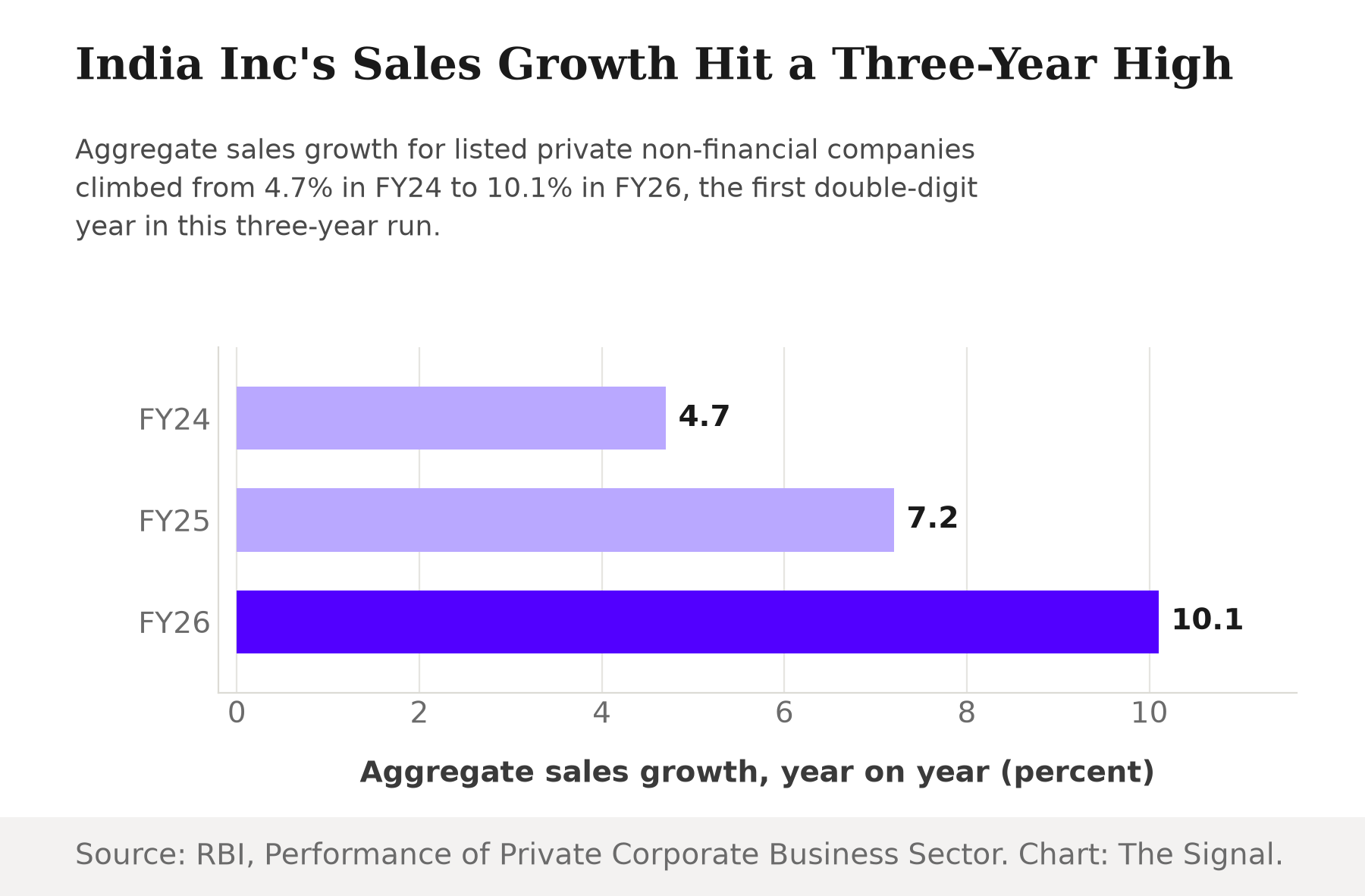
India's listed companies just closed their strongest sales year in a while. The Reserve Bank of India's report on the private corporate business sector states that listed private non-financial companies recorded a double-digit sales growth of 10.1 per cent in 2025-26, the fiscal year ended March 2026. It is happening alongside a strong macro headline: MoSPI's provisional estimates of national income report that real GDP grew 7.7% in 2025-26, with nominal GDP up 8.9% the same year. Read only the top line and the story writes itself: India Inc had a very good year.
That 10.1% is a genuine break from trend, not a one-off blip. The RBI's report on the year before states that sales growth for the same set of companies improved to 7.2% in 2024-25, up from a low of 4.7% in 2023-24. Three years, three accelerating prints, and 2025-26 is the first to cross into double digits.
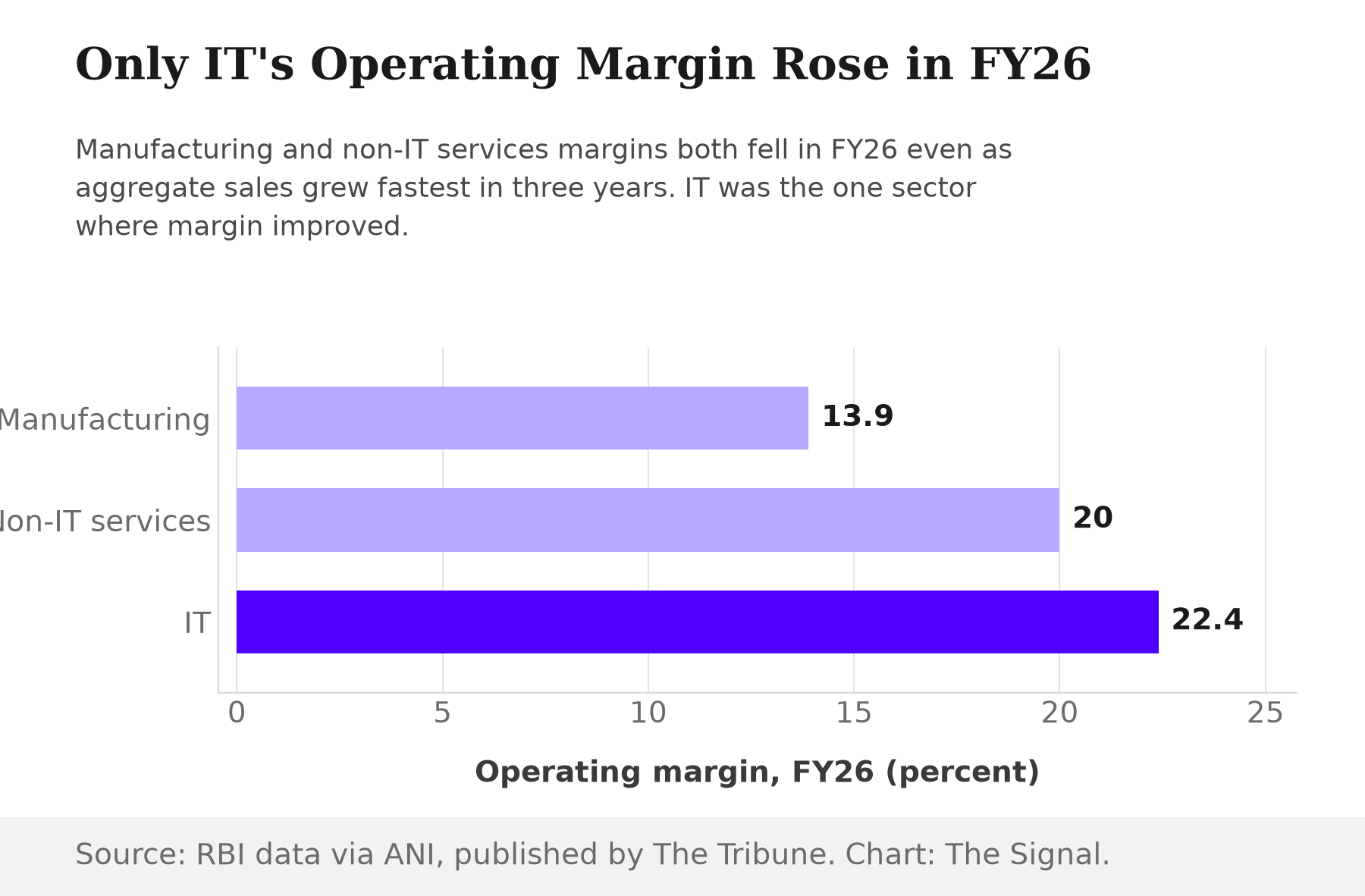
It is worth slowing down on that trajectory, because a faster top line does not automatically mean fatter profit. Break the same fiscal year down by sector and the operating-margin picture splits in two rather than moving together. RBI data carried by ANI and published in The Tribune show that in 2025-26, manufacturing's operating margin fell 30 basis points to 13.9%, non-IT services fell 210 basis points to 20.0%, while IT companies' margin improved 50 basis points to 22.4%. Two of the three broad segments of India's listed corporate sector got a smaller slice of a bigger pie. Only one got a bigger slice too.
A cost base that looks nothing alike across sectors
Part of why the same fiscal year can pull sectors in opposite directions is that they do not carry the same cost structure to begin with. The RBI's Q1:2024-25 release on the corporate sector reports that, as of the first quarter of 2024-25, staff cost stood at 5.8% of sales for listed manufacturing firms, 49.1% for IT firms, and 11.0% for non-IT services firms.
Staff cost eats a very different share of revenue by sector.
| Sector | Staff cost as a share of sales, Q1 2024-25 |
|---|---|
| Manufacturing | 5.8% |
| IT services | 49.1% |
| Non-IT services | 11.0% |
Source: The Reserve Bank of India's Q1:2024-25 corporate sector release.
That gap matters for reading the margin split. IT is the one segment where staff cost is close to half of sales, 49.1% as of Q1 2024-25, so a swing in staff cost moves its margin more than almost anything else on the income statement. Manufacturing and non-IT services carry far lighter wage bills relative to sales. That makes their 2025-26 margin declines less likely to be a pure staff-cost story and more likely to run through something else entirely, most plausibly the cost of materials and other inputs.
What the same slide looked like a year earlier
The RBI's report for 2024-25 gives a closer look at that "something else." TaxGuru's summary of the RBI's report for 2024-25 states that manufacturing's staff cost rose 10.0% during 2024-25, outpacing the sector's 6.0% sales growth, itself up from 3.5% the year before, while its operating margin moderated 20 basis points to 14.2%. The same summary reports that the raw material to sales ratio rose to 55.7% in 2024-25 from 54.2% the year before. Both costs climbed faster than sales in 2024-25, and margin gave ground on both fronts at once.
Set that 14.2% figure for 2024-25 next to 2025-26's reported 30 basis point manufacturing decline to 13.9% and the two figures describe the same slide continuing: a margin near 14.2% in 2024-25, and 13.9% a year later. What changed between the two years is the sales line underneath it. In 2024-25, sales grew 6.0% while margin still fell. In 2025-26, sales grew a much faster 10.1% at the aggregate level, and manufacturing's margin still fell, just by less. Faster revenue growth did not undo the squeeze. It only slowed it down.
The honest objection
The strongest case against reading this as a broad cost squeeze is that the 2024-25 data do not point to labor alone. The raw material to sales ratio rose alongside staff cost in 2024-25, which means input costs, not wages, absorbed a real share of the pressure on margin. On that reading, manufacturing and non-IT services are working through a commodity and input-cost cycle common to capital-intensive and materials-heavy businesses everywhere, not a story specific to how much Indian companies pay their workers.
That case has real weight, and the sector staff-cost baseline actually supports it. Manufacturing and non-IT services carry staff cost of only 5.8% and 11.0% of sales respectively, too small a base for wages alone to explain a 210 basis point margin swing in non-IT services in 2025-26. Something with more heft in the cost structure, most plausibly materials and other operating costs, has to be doing most of the work.
That is no longer just an inference from the year-old baseline. RBI data carried by Upstox show that in 2025-26 itself, raw material expenses for manufacturing companies grew 12.0% and the raw material-to-sales ratio climbed further, to 57.6% from 55.7% the year before, continuing exactly the input-cost trend already visible in 2024-25. Staff cost moved differently: it grew 10.7% in manufacturing, 6.1% in IT and 9% in non-IT services in nominal terms, but the staff cost-to-sales ratio stayed broadly stable in manufacturing and declined in services rather than rising. A cost ratio that holds flat or falls is not what a wage-driven margin squeeze looks like. 2024-25's numbers alone could not answer the wage question. 2025-26's own release settles it: the pressure on manufacturing and non-IT services margin is coming from materials and other costs, not from paying workers a bigger share of sales.
The Signal
The headline numbers for 2025-26, a return to double-digit sales growth and 7.7% real GDP growth, describe a corporate sector that is genuinely growing faster than it has in years. But growth and margin are not the same claim, and the RBI's own sector data show them moving apart for two of three segments even as the top line accelerated. Manufacturing and non-IT services, the two segments with the lightest wage bills relative to sales, are the ones whose margins shrank. IT, the segment most exposed to staff cost, is the one where margin grew. That is the opposite pairing a straightforward wage-squeeze story would predict, and the 2025-26 data itself now backs the raw-material read directly: the raw material-to-sales ratio kept climbing, to 57.6% from 55.7%, while the staff cost-to-sales ratio held flat or fell. India Inc's faster sales are not, on this evidence, translating into a bigger wage share of that revenue; they are being absorbed by materials and other input costs before they even reach the margin line, let alone workers' paychecks.
Reporting basis: the 2025-26 aggregate sales growth figure and the 2024-25 comparison are from the Reserve Bank of India's own press releases on the performance of the private corporate business sector. The Q1:2024-25 sector staff-cost ratios are from a separate RBI release in the same series. The 2025-26 sector-level operating margins are RBI data as carried by ANI and published by The Tribune, drawing on the same underlying RBI report rather than independent reporting. The 2024-25 staff-cost, sales-growth, and raw-material figures are as summarised by TaxGuru from the RBI's report for 2024-25. The 2025-26 raw-material and staff-cost ratios are RBI data as carried by Upstox, drawing on the same underlying RBI report. Real and nominal GDP growth for 2025-26 are from MoSPI's provisional estimates of national income. The observation that the 2024-25 and 2025-26 manufacturing margins describe a continuous decline is The Signal's own reading of those two RBI-sourced figures side by side.