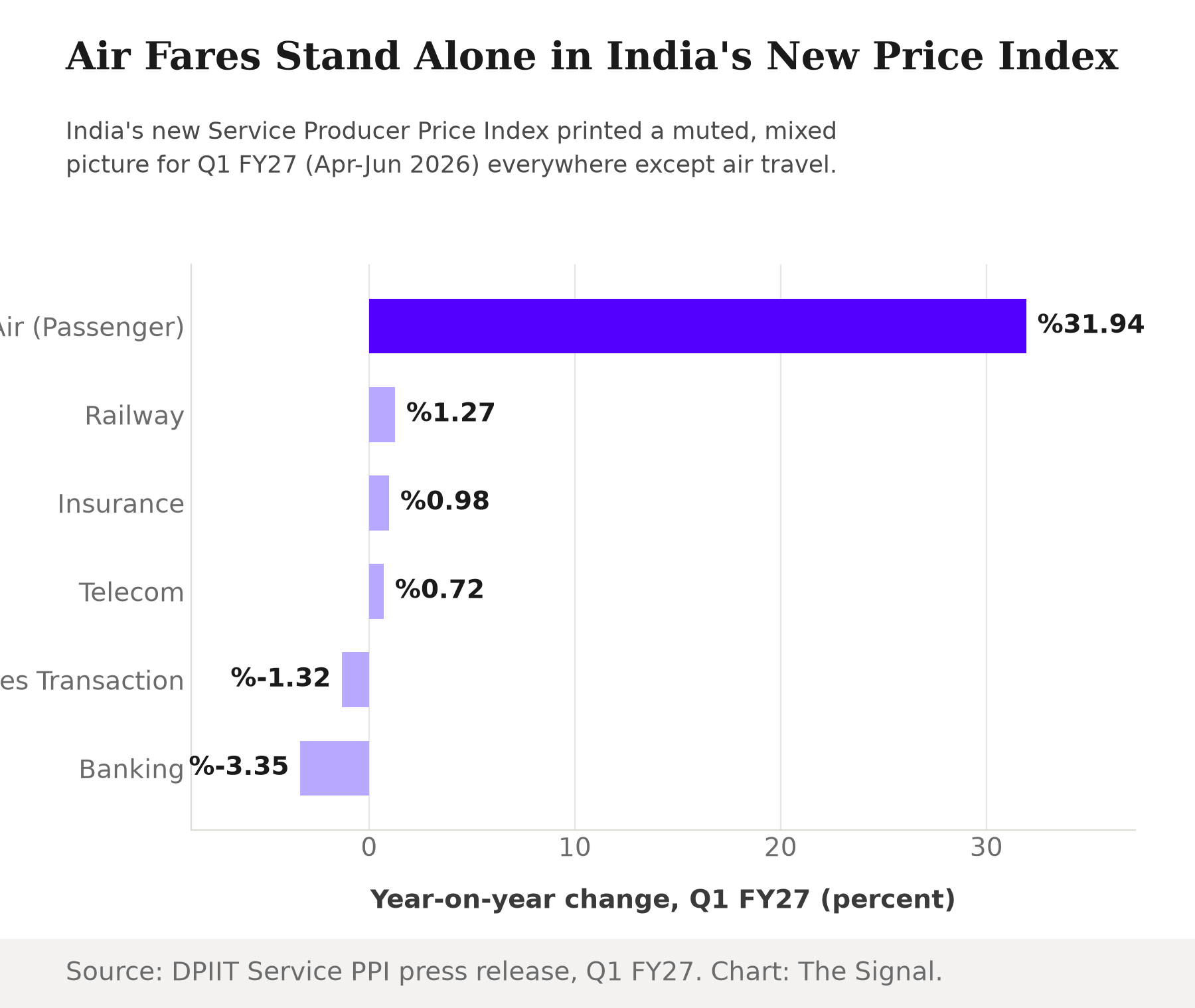
India got a new economic instrument today, and on the surface it reads like a shrug. The Office of the Economic Adviser, DPIIT released the country's first quarterly Service Price Index for Q1 FY27, the April to June 2026 quarter, a wholesale-level gauge of what businesses charge each other across seven services, from banking and insurance to telecom, railways and air travel. Read the rest of the basket and the debut looks uneventful: banking prices actually fell 3.35% year-on-year, telecom rose just 0.72%, insurance 0.98% and railway 1.27%, and securities transaction charges fell 1.32%, a muted, mixed print that would not normally make news on its own.
The one outlier in a calm basket
It is worth slowing down on that read. Pull one line out of that basket and the picture flips entirely.
India's Air (Passenger) Service Price Index climbed to 126.4 in Q1 FY27 from 106.9 in Q4 FY26, the January to March 2026 quarter, a year-on-year jump of 31.94%, by far the sharpest move of any of the seven services the new index tracks and an outright reversal of the calm the rest of the basket shows. This is the first year-on-year figure the young series has been able to compute, and it lands nowhere near the other six.
Wholesale air fares, in other words, are repricing on a trajectory separate from the rest of the services economy.
What the consumer price index cannot show
The natural comparison is India's Consumer Price Index, the retail-facing gauge most readers already track. The CPI's "Transport" division, which blends vehicle purchases, fuel and passenger transport across every mode into one number, rose just 4.43% year-on-year in July 2026, the most recent month reported. Narrow it further to "Passenger transport services," which still blends air, rail and road travel rather than isolating air fares specifically, and the increase is smaller still, just 2.90% year-on-year. Headline CPI inflation for that same month was 4.45%. Against a 31.94% wholesale move in air fares specifically, that is roughly seven times the Transport division's pace and nearly eleven times the narrower passenger-transport group's.
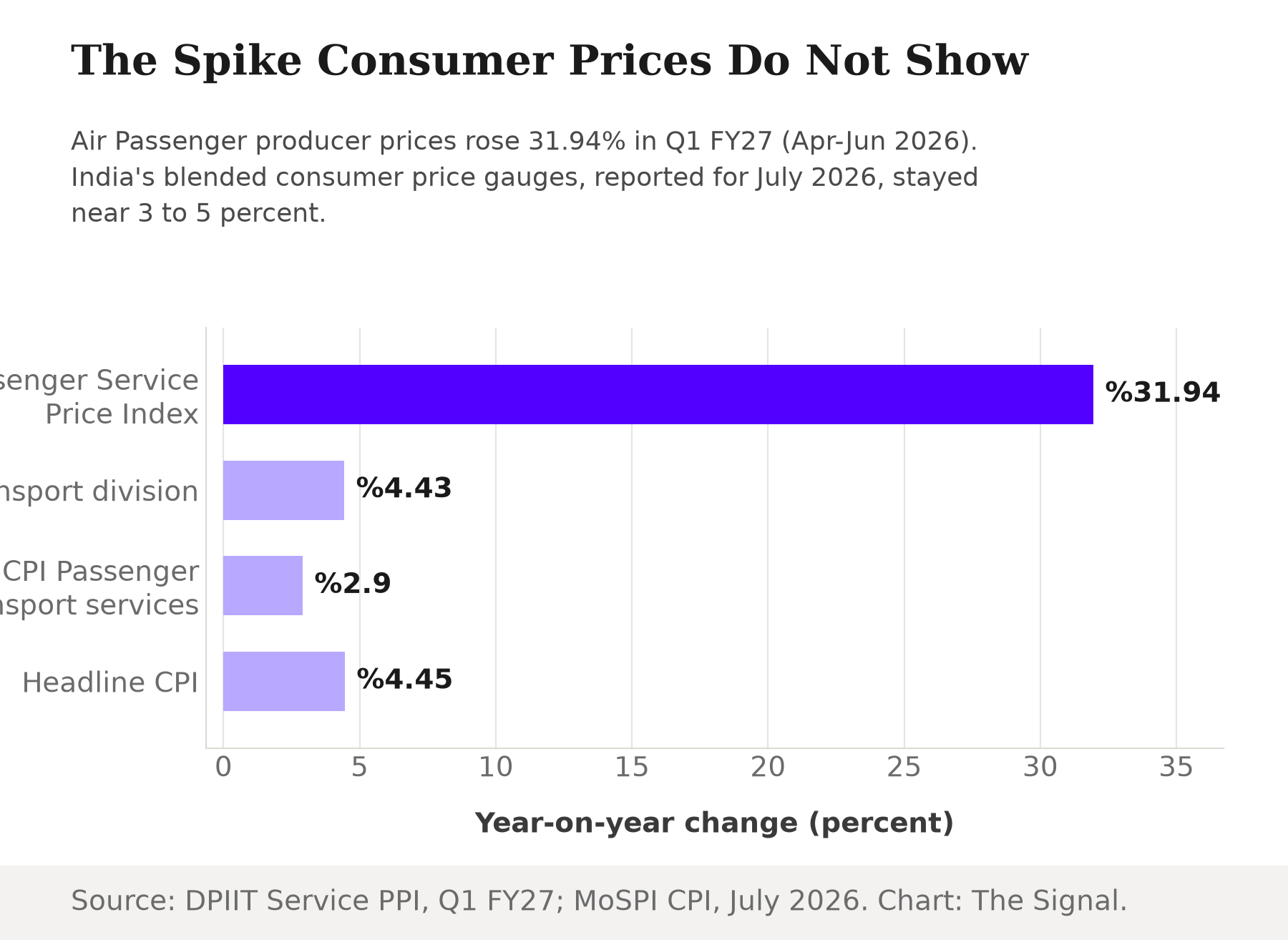
The gap reflects a design difference between the two series, not a measurement error. The CPI is built to price what an average household actually buys, so it blends every mode of passenger transport into one line and gives that line a modest weight in the average consumer's basket. The producer gauge does the opposite: it prices what one specific service costs at the wholesale level, sector by sector, with nothing else mixed in. A blended, economy-wide consumer gauge was never going to isolate a single sector's move the way a sector-specific wholesale gauge can.
A young instrument, its second reading
That design difference matters more given how new this series is. The Service Price Index framework was launched in June 2026 with a base year of 2022-23, which makes today's Q1 FY27 print only the second quarterly reading of an entirely new statistical series. A single outlier reading this early is a real data point, but it is not yet a trend with a track record. The instrument itself is still establishing its own baseline.
The honest objection
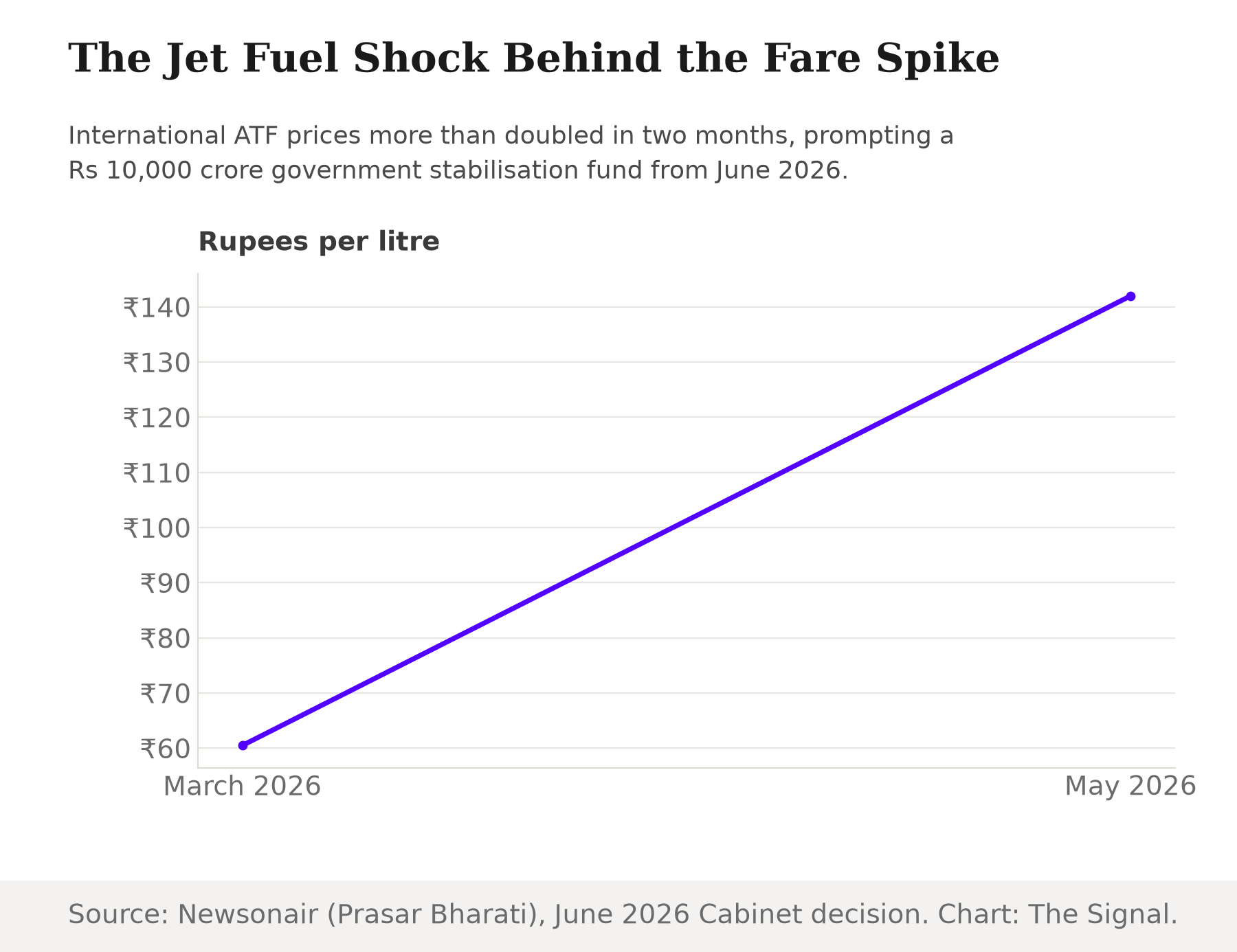
The strongest case against reading this as evidence of airlines exercising fresh pricing power is that the whole move may simply be a mechanical pass-through of a fuel cost shock, not repricing behavior at all. International ATF prices rose two and a half times in two months, from Rs 60.5 per litre in March 2026 to Rs 142 per litre in May 2026, prompting the Union Cabinet to approve a one-time, self-sustaining Rs 10,000 crore ATF Price Stabilisation Fund in early June 2026, in force for 36 months. On that reading, airlines were absorbing an extraordinary, temporary input shock, the government had already moved to shield them before the quarter even closed, and the 31.94% print is a snapshot of a cost spike already being unwound rather than a durable repricing.
That mechanism has a name and a company-level paper trail. IndiGo, which held a 66.3% domestic market share in June 2026, raised its passenger yield 21.3% year-on-year to Rs 6.04 per revenue passenger-km in Q1 FY27, even as its load factor fell to 83.3% from 84.6% a year earlier, its aircraft fuel expenses jumped 85.7% to Rs 1,083.29 crore, and the airline still posted a net loss of Rs 238 crore despite 19.9% revenue growth. That is a carrier raising fares to cover a fuel bill, filling proportionally fewer seats even as prices rose, not one riding a wave of new demand. The demand side backs that reading up: domestic air passenger traffic grew just 1.44% year-on-year in H1 2026 and fell 1.03% month-on-month in June, DGCA's own traffic data show, a soft travel backdrop nowhere close to a boom that could explain a 31.94% fare jump on its own.
That case is real, and it likely explains much of why air fares specifically moved rather than some other service. But it does not undo the actual finding here. Whatever caused the spike, cost shock or demand or both, the CPI's Transport division and Passenger transport services group covered that identical window and still printed 4.43% and 2.90%. The steelman explains why air fares jumped. It does not explain how a reader watching only the consumer price gauge would ever have seen that jump coming.
The Signal
The headline number from today's release is calm on purpose: a new wholesale price gauge, one sector moving hard while six others barely stir, is exactly what a properly designed instrument should show when only one part of the economy is actually repricing. Frequent flyers already knew air travel got expensive; that was never the point. The point is that India's main inflation gauge, the one that sets the public conversation on the cost of living, structurally cannot surface a move like this on its own, because it was built to blend, not to isolate. Watch the next two quarterly prints. If the Air Passenger reading cools once the ATF stabilisation fund has had a full quarter to work, this was a fuel shock passing through a new measurement window. Persistence past that point would mean the new gauge caught something the consumer price gauge was never going to see.
Reporting basis: the Service Price Index figures for Q1 FY27, including the Air (Passenger) reading and its year-on-year rate, and the year-on-year rates for banking, telecom, insurance, railway and securities transaction, are from the Office of the Economic Adviser, DPIIT's own press release. The Consumer Price Index figures, the Transport division, the Passenger transport services group and the headline rate, are from the National Statistics Office, MoSPI's press release for July 2026. The ATF price move and the Rs 10,000 crore stabilisation fund are as reported by Newsonair, the government's own news service, on the Union Cabinet's decision. The launch date and base year of the Service Price Index framework are per a single Open magazine report, the only source for that context. IndiGo's yield, load factor, fuel expense and net loss figures are from InterGlobe Aviation's own Q1 FY27 earnings presentation. IndiGo's June 2026 market share and the DGCA's domestic passenger traffic figures for H1 2026 are from the DGCA's own traffic data report, as carried by Press Trust of India. The seven-times and nearly-eleven-times comparisons between the Air Passenger reading and the CPI's Transport division and Passenger transport services group are The Signal's calculations from those figures.