On August 3, 2026, India's civil aviation ministry told the Rajya Sabha that Akasa Air had logged more significant technical defects than any other Indian carrier: 152 between January and June 2026, against 47 for IndiGo and 53 for Air India Express, out of 352 reported industry-wide. The same reply disclosed that DGCA issued 382 show-cause notices to airlines for safety violations between January 2024 and June 2026, and that the industry-wide tally of significant defects from 2023 through June 2026 reached 2,420. Coverage of the numbers wrote itself: India's newest full-service carrier, barely four years old, was breaking down more than the country's largest airline.
Akasa Air reported 152 significant defects in six months. IndiGo, flying eleven times as many planes, reported 47.
It is worth slowing down on that comparison before accepting it. IndiGo operated 432 aircraft as of June 30, 2026, roughly eleven times the size of Akasa's fleet in the same period, while Akasa's fleet stood at 39 aircraft as of June 22, 2026, the point through which the defect data was reported. A raw defect count with no fleet size attached is not a reliability figure. It is closer to comparing two factories' total defective units without saying how many units each factory made.
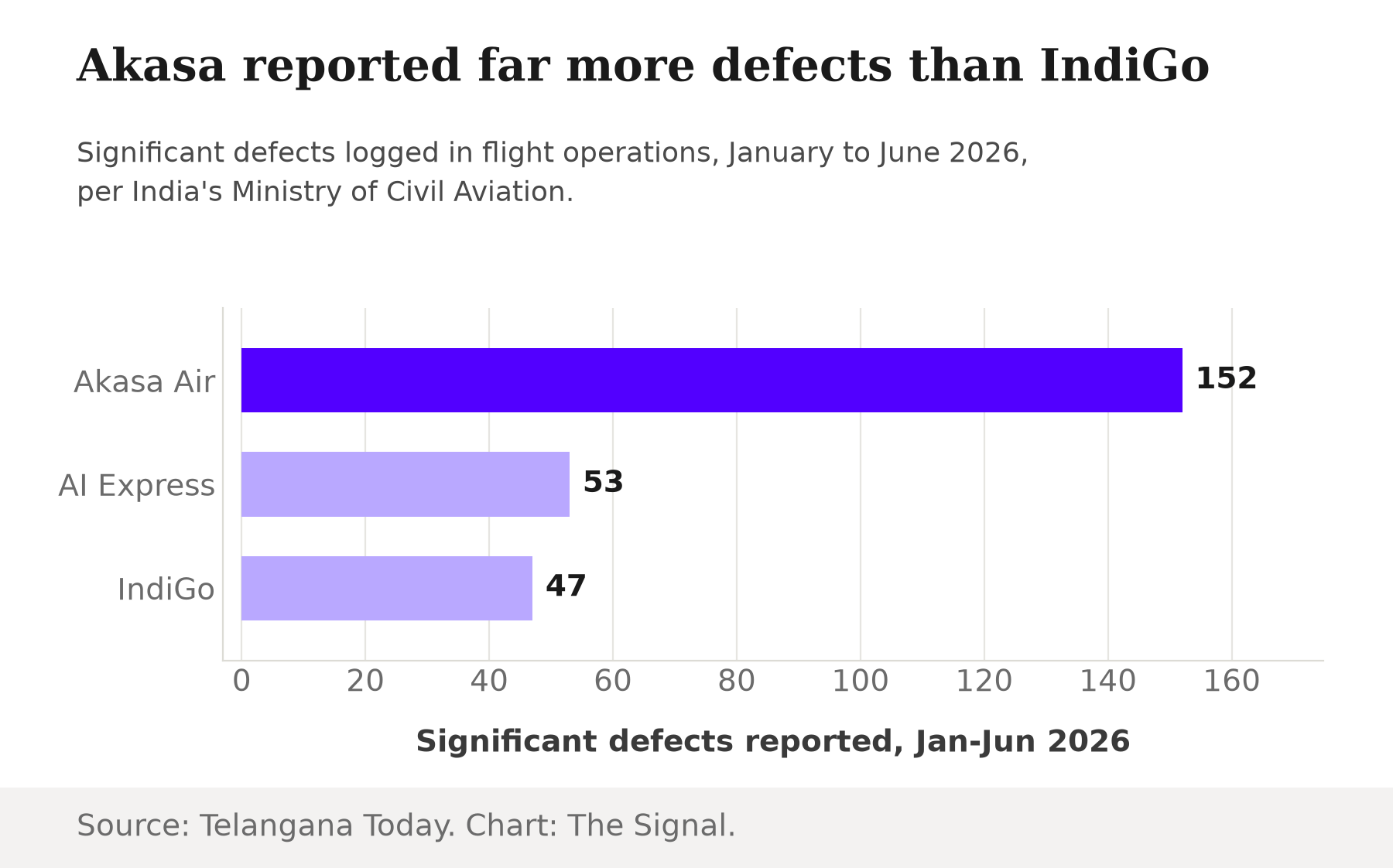
Normalize for fleet size and the picture gets more extreme, not less. Akasa's 152 defects across its 39 aircraft work out to about 3.9 significant defects per plane over the six months; IndiGo's 47 defects across its 432 aircraft work out to about 0.11 per plane, a gap of nearly 36 times (our calculation, from those figures). Read only that number, and Akasa looks far worse per aircraft than the raw 152-versus-47 comparison implies, not better.
The audit that tells a different story
A separate DGCA exercise complicates that reading. An audit found 377 of 754 scheduled-airline aircraft examined since January 2025 flagged for repetitive defects, nearly half the fleet reviewed, current as of February 2026. Broken out by carrier, 148 of IndiGo's 405 examined aircraft were flagged, about 37 percent, versus 14 of Akasa's 32, about 44 percent, a far narrower gap than the raw significant-defect counts suggest.
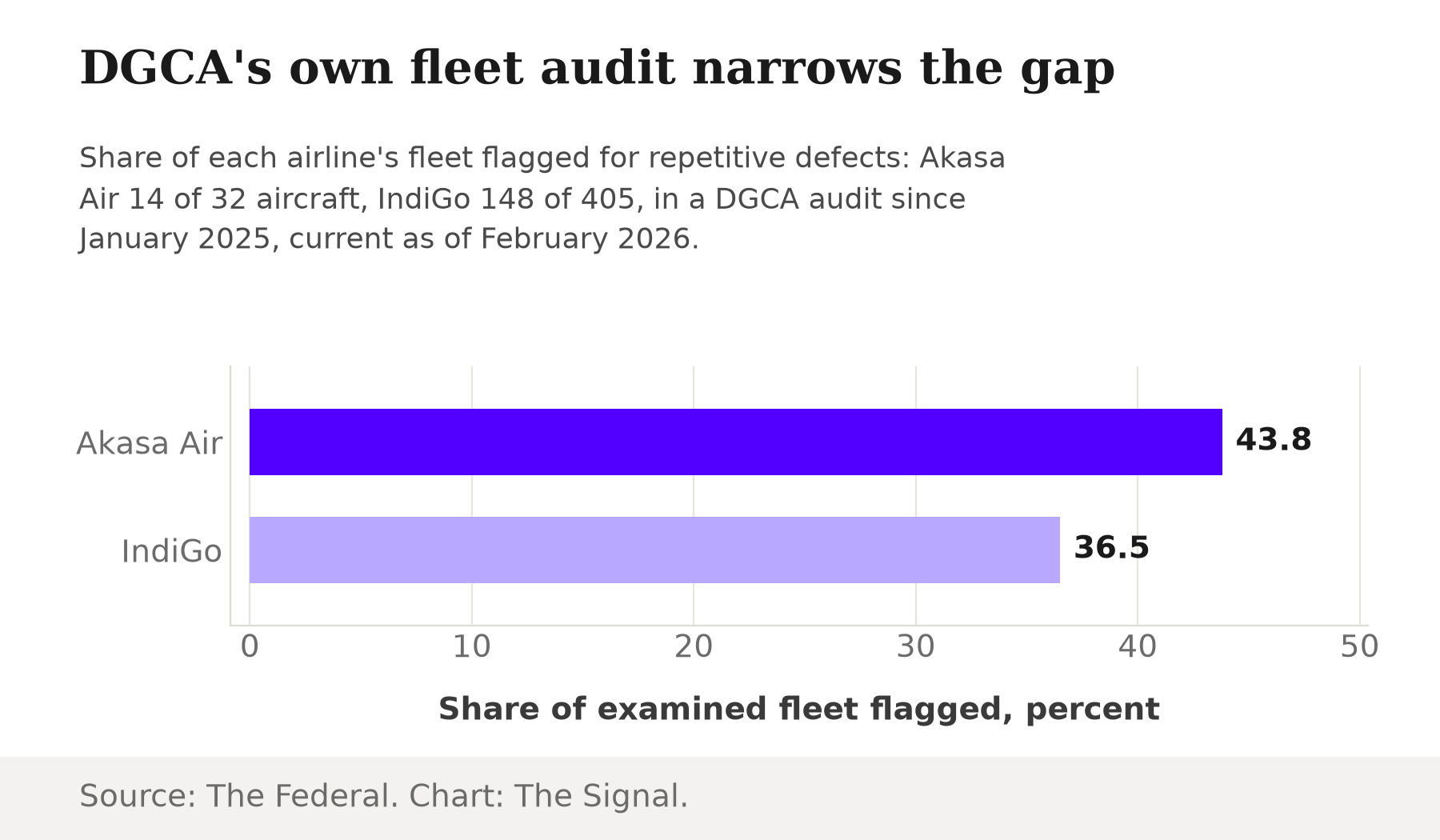
That is a genuinely different result. The significant-defect count, which airlines self-report as incidents occur, puts Akasa's rate at roughly 36 times IndiGo's per aircraft. DGCA's own repetitive-defect audit, which examines the fleet directly rather than relying on incident-by-incident self-reporting, puts the gap at closer to 1.2 times. Those two figures describe overlapping but not identical windows: the audit spans aircraft examined since January 2025, while the significant-defect count covers January to June 2026 alone. The exact ratios should be read as illustrating the scale mismatch, not as a precise conversion between the two measures. But a mismatch that large, between a metric an airline compiles about itself and a metric DGCA compiles by examining the aircraft, is itself the finding.
| Akasa Air | IndiGo | |
|---|---|---|
| Fleet size | 39, as of June 22, 2026 | 432, as of June 30, 2026 |
| Significant defects, Jan-Jun 2026 | 152 | 47 |
| Defects per aircraft (our calculation) | about 3.9 | about 0.11 |
| Repetitive-defect audit share | 43.8% (14 of 32) | 36.5% (148 of 405) |
Fleet and significant-defect figures from India Infoline, Daily Excelsior and Telangana Today; repetitive-defect audit shares from The Federal, citing DGCA's annexure to Parliament. Per-aircraft rates are The Signal's calculations.
What Akasa says, and what DGCA's own findings suggest
Akasa Air's CEO, Vinay Dube, has attributed the airline's high significant-defect count to its reporting culture rather than to worse aircraft reliability, saying the airline "takes great pride in its safety and safety reporting culture and this is a reflection of that", as of August 2026. That is the airline's own defense, made by an interested party, and it should be read as a claim rather than a settled conclusion.
It is not, however, an implausible one. DGCA's own comprehensive surveillance at major airports in June 2025 found defects that recurred repeatedly because rectification was ineffective, and cases where defect reports generated by aircraft systems were never even recorded in the technical logbook. That finding, from DGCA itself rather than any airline, points the other way from what a skeptical reading of Akasa's numbers might assume: the documented failure mode in Indian aviation's defect-reporting system is under-recording, not airlines padding their own disclosures to look diligent. If under-recording is the industry's real problem, an airline that logs more, not fewer, significant defects is doing more of what the regulator says is missing elsewhere.
The honest objection
The fleet-adjusted numbers do not fully vindicate that reading either. Even in DGCA's own repetitive-defect audit, the metric least distorted by self-reporting habits, Akasa's flagged-aircraft share is still higher than IndiGo's, 43.8 percent against 36.5 percent, not equal. A reporting-culture story alone should not leave any residual gap once the count is normalized to a comparable, regulator-audited basis; a small one remains. And the scale mismatch between the two metrics, a 36-times gap in raw per-aircraft counts against a 1.2-times gap in audited repetitive-defect shares, is large enough that reporting culture is unlikely to be the entire explanation for either number on its own.
There is also a limit to how much "classification" itself can explain the gap. DGCA's own post-crash tightening of its defect-reporting rules defines a major defect as any fault that reduces the safety of the aircraft or its occupants, and a repetitive defect as one recurring three times within 15 flight cycles despite attempted rectification, a threshold the draft applies uniformly to every scheduled airline, non-scheduled operator and maintenance organisation, not one left to each operator's own discretion. If what counts as significant is meant to be the same yardstick for Akasa and IndiGo alike, then a 36-times per-aircraft gap cannot be waved away as one airline simply drawing its own line more generously than the other.
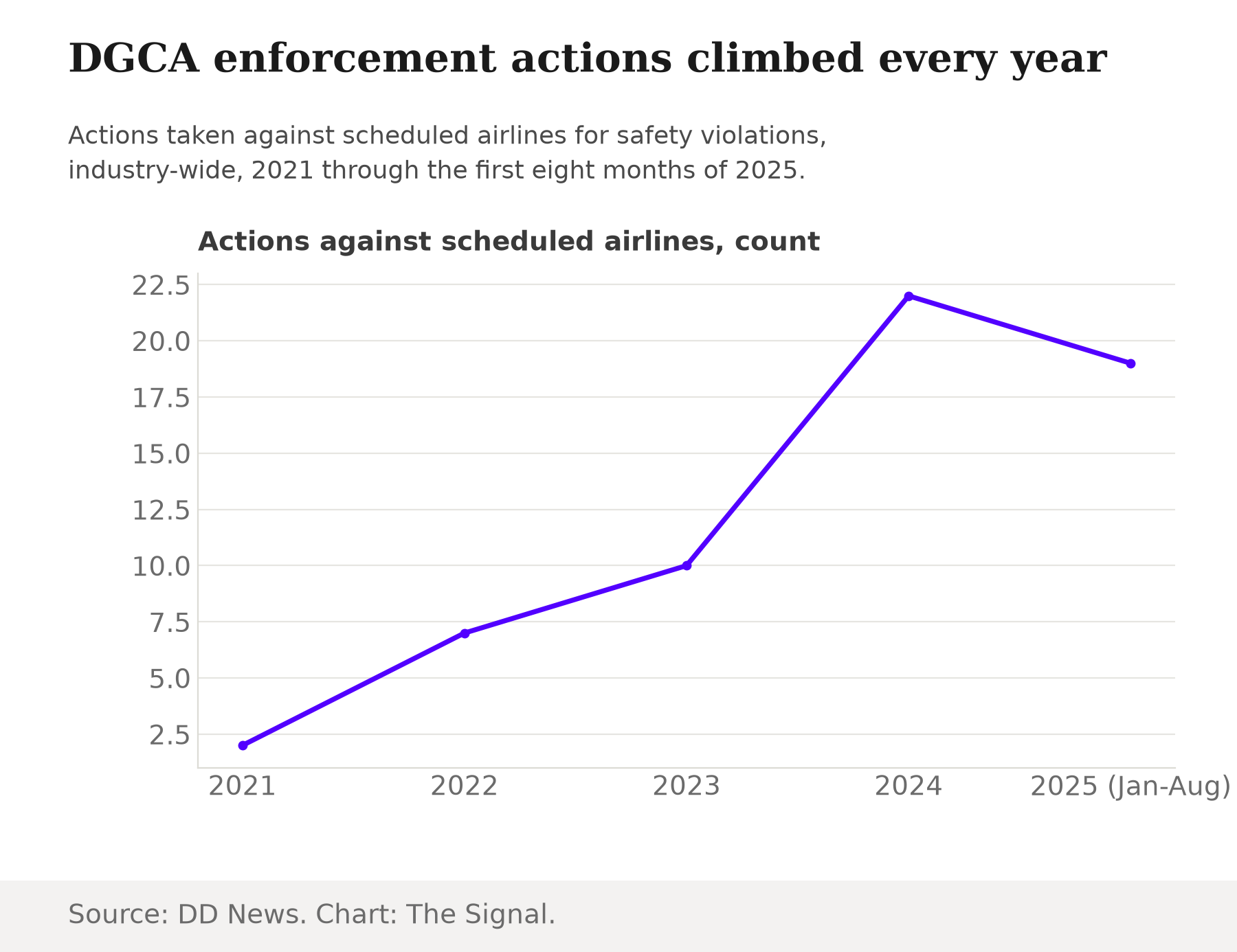
Some of the wider pressure is not specific to Akasa at all. DGCA's enforcement actions against scheduled airlines rose from 2 in 2021 to 22 in 2024, reaching 19 within the first eight months of 2025, a trend that predates and extends beyond this year's Akasa-IndiGo comparison and points to a regulator scrutinizing the whole industry more closely, not singling out one carrier.
The Signal
A defect count with no denominator is not a safety score, it is an unfinished one. The raw 152-versus-47 comparison that made Akasa look like India's most defect-prone carrier collapses once fleet size enters the picture, and DGCA's own audit-based measure, built by examining aircraft rather than trusting incident logs, narrows the reliability gap between Akasa and IndiGo from roughly 36 times to roughly 1.2 times. But 1.2 times is not zero. Anyone reading a defect league table, a traveler, an investor, a regulator drafting the next disclosure rule, should ask what the count is measuring before asking who tops it. Watch whether that narrower, audit-based gap keeps shrinking as Akasa's fleet matures and generates more data, or whether it holds steady even as the airline grows. A count is not a rate until someone divides it.
Reporting basis: the significant-defect figures for Akasa Air, Air India Express and IndiGo, and the 382 show-cause notices, are from the Civil Aviation Ministry's written reply to the Rajya Sabha on August 3, 2026, as reported by Telangana Today, Deccan Chronicle and The Hans India, three separate outlets covering the same parliamentary disclosure. The repetitive-defect audit shares are from DGCA's airline-wise annexure to a separate parliamentary reply, as reported by Lokmat Times and The Federal. Fleet sizes are from India Infoline, reporting IndiGo's Q1 FY27 results, and Daily Excelsior, reporting Akasa's fleet induction. Akasa CEO Vinay Dube's comment is as quoted by the Free Press Journal. DGCA's findings on under-recorded defects are from the Press Information Bureau, and the enforcement-action trend is from DD News, both citing the regulator and the ministry directly. The per-aircraft defect rates, and the roughly 36-times gap in raw significant-defect counts against the roughly 1.2-times gap in DGCA's audited repetitive-defect shares, are The Signal's calculations from those figures.