India's official jobless numbers have been moving in a reassuring direction. The unemployment rate for everyone aged 15 and above held at 3.1% in 2025, and the youth rate, covering those aged 15 to 29, eased to 9.9% in 2025 from 10.3% in 2024, according to the Ministry of Statistics and Programme Implementation's PLFS Annual Report 2025, released via a Press Information Bureau statement. Zoom out further and the picture brightens again: the overall labour force participation rate for people 15 and above climbed to 60.1% in the year to June 2024, up from 57.9% the year before, per the ministry's earlier PLFS Annual Report. More people are in the workforce, and a smaller share of them are stuck without a job.
It is worth asking what that unemployment rate is actually built to see. NITI Aayog's own skilling publication, released in August 2026, puts a very different number next to it.
Two official measures of the same age group describe two different populations of idle people.
Why the rate never sees them
The gap is definitional, not a statistical error. NITI Aayog's report notes that about 88% of the 8.7 crore NEET population is engaged in domestic duties rather than actively searching for a job. India's unemployment rate, like most countries', only counts people who are part of the labour force: those working, or actively looking for work. Someone doing unpaid domestic work, neither employed nor searching, is neither of those things. The survey that produces the unemployment rate does not count them as jobless. It does not count them at all.
A degree does not fix it
Education is often treated as the antidote to exactly this kind of idleness. The data says otherwise: 13% of all Indian graduates, and 20.4% of graduate women specifically, are unemployed, against a national unemployment rate of 3.2% in the same PLFS 2023-24 survey round, per NITI Aayog's report. The gap holds even for graduates who do find work. Only 8.25% of India's graduates are employed in roles that actually match their qualifications, according to the Economic Survey 2024-25 as cited in the same report.
A degree does not reduce joblessness in India's data. It goes with more of it.
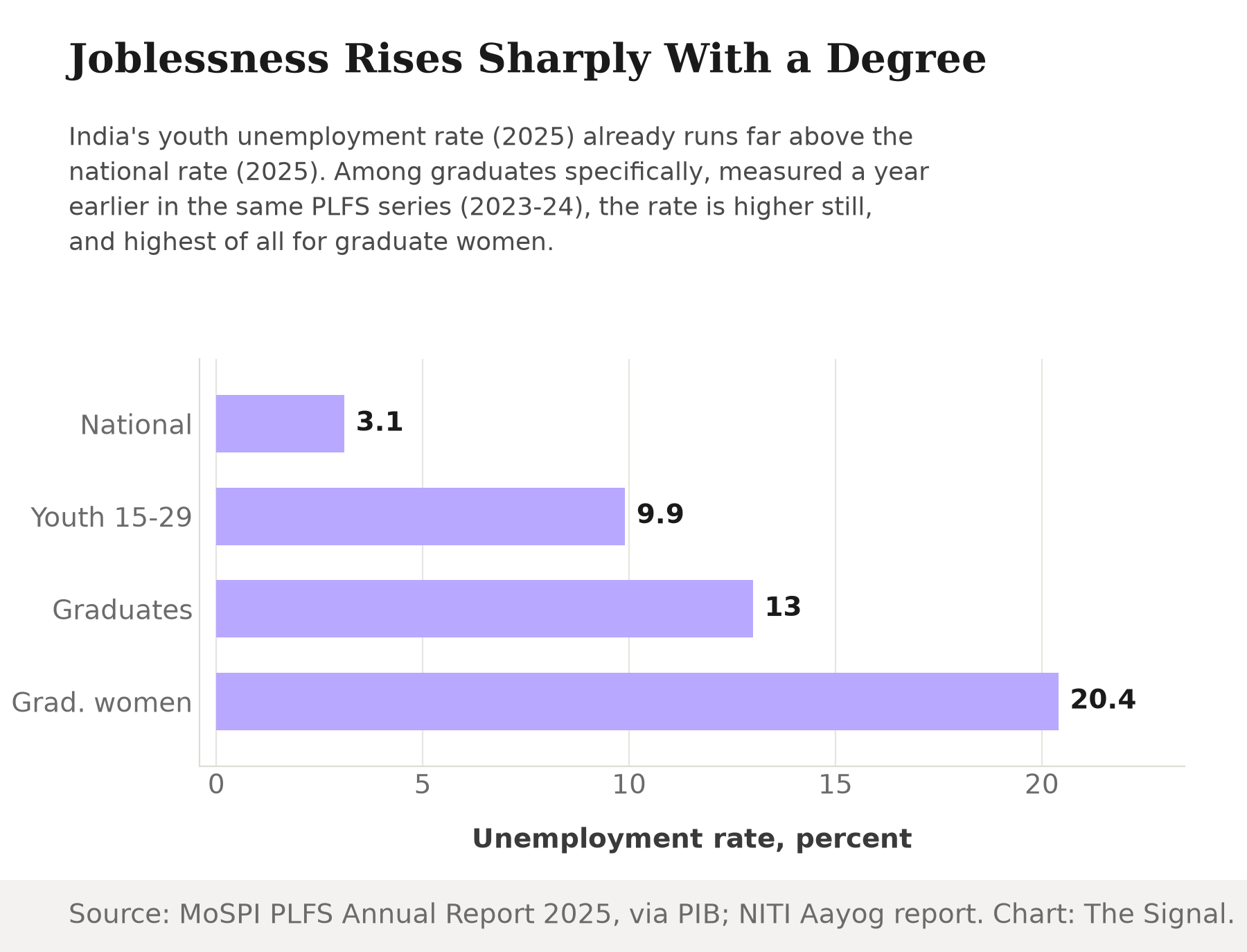
Source: national and youth rates from the Ministry of Statistics and Programme Implementation, PLFS Annual Report 2025, via PIB; graduate rates from NITI Aayog's Reimagining Skilling for Viksit Bharat@2047, citing PLFS 2023-24. Chart: The Signal.
The pattern climbs at every rung: national, youth, all graduates, graduate women, each rate higher than the one before it. On this evidence, a degree does not appear to shorten the wait for work in India's labour market; it lengthens it.
The gap is widest for women
NITI Aayog's report breaks the picture down by gender, and the divide is stark. Among women specifically, just 3% hold formal jobs, while 71% are either in informal work or fall into the NEET category itself. Formal work, the kind with a contract, benefits and legal protection, is the exception for Indian women of working age, not the norm.
The system built to catch them
The government's own skilling infrastructure is not idle either. Since 2014-15, India's national programmes have formally skilled 7.67 crore people, and the Union Budget for FY 2025-26 allocated Rs 34,000 crore in skilling-related expenditure across Central Ministries, per NITI Aayog's report.
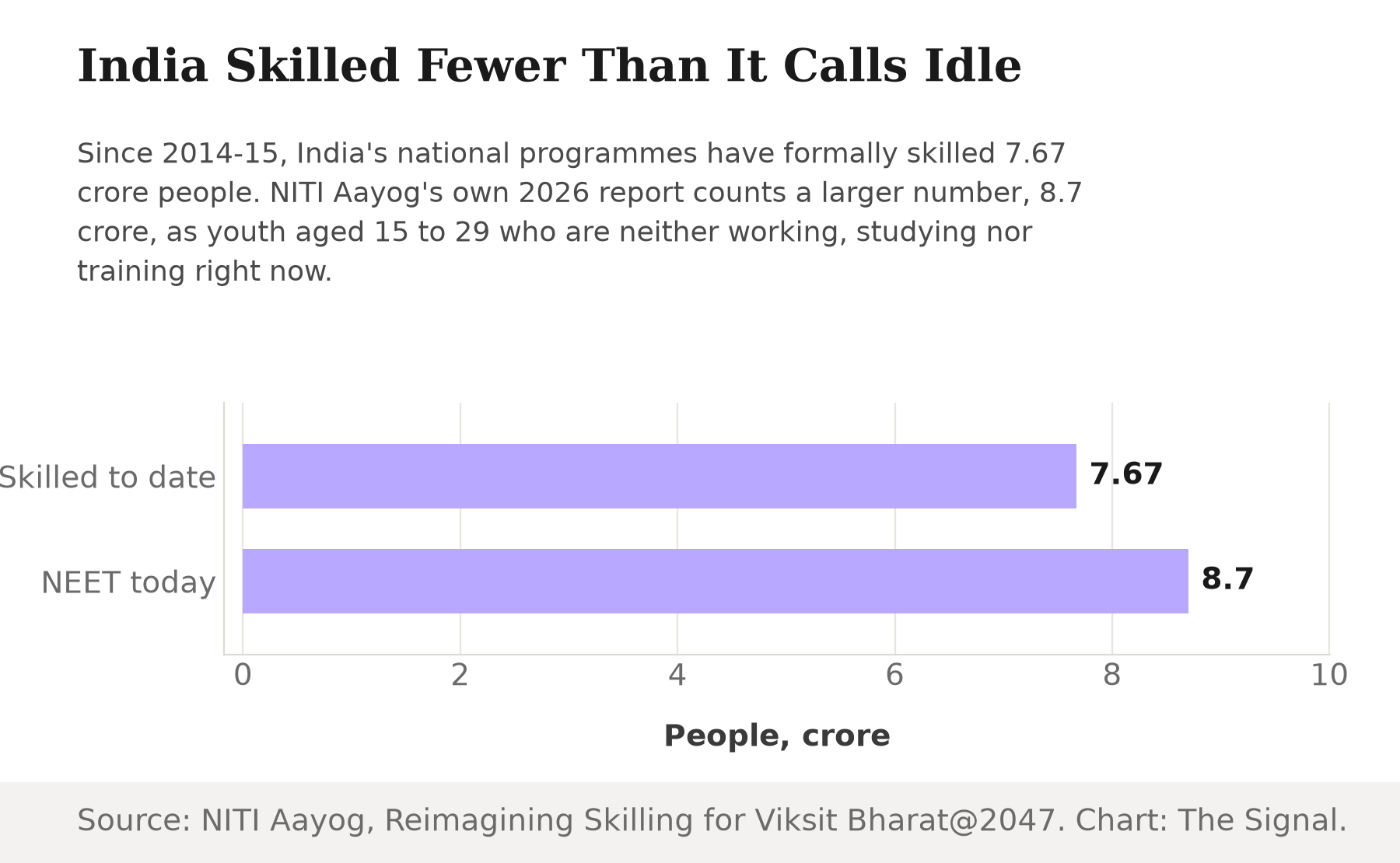
Source: NITI Aayog, Reimagining Skilling for Viksit Bharat@2047 (skilling total) and page 26 (NEET count). Chart: The Signal.
A decade of skilling has not caught up with the current stock of idle youth, and the report's own respondents point to why. 82% of NEET youth report a lack of job-interview-preparation modules and placement tie-ups as a foundational gap in existing skilling programmes, and 43% cite a lack of awareness of the right training programmes among their top three reasons for not pursuing skilling.
The barriers NEET youth describe are about delivery, not desire.
| Barrier NEET youth cite | Share reporting it |
|---|---|
| Lack of interview-prep modules and placement tie-ups | 82% |
| Lack of awareness of the right training programme | 43% |
Source: NITI Aayog, Reimagining Skilling for Viksit Bharat@2047, citing the State of Skills Survey 2024.
Money and training capacity exist. The shortfall sits earlier: whether people know a programme exists, and whether finishing it leads anywhere as concrete as a job interview.
The honest objection
The strongest case against reading 8.7 crore as a jobs crisis is that domestic duties are not automatically distress. A share of that NEET population, particularly women, may be doing unpaid household work by preference or family arrangement rather than being locked out of a job they actively want. On that view, NITI Aayog is comparing two categories that were never meant to be summed: officially unemployed people who are job hunting and failing, and a separate, much larger group who are simply outside the labour force altogether, the same way a stay-at-home parent or a full-time student anywhere is not counted as unemployed.
That case has real force for some share of the 8.7 crore, but the report's own numbers strain against it for the rest. Among women, just 3% hold formal jobs against 71% who are informal or NEET, a gap too wide to read as simple preference, and 82% of NEET youth cite a concrete, fixable barrier, missing interview preparation and placement tie-ups, as the reason they are not in a skilling pipeline that could move them toward work. People citing a specific procedural gap are not describing contentment. They are describing a door they cannot find.
The Signal
The unemployment rate is doing its job. It just answers a narrower question than the one that matters for policy: how many people are actively without work right now despite looking for it. NITI Aayog's own publication asks a different, larger question: how many young Indians are building no skills, earning no wage and gaining no credential at all, whether or not they are looking. That gap, between a headline youth unemployment rate and an 8.7 crore NEET count, is not a contradiction. It is a warning that a jobs policy sized to the narrower rate is calibrated to a fraction of the problem the government's own numbers describe. Watch what the next skilling budget targets. If it is aimed only at raising the count trained, regardless of whether trainees know the programme exists, it will keep missing the same 8.7 crore. If it starts closing the interview-prep and awareness gaps NEET youth themselves describe, the money already budgeted might finally reach them.
Reporting basis: the NEET count and its domestic-duties composition, the graduate and gender unemployment figures, the skilling totals and FY26 budget allocation, and the barriers NEET youth describe are all from NITI Aayog's "Reimagining Skilling for Viksit Bharat@2047" publication, released August 2026, which in turn draws several of those figures from the NSS 78th Round, PLFS 2023-24, the Economic Survey 2024-25 and the State of Skills Survey 2024, each attributed to the underlying source where NITI Aayog names it. The national and youth unemployment rates and the labour force participation rate are from the Ministry of Statistics and Programme Implementation's PLFS Annual releases, via Press Information Bureau statements. No figure in this piece is The Signal's own calculation.