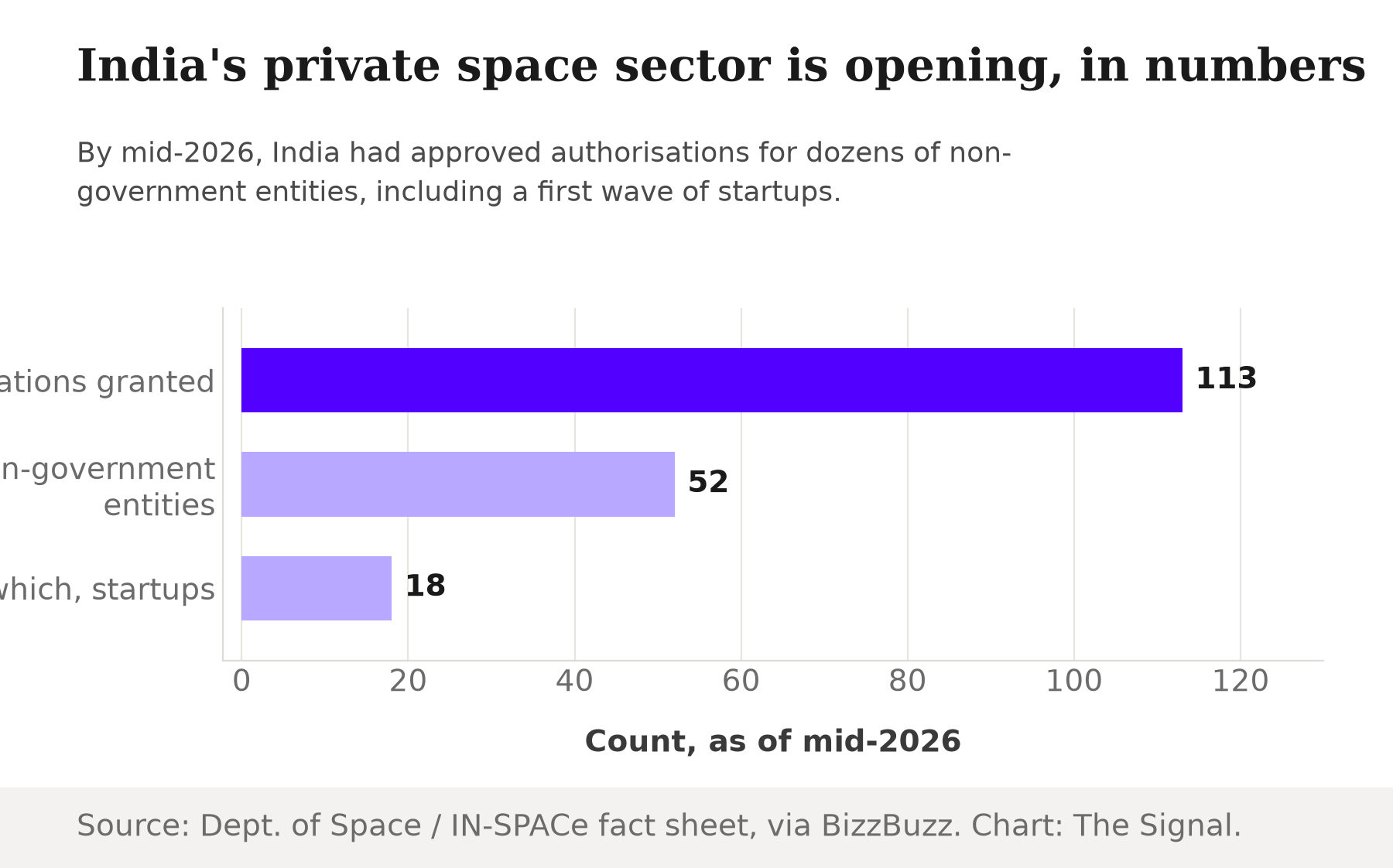
The government's pitch for India's space sector reads like a straightforward growth story. As of August 2026, India's space economy is valued at $9 billion and is projected to reach $40-45 billion over the next decade, a fact sheet from the Department of Space states. The door to private capital has opened alongside that target: by mid-2026, India had granted 113 authorisations to 52 non-government entities, including 18 startups working on satellite operations, payload establishment and launch services, and private investment in Indian space startups had crossed $500 million by early 2026, with nearly $150 million of that arriving in 2025 alone. Read only that far, and the story is momentum: a market opening up, capital following, a five-fold target within reach.
India's space economy is targeted to grow roughly fivefold over the next decade.
The government's own numbers describe both the current base and the ambition sitting on top of it.
It is worth slowing down on that framing. That target is not just a satellite-services or downstream-applications story. Getting there requires putting a great deal more mass into orbit, and that is priced by the launch, at a rate India does not currently offer.
The number that undercuts the pitch
A University of Cambridge Bennett School of Public Policy study, published in Economics Letters, finds that in 2025 the average cost per kilogram to Low Earth Orbit ranged from $3,225 in the United States to over $13,000 in India: more than four times as much. That is not a one-off contract price or a single mission's overrun. It is the average across a full year, from a peer-reviewed comparison of national launch costs.
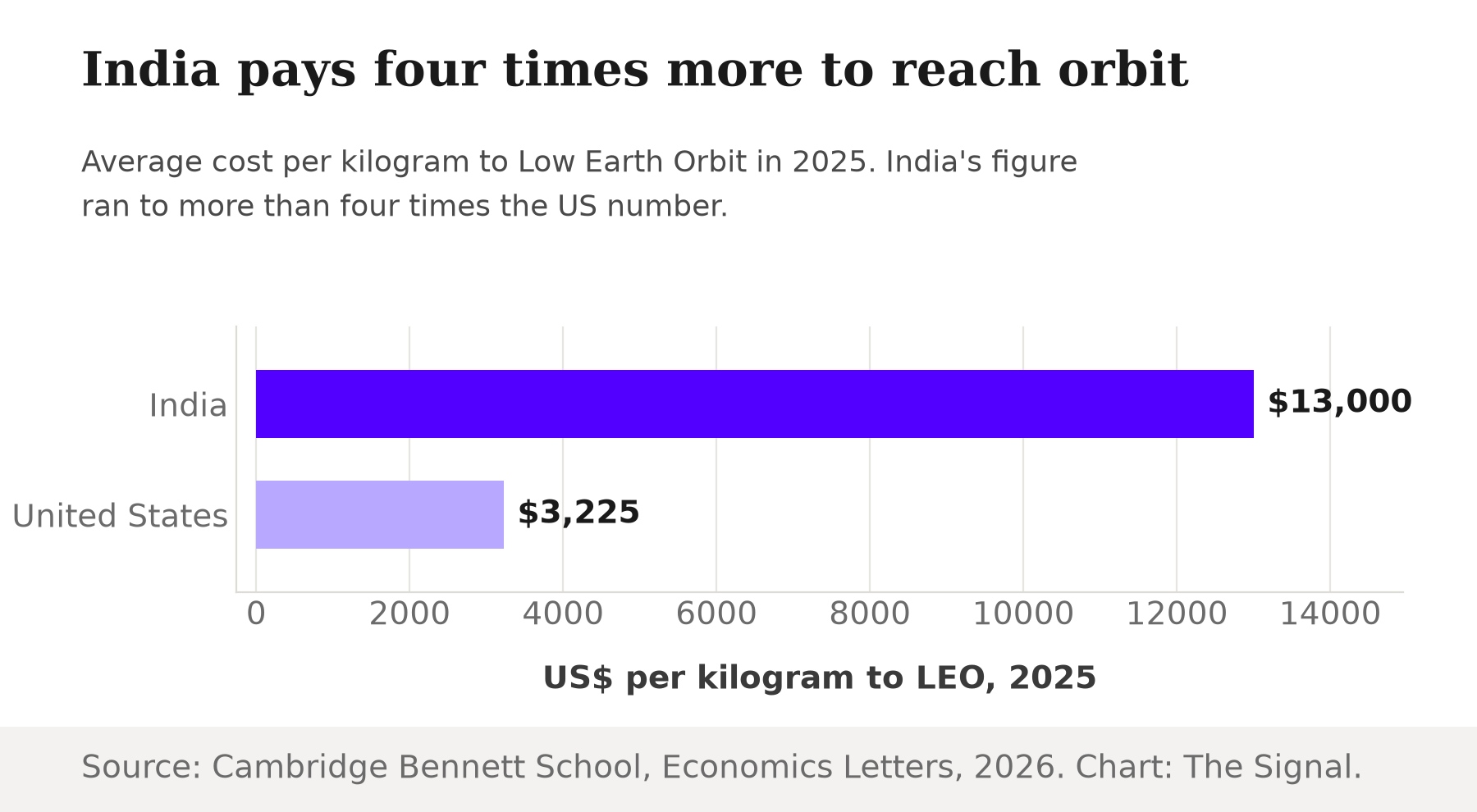
A growth target and a cost structure are two different claims, and India's fact sheet leans only on the growth side. Nothing in the government's own projection engages with what it costs India to put a kilogram into space today, well above the American rate, and whether that gap closes on its own over the next decade.
Why the gap exists: cadence and reusability
The reason is visible in a single comparison. SpaceX flew 165 Falcon 9 missions in 2025, more orbital launches than the rest of the world combined. ISRO, by contrast, marked its 100th launch ever from India's Sriharikota spaceport only in January 2025, with the GSLV-F15/NVS-02 mission. SpaceX flew more missions in a single year than India has launched across the entire history of its space programme.
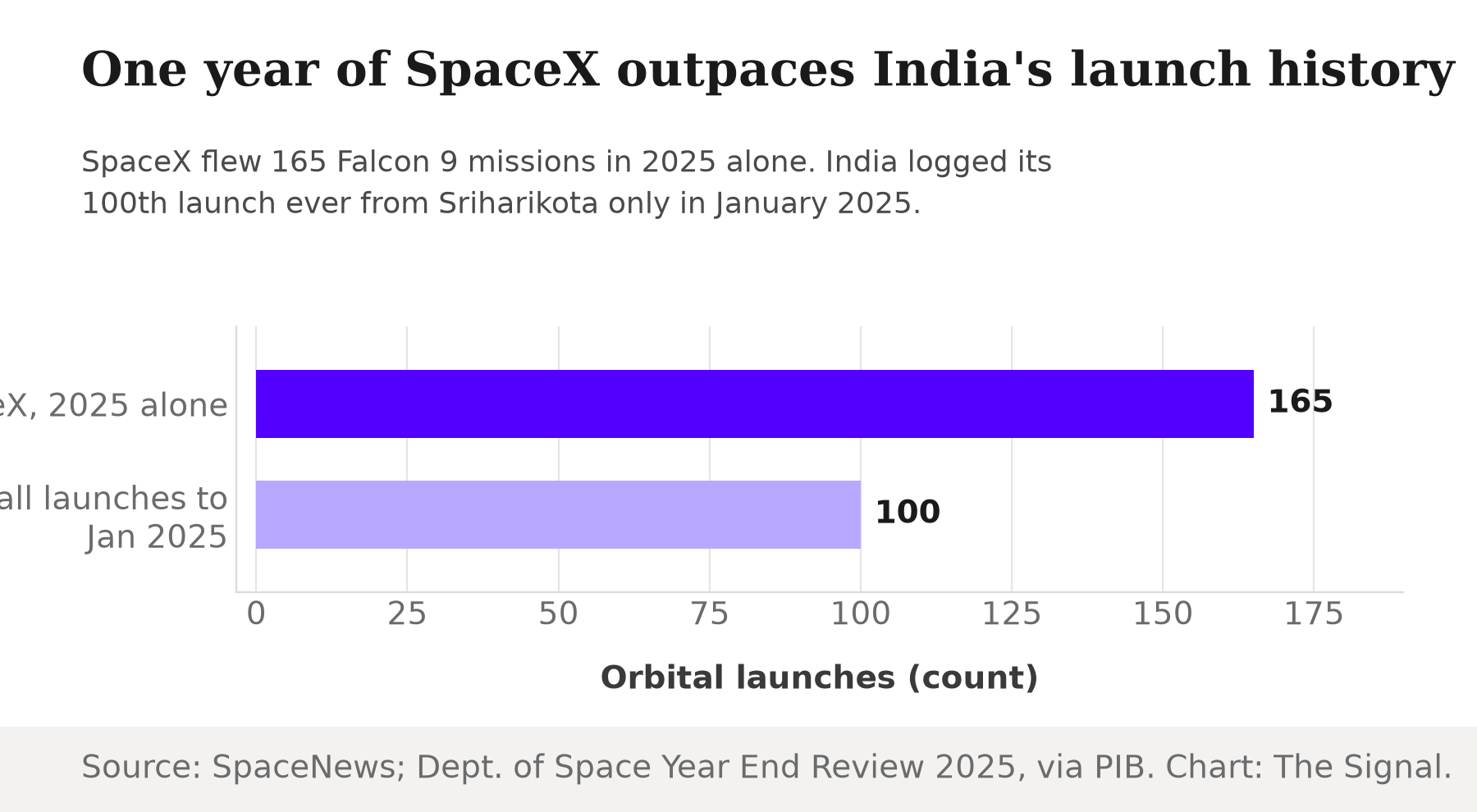
That gap in cadence is the mechanism behind the cost gap, not a coincidence sitting next to it. Falcon 9's boosters are reused, spreading a rocket's cost across dozens of flights, and the sheer flight rate lets SpaceX amortise fixed costs, tooling and staff over a high volume of missions. ISRO's rockets are expendable, and the flight rate implied by 100 launches spread across a decades-long national programme is a small fraction of what SpaceX manages in one year alone. A cost-per-kilogram number is, in the end, a story about how many kilograms you fly and how many times you rebuild the vehicle to fly them. On both counts, India's current program is starting from a weaker position.
The private opening is real, but still small
The government's response to this structural gap is liberalisation rather than a direct assault on cost. Authorisations opened to 52 non-government entities by mid-2026, including 18 startups, and private capital has followed: over $500 million cumulatively, with nearly $150 million raised in 2025 alone. That is a genuine structural shift from a launch market that, for most of India's history, ran through a single state provider.
It is also a small base against the scale the cost gap demands. Five hundred million dollars of cumulative private investment, spread across 18 startups, is not the capital intensity that built reusable launch in the United States, where a single company's launch infrastructure investment has run into the billions over a decade of sustained spending. Authorisations open a door; they do not, on their own, buy down a four-times cost gap that rests on reusable hardware and a flight cadence India has not yet built.
The startups themselves are not promising a different number yet, either. Skyroot Aerospace, the best-funded of the new entrants, expects its expendable Vikram-1 rocket to average at least $11,000 per kilogram to low Earth orbit at peak payload capacity: cheaper than the national average, but still more than three times the American rate, and nowhere near it. A private launch market is not the same claim as a cheap one; it depends on whether these companies eventually build reusable hardware, not merely on how many of them exist.
What the growth target actually assumes
The government also states that, as of August 2026, India holds about 2-3 percent of the global space economy, with its share targeted to rise to 8 percent by 2030. Tripling a global market-share number in under four years, while the cost of the core input, launch to orbit, sits four times above the leading competitor, is the load-bearing assumption sitting underneath the headline $40-45 billion figure. Either the launch-cost gap narrows sharply within that window, or the growth has to come almost entirely from segments of the space economy that do not depend on cheap Indian launch: ground equipment, applications, and satellites launched on someone else's rocket.
The honest objection
The strongest case against reading too much into the cost gap is that a space economy is not only a launch business. Satellite manufacturing, ground stations, downstream data and applications are large, growing components of the figure the government is projecting, and an Indian satellite operator can, in principle, buy a launch from any provider in the world, including a cheaper one abroad. On this view, ISRO's own cost structure is a side issue: India does not need to launch cheaply itself to capture value from a bigger global space economy.
That case has real force, but it does not fully dissolve the problem. A national space economy that has to outsource its cheapest access to orbit to a foreign competitor is conceding a high-margin, strategically sensitive layer of the stack, the one the United States and China have both treated as a matter of state capacity, not procurement convenience. And the domestic private launch entrants IN-SPACe has authorised are themselves trying to build Indian launch capability, which means they inherit the same cadence and reusability problem ISRO has, not an exemption from it. The gap narrows the market these startups can compete in even as it makes the case for why IN-SPACe licensed them at all.
The Signal
The $40-45 billion target is a plausible number for a space economy that is genuinely opening to private capital and genuinely growing. What it is not, on the government's own figures, is a target reconciled with the cost of getting to orbit. A launch-cost gap against the market leader running to over $13,000 a kilogram against $3,225, sustained across a launch history of just 100 total launches against SpaceX's 165 in 2025 alone, is not a rounding error inside a growth projection. It is the constraint the projection has to solve for and has not yet named. Watch whether the 18 authorised startups build toward reusable hardware and higher flight rates, or whether they simply add more expendable capacity at the same expensive rate ISRO already runs. One path closes the gap the data describes. The other just spreads it across more companies.
Reporting basis: the launch-cost comparison is from a single University of Cambridge Bennett School of Public Policy study (Terzi and Nicoli, Economics Letters, 2026), covering 2025 data, and is the sole source for that figure. India's space economy valuation, its $40-45 billion decade projection, and the authorisation and market-share figures are from an official Department of Space fact sheet, as separately carried by The Sentinel, the Free Press Journal and BizzBuzz. The private-investment figures are from the same fact sheet, via the Free Press Journal. The 100th-launch milestone is from the Department of Space's own Year End Review 2025, via the Press Information Bureau. The SpaceX 2025 launch count is per SpaceNews' analysis of global orbital launch data. The Skyroot per-kilogram cost figure is from CEO Pawan Kumar Chandana's statement to Mint, as reported by Outlook Business. The characterisation of the cost gap as a cadence and reusability problem, and the comparison between SpaceX's 2025 flight count and India's full launch history, are The Signal's own analysis of those figures.