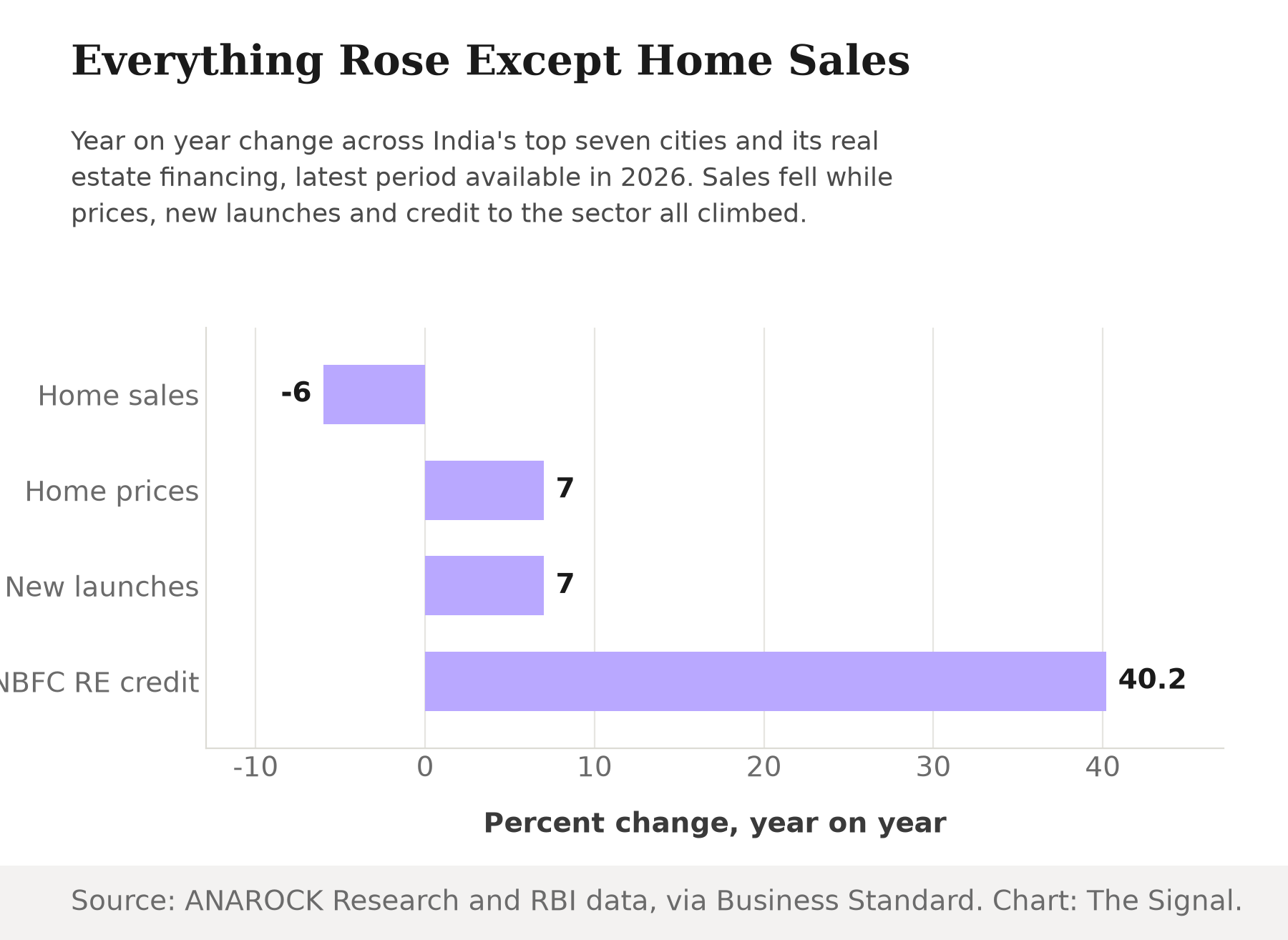
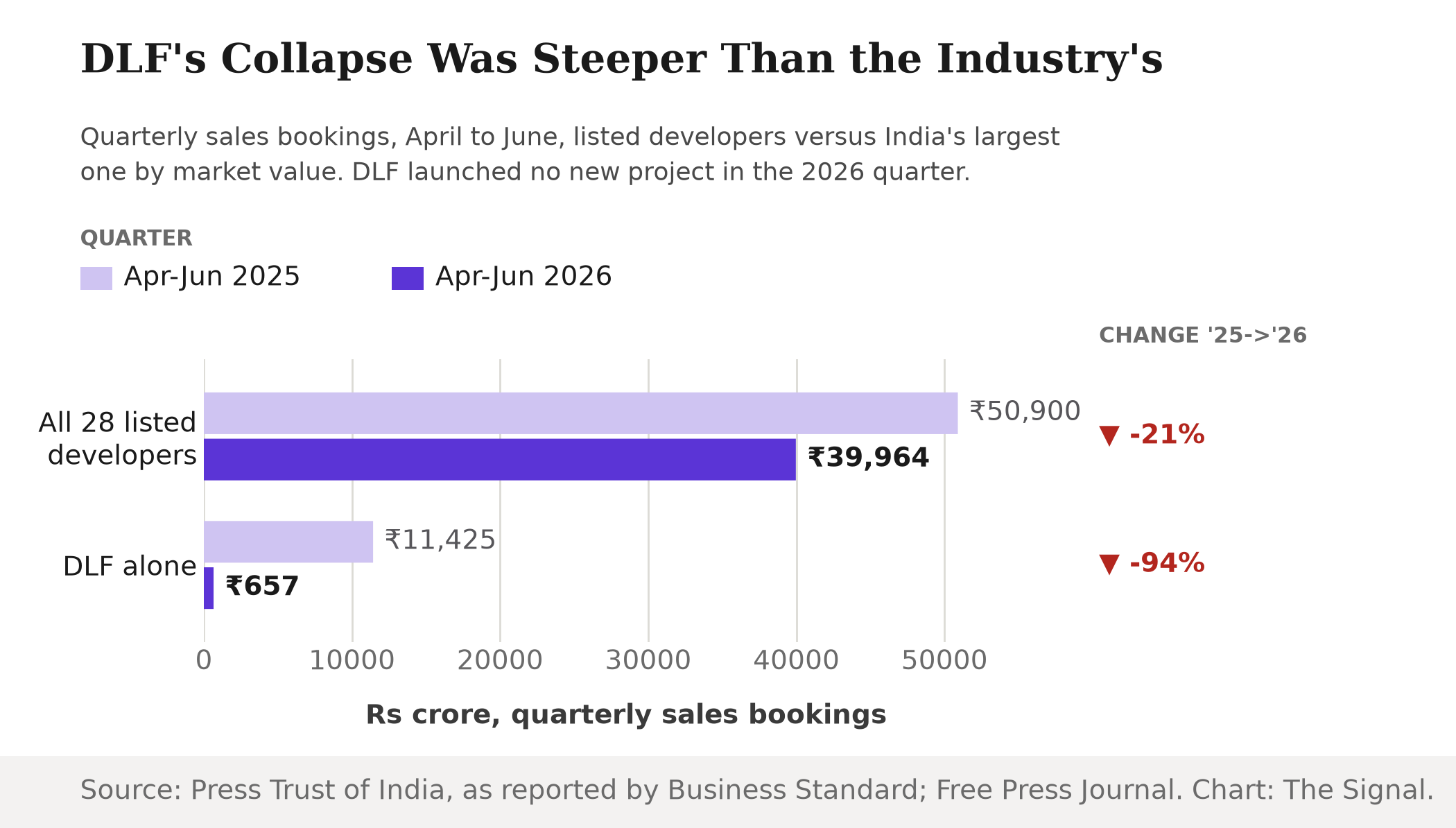
The quarterly numbers out of India's listed real estate companies read like a straightforward slowdown. Combined sales bookings of the 28 major listed developers fell 21% to Rs 39,964 crore in the April-June 2026 quarter, from Rs 50,900 crore a year earlier. At the city level, the picture matches: housing sales across India's top seven cities fell 6% year-on-year to about 90,715 units, the lowest since January 2023. Buyers, by every headline count, pulled back.
It is worth slowing down on what that slowdown did not do. It did not touch prices. Average residential prices across the same top seven cities rose 7% year-on-year in the April-June quarter, with the National Capital Region up 13% and Bengaluru up 8%. Demand cooled and the market got more expensive anyway.
Sales fell 6 percent. Prices rose 7 percent. Both are true of the same quarter.
Start with DLF. DLF, India's largest listed realty firm by market value, booked just Rs 657 crore in sales in the April-June quarter, down from Rs 11,425 crore a year earlier, a decline of about 94%, after not launching a single project in the quarter. DLF did not fail to sell homes. It chose not to have new ones to sell.
Nobody is discounting anything
A normal reading of a sales slump is that sellers cut prices to move inventory. That is not what is happening here, and DLF is the cleanest illustration of why. A developer that stops launching does not need to discount, because it has nothing new competing for a buyer's attention. Its "sales collapse" is really a launch pause, and a launch pause protects price rather than pressuring it.
But DLF is one company, and the pattern does not hold for the industry as a whole. Developers actually launched nearly 106,000 new housing units across the top seven cities in the same quarter, a 7% increase over the roughly 98,625 units launched a year earlier. So while the largest listed name went quiet, the broader market kept building at a faster pace even as unit sales fell 6%. New supply grew and prices grew together, which is the part a simple demand-down, price-down story cannot explain.
That gap between building and selling is now sitting in warehouses no one is emptying. Unsold housing inventory across the top seven cities climbed to about 6,16,500 units by the end of Q2 2026, up roughly 10% year-on-year, and the time it would take to clear that stock at the current sales pace widened to about 19 months, from 18 months just the quarter before. Nineteen months of unsold homes is exactly the kind of overhang that is supposed to force price cuts. It has not.
The RBI says the same thing, a quarter behind
None of this rests on a single private tracker. The RBI's own All-India House Price Index, which runs a quarter behind the property consultancies, rose 4.2% year-on-year in the January-March 2026 quarter, itself an acceleration from 3.8% growth in the same quarter a year earlier. That is a smaller number than the 7% the brokerage data shows for April-June, because the RBI index is broader and slower-moving, but the direction, prices still climbing, is the same official series confirming a privately compiled one.
Who is financing the wait
If demand is genuinely softer and supply keeps growing, something has to explain why developers can afford to sit on inventory rather than cut prices to sell it. The answer shows up in the credit numbers. RBI data show bank credit to the services sector grew 21.4% year-on-year as of June 2026, with commercial real estate named among the segments driving that acceleration, alongside NBFCs and trade. More specifically, NBFC credit to commercial real estate grew 40.2% year-on-year to Rs 1.20 trillion as of May 2026, the fastest-growing segment within NBFC services lending.
NBFC credit to real estate grew 40.2 percent while home prices rose 7 percent, nearly seven times as fast.
That gap, 40.2% credit growth against 7% price growth, is not proof of cause and effect on its own. But it describes a market where a developer that cannot move units quickly still has an open line of financing to carry that unsold stock, rather than a balance sheet forcing a fire sale. Buyers are absorbing higher prices for fewer homes. Lenders, so far, are carrying the risk on the homes that are not moving.
The honest objection
The strongest case against reading any of this as a slowdown at all is that another data provider shows the opposite. PropEquity reported that housing sales across India's top nine cities rose 19% year-on-year to 1,12,458 units in the April-June quarter, on the back of a 43% jump in new supply. If that basket is right, there is no demand problem to explain away, and the "slowdown" is an artifact of which cities and which developers a tracker chooses to count.
That objection is real, and it is a genuine reason to hold the ANAROCK-based decline loosely rather than treat it as settled fact. But it does not touch the actual puzzle. Even in PropEquity's growth telling, new supply rose 43% against sales growth of 19%, more than twice as fast. Pick either dataset, decline or growth, and the same asymmetry survives: supply is expanding faster than whatever demand trend you choose to believe. That is the condition under which prices are supposed to soften. They have not.
| Data provider | Cities | Sales, Apr-Jun 2026 | New supply, Apr-Jun 2026 |
|---|---|---|---|
| ANAROCK Research | Top 7 | Down 6% YoY | Up 7% YoY |
| PropEquity | Top 9 | Up 19% YoY | Up 43% YoY |
Source: Business Standard, citing ANAROCK Research and PropEquity.
The industry's own forward bet points the same way. ANAROCK projects the combined pre-sales of India's 11 leading listed residential developers to rise 22.3% to Rs 1.82 lakh crore in FY27, from Rs 1.49 lakh crore in FY26, despite the quarterly slowdown. Developers are not pricing in a demand problem. They are pricing in a launch calendar that paused for a quarter and will restart.
The Signal
The consensus read, a housing market cooling off, gets the first half right and misses the second. Sales did fall, at least on the measure most of the coverage used. But nothing about that fall forced anyone to concede on price. DLF simply stopped launching instead of discounting. The wider market kept building at a faster clip than it sold. The lenders kept extending credit to the sector faster than prices even rose. A housing slowdown that leaves prices untouched is not describing weak demand. It is describing a market where sellers can afford to wait, because someone else is financing the wait. Watch what happens if that credit growth ever slows before the launch pipeline reopens. That is the quarter prices actually move.
Reporting basis: the 28-company listed-developer bookings figure and DLF's individual number are Press Trust of India's compilation from investor presentations, as carried by Business Standard and Free Press Journal respectively, one origin republished by both. The top-seven-city sales, price and launch figures are ANAROCK Research's analysis, as reported separately by Business Standard, Zee Business and Outlook Money. The inventory and inventory-overhang figures are drawn directly from ANAROCK's own Q2 2026 Pan-India Residential Market Viewpoints report. The FY27 pre-sales projection is a separate ANAROCK Research analysis, as reported by Business Standard. The house price index and the two credit growth figures are official RBI releases. The rival top-nine-city sales and supply figures are PropEquity's data, as reported by Business Standard. The comparison of credit growth against price growth, and of PropEquity's supply-to-sales gap against ANAROCK's, are The Signal's calculations from those figures.