FSSAI has been busy. The food regulator has issued more than 150 notices to food companies, including Nestle India, PepsiCo and Coca-Cola India, in the months before August 2026, over misleading advertisements, false claims and non-compliance with labelling regulations. Read the announcement on its own and it looks like a regulator finally putting weight behind India's food-safety rules. A hundred and fifty notices to some of the country's biggest packaged-food brands in one stretch is not a quiet warning. It reads like enforcement.
It is worth slowing down on what a notice actually risks costing the companies that get one. Section 53(1) of the Food Safety and Standards Act, 2006, caps the penalty for a misleading food advertisement at ten lakh rupees. Parliament wrote that ceiling in 2006 and has not revisited it since.
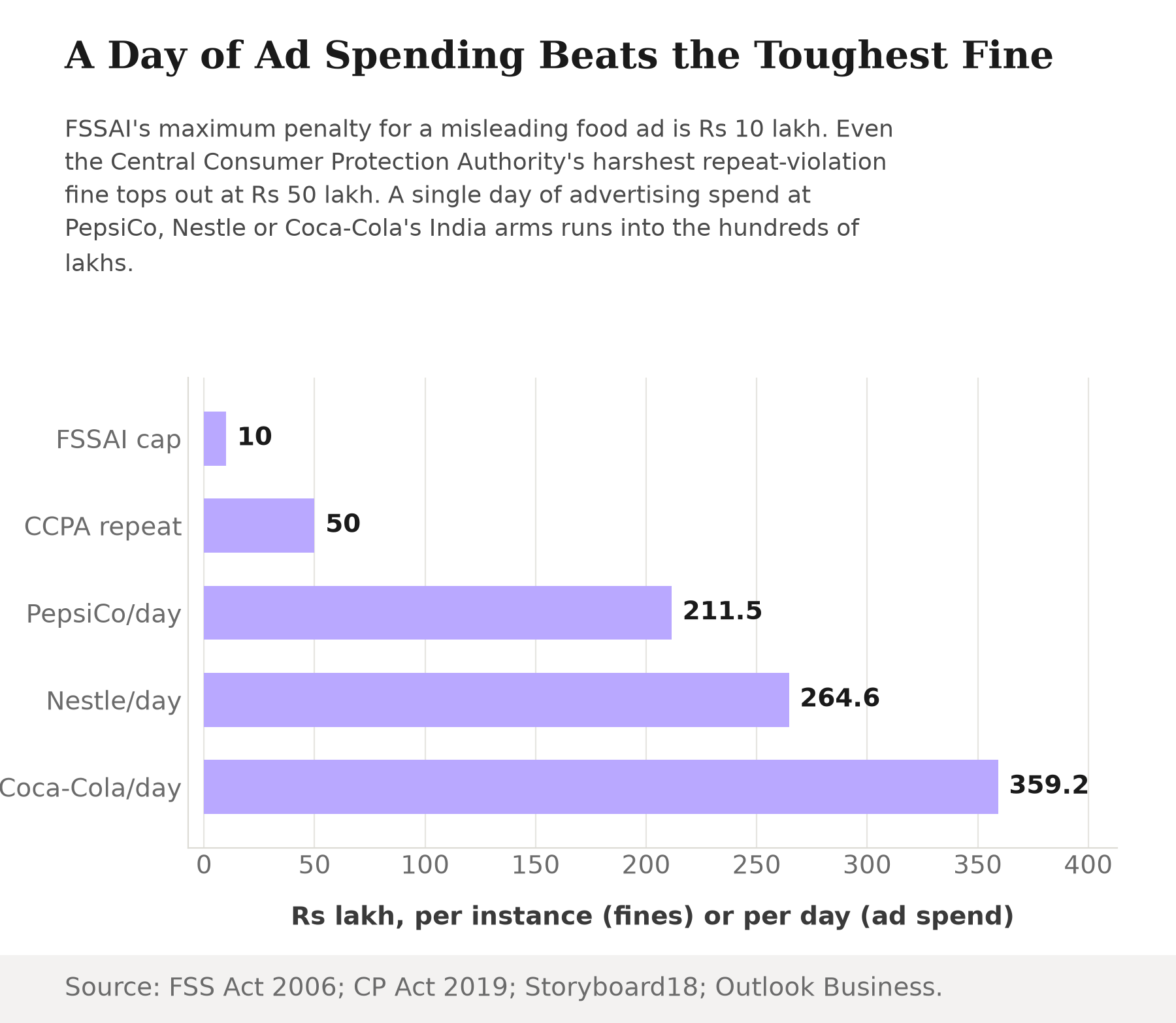
Rs 10 lakh sounds like real money until it is set against what the companies FSSAI named spend to get an ad in front of a customer in the first place. Nestle India spent Rs 965.86 crore on advertising and sales promotion in the year ended 31 March 2025. Spread evenly across the year, that is about Rs 264.6 lakh a day (our calculation, dividing the annual figure by 365). Nestle spends more than 26 times FSSAI's entire legal ceiling for punishing a misleading ad on advertising in one ordinary day.
FSSAI's maximum fine for a misleading ad is a fraction of a single day's ad budget.
| Regulator and law | First violation | Repeat violation |
|---|---|---|
| FSSAI, under Section 53(1) of the Food Safety and Standards Act, 2006 | Up to Rs 10 lakh | No separate repeat-violation tier in the clause |
| CCPA, under Section 21 of the Consumer Protection Act, 2019 | Up to Rs 10 lakh | Up to Rs 50 lakh |
Source: Food Safety and Standards Act, 2006; Consumer Protection Act, 2019.
A tougher regulator exists, and it barely changes the math
FSSAI is not the only body that can act on a misleading food advertisement. Under Section 21(2) and 21(4) of the Consumer Protection Act, 2019, the Central Consumer Protection Authority can fine a false or misleading advertisement up to Rs 10 lakh on a first violation and up to Rs 50 lakh for a repeat violation. That five-times step-up exists for exactly the kind of repeat offender a 150-notice list suggests FSSAI is chasing.
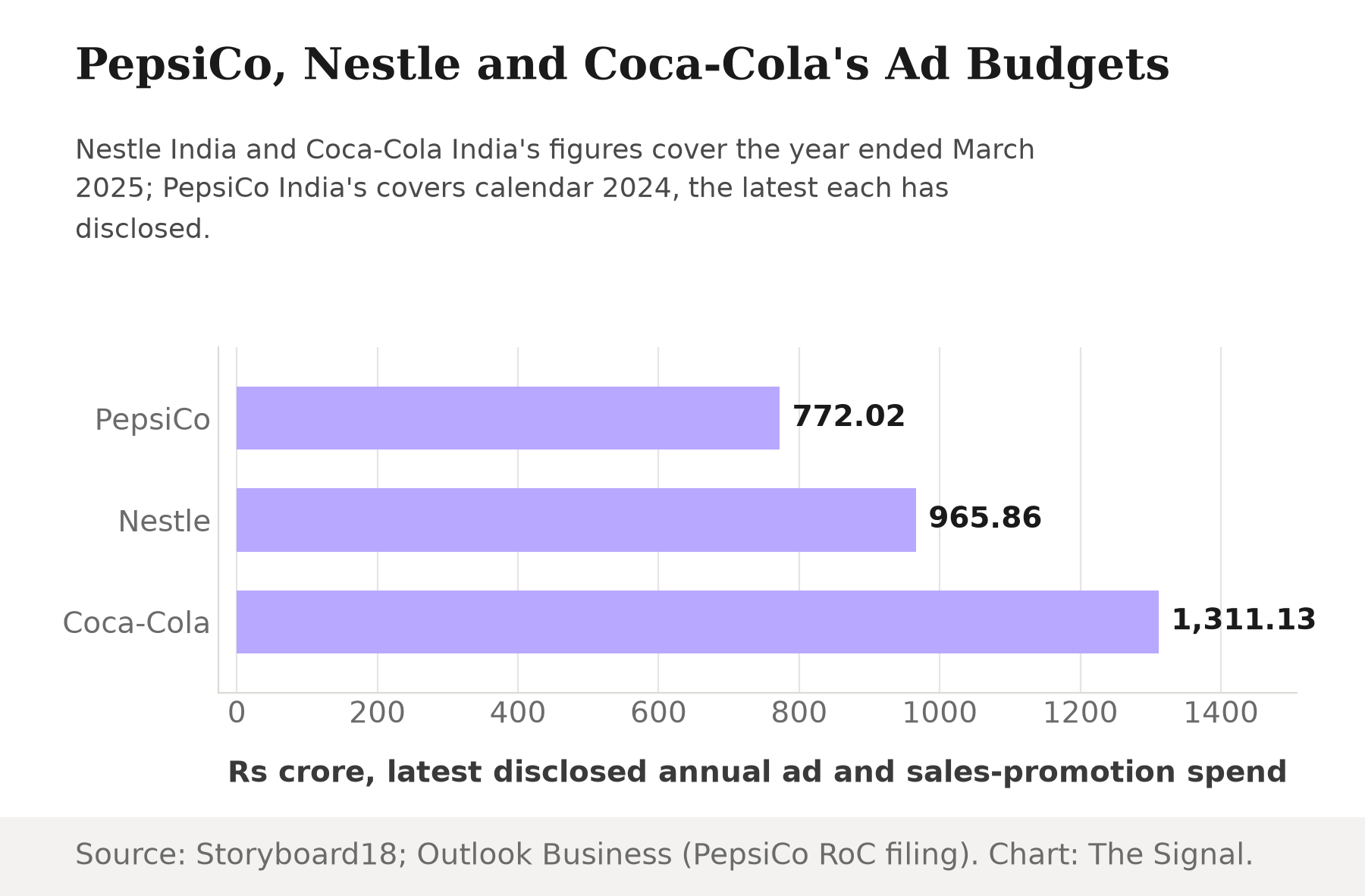
Set even that harsher ceiling against a bigger spender and it barely moves the needle. Coca-Cola India spent Rs 1,311.13 crore on advertising and sales promotion in the year ended 31 March 2025, about Rs 359.2 lakh a day. That single day of advertising costs Coca-Cola India more than seven times the CCPA's harshest possible repeat-violation fine. PepsiCo India's advertising and promotional expenses were Rs 772.02 crore in calendar year 2024, about Rs 211.5 lakh a day, still more than twenty-one times FSSAI's Rs 10 lakh cap.
What the tougher regulator has actually collected
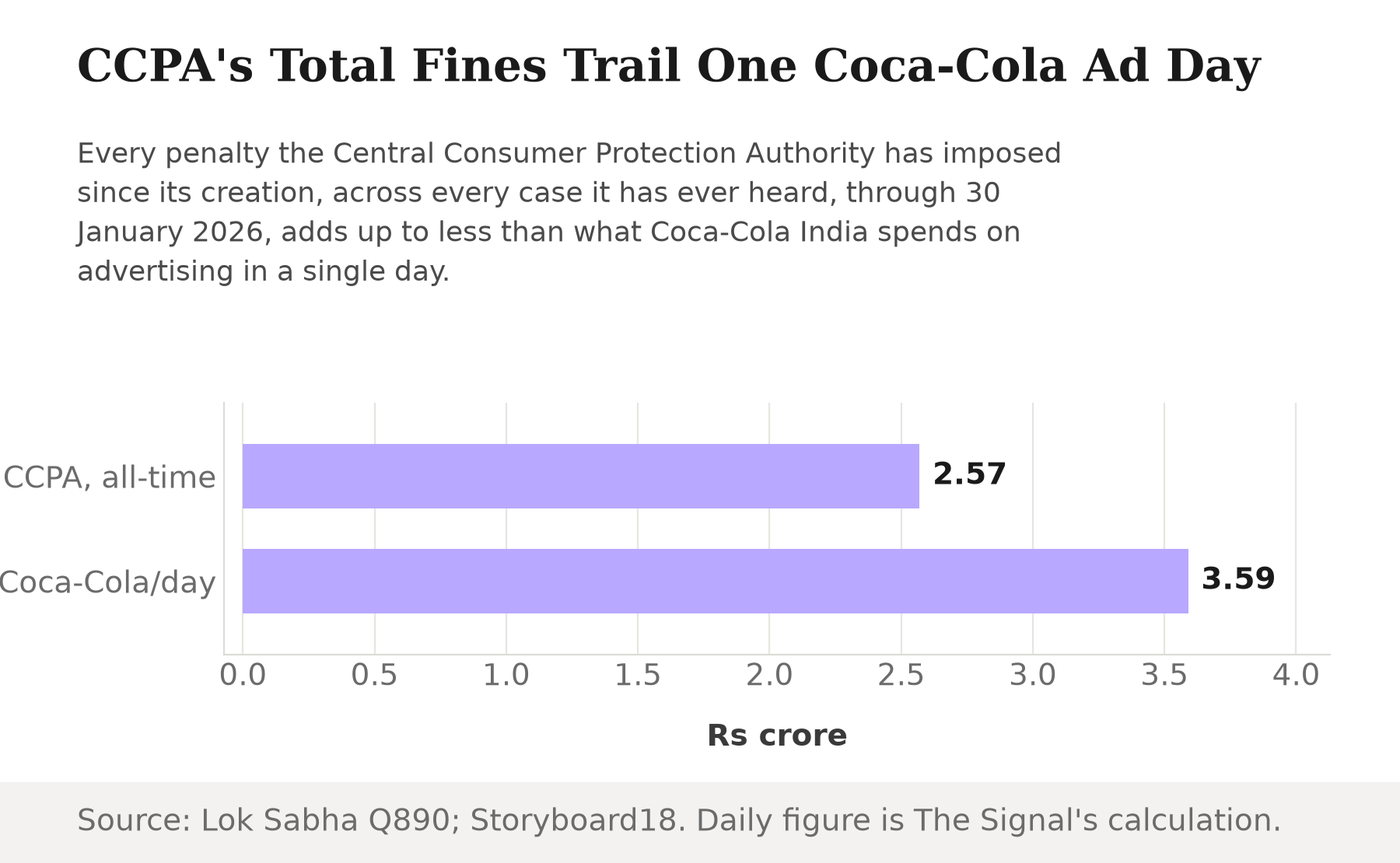
The gap between the legal ceiling and the ad budget is one measure. What the CCPA has actually assessed, in practice, is a tighter one. Since the CCPA's creation and through 30 January 2026, the total value of every penalty it has ever imposed, across every case it has heard, is Rs 2,57,40,500, about Rs 2.57 crore. That is not a food-advertising total. That is every case the CCPA has decided, for any product and under any provision, since the authority began work.
Coca-Cola India's roughly Rs 3.59 crore in daily advertising spend is about 40 percent more than the CCPA's entire Rs 2.57 crore penalty total across every case it has ever heard (our calculation). The regulator built with a fine five times harsher than FSSAI's has, in its entire history, assessed less in penalties than one company spends on one day of ads.
The pattern holds in the cases the CCPA does bring. On 18 June 2026, the CCPA fined Storia Foods and Beverages and Mrs Bectors Food Specialities' English Oven Rs 1 lakh each for misleading "100%" claims on coconut water, juice and bread products. One lakh rupees, a tenth of the ceiling available for even a first violation, in two of the regulator's most publicised enforcement actions of June 2026.
The honest objection
The strongest case for treating this as adequate deterrence is that the fine was never meant to carry the punishment on its own. A notice is public, a company has to respond to it, and being named in one of the more than 150 notices FSSAI issued over false claims and labelling violations can cost more in reputation and compliance work than a modest fine on paper. The companies on FSSAI's list already include some of India's most recognised packaged-food brands. If reputational exposure is the real lever, the size of the legal ceiling matters less than the size of the list a company's name lands on.
That case would be more convincing if regulators had ever tested it by using the ceiling they have. They have not, not even close. The CCPA's two most publicised food-labelling penalties of June 2026, against Storia Foods and Mrs Bectors' English Oven, were Rs 1 lakh each, a tenth of what a first violation allows and a fiftieth of what a repeat violation allows. A reputational-deterrence theory that has never once been paired with a fine anywhere near the legal ceiling is a theory regulators have chosen not to test, not one that has been tried and found sufficient.
The law does give the CCPA a lever that does not run through a fine at all. Section 21(1) of the Consumer Protection Act, 2019 lets the CCPA order a misleading advertisement discontinued or modified outright, and Section 21(3) lets it bar the endorser of that advertisement from endorsing any product or service for up to a year on a first violation and up to three years on a repeat one. That tool does not scale with ad budget, since it stops the campaign or the face fronting it rather than taxing the spend. But it reaches an endorser, not the company paying for the ad, and the CCPA's own account of the Storia Foods and English Oven cases describes only the Rs 1 lakh penalty, with no discontinuation order or endorser ban attached.
The Signal
FSSAI's 150 notices are a real signal that the regulator is watching. They are not, on the numbers, a signal that getting caught costs anything close to what it takes to run the ad in the first place. A law written in 2006 still caps the penalty at Rs 10 lakh, and the tougher regulator built to go as high as Rs 50 lakh has spent two decades barely using the room it has. Watch what happens to the companies on FSSAI's list, not the notices themselves. If any of them turn into CCPA cases decided anywhere near that ceiling, the deterrent is starting to bite. If they settle, as the pattern so far suggests, into another round of Rs 1 lakh orders, the notice was the whole punishment, and the ad budget was never at risk.
Reporting basis: the count and description of FSSAI's notices to Nestle India, PepsiCo and Coca-Cola India is per a PTI wire report as carried by Telangana Today. The Food Safety and Standards Act, 2006 and the Consumer Protection Act, 2019 are cited from their Gazette texts, hosted respectively by the West Bengal consumer affairs department and Invest India; the Consumer Protection Act's Section 21(1) and 21(3), on discontinuation orders and endorser bans, are cited from ibclaw.in's copy of the Act text. Nestle India's and Coca-Cola India's advertising and sales-promotion spend for FY2024-25 are per Storyboard18, citing each company's annual report and financial statements; PepsiCo India's advertising and promotional expenses for calendar 2024 are per Outlook Business, citing PepsiCo India Holdings' RoC filing. The Central Consumer Protection Authority's cumulative penalty total through 30 January 2026 is from a Lok Sabha written reply by the Ministry of Consumer Affairs, Food and Public Distribution. The Storia Foods and English Oven penalties are per SCC Online's report of the CCPA order. The daily advertising-spend figures and the comparisons against the legal ceilings and the CCPA's cumulative total are The Signal's calculations from those figures.