A year ago this month, President Droupadi Murmu assented to a law imposing a complete ban on offering, operating or facilitating online money games in India, effective 22 August 2025. Within days, Dream Sports co-founder and CEO Harsh Jain told employees that Dream11's revenue had plunged 95 percent overnight, with profits completely erased. Weeks later, Dream11 walked away from its three-year, roughly $44 million title sponsorship of the Indian cricket team, a deal that had put its logo on every Indian jersey since 2023. The obvious read is that India's Parliament killed its own biggest gaming company in a single stroke.
It is worth slowing down on that. The law banned the stakes, not the software behind them. By September 2025, less than a month after the ban, Dream11 was back with an ad-supported, free-to-play format, still running on the audience it had spent a decade building. The contests looked the same. What changed was who paid for them.
Revenue collapsed 95 percent overnight. The user base did not move.
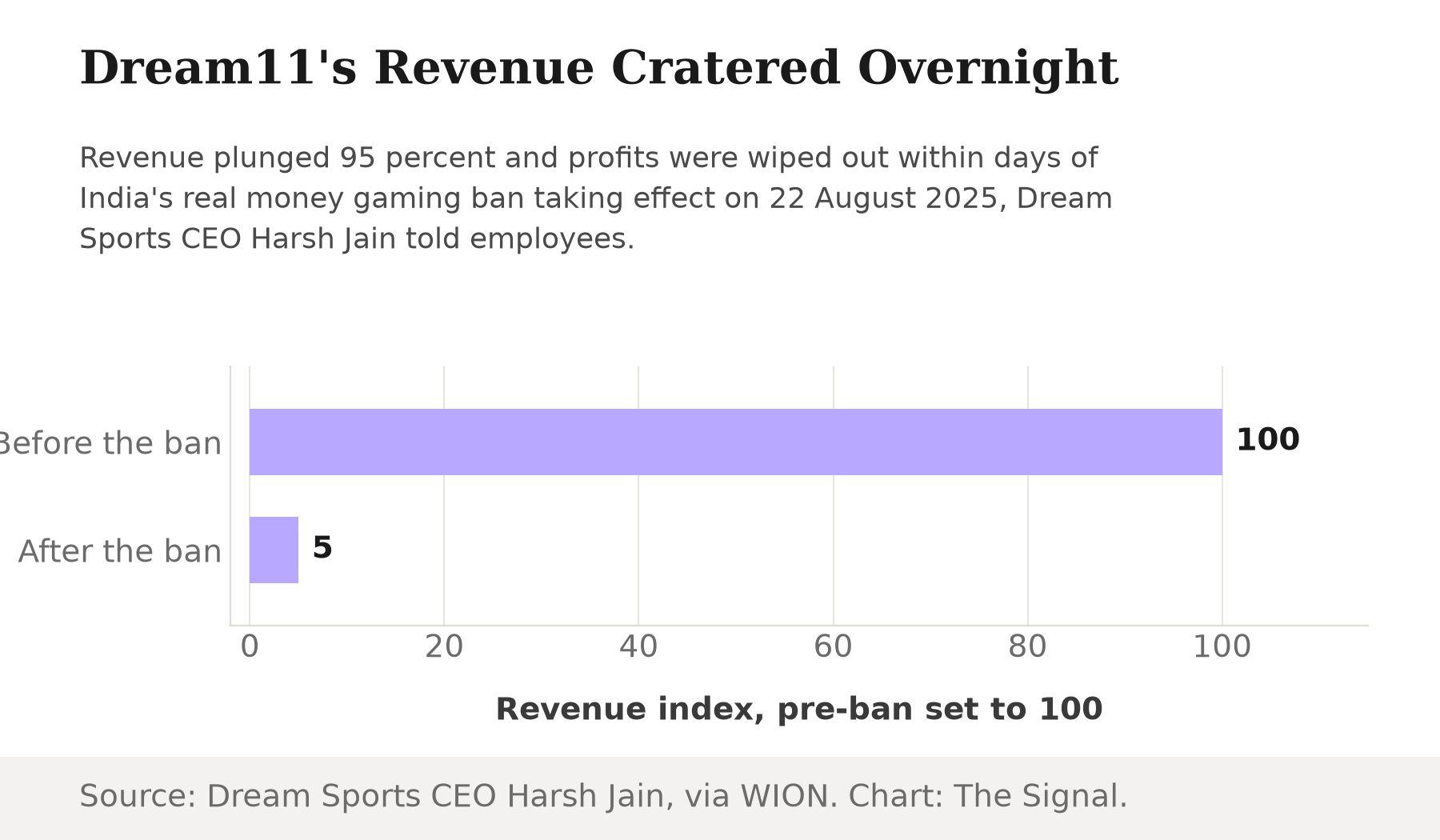
Source: WION. Index is The Signal's calculation from the reported 95 percent drop.
What the law actually banned
The Promotion and Regulation of Online Gaming Act, 2025 did not touch fantasy contests, leaderboards or matchday engagement as a format. Its Section 5 bars any person from offering, aiding, abetting or otherwise engaging in the offering of an "online money game", a category the statute defines around one mechanic: paying money or stakes in expectation of winning, whether the underlying game turns on skill or chance. That is the exact mechanic Dream11's paid contests used. It is also the only piece the law removes. Nothing in the Act requires an app to stop running contests, stop tracking a scoreboard, or delete its user accounts. It requires the app to stop charging an entry fee.
That distinction is the whole story. By 2024, Dream11 had crossed 250 million registered users and commanded an estimated 70 percent share of India's fantasy sports market, built over a decade on the exact paid, cash-prize format the new law now bans. None of that scale, habit or product design needed to be rebuilt. Only the payment layer did.
The 95 percent
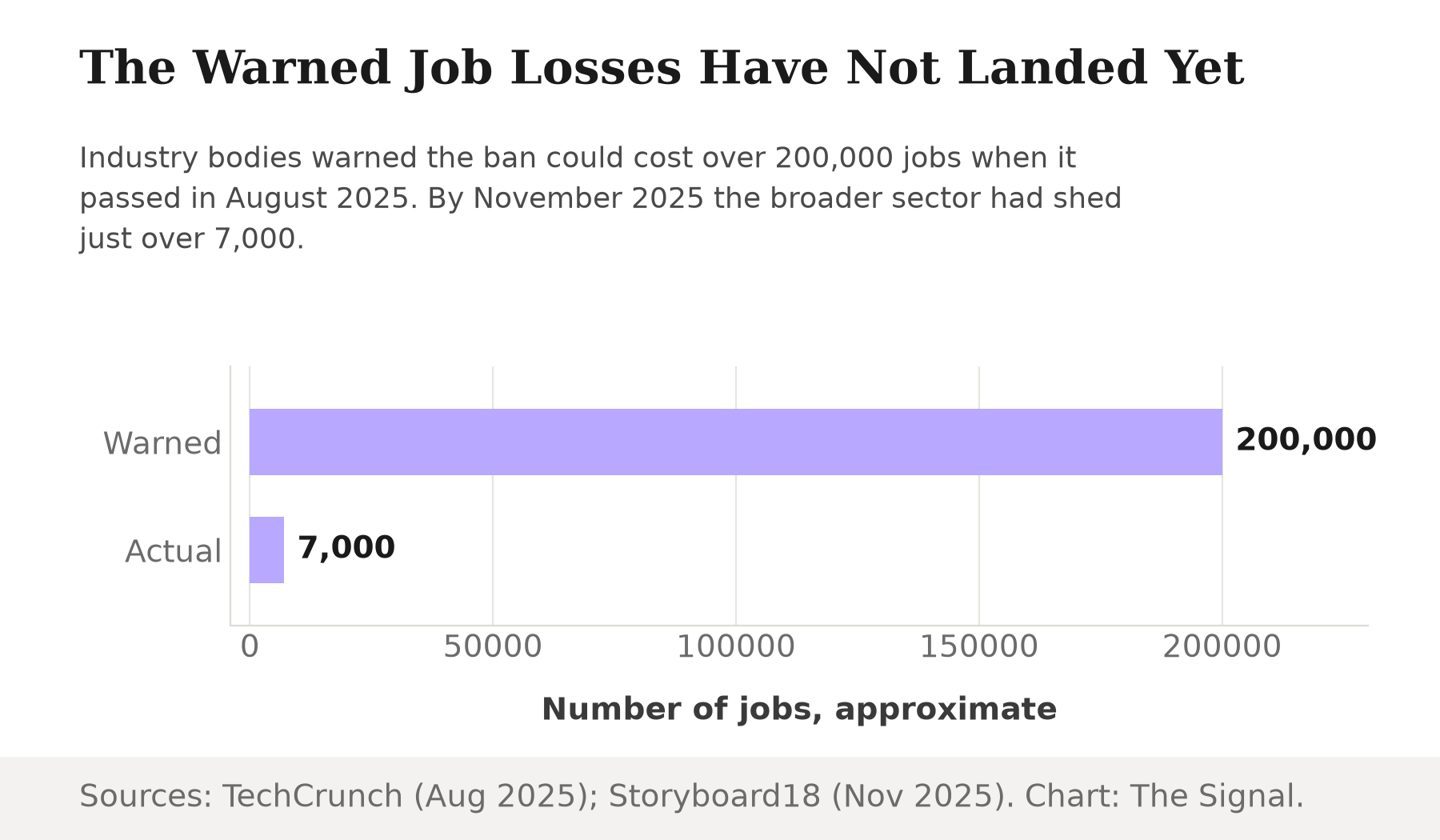
The immediate hit was real and it was steep. Harsh Jain told employees the company's revenue plunged 95 percent overnight, with profits completely erased. The BCCI sponsorship, worth about 358 crore rupees ($44 million) over three years running through 2026, ended with the ban, since Dream11 could no longer operate as a real money gaming sponsor. Before the ban passed, India's real money gaming startups carried a combined enterprise valuation of about 2 trillion rupees ($23 billion), and industry bodies warned the law could cost over 200,000 jobs and shut down more than 400 companies. That was the scale of the business the government was choosing to switch off.
Industry bodies warned of 200,000 job losses. The sector had shed 7,000 by November.
Sources: TechCrunch; Storyboard18.
The pre-ban warning and the measured toll three months in are not the same number, and they should not be read as the same claim: one is an industry estimate of what could happen across the whole sector, the other is what had actually been counted at listed firms and beyond by November 2025. The gap between them does not mean the ban was painless. It means most of the damage so far has landed on revenue and capital, not on headcount, which is exactly what a company that keeps its user base and cuts its monetisation would produce.
The users never left
Once the entry fee was gone, Dream11 did not shrink its product, it re-priced it. Free Press Journal reported that the company rolled out an ad-supported format allowing users to keep playing for free and win daily prizes, with brand partners including Swiggy, Astrotalk and Tata Neu funding the prize pool instead of user stakes. The contests, the leaderboards and the daily habit stayed intact. The only structural change was that a brand's marketing budget replaced 250 million individual entry fees as the source of the money in the system.
That substitution only works because the audience is still there to sell. The 250 million accounts and 70 percent market share Dream11 had built by 2024 are, in an ad-funded model, the product itself: attention a sponsor pays to reach, not stakes a player pays to risk. The ban removed the mechanism that made Dream11 a gambling-adjacent product. It left behind exactly the mechanism that makes any free app valuable, a large, habitual, engaged user base that advertisers will pay to sit in front of.
The sector's ledger since
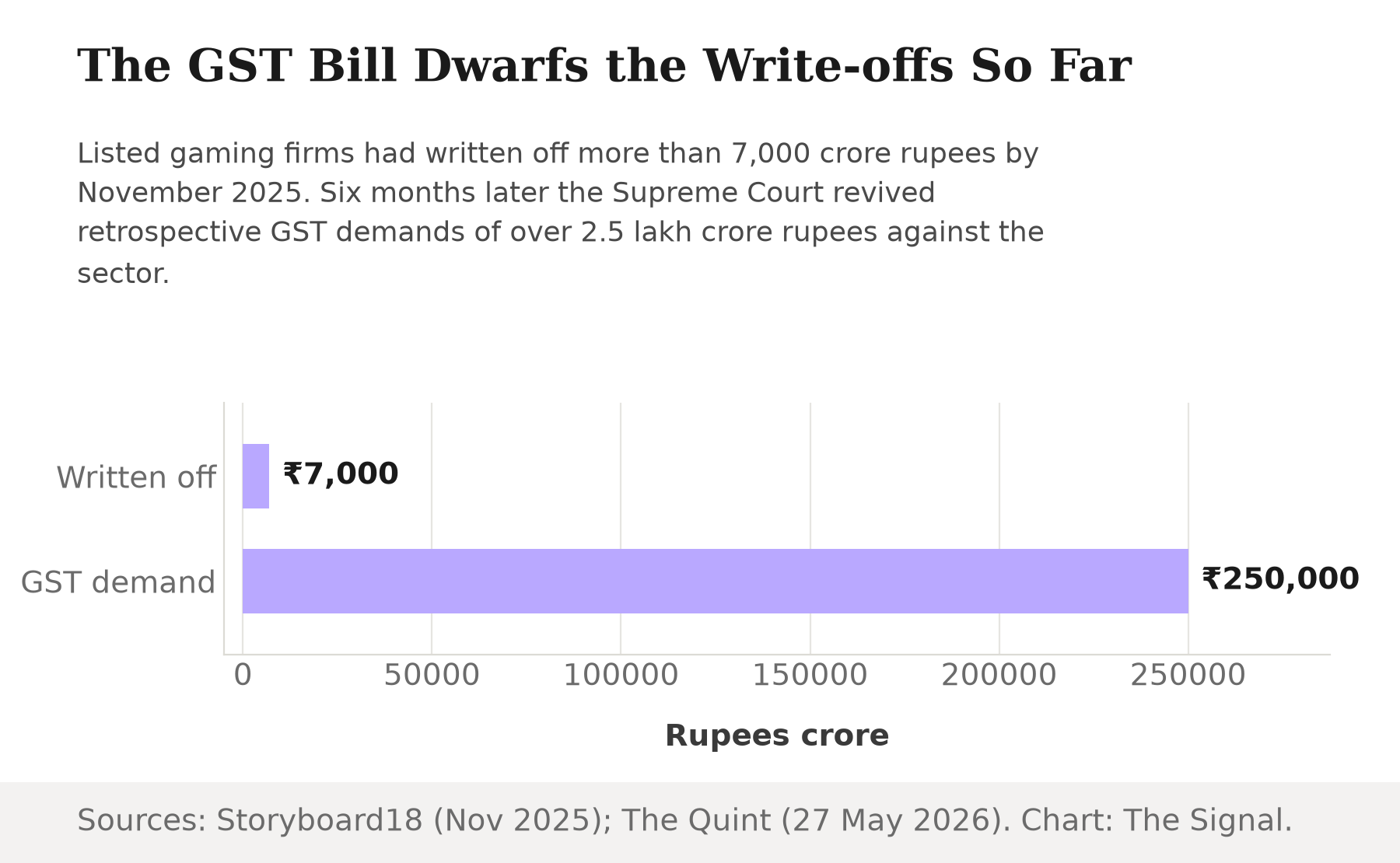
Dream11 is the largest name in the space, but it is not the only one absorbing the shift. By November 2025, roughly three months after the ban, India's listed real money gaming firms had written off more than 7,000 crore rupees in investments, and the broader sector had shed over 7,000 jobs. Those are real, booked losses at firms that, unlike Dream11, may not have had the brand recognition or the user scale to pivot to an ad-funded format at the same speed.
The bill isn't closed
Two developments this year show the state is not done shaping this market. The Promotion and Regulation of Online Gaming Rules, 2026, which operationalise the Act by establishing the Online Gaming Authority of India as the sector's unified regulator, came into force on 1 May 2026. And on 27 May 2026, the Supreme Court upheld a retrospective 28 percent GST on the full face value of bets placed on real money games, not just the platform fee or the gross gaming revenue, reviving tax demands of over 2.5 lakh crore rupees against the sector. That demand looks backward, at money staked before the ban, but it lands on the same balance sheets now running the ad-supported pivot.
The revived GST demand is far larger than what the sector has written off so far.
Sources: Storyboard18; The Quint.
Set against the 7,000 crore rupees already written off, a demand of 2.5 lakh crore rupees is a different order of problem, one that a free, ad-funded product with a large user base does nothing to solve. It is a legacy liability from the era when the stakes were real, arriving after the stakes are gone.
The honest objection
The strongest case against the "mechanism survived" reading is that Dream Sports built its entire valuation on the format the law just banned. The company was valued at $8 billion after raising $840 million in November 2021, a number investors reached almost entirely on the strength of its real money contest business. An ad-funded free product monetises the same users at a fraction of the revenue per user that entry fees generated, and it now carries the added risk of a retrospective tax bill that predates the pivot entirely. On this view, Dream11 has not proven its business model survived. It has proven only that its app stayed open while its economics were gutted, and the GST ruling suggests the reckoning for the old model is still arriving, not finished.
That case is real, and it explains why Dream11 has not said its revenue has recovered. But it does not undo the more basic point: the thing regulators actually feared enough to legislate against, a mechanism that keeps 250 million people opening one app every matchday, survived a law written specifically to stop it. A company that loses its revenue model but keeps its users has a monetisation problem to solve. A company that loses its users has no company left. Dream11 is still the former.
The Signal
A law that bans "online money games" is aimed at the money, and on that narrow target it worked completely: Dream11's revenue and its cricket sponsorship are both gone. But the law could not touch the part of the product that made it worth $8 billion in the first place, the design that gets 250 million people to open an app every matchday. That part moved from user-funded to brand-funded in under a month. Watch what happens to the revived GST demand next: if it is negotiated down or spread over years, the ad-supported model gets room to prove itself as a real business, not just a survival mode. If it is enforced at face value, the mechanism that survived the ban may still not survive the bill for the era before it.
Reporting basis: the assent date and text of the Promotion and Regulation of Online Gaming Act, 2025 are per All India Radio's official news service and the bill text hosted by PRS Legislative Research. Dream11's revenue and profit collapse is as CEO Harsh Jain told employees, reported by WION. The BCCI sponsorship's end is per Al Jazeera. Industry valuation and job-loss warnings ahead of the ban are per TechCrunch, citing industry body estimates. Dream11's 2024 user count and market share are per Forbes India. Dream Sports' 2021 funding valuation is per Front Office Sports. Sector-wide write-offs and job losses as of November 2025 are per Storyboard18's analysis of sector filings. Dream11's free-to-play pivot and brand partnerships are per the Free Press Journal. The Rules 2026 effective date is per All India Radio, and the Supreme Court's GST ruling is per The Quint. The revenue index chart and the comparison between warned and realised job losses are The Signal's calculations from those figures.