
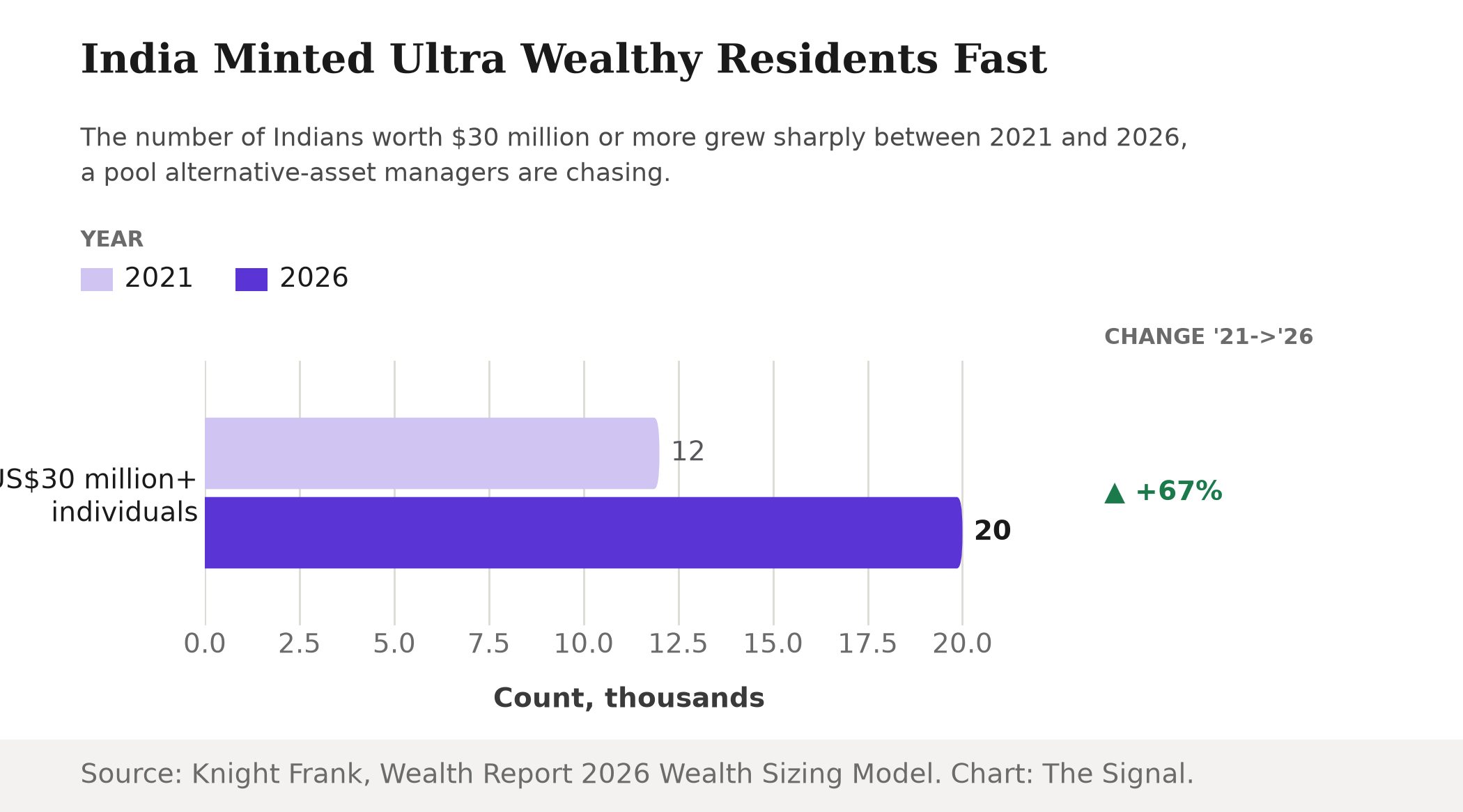
India's family offices have a new statistic to wave around. In its Indian Family Office Playbook published in August 2026, EY and Julius Baer found that 40 to 45 percent of allocations in many family offices are now directed toward alternatives such as private equity, venture capital, private credit, AIFs, REITs and InvITs. That number arrives alongside a genuinely large wealth base to draw on. India's population of individuals worth $30 million or more surged 63 percent between 2021 and 2026, from just over 12,000 to nearly 20,000, and the number of single-family offices in the country grew from about 45 in 2018 to more than 300 by 2024. Read the numbers together and the story writes itself: a rapidly multiplying class of the ultra-rich, newly organised into professional family offices, is rotating close to half its money into the illiquid, high-conviction bets that private equity and venture capital are built on.
It is worth slowing down on that 40 to 45 percent figure. It does not measure private equity or venture capital on its own. By its own definition it bundles two very different kinds of asset together: AIFs, the SEBI-regulated category that includes illiquid private equity, venture and private-credit funds, alongside REITs and InvITs, which are listed, exchange-traded and can be sold in seconds. Nothing in the 40 to 45 percent figure says how the money actually splits between the two.
The split is not close. In a June 2025 edition of the same survey series, the most recent EY-Julius Baer breakout of private equity and venture capital allocation specifically, 57 percent of family offices allocated less than 10 percent of their portfolios to private equity or venture capital, often citing limited access or a cautious approach. A headline number built to sound like conviction in illiquid private markets is, for most family offices, a small position in the least liquid asset the number counts.
A more current, full-portfolio breakdown confirms the shape of that split rather than complicating it. The Economic Times-1Lattice Indian Family Offices Report '26 put family offices' average 2021-2025 portfolio at roughly 40 percent public equities, 20 percent private equity and venture capital, 15 percent real estate and 15 percent debt, with just 2 percent in luxury or passion assets. Even that 20 percent average, double what the EY survey's majority reported, is still half the weight of listed public equities alone. It would take only a handful of larger allocators pulling the average up for that number to stay consistent with most family offices sitting under 10 percent.
"Alternatives" is a much wider bucket than private equity alone
| Metric | Figure | As of |
|---|---|---|
| Family office allocation to "alternatives" (AIFs, REITs, InvITs, PE, VC and private credit combined) | 40-45% | August 2026 |
| Family offices allocating under 10% of their portfolio to PE/VC specifically | 57% | June 2025 |
Source: EY-Julius Baer Indian Family Office Playbook, August 2026 edition and June 2025 edition.
The uncalled billions
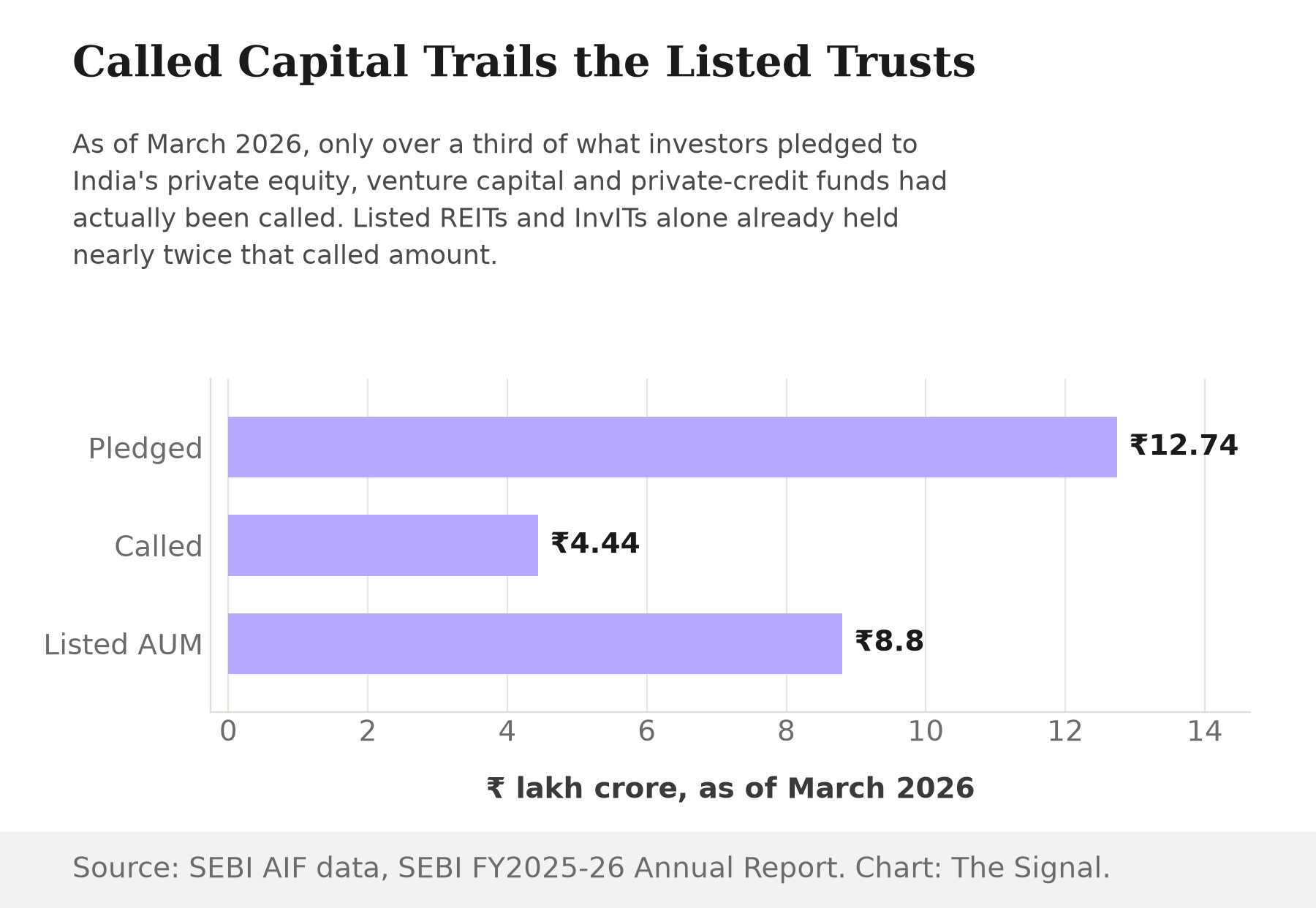
SEBI's own numbers back this up from the supply side. As of March 2026, Category II AIFs, the bucket housing private equity, venture capital and private-credit funds, had commitments of Rs 12.74 lakh crore but had actually drawn only Rs 4.44 lakh crore of that money, a call rate of about 35 percent. Nearly two-thirds of the capital investors have formally pledged to India's illiquid private-fund industry has not actually been asked for yet, let alone invested in a company.
Part of that gap is written into the rules. SEBI's AIF Regulations require Category I and II AIFs, the bucket that houses private equity and venture capital funds, to be close-ended with a minimum tenure of three years, and set a minimum investor commitment of Rs 1 crore, a floor and a lock-up neither REITs nor InvITs impose on an investor who can exit on an exchange the same day.
Meanwhile the liquid half of the "alternatives" bucket is already bigger than the money genuinely locked into illiquid funds. REITs and InvITs, both exchange-listed and far more liquid than a direct private equity stake, held a combined net asset value of Rs 8.8 lakh crore in India by the end of March 2026, nearly double the Rs 4.44 lakh crore that has actually been called into Category II AIFs. Family offices are not short of money to put into "alternatives." They are short of appetite for the illiquid kind.
A wealth boom outpacing the plumbing
The number of people who could plausibly write these checks keeps rising. Bain & Company found that India's total private equity and venture capital investment rebounded about 9 percent year over year in 2024 to reach roughly $43 billion, evidence that overall deal-making has recovered from its post-2022 slump. But that recovery has been driven largely by institutional and global capital, not by the newly organised crop of Indian family offices. The same wealth pool that grew 63 percent between 2021 and 2026, and the family-office count that multiplied more than sixfold between 2018 and 2024, have not shown up as a proportionate rise in direct private equity and venture capital allocation. The wealth is arriving faster than the willingness to lock it up.
The honest objection
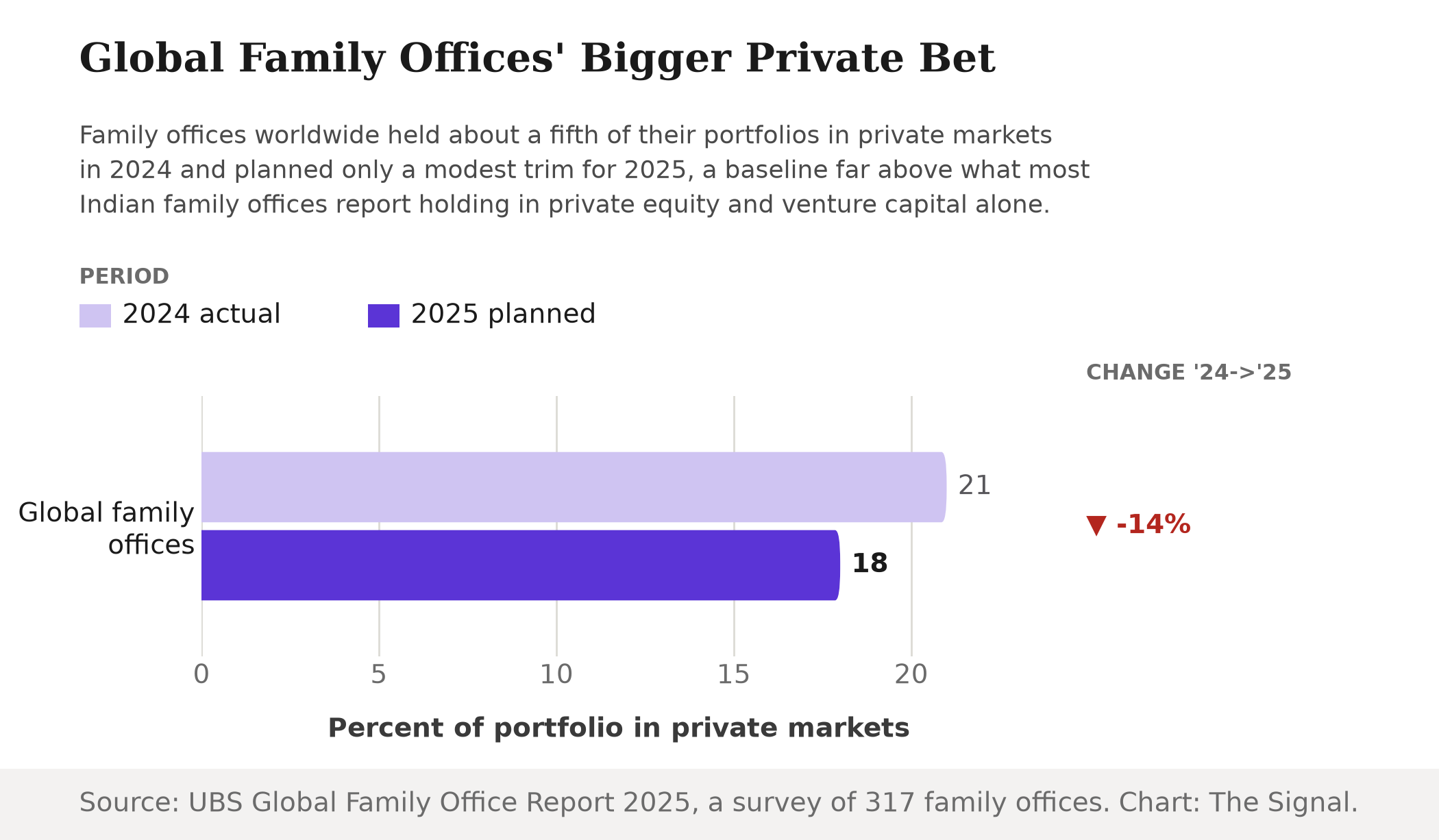
The strongest case against reading this as caution is that Indian family offices may simply be early in a cycle every wealth-management industry goes through. Globally, family offices held 21 percent of their portfolios in private markets in 2024, and those planning to change allocations for 2025 intended to trim that to 18 percent on average, UBS found in a 2024 survey of 317 family offices worldwide. If even the world's most experienced family offices are pulling back from private markets, India's newer, more cautious ones could simply be catching up to a global mood, not revealing anything distinctive about India.
That case holds up only so far. Global family offices were trimming from a 21 percent baseline, more than double the under-10-percent that most Indian family offices report holding in private equity and venture capital alone. An industry converging toward a global norm should be closing that gap, not sitting at less than half of it. The direction of travel looks similar, but the distance covered is nowhere close.
The Signal
The 40 to 45 percent statistic is not wrong. It is just measuring the wrong thing if the question is appetite for illiquid risk. What India's rich are actually doing, at scale, is buying the liquid wrapper around alternative assets, listed trusts they can exit on an exchange, while leaving the bulk of what they have pledged to illiquid private funds uncalled. The private-fund industry has not failed to raise commitments. What is showing up instead is a revealed preference for optionality over conviction. Watch the call rate on Category II AIFs over the next few years: if it climbs meaningfully above 35 percent as fund vintages mature, the illiquid allocation is catching up to the marketing copy. If it stays flat while REIT and InvIT AUM keeps compounding, the "alternatives" story was a liquidity story all along.
Reporting basis: the private fund commitment and call-rate figures are from SEBI's Alternative Investment Fund activity data; the REIT and InvIT net asset value figures are from SEBI's FY2025-26 Annual Report. The family office allocation figures come from two editions of the EY-Julius Baer Indian Family Office Playbook survey, published in August 2026 and June 2025. The family-office count is from a separate EY India analysis of the sector's growth. The ultra-high-net-worth population figures are from Knight Frank's Wealth Sizing Model in its Wealth Report 2026. The private equity and venture capital deal-value figures are from Bain & Company's India Private Equity Report 2025. The global family office comparison is from UBS's Global Family Office Report 2025, a survey of 317 family offices. The full-portfolio breakdown is from The Economic Times-1Lattice Indian Family Offices Report '26. The AIF minimum-tenure and minimum-investment rules are from SEBI's Alternative Investment Funds FAQ. The 35 percent call rate, the comparison between called AIF capital and REIT/InvIT net asset value, and the multi-year growth ratios cited for the family-office count and the ultra-high-net-worth population are The Signal's calculations from those figures.