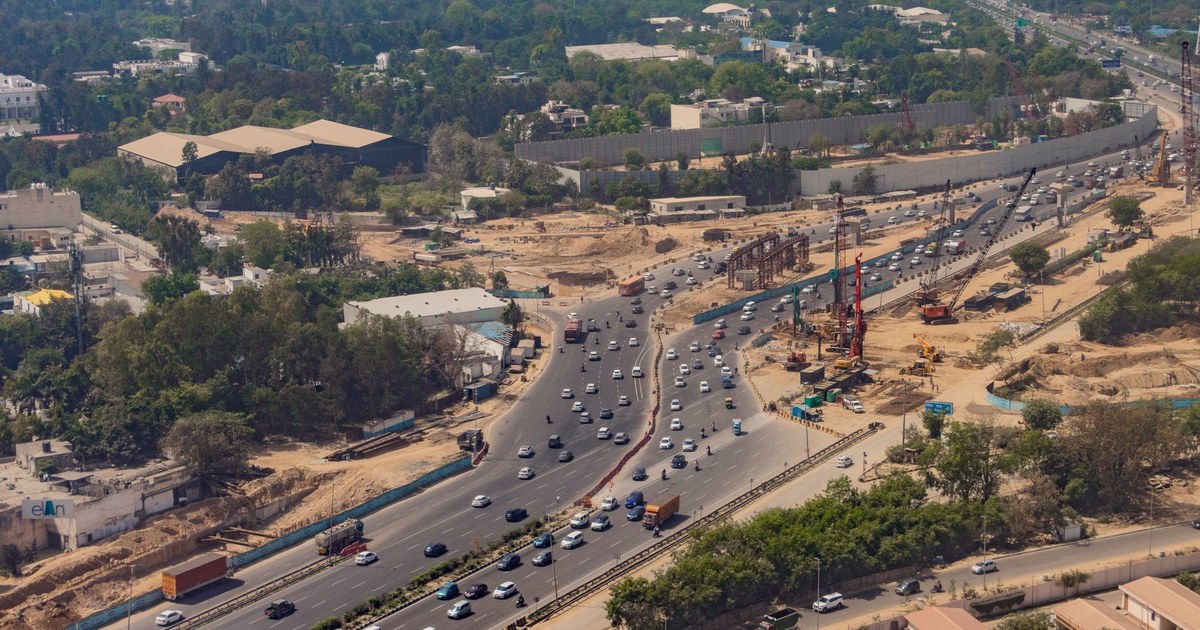
Delhi wants to charge drivers for entering the city's busiest areas, the same tool London and New York already run. Delhi's draft Master Plan 2047 proposes that road agencies and the transport department, working with traffic police, designate "congestion pricing zones" around areas such as TOD nodes, the Walled City Heritage Zone and the Metropolitan City Centre. Read as one clause in a planning document gazetted this month, it looks like Delhi is catching up to cities that made this move years ago. London's Congestion Charge rose to £18 a day from 2 January 2026, up from the £15 rate that had held since 2020, a 20 percent increase. New York has charged $9 a day for passenger vehicles entering its Manhattan Congestion Relief Zone since January 2025. Delhi wants the same lever.
It is worth slowing down on that comparison. A congestion charge is not really a pricing policy. It is a bet that the driver taxed off the road has somewhere better to go. London and New York can make that bet because their transit systems catch the trips it displaces: in the first year of New York's toll, subway trips entering the pricing zone rose 9 percent, with express and local bus trips up 7.8 and 8.4 percent, according to MTA data cited by the Governor's office. Delhi's own government has already made the opposite admission about its own system.
The number that matters is not on any price list. In 2019, weighing whether to exempt two-wheelers from an earlier vehicle-rationing scheme, Delhi's transport minister told the Tribune that the city did not have the vacant public transport capacity to absorb those riders if they were forced off their bikes. That sentence, from Delhi's own government, is the case against assuming a London-style charge works the same way here. The tool being borrowed depends on a system Delhi has told its own press, on the record, it does not have.
What the master plan actually proposes
MPD 2047's language is procedural, not a price list. The clause hands zone identification to road agencies and the transport department, working with traffic police, and names three kinds of candidate area: TOD nodes, the Walled City Heritage Zone and the Metropolitan City Centre. No charge amount, no start date and no exemption schedule appear in it. That puts Delhi's draft plan at an earlier stage than either of the two cities it is implicitly modeled on, both of which have years of running toll data behind their current rates.
Delhi has named the zones. It has not named a price.
| City | Congestion charge | In effect since |
|---|---|---|
| Delhi (proposed) | Not specified; zones still to be identified by road agencies and the transport department | Draft Master Plan 2047, August 2026 |
| London | £18 a day | 2 January 2026, up from £15 since 2020 |
| New York (Manhattan) | $9 a day for passenger vehicles | January 2025 |
Source: ThePrint, citing the draft Master Plan for Delhi 2047; Transport for London; Office of the Governor of New York.
Delhi already ran this experiment once
Delhi is not attempting road pricing on a blank slate. In January 2016, the CSIR-Central Road Research Institute found that the Odd-Even scheme cut traffic volume by 15 to 20 percent on the most congested NCR stretches, and travel time by 30 to 50 percent, while it ran. Those are large effects for a two-week alternate-day rationing scheme. But Odd-Even was a blunt ban, not a price signal, and its exemptions ran along exactly the fault line the transport minister named three years later. Two-wheelers, the vehicle class the government said public transport could not absorb, were exempted from Odd-Even's rationing rules. A scheme that has to carve out the vehicles its own transit network cannot replace is not a clean pilot of road pricing. It is evidence of the gap the new plan has not yet addressed.
Where the price signal actually works
London and New York's tolls are not free-standing; ridership absorbing the displaced trips is the mechanism, not a side effect. 85 percent of commuters into Manhattan's Central Business District already travel by public transportation and only 11 percent drive, according to New York Governor Kathy Hochul's office, a base of transit riders large enough that a toll only has to nudge the remaining minority off the road. New York's Congestion Relief Zone subway trips grew 9 percent, and express and local bus trips grew 7.8 and 8.4 percent, in the toll's first year, according to MTA data cited by Governor Kathy Hochul's office. That is the loop a congestion charge needs: price the road, and transit catches what falls off it.
A price on driving only works if transit can catch what it displaces.
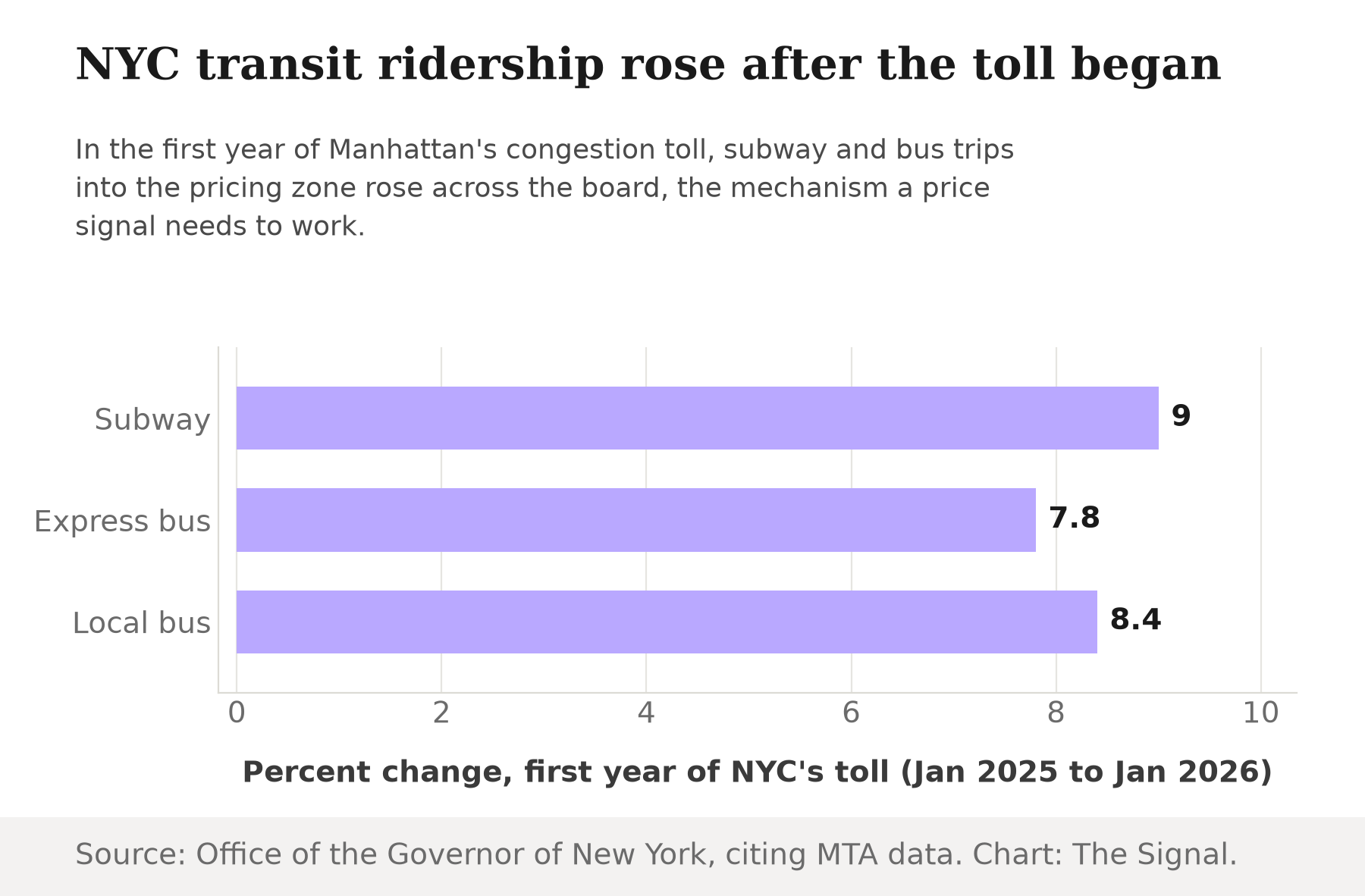
Source: Office of the Governor of New York, citing MTA data. Chart: The Signal.
The capacity Delhi would need
Delhi Metro is a genuinely large network. It carried 235.8 crore passenger journeys in 2025, averaging 64.60 lakh riders a day, according to DMRC data reported by the Tribune. Buses are building too: Delhi's DTC bus fleet has reached about 6,800 vehicles, and the Delhi government plans to expand it to around 14,000 by 2028-29, according to the Tribune. But the fleet it would need to absorb any diverted trips from is growing too. Delhi's registered vehicle count grew from 1.27 crore in 2021-22 to 1.56 crore in 2024-25, nearly 23 percent in three years, according to Delhi government data reported by ThePrint. Nothing in the draft master plan's congestion-pricing clause commits that bus expansion, or any other new transit capacity, specifically to the zones it names before they start charging.
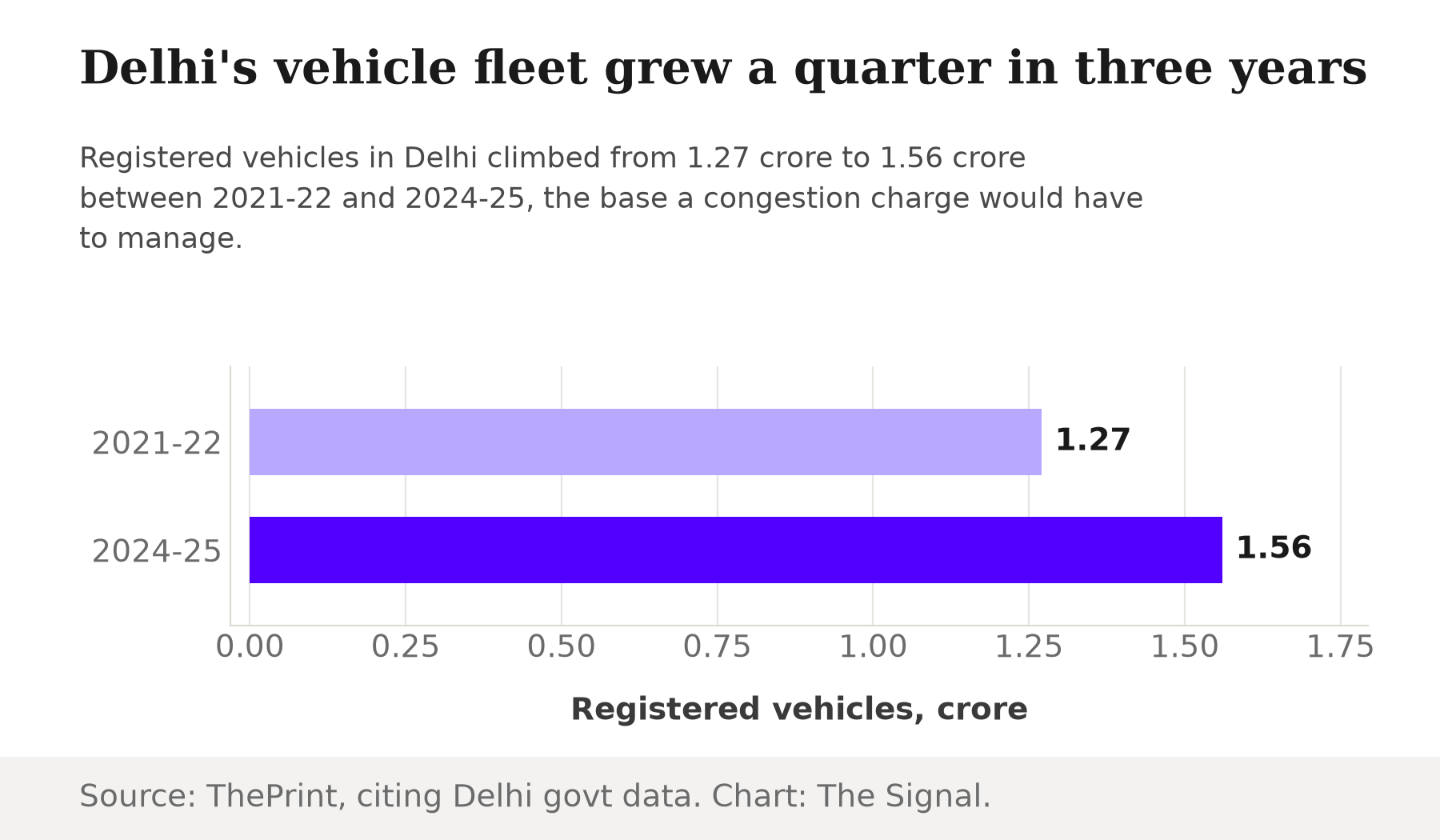
Source: ThePrint, citing Delhi government data. Chart: The Signal.
The honest objection
The strongest case for Delhi's plan is that it is not Odd-Even. MPD 2047's zones are specific areas, TOD nodes, the Walled City Heritage Zone and the Metropolitan City Centre, not a citywide alternate-day ban on half the fleet. London's own charge covers a roughly square-mile central zone, not all of London. A price on a handful of dense nodes needs far less spare transit capacity than rationing an entire city's cars did in 2016, so the 2019 capacity admission may simply not apply at this smaller scale.
That case has real force. But it runs straight into a fact: MPD 2047 proposes pricing exactly the densest, most transit-dependent parts of the city, the Walled City Heritage Zone and the Metropolitan City Centre among them. That is where the case for a working alternative matters most, not least. Odd-Even's own exemption record shows what Delhi does when a rationing tool meets a transit gap: it carves out the vehicles the network cannot replace, rather than close the gap first. Nothing in the draft plan's own clause commits to doing it differently this time.
The Signal
MPD 2047 has borrowed the price mechanism from London and New York without yet borrowing the commitment that makes it work: a transit system built, and funded, to catch what the price pushes off the road. London and New York can point to rising subway and bus ridership as the toll's answer to "where do the cars go." Delhi's own transport ministry has already put on record that its answer, in 2019, was that there was nowhere for them to go. Watch what the transport department attaches to this clause when it actually sets a price: a matching commitment to add bus and Metro capacity in the named zones would mean Delhi has learned Odd-Even's lesson. A price with no capacity behind it would mean Delhi is set to relearn it.
Reporting basis: the Master Plan 2047 congestion-pricing clause and Delhi's registered-vehicle counts are per ThePrint's reporting, citing PTI copy and Delhi government data respectively. London's Congestion Charge rate is per Transport for London's own proposal notice. New York's toll rate and its first-year transit ridership figures are per the Office of the Governor of New York, citing MTA data. The 2016 Odd-Even scheme's traffic and travel-time effects are per a CSIR-Central Road Research Institute field study. The 2019 capacity admission on two-wheeler exemptions is per the Tribune's report of Delhi's transport minister. Delhi Metro's 2025 ridership is per DMRC data reported by the Tribune. Manhattan's commuter mode share is per the Office of the Governor of New York. Delhi's DTC bus fleet size and expansion target are per the Tribune. The percentage changes in London's charge and Delhi's vehicle fleet are The Signal's calculations from those figures.