
At his post-monetary-policy press conference on August 5, 2026, RBI Governor Sanjay Malhotra was asked directly about the special swap facility the central bank had opened for FCNR(B) dollar deposits. His answer was unambiguous: "As of now, there is no proposal under consideration to close the scheme prematurely." Banks took the guidance at face value. They kept mobilising deposits, and some kept committing to lend dollars against them, planning around the scheme's stated end date of September 30.
Nine days later, the RBI moved up the deadline for banks to mobilise fresh FCNR(B) deposits to August 31, and shortened the window to execute the swaps from October 16 to September 11. The facility had by then already pulled in $56.846 billion in combined FCNR(B), ECB and OFCB inflows as of August 13. The surface read is straightforward: the RBI got the dollars it wanted, and closed the tap. That is the read the central bank itself has encouraged.
It is worth slowing down on the nine days. A governor rarely rules out an action at a public press conference and then takes that exact action nine days later without the position having genuinely been in motion underneath him. Either the August 5 denial was true and the facility's fate turned fast, or the calculus behind the August 14 reversal was already further along than the public was told. Both readings say something uncomfortable about how banks were meant to plan around this scheme.
What actually changed, and who bears it
The FCNR(B) swap facility let banks convert foreign-currency deposits into rupees with the RBI, then convert back at a pre-agreed rate at maturity, insulating the bank from currency risk on the swap itself. But the RBI's own FAQ on the facility is explicit about what it does not cover: "The facility is a plain buy/sell foreign exchange swap from the RBI side covering only the principal amount of the deposits and not the interest component." Eligible deposits also had to carry a minimum original tenor of three years. The interest-differential cost of holding those dollar deposits was always the bank's to carry, not the RBI's.
How the cost of a swapped deposit splits
| Component | Who bears it |
|---|---|
| Principal of the deposit | RBI, via the swap |
| Interest-differential cost | The bank, not the RBI |
Source: RBI's FAQ on the FCNR(B) swap facility.
That design matters for what the early closure actually did. It did not strand deposits banks had already swapped; it cut off the runway banks were using to plan the deposits and the lending built on top of them.
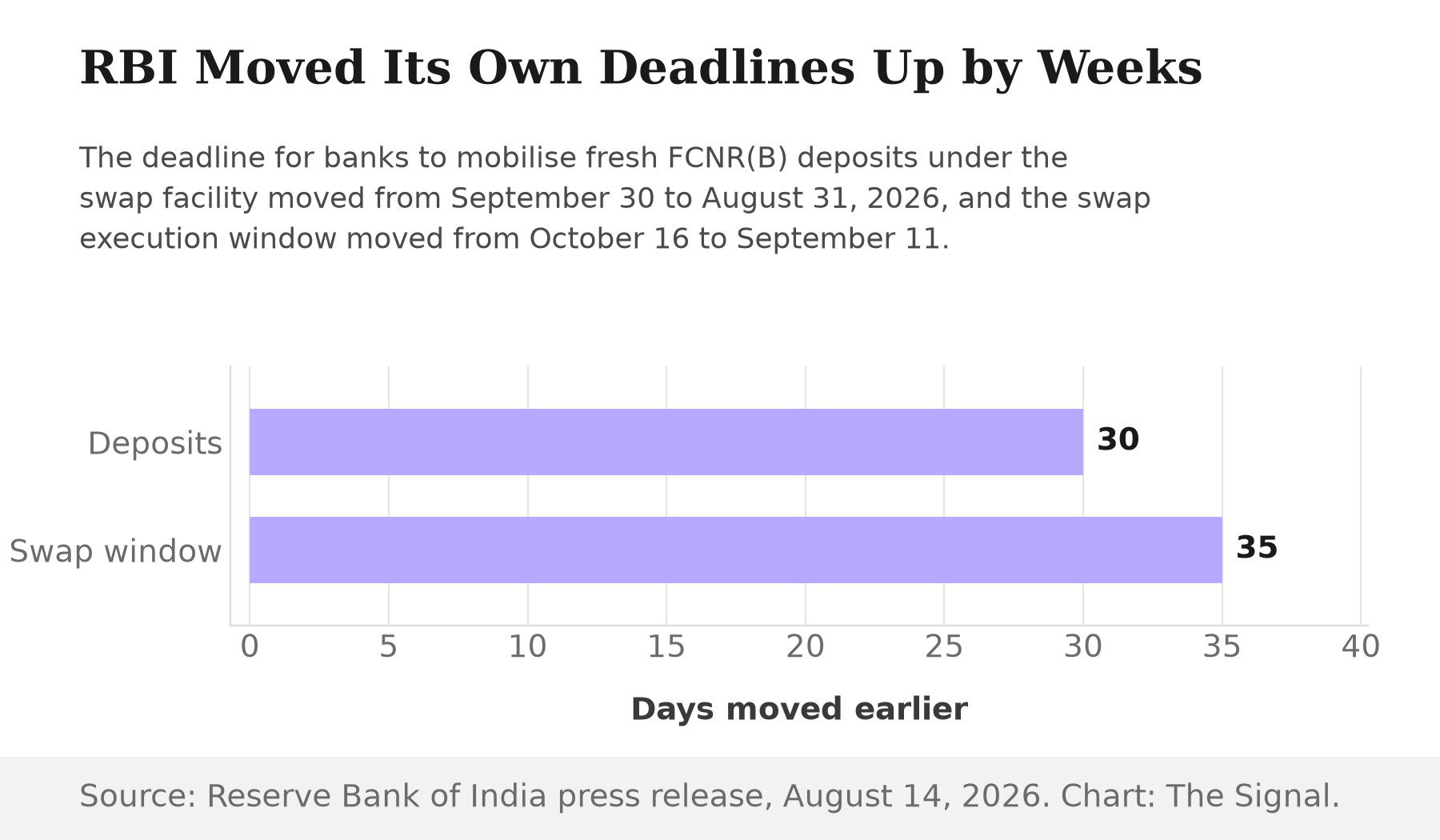
Source: RBI press release advancing the FCNR(B) swap facility deadline. Chart: The Signal.
What the compressed timeline costs banks
Banks that had already committed to lend against FCNR(B) deposits now have to raise short-term replacement funding, potentially at higher rates, before refinancing those liabilities through longer-term loans or overseas bonds. The shortened window left less time to arrange the long-term foreign-currency funding they had been planning around. That is a direct funding-cost hit, not an abstract one: a bank that expected weeks more runway to lock in cheaper long-term dollars now has to bridge the gap with pricier short-term borrowing.
The compression shows up in the operational detail too. Opening the accounts and arranging the overseas funds that back a FCNR(B) deposit normally takes 15 to 20 days, a process banks now have to accelerate against a deposit deadline that arrived a month sooner than advertised. Economist Madhavi Arora put the underlying problem plainly: "Markets can adjust to policy changes; what they find harder to price is uncertainty around the policy framework." A single rate change is a number a bank can model. Pulling a scheme forward days after publicly ruling it out is a different kind of risk, and it shows up in how banks price every future RBI facility, not just this one.
The dollars still on the table
The closure was not costless for the RBI's own numbers either. SBI Research had projected combined FCNR(B), ECB and OFCB inflows could reach $80 billion to $85 billion by the scheme's original September 30 deadline, against the $56.846 billion already secured by August 13. The early closure likely left a meaningful slice of that projected inflow unmobilised.
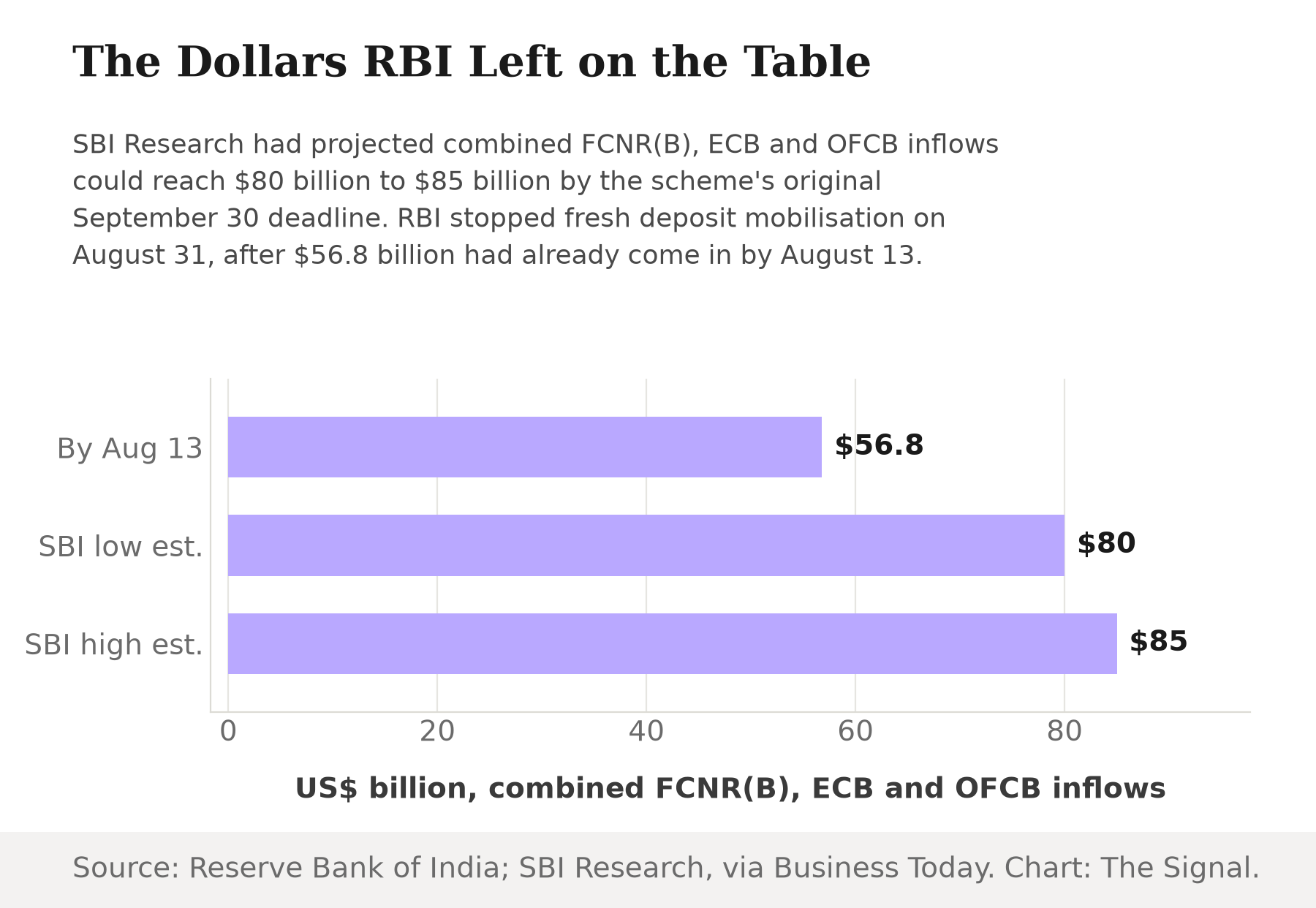
Source: Reserve Bank of India press release for the $56.846 billion inflow figure; SBI Research's projection, as reported by Business Today. Chart: The Signal.
That is the tension the RBI's own defenders have to sit with: the facility was working, by the RBI's preferred measure of dollars mobilised, when it was cut off. Economists cited in reporting on the closure argued the cost of running the facility longer had to be borne somewhere: "The cost burden has to be eventually borne by the central bank and the government." Every dollar swapped in is a dollar the RBI has to manage on its own balance sheet, and strong inflows were adding to the rupee liquidity the RBI would eventually need to sterilise. That argument does not require bad faith on the RBI's part. It requires only that the cost of keeping the window open kept rising the longer it stayed open, even as the dollar total kept climbing too.
The honest objection
The strongest case for the RBI is the one Governor Malhotra made himself two weeks after his denial. He rejected the "U-turn" framing directly: "It will not be correct to call it a U-turn; it is rather a calibration." His argument was that the marginal utility of each additional dollar swapped in was falling as the total climbed, while the marginal cost of sterilising those inflows for longer was rising. On that logic, a central bank that keeps a facility open past the point where the trade-off flips is not being prudent, it is running the scheme on autopilot. Closing early, in this telling, is simply the responsible call.
That case is real, and the economics behind it holds up: a facility that is getting more expensive to run for less marginal benefit should not run forever. But it explains why the RBI eventually closed the window. It does not explain why the governor stood at a public press conference on August 5 and said no such move was under consideration, when the facility had already pulled in tens of billions of dollars and the same cost-benefit math he later invoked was presumably already visible to him. A genuine recalibration, communicated as one, would have cost the RBI little. Following a denial with the opposite action nine days later costs something different: the next time the RBI says a scheme is not under review, banks now have a concrete data point for how much that statement is worth.
The Signal
Nothing here says the RBI made the wrong call on the economics. Closing a swap facility once its rising sterilisation cost outweighs its falling marginal benefit is a defensible, even conventional, piece of central-bank housekeeping. What is not defensible on the same terms is the nine-day gap between the public denial and the reversal, because that gap is what banks are actually pricing now, not the closure itself. Watch what the RBI does the next time it opens a facility with a stated end date. Guidance holding until the date it names would make the calibration defense the real story. If another deadline moves without warning, the pattern, not the individual decision, becomes the thing banks build into every rate they quote the RBI.
Reporting basis: the revised FCNR(B) deposit-mobilisation and swap-execution deadlines and the $56.846 billion inflow figure as of August 13, 2026 are from the Reserve Bank of India's own press release. The facility's design, including the three-year minimum tenor and the principal-only swap coverage, is from the RBI's own FAQ page. Governor Malhotra's August 5 denial is as reported by Business Today, and his later calibration defense is as reported by Deccan Chronicle, each quoting the governor directly. The SBI Research inflow projection is as reported by Business Today; the economists' comments on the sterilisation cost are also from Business Today; the funding-cost mechanism for banks with existing lending commitments is as reported by Outlook Business; and economist Madhavi Arora's quote on framework uncertainty is as reported by Business Today. The gap between the SBI Research projection and the amount secured by August 13 is The Signal's calculation from those two reported figures.