Reliance Industries has proposed investing around Rs 2.73 lakh crore over 30 years to build what would become India's first integrated underground coal gasification complex, in Eluru district, Andhra Pradesh. The pitch is straightforward: the Chintalapudi and Recherla coal blocks that Reliance has secured hold a combined 3,130.61 million tonnes of coal, but the deposits sit more than 600 metres down, deep enough that officials say conventional mining is commercially unviable there. Underground coal gasification skips the mining step entirely: it burns the coal in place and pipes out the resulting synthetic gas, turning reserves that were commercially dead into a chemical feedstock. On paper, it is a mega-project announcement in the classic mould: a rupee figure in the lakh crores, a new industrial complex, a state eager for the investment.
Reliance's headline coal-gas investment is Rs 2.73 lakh crore. Its committed spending through 2027 is Rs 3,000 crore.
It is worth slowing down on that gap before treating the headline figure as real money in motion.
The real commitment is a rounding error
The Rs 2.73 lakh crore is staged in three phases: roughly Rs 3,000 crore for exploration and pilot testing from the third quarter of 2026 through the fourth quarter of 2027, then Rs 1.2 lakh crore for development from 2028 to 2030, then Rs 1.5 lakh crore for production from 2030 onward. Reliance's own filing is explicit that the second and third phases happen only if the pilot testing succeeds. Add the two contingent phases together and they are roughly 99 percent of the total. What is actually funded and running today is the remaining slice, about 1.1 percent of the headline number.
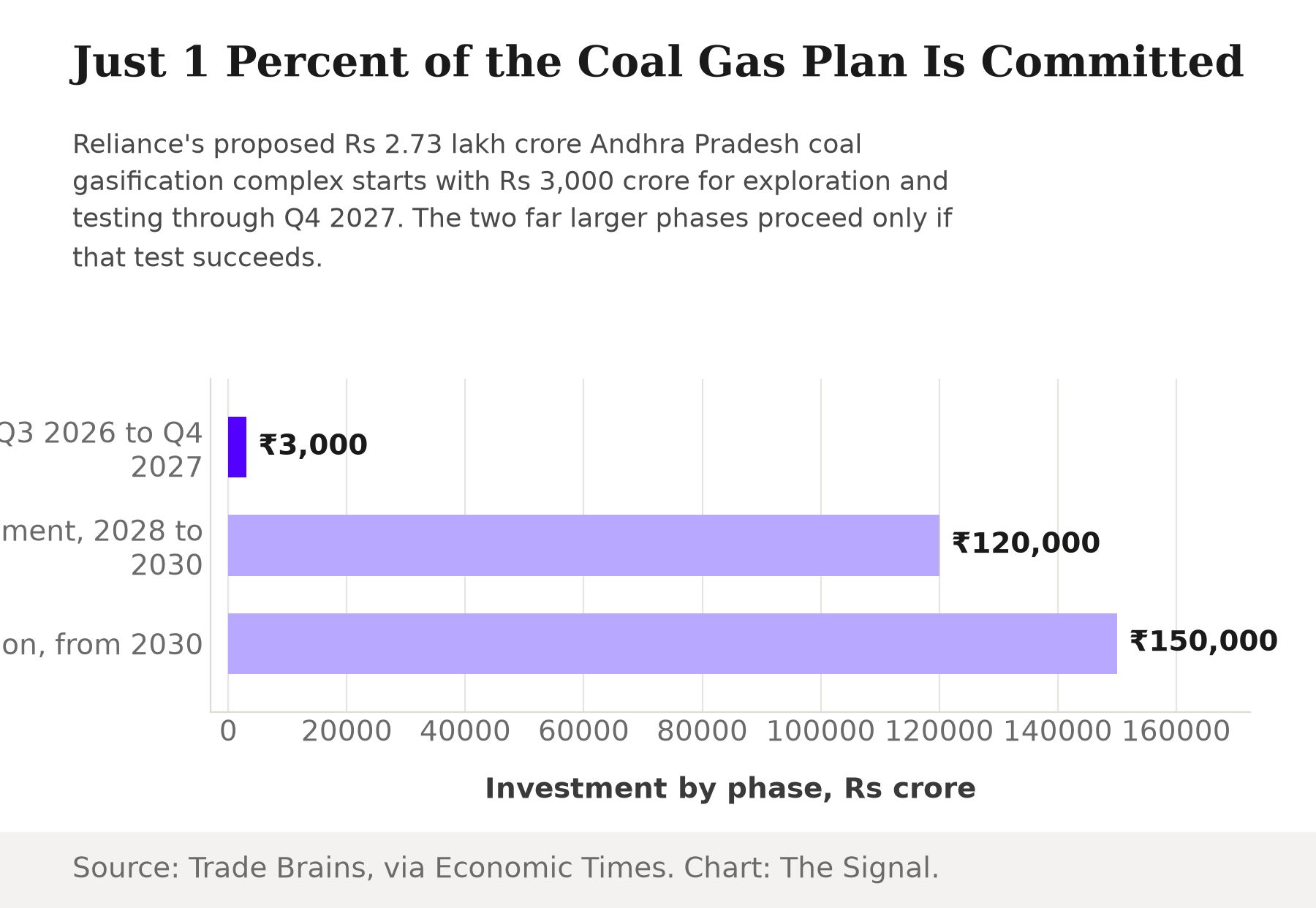
Staging capital behind an unproven pilot is standard project finance, not a mark against the deal. But it changes what the Rs 2.73 lakh crore figure actually means. It is not committed capital. It is a conditional roadmap that becomes real money only if underground coal gasification works at scale on these two blocks, which Reliance itself is testing for the first time in India between now and the end of 2027. If the pilot succeeds, the project could eventually create 3,000 to 5,000 direct jobs and 20,000 to 35,000 indirect jobs, but that employment case rests on the same untested step.
The scale of even that contingent figure is worth measuring against Reliance's own balance sheet. RIL's total capital expenditure across its entire business, O2C, New Energy, Jio and Retail combined, was Rs 1,44,271 crore in the year ended March 2026. The Rs 2.73 lakh crore UCG headline is not a stretch commitment relative to that run-rate. Spread over 30 years, it is well within what Reliance already spends company-wide most years. That is one reason a modest phase-one outlay ahead of proof is unremarkable and low-risk: it holds the option open without much exposure.
The coal no one could reach
The reason Reliance needs an unproven technology at all is worth stating plainly. The Chintalapudi block holds an estimated 904.94 million tonnes of coal and the adjoining Recherla block holds about 2,225.67 million tonnes, together 3,130.61 million tonnes, at depths beyond 600 metres that officials say make conventional mining commercially unviable. Set against India's total estimated coal resource of 400.715 billion tonnes as of 1 April 2025, these two blocks are a small share nationally, about 0.78 percent (our calculation: 3,130.61 million tonnes against 400,715 million tonnes). But their significance is not scale, it is stranding. That coal was worth zero to anyone as long as digging it out cost more than it would sell for. Underground gasification is the only route that turns it into revenue without a shaft or an open pit.
Where this fits nationally
Reliance's Andhra Pradesh complex is not a standalone bet. The government's National Coal Gasification Mission targets 100 million tonnes of yearly coal gasification capacity by 2030, against roughly 22.6 million tonnes currently operational or under implementation, meaning the country is a little under a quarter of the way to its own goal as of the mission's latest update in July 2026.
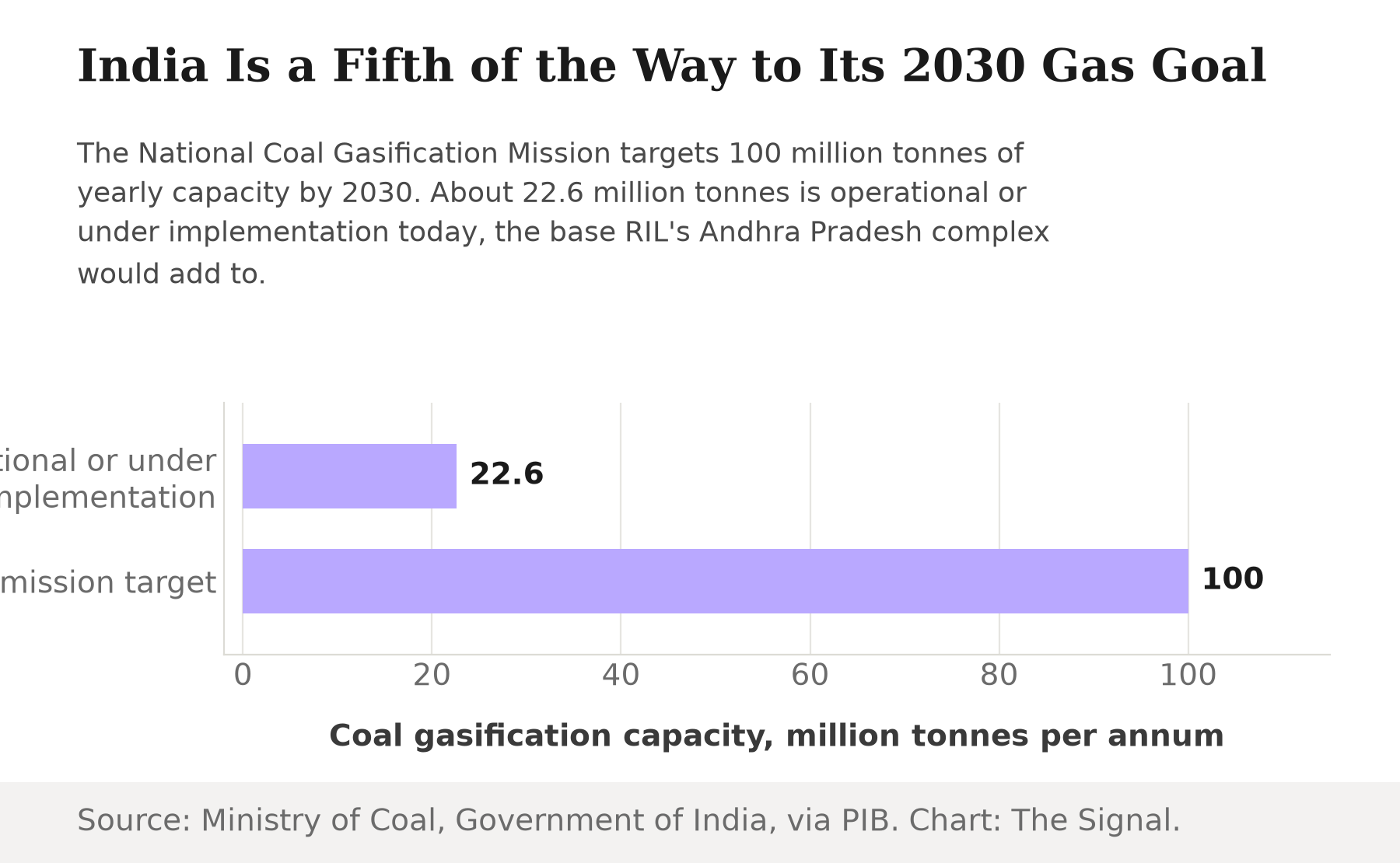
The Union Cabinet approved a Rs 37,500 crore scheme for coal and lignite gasification in May 2026, offering incentives of up to 20 percent of plant-and-machinery cost, explicitly to cut India's reliance on imports of LNG (more than half imported), urea (about a fifth imported), ammonia (nearly all of it imported) and methanol (80 to 90 percent imported). Reliance's project, if the pilot succeeds and the later phases proceed, would be one contributor to that national capacity build, not the whole of it. The gap between 22.6 million tonnes and 100 million tonnes is wide enough that a single company's project, still unproven, cannot be assumed to close it on its own.
The same week's oil math
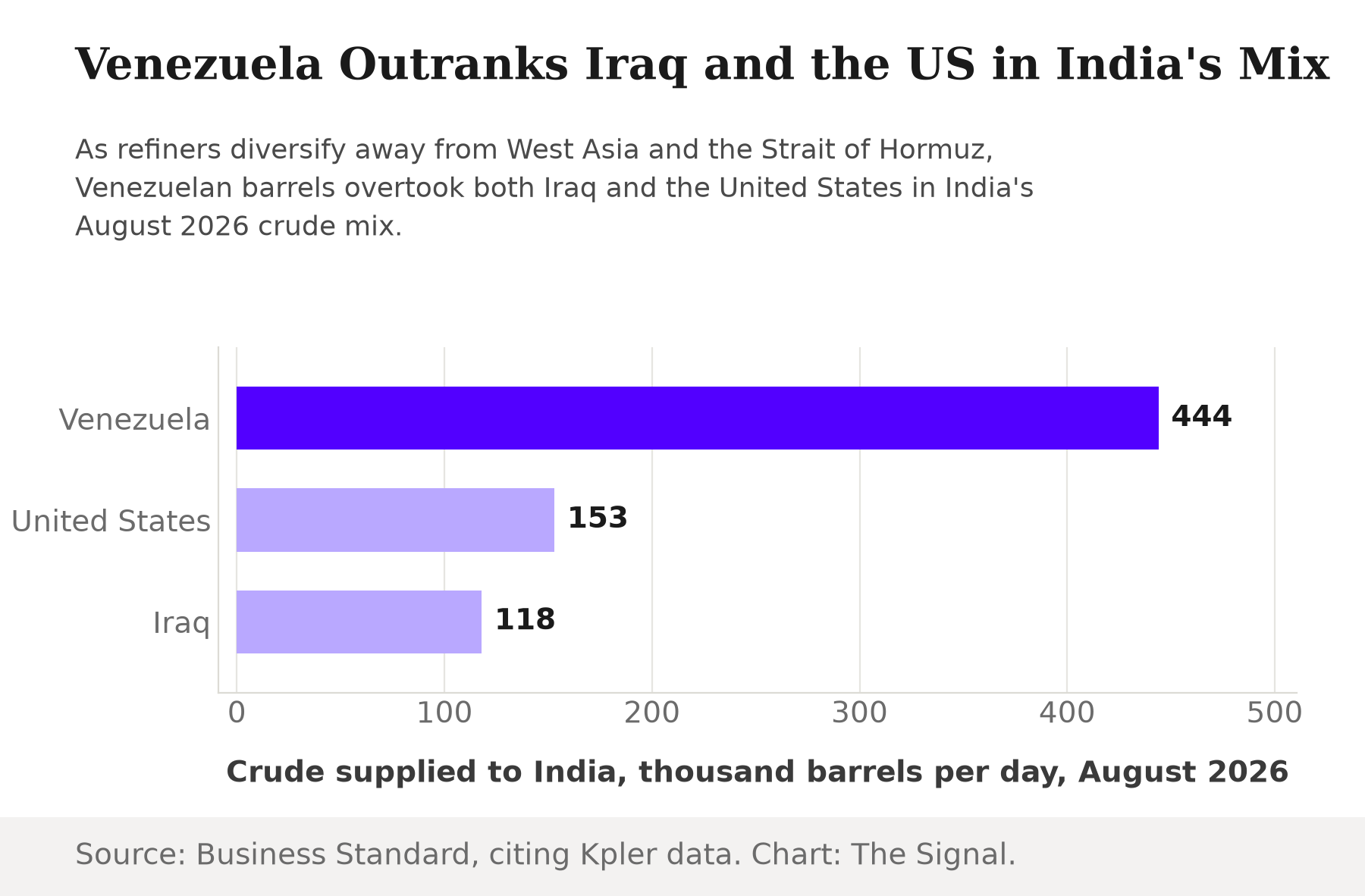
The proposal surfaced in a week when India's energy-import arithmetic was already under strain from a different direction. Brent crude rose to $93.83 a barrel on 20 August 2026, up 2.42 percent from the previous day, and India's dependence on imported crude oil hit a record 88.7 percent in the 2025-26 fiscal year, provisional, up from 85.5 percent in 2021-22, the government told the Rajya Sabha. Refiners have been responding by widening where they buy from. Indian crude imports from Venezuela reached about 444,000 barrels a day in August 2026, ahead of Iraq's 118,000 barrels a day and the United States' 153,000 barrels a day, as refiners diversify away from West Asia and the Strait of Hormuz.
Coal tells a different story from crude. India's own coal-import substitution has already delivered a measurable result: coal imports are falling even as crude dependence keeps climbing.
| Import metric | Earlier period | Latest reported period |
|---|---|---|
| Coal imports | 264.53 million tonnes (FY2023-24) | 243.62 million tonnes, down 7.9 percent, saving about $7.93 billion in foreign exchange (FY2024-25) |
| Crude oil import dependence | 85.5 percent (FY2021-22) | 88.7 percent, provisional (FY2025-26) |
Source: Ministry of Coal, via PIB; ThePrint, citing the Ministry of Petroleum and Natural Gas's Rajya Sabha reply.
Coal gasification will not touch the crude side of that table at all, syngas from coal substitutes for imported gas, urea, ammonia and methanol feedstock, not for crude oil. But it sits in the same national argument: cut the import bill wherever technology allows, because on the oil side, the bill keeps growing regardless.
The honest objection
The strongest case for taking Reliance's headline investment figure at face value is that staged capital is how every large infrastructure project works; a premature number is not a fake one. Reliance has secured the blocks, filed a specific three-phase plan with dates, and named a testing window ending in 2027. A company does not usually publish job and phase-by-phase rupee figures for a project it has no intention of building. On this view, the exploration-and-testing outlay is simply what phase one costs, not evidence of hedging.
That case holds for the shape of the deal, but it does not change what the number means today. A phased plan with a hard contingency, no phase two spending unless testing succeeds, is a real project with an unproven core, not a fully committed capital outlay with a funding schedule attached. The technology itself is not unprecedented globally: underground coal gasification has already produced high-quality syngas at 1,400 metres in Canada's Swan Hills project and at 500 to 600 metres in Spain's El Tremedal project, both deeper than or comparable to the depth Reliance is testing, which is a point in the pilot's favour. What has not been demonstrated is this specific technology working on these specific coal blocks in India, and that is the step the whole plan still depends on. Treating the full figure as locked in skips over it.
The Signal
The number to watch is not the Rs 2.73 lakh crore headline. It is what happens between the third quarter of 2026 and the fourth quarter of 2027, when Reliance's pilot either proves that gas can be pulled reliably from coal seams 600 metres down or it does not. If the test succeeds, Rs 1.2 lakh crore in development spending starts in 2028 and India's coal-gasification capacity gets a large new contributor, still short of the 2030 target but materially closer. Without that success, the headline figure quietly becomes a number that was never going to be spent. Either way, a rupee figure attached to an untested phase is a forecast, not a fact, and the difference between the two is the entire story here.
Reporting basis: Reliance's Rs 2.73 lakh crore proposal and its Eluru, Andhra Pradesh location are per Outlook Business, citing an Economic Times account of the filing. The three-phase investment schedule and job figures are per Trade Brains' account of the same Economic Times material, one origin recarried by both outlets. The Chintalapudi and Recherla block reserve figures and the depth constraint are per ETV Bharat. India's total coal resource figure is from the Ministry of Coal's official statistics. The National Coal Gasification Mission's capacity target and current status are from a Ministry of Coal PIB release; the Rs 37,500 crore gasification incentive scheme is from a separate Cabinet PIB release. The coal-import figures and foreign-exchange savings are from a Ministry of Coal PIB release. India's crude import dependence is per ThePrint, citing the Ministry of Petroleum and Natural Gas's written reply to the Rajya Sabha. The Brent crude price is from Trading Economics market data. India's Venezuela, Iraq and United States crude sourcing figures are per Business Standard, citing Kpler ship-tracking data. The share of national coal resources held by the two Andhra Pradesh blocks is The Signal's calculation from those figures. The comparison of global underground coal gasification depths, including the Swan Hills and El Tremedal sites, is from a peer-reviewed article in Frontiers in Energy Research. Reliance's own FY26 capital expenditure figure is from the company's own audited results media release.