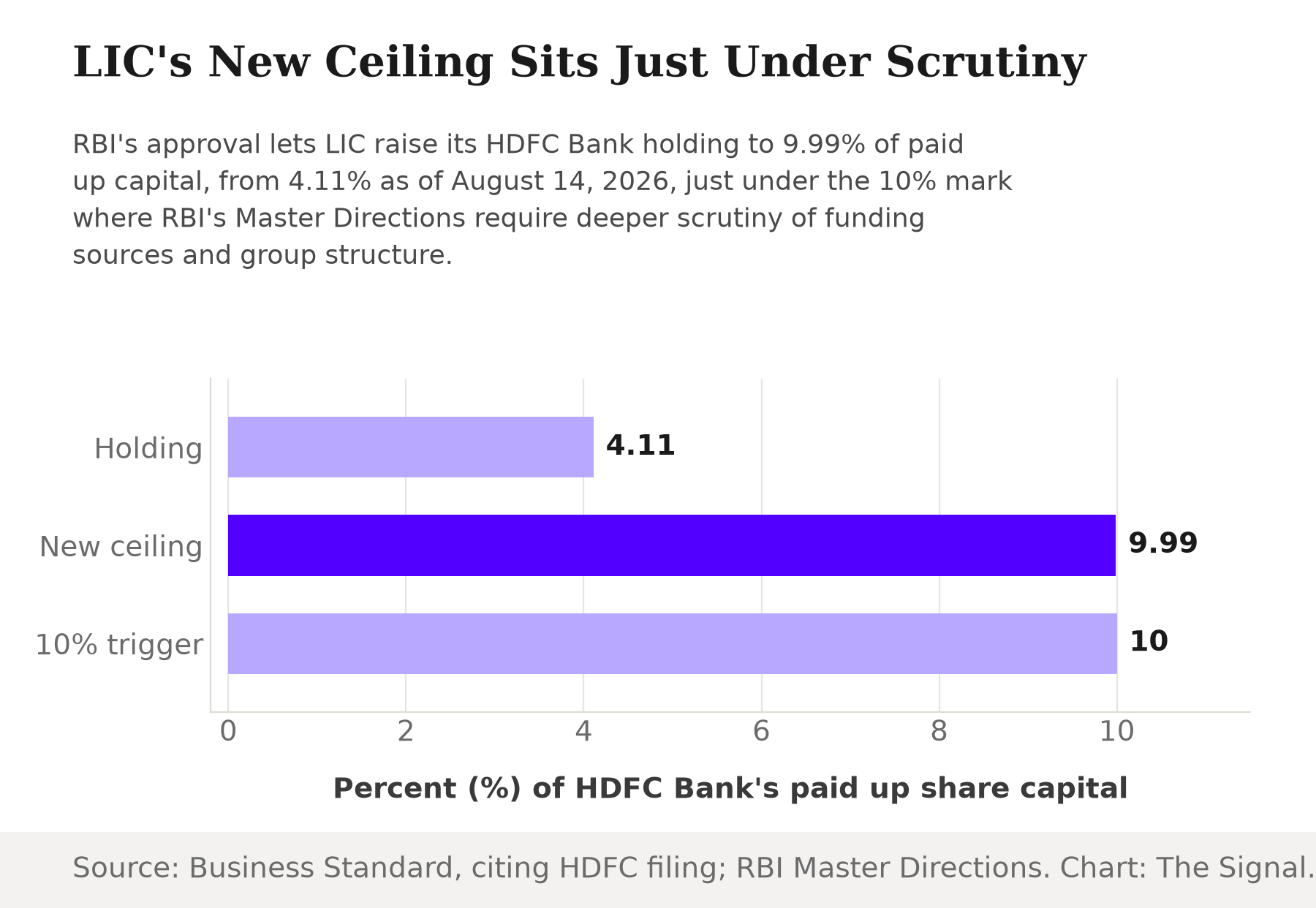
On August 19, 2026, the Reserve Bank of India cleared Life Insurance Corporation of India to raise its holding in HDFC Bank from 4.11% to as much as 9.99% of the bank's paid-up share capital or voting rights, HDFC Bank told exchanges the next day, as reported by Business Standard. The easy read: India's largest insurer just got room to nearly double its stake in India's largest private bank, a straightforward vote of confidence from a state-run institution.
It is worth slowing down on that number. RBI did not approve LIC to buy up to 10%, or 12%, or a fifth of HDFC Bank. It approved 9.99%, one hundredth of a percentage point under a line that means something in Indian banking law. Cross it, and a much harder approval process kicks in.
A single basis point separates LIC's new ceiling from a much harder approval.
That 10% line comes from RBI's Master Directions on acquiring shares or voting rights in banking companies. Below it, an investor clears a baseline fit-and-proper test. At 10% or more, RBI must additionally examine the applicant's group-entity structure and the source and stability of its funds. LIC's new ceiling raises its HDFC Bank stake by 5.88 percentage points, from 4.11% to 9.99%, without ever opening that deeper file.
The threshold that decides how hard RBI looks
The 10% mark is not the only regulatory line near this deal. The Banking Regulation Act's default rule caps any single shareholder's voting rights in a bank at 10% of the total, regardless of economic stake, unless RBI separately agrees to raise that ceiling in phases, up to a maximum of 26%. SEBI's takeover rules sit further out still: an investor crossing 25% of a listed company's voting rights must launch a public open offer to other shareholders.
LIC's new ceiling clears none of these bars, by design or by consequence.
| Threshold | What crossing it triggers | Source |
|---|---|---|
| 10% of paid-up capital or voting rights | RBI's Master Directions require deeper scrutiny: group-entity structure, and the source and stability of the acquirer's funds | RBI Master Directions, 2025 |
| 10% of voting rights (default cap) | The Banking Regulation Act's own ceiling on how much of a bank any shareholder can vote, absent a specific RBI increase to as much as 26% | Banking Regulation Act, 1949 |
| 25% of voting rights | SEBI requires a public open offer to the target company's other shareholders | SEBI SAST Regulations, 2011 |
Source: RBI; Banking Regulation Act, 1949, via PRS Legislative Research; SEBI. Compiled by The Signal.
Read against that table, 9.99% looks less like an arbitrary number and more like the largest stake LIC can hold while its votes still count in full and its acquisition file stays in the simpler lane. Since the Banking Regulation Act already caps LIC's votes at 10% by default, buying past 9.99% would not immediately buy proportional say in the bank, not without RBI separately agreeing to lift the voting cap itself.
LIC has run this exact play before
What makes that reading harder to accept as coincidence is that this is not the first time LIC has landed on precisely this number. In November 2021, RBI approved LIC to raise its stake in Kotak Mahindra Bank from 4.96% to up to 9.99%, as BusinessToday reported. Different bank, different year, different starting stake. Same ceiling.
Two banks, five years apart, one identical ceiling.
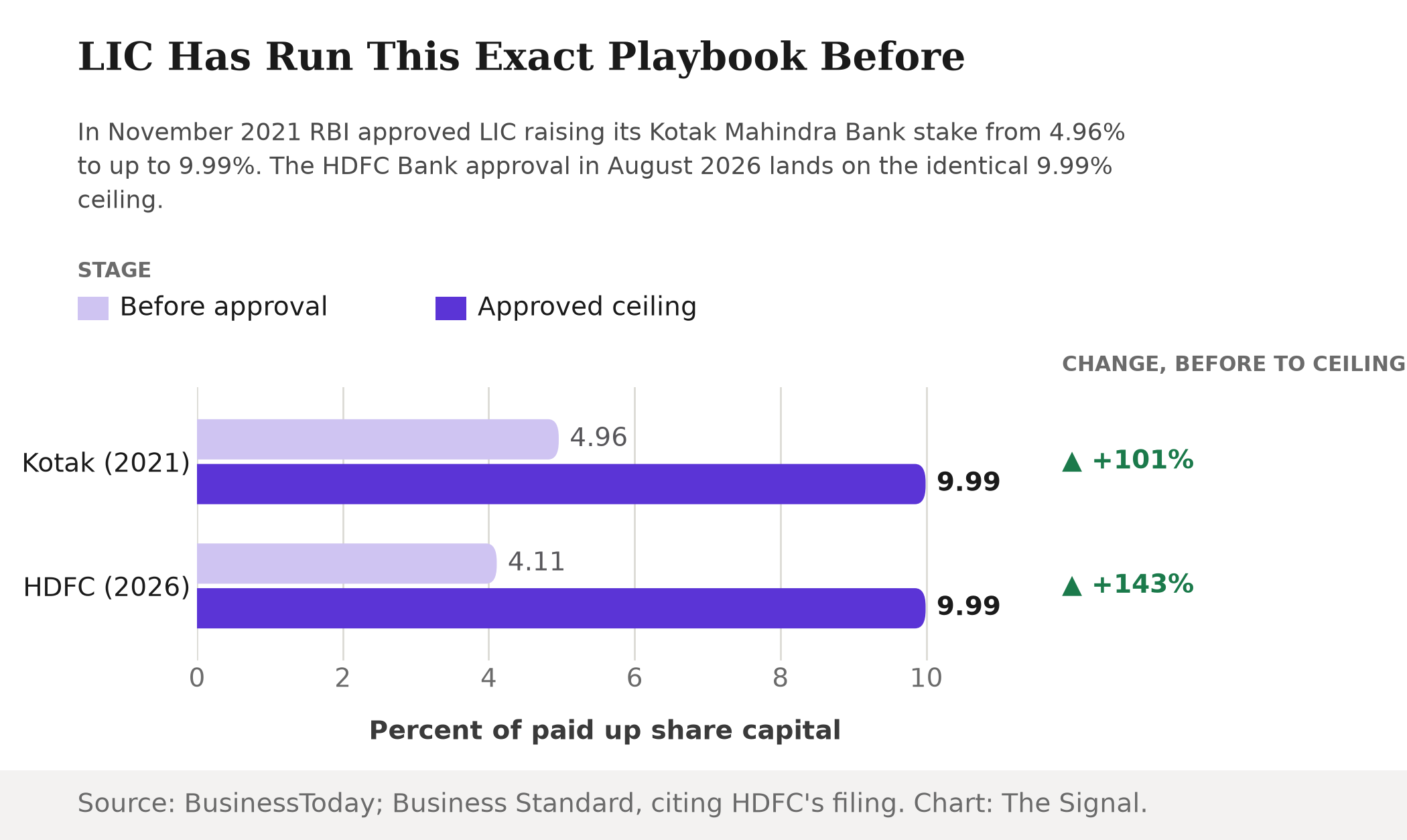
A single filing landing on 9.99% could be an accident of rounding. Two filings landing on it, five years and one different bank apart, look more like a standing rule: raise the stake as high as it can go without crossing into RBI's harder scrutiny lane or the Banking Regulation Act's voting ceiling, then stop. RBI approved both increases in full view of the exact number each time, which is nothing improper. It does suggest LIC treats 9.99% as a known, reusable ceiling rather than working it out fresh at each bank.
What ₹57 lakh crore buys
The reason LIC can repeat this play at will is scale. LIC's total assets under management reached ₹57,29,396 crore as of March 31, 2026, up 5.08% from ₹54,52,297 crore a year earlier, according to LIC's own results release. That is the policyholder float LIC can deploy into stakes like this one, built from decades of premiums from Indian savers rather than shareholder capital.
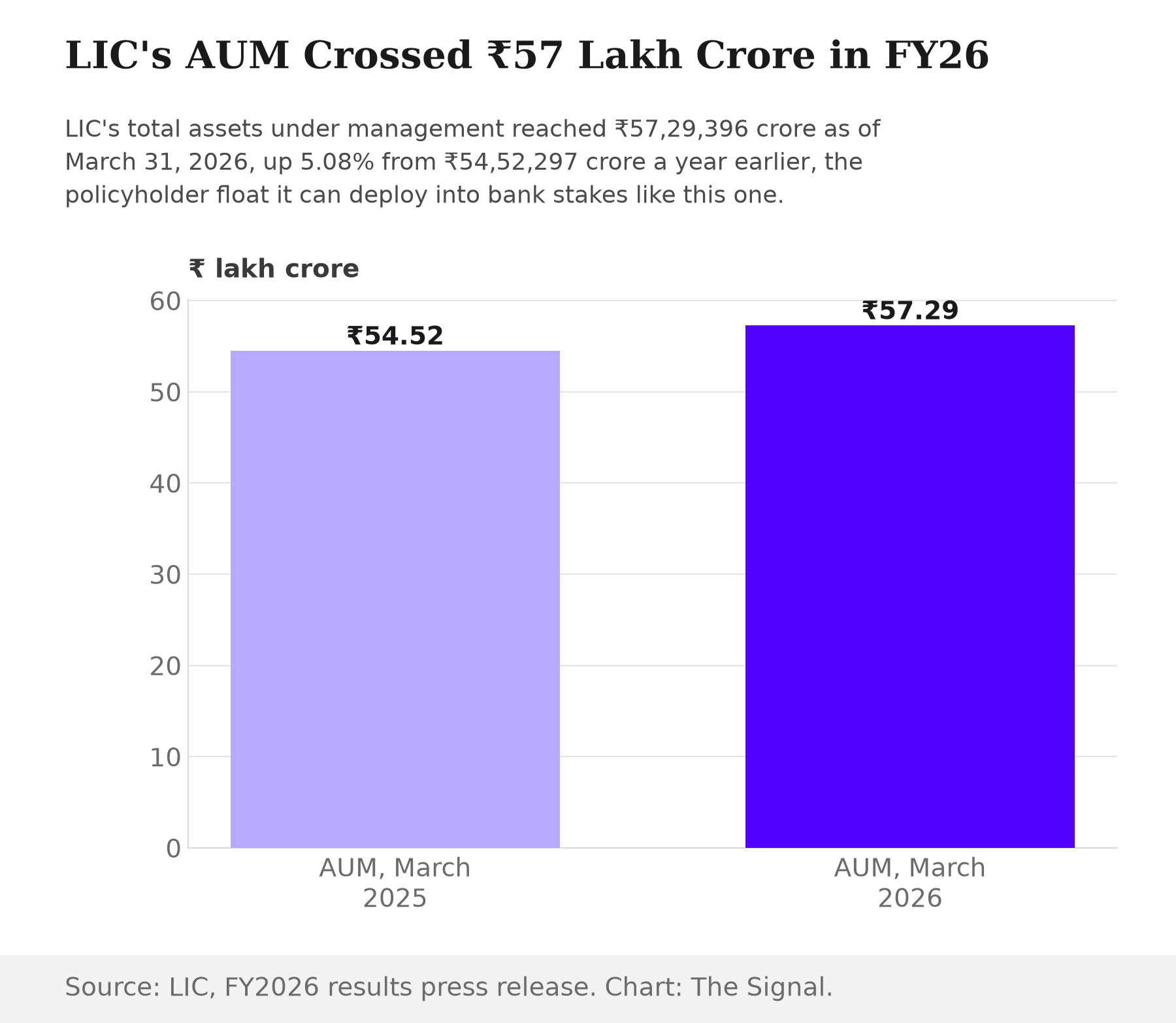
A pool that size does not need to concentrate its bets. It can hold sizeable stakes in HDFC Bank and Kotak Mahindra Bank at once, each calibrated to stay just inside the lane that keeps the approval simple.
The honest objection
The strongest case against reading anything strategic into 9.99% is that it may simply reflect prudent capital allocation, not threshold engineering. Since the Banking Regulation Act already caps any shareholder's votes at 10% regardless of economic ownership, a sophisticated investor with no interest in seeking a further RBI relaxation has little reason to buy stock past the point where its votes stop growing. On that view, the number reflects arithmetic, not gamesmanship: LIC is simply not paying for voting power that would not follow.
That case is real, and it likely explains most of the logic here. But it does not explain the precision, or the repetition. A shareholder optimizing purely for voting power would land somewhere under 10%, but there is no obvious reason it must be 9.99% rather than 9.8% or 9.5%, a wider margin against the same "10 per cent or more" line. Landing on the identical two-decimal figure twice, at two banks, five years apart, looks less like solving a voting-rights equation from scratch each time and more like applying a rule of thumb: get as close to the line as the math allows, then stop.
The Signal
RBI's approval letter is not the story. The number inside it is. 9.99% is what a stake looks like when a regulatory threshold, not a valuation or a conviction level, sets the ceiling, and LIC has now shown that pattern at two of India's largest private banks. What is worth watching is whether it runs the same playbook at other Indian banks in the years ahead. A single 9.99% stake is a calibrated investment. A habit of stopping at exactly that number, bank after bank, starts to look less like caution and more like a strategy regulators may eventually want to examine in aggregate, rather than one filing at a time.
That aggregate view may already be forming, just not in the direction of tighter scrutiny. In July 2026, weeks before clearing LIC's HDFC Bank stake, RBI proposed easing its own approval process for mutual funds, insurers, and pension funds that keep needing fresh clearance as their bank holdings approach the major-shareholding thresholds, a draft rule change prompted by representations from asset managers rather than by LIC specifically. That is the regulator's own acknowledgment that near-threshold stake-building by institutional investors is common enough to warrant a standing rule, not a one-off review each time. LIC's repeated 9.99% may be the clearest instance of the pattern. It is unlikely to be the only one.
Reporting basis: the RBI approval letter for LIC's HDFC Bank stake and LIC's holding as of August 14, 2026, are as reported by Business Standard, citing HDFC Bank's stock-exchange intimation of that approval. The 10% scrutiny threshold is from RBI's Master Direction on the acquisition and holding of shares or voting rights in banking companies, 2025. The Banking Regulation Act's default voting-rights cap is from the statute's text as compiled by PRS Legislative Research. The 25% open-offer threshold is from SEBI's Substantial Acquisition of Shares and Takeovers Regulations, 2011. LIC's 2021 Kotak Mahindra Bank approval is as reported by BusinessToday. LIC's assets under management are from LIC's own FY2026 results press release. RBI's July 2026 draft proposal to ease repeat-approval rules for mutual funds, insurers, and pension funds is from RBI's press release announcing the draft Amendment Directions. The percentage-point gap between LIC's new ceiling and RBI's scrutiny threshold, and the percentage increases at each bank, are The Signal's calculations from those figures.