Sugar in Maharashtra hit a record ex-mill price this month, and India's response has moved fast. From 1 August, the Department of Food & Public Distribution capped how much sugar any dealer can hold nationwide at 4,000 quintals, an order running through 30 November 2026, aimed at hoarding. Days later, officials began weighing whether to lower or scrap the 100 percent duty on imported sugar, a proposal Bloomberg reported was under consideration ahead of festival-season demand, as carried by Business Standard. Read only that far, and India's sugar problem looks like an ordinary supply squeeze that a stock cap and an open import window can fix.
It is worth slowing down on that. Neither lever touches the policy that has spent five years quietly competing with the sugar bag for the same raw cane: the mandate to blend ethanol into petrol.
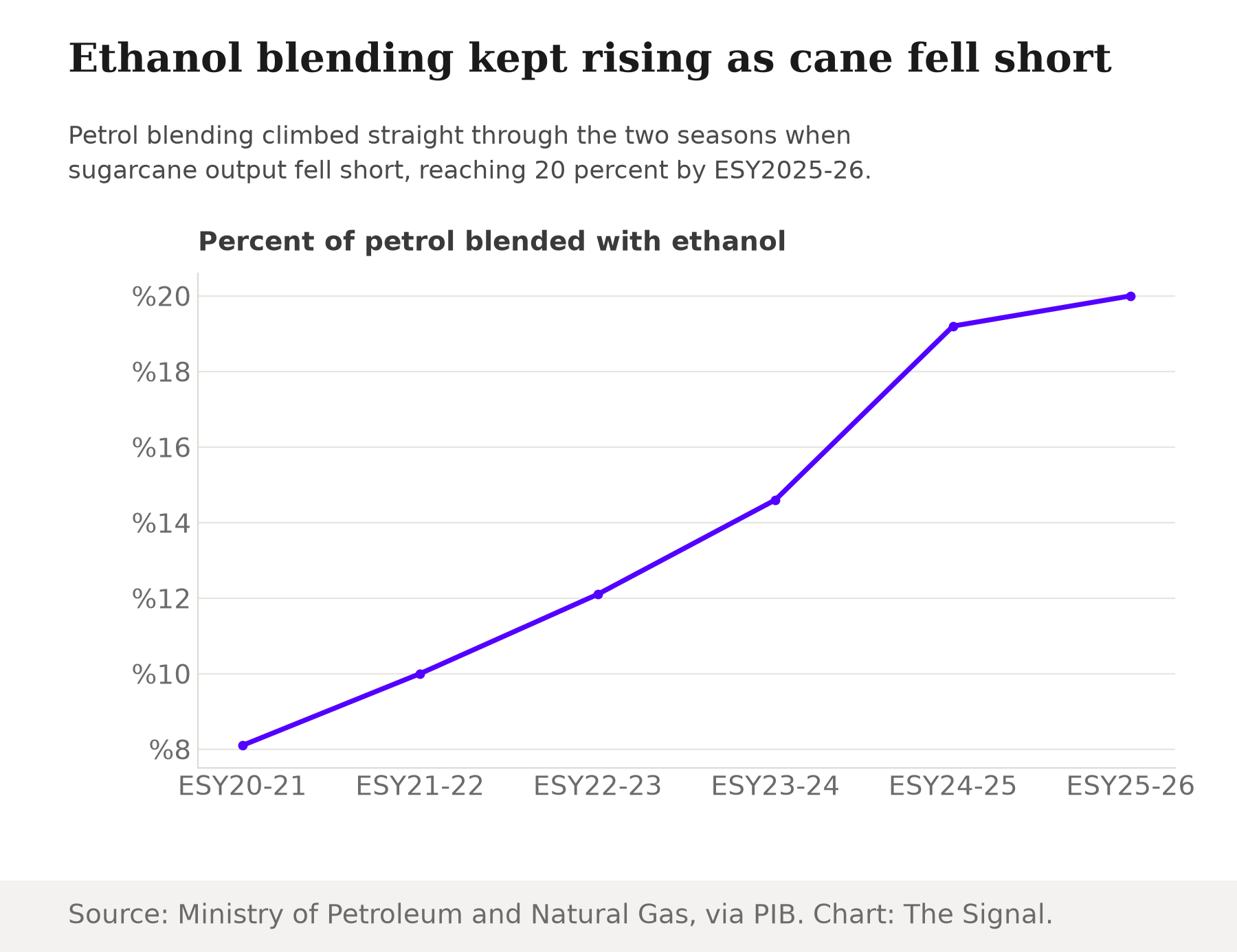
India's ethanol-blending rate more than doubled in the two years the sugar forecast fell apart.
The Ministry of Petroleum & Natural Gas reports blending climbed from about 8.1 percent of petrol in ESY2020-21 to 20 percent by ESY2025-26, a figure reached in the November 2025 to June 2026 window of that supply year. Zoom out further and the climb looks even steeper: blending was stuck below 1.5 percent as recently as 2013-14, before the Ethanol Blended Petrol Programme's ramp-up began in earnest. That climb never paused, not even in the two seasons when sugarcane itself stopped cooperating.
Source: Ministry of Petroleum & Natural Gas, via PIB. Chart: The Signal.
The surplus that never showed up
The mandate was not built on nothing. NITI Aayog's 2021 roadmap for E20 leaned on "rising production of foodgrains and sugarcane leading to surpluses" as one of the justifications for treating 20 percent ethanol blending as, in the roadmap's words, a national imperative. The logic was straightforward: India grows more cane than its sugar mills need, so diverting a slice of it into fuel costs the sugar market nothing.
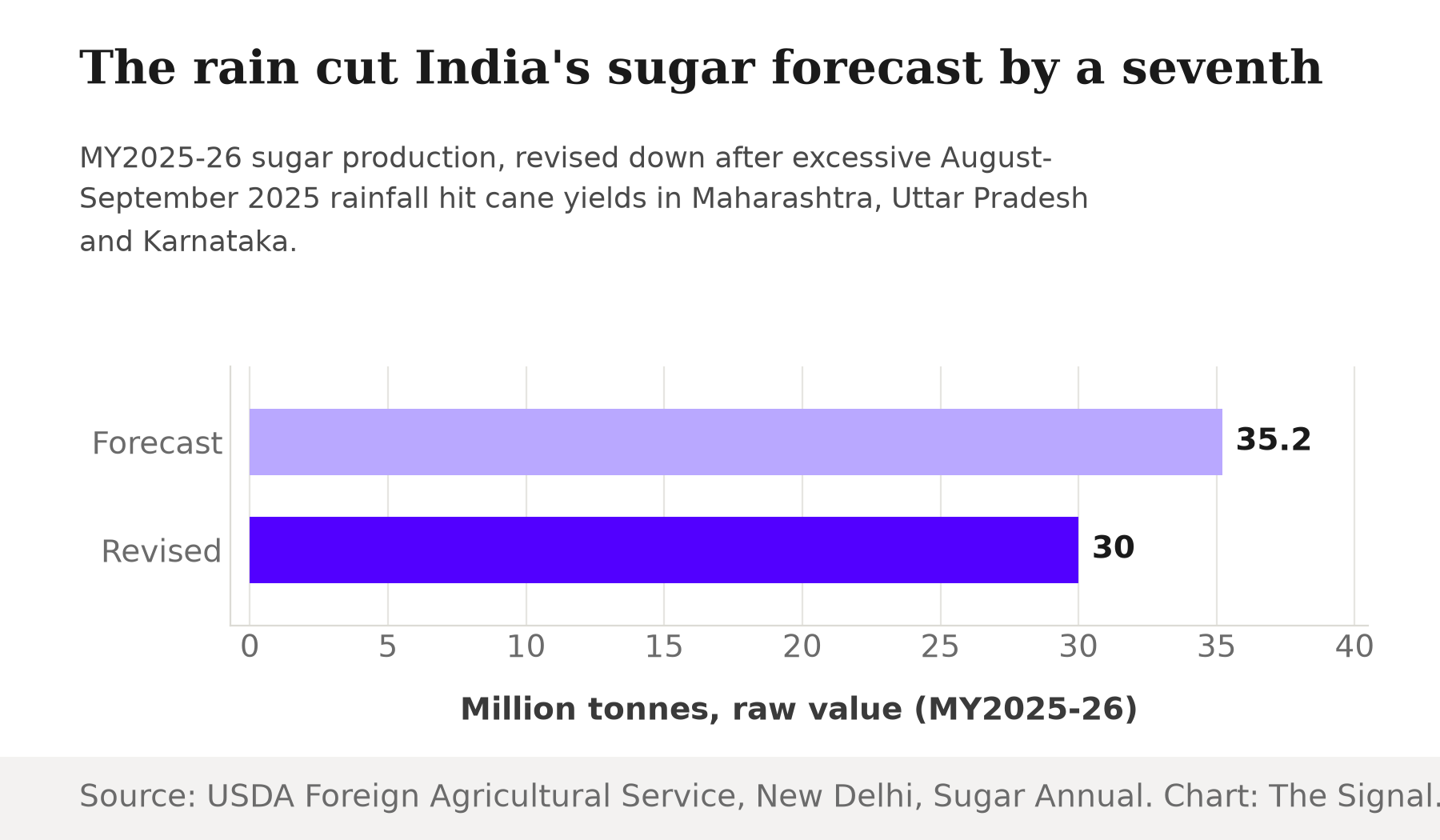
This season, that assumption broke. USDA's Foreign Agricultural Service reported in its April 2026 Sugar Annual that India's MY2025-26 sugar production estimate had been revised down to 30 million tonnes, a 14 percent cut from the initial forecast of 35.2 million tonnes. The 2021 roadmap's surplus assumption and the 2026 production cut are describing the same crop, five years apart, and the second number is the one that actually showed up at the mill gate.
Source: USDA Foreign Agricultural Service, India Sugar Annual. Chart: The Signal.
The mandate had already been through this once
This is not the first time cane fell short of the ethanol program's needs. USDA's Biofuels Annual estimated that restrictions on ethanol from sugar derivatives cut ethanol feedstock availability by 20 percent in calendar year 2024 compared with 2023, forcing distillers toward grain-based ethanol instead, after two straight seasons of weak cane output. That earlier squeeze shows the government is willing to throttle the cane-to-ethanol pipeline when sugar supply is at risk. It just has not applied that lever this time, even as the same underlying shortage returned.
Meanwhile the incentive to grow cane over other crops has kept rising, not falling. The Department of Food & Public Distribution had already fixed the 2024-25 season's Fair and Remunerative Price at Rs 340 per quintal, and the Cabinet Committee on Economic Affairs then raised the FRP for the 2025-26 season, 4.41 percent higher still. A guaranteed, rising floor price gives farmers no reason to shift acreage away from cane, whichever end use, sugar or ethanol, the cane is eventually sold into.
One in ten tonnes went the other way
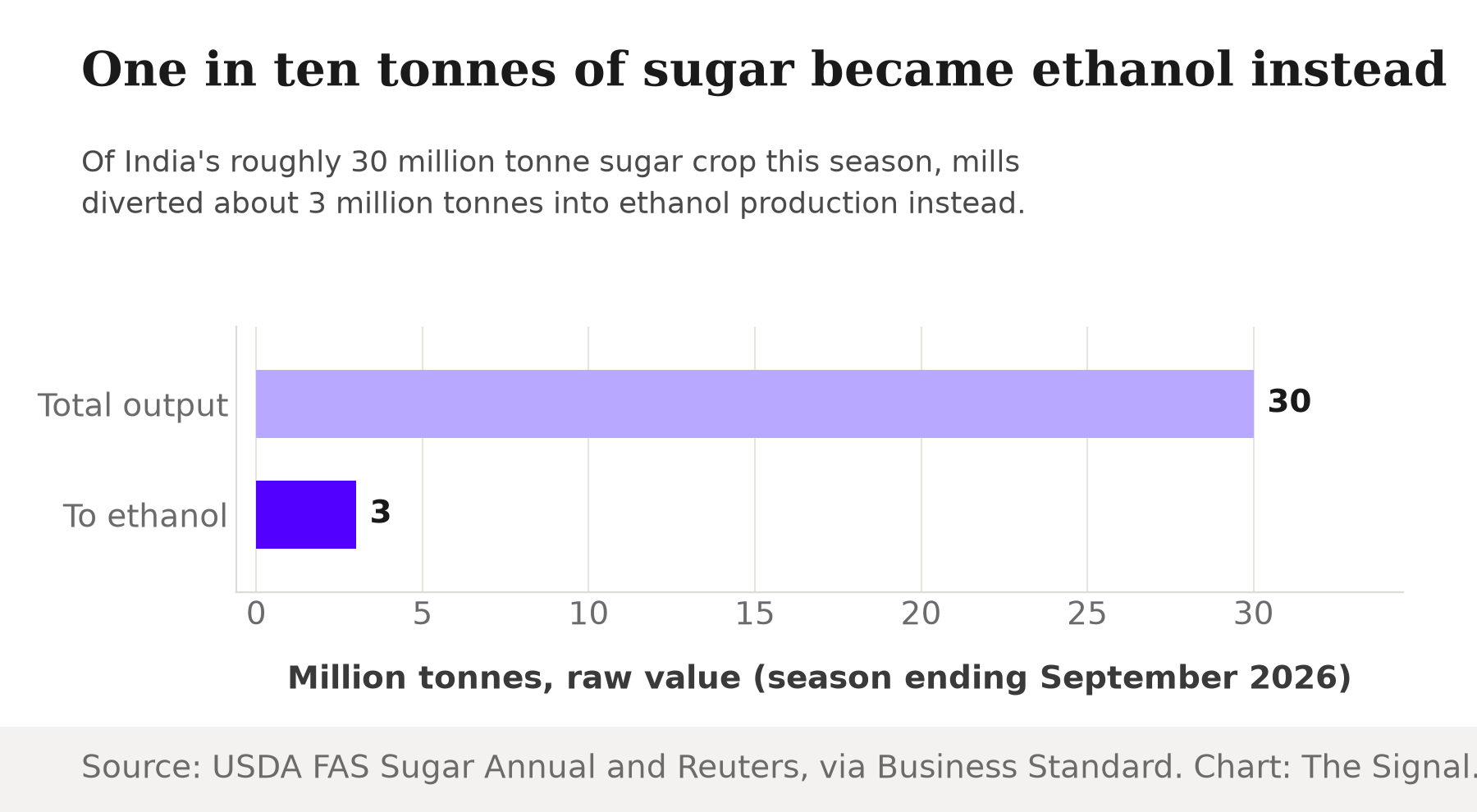
Indian mills diverted about 3 million tonnes of sugar, roughly 10 percent of total output, into ethanol this season, Reuters reported, as carried by Business Standard, with the government now weighing curbs on cane-based ethanol production next season to rebuild sugar supply. That diversion estimate is close to what the industry itself expected: ISMA's first advance estimate in November 2025 had projected 2025-26 sugar production at 30.95 million tonnes, up 18.58 percent on the year, with about 3.4 million tonnes of sugar diverted to ethanol. Both the diversion and the output came in lower than that November forecast, but the direction held: roughly a tenth of the crop, forecast and actual alike, went to the distillery rather than the sugar bag.
Source: total output from USDA Foreign Agricultural Service, India Sugar Annual; diverted volume from Reuters, via Business Standard. Chart: The Signal.
What is actually on the table
Both of this month's fixes work on the sugar already sitting in warehouses, not on the cane going into the distillery.
| Lever | What it changes | Status |
|---|---|---|
| Dealer stock limit | Caps sugar any dealer can hold nationwide at 4,000 quintals | In effect, 1 August to 30 November 2026 |
| Import duty | Would lower or scrap the 100 percent tariff on imported sugar | Under consideration |
Source: Department of Food & Public Distribution order, via ThePrint; Bloomberg, via Business Standard.
A stock cap rations what mills and traders already hold, while a duty cut simply brings in sugar grown somewhere else. Neither reduces the roughly one tonne in ten of India's own crop that keeps leaving the sugar supply through the ethanol route.
The honest objection
The strongest case against blaming the mandate is that weather, not policy, did the damage this year. The 14 percent cut to the sugar forecast followed excessive rainfall during the 2025 monsoon, not a change in how much cane went to ethanol. On this view, the ethanol program is a fixed, modest claim on a crop that a bad monsoon simply shrank around, and treating diversion as the culprit mistakes a weather shock for a policy failure. India's energy-security case for ethanol, less crude to import, has not gone away either.
That case explains why this season's shortfall happened, not why the response has left the diversion pipeline alone. The 2024 precedent shows India already knows how to throttle cane-to-ethanol flows when sugar is tight; it chose not to this time, even as mills kept sending roughly a tenth of the crop to distilleries through a season that needed every tonne it could get. A surplus-fed mandate that cannot pause when the surplus disappears is not being tested by bad weather. It is being tested by its own design.
The Signal
India built its ethanol mandate on an assumption, a rising cane surplus, that this season did not deliver, and the two fixes now in motion, a stock cap and a possible duty cut, both work around that fact rather than on it. Watch what happens to the diversion share next season, not the headline blending percentage. If mills pull back from ethanol once the cane shortage becomes undeniable, the surplus assumption gets a course correction. If diversion holds near a tenth of the crop while stock limits and import duties do the price-fighting instead, the mandate has effectively been declared untouchable, and every future bad monsoon will be a sugar-price story before anyone checks the fuel pump.
Reporting basis: the ethanol-blending series is from the Ministry of Petroleum & Natural Gas and the 2021 roadmap rationale from NITI Aayog, via their own published documents. The MY2025-26 production cut and the 2024 feedstock-restriction estimate are both from USDA's Foreign Agricultural Service, New Delhi, in its Sugar Annual and Biofuels Annual. The sugarcane price rise is from the Cabinet Committee on Economic Affairs, via a Press Information Bureau release. The diversion volume and the government's curbs deliberation are per Reuters, as carried by Business Standard; the November 2025 production and diversion forecast is per the Indian Sugar & Bio-Energy Manufacturers Association, as reported by Business Standard; the import-duty deliberation is per Bloomberg, also via Business Standard. The dealer stock-limit order is per the Department of Food & Public Distribution, as reported by ThePrint.