The headline read on the Reserve Bank of India's latest move is straightforward: fintechs just got a freer hand to help Indians send money overseas. An RBI circular effective May 13, 2026 states that the central bank has "decided to dispense with the process of granting of the approvals" it previously required for fintechs partnering with Authorised Dealer banks on outward remittances. Until that circular, every one of those tie-ups needed RBI to sign off individually. Now it does not. On its face, this reads as deregulation: one fewer form to file, one fewer approval to wait on, before a payments app can plug into a bank's remittance rails.
It is worth slowing down on what that circular actually touches. It changes which businesses are allowed to build the pipe. It says nothing about how much water can flow through it.
The pipe just got easier to build. The tap has not moved.
That is the more consequential number in this story, and it predates the circular by more than a decade. Under the Liberalised Remittance Scheme, resident individuals, including minors, may freely remit up to US$250,000 a financial year, for the routine outward transfers the scheme covers. That ceiling started at US$25,000 when the scheme launched in February 2004, a tenfold increase over the scheme's first decade. It reached US$250,000 by 2015. It has sat there ever since, through 2026.
It has not even stayed still in the currency that matters to the person sending the money. The rupee has weakened from about ₹63.5 to the US dollar in June 2015, around when the ceiling last moved, to about ₹95.4 to the dollar in August 2026, a depreciation of roughly 50%. Remitting the full US$250,000 today costs a resident about ₹2.39 crore; the same US$250,000 cost roughly ₹1.59 crore in 2015. The dollar ceiling the RBI set has not moved. Priced in the currency Indian remitters actually earn, it has quietly gotten costlier to reach.
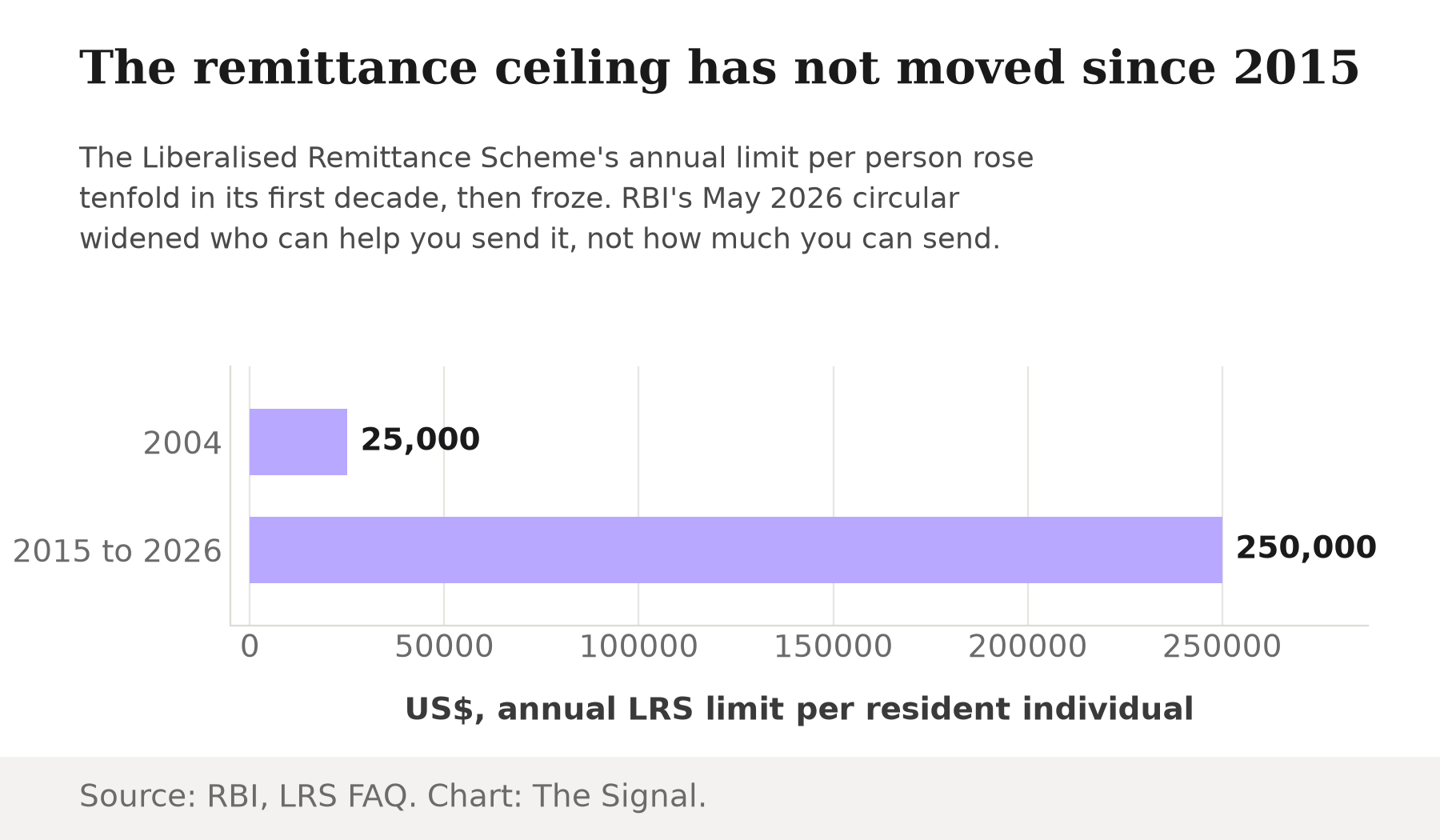
Source: RBI FAQs on the Liberalised Remittance Scheme for Resident Individuals. Chart: The Signal.
What the circular actually changes
Read the RBI's own language and the scope of the May 2026 move is narrow and specific. The circular addresses only the approval step for non-bank entities tying up with Authorised Dealer banks, the mechanism by which a fintech app becomes the interface a customer taps to send money abroad while an AD bank still executes and reports the transaction. Before May 13, 2026, each such tie-up needed the RBI's individual clearance. After it, an AD bank and a non-bank partner can strike that arrangement without waiting on a case-by-case approval from the regulator.
| Before May 13, 2026 | After May 13, 2026 | |
|---|---|---|
| Fintech-AD bank tie-up for outward remittances | Required RBI's case-by-case approval | No individual RBI approval required |
| Annual amount a resident individual may remit | US$250,000 | US$250,000, unchanged |
Source: RBI circular RBI/2026-27/82; RBI LRS FAQ.
That is a distribution reform, not a liberalisation of the scheme itself. It lowers the regulatory cost of building a remittance product. That is exactly the kind of friction that has kept new entrants out of a business banks have long run largely on their own. More apps competing to be the interface for outward transfers is a real change: it should mean more choice, faster onboarding, and pressure on fees, because a bank-only channel with a licensing gate in front of every new partner favours whoever already has the relationships. Remove the gate and smaller, faster-moving fintechs can compete for that business on service, instead of on navigating RBI's approval queue.
None of that changes the size of the pool any one person is legally allowed to move. A resident individual sending above the US$250,000 annual ceiling abroad cannot do so through the scheme, no matter how many apps are now free to offer the service, and no matter how frictionless the app makes the first US$250,000. The RBI eased the front door. It left the room behind it exactly the size it has been since 2015.
Put beside other large economies with capital controls, that room is generous by design. China's State Administration of Foreign Exchange caps a resident individual's annual foreign-exchange purchase quota at US$50,000, a fifth of what an Indian resident may remit abroad under the LRS. India built a wide capital-account door for individuals well over a decade ago. The RBI's May 2026 circular does not touch how wide that door is, only who is allowed to help someone walk through it.
The honest objection
The strongest case against treating this as a non-event is that friction is not a side issue, it is often the binding constraint. A meaningful share of India's outward-remittance activity that never happens through formal channels does not fail because the legal ceiling is too low. It fails because opening an account with the right bank, finding the right desk, and completing paperwork is expensive in time and trust for someone who is not already a private-banking client. If more fintechs can now legally plug into AD banks without waiting on the RBI, more ordinary residents may find it easy enough, for the first time, to use the US$250,000 annual allowance that has technically been available to them all along. On that reading, the ceiling did not need to move, because many would-be remitters were never within reach of it, and the real reform is making the existing number usable.
That case is real, and it is probably where most of the near-term effect of this circular shows up. But it is an argument about who can now access the ceiling more easily, not about the ceiling itself. For the segment of remitters who were already banked, already using formal AD channels, and already pushing toward the US$250,000 limit, whether for a child's overseas education, a property purchase, or portfolio investment abroad, this circular changes nothing. Those users were never blocked by the approval gate the RBI just removed; the bank they already use could offer the service without a fintech partner. A friction fix for the marginal, newly-onboarded user is not a capacity fix for the user already at the top of the scheme.
The Signal
The RBI has now made two separate decisions look like one announcement. It widened who is allowed to build the plumbing for outward remittances, and it left the size of the tank exactly where it set it in 2015. Both are legitimate regulatory choices, and they are not in tension with each other; a central bank can rationally want more competition in how money moves while staying cautious about how much of it can leave in the first place. But conflating the two, treating a distribution reform as if it were a liberalisation of the scheme, misreads what actually happened in May 2026. Watch what the RBI touches next. If it revises the US$250,000 ceiling itself, a number it has not moved in over a decade, that is a statement about capital-account openness. If it keeps opening the channel while leaving the ceiling untouched, the message is narrower: send your money more easily, not more of it.
Reporting basis: the approval-removal for non-bank tie-ups with Authorised Dealer banks is from RBI circular RBI/2026-27/82, A.P. (DIR Series) Circular No. 10, dated May 13, 2026, as published by the Reserve Bank of India. The Liberalised Remittance Scheme's launch limit, its current US$250,000 ceiling, and the year it last changed are from the RBI's own LRS FAQ page for resident individuals. The rupee-dollar exchange rates are from the US Federal Reserve Board's H.10 foreign exchange release. China's individual annual forex-purchase quota is from the State Administration of Foreign Exchange's own published Q&A on the policy. All four are primary sources with no secondary relay. The characterisation of the ceiling as unchanged through 2026, the rupee-terms calculation, the international comparison, and the framing of these facts against each other, is The Signal's own analysis.