On April 30, 2026, the Reserve Bank of India reported that 98.47% of the value of Rs 2,000 notes in circulation when the withdrawal was announced has been returned, leaving Rs 5,451 crore of the original Rs 3.56 lakh crore still outside the banking system, the latest such update the RBI has published. Read as a headline number, that is close to a clean sweep: a currency swap run for nearly three years with no hard deadline and no penalty for sitting on the notes, and it still emptied out almost entirely.
It is worth checking that figure against the withdrawal India actually remembers. The 2016 demonetisation of Rs 500 and Rs 1,000 notes was the coercive version of this exercise: holding the old notes past the deadline became a criminal offence, and cash itself was rationed for weeks. By the RBI's own reconciliation, that harsher process left a smaller share of its currency unreturned, not a bigger one.
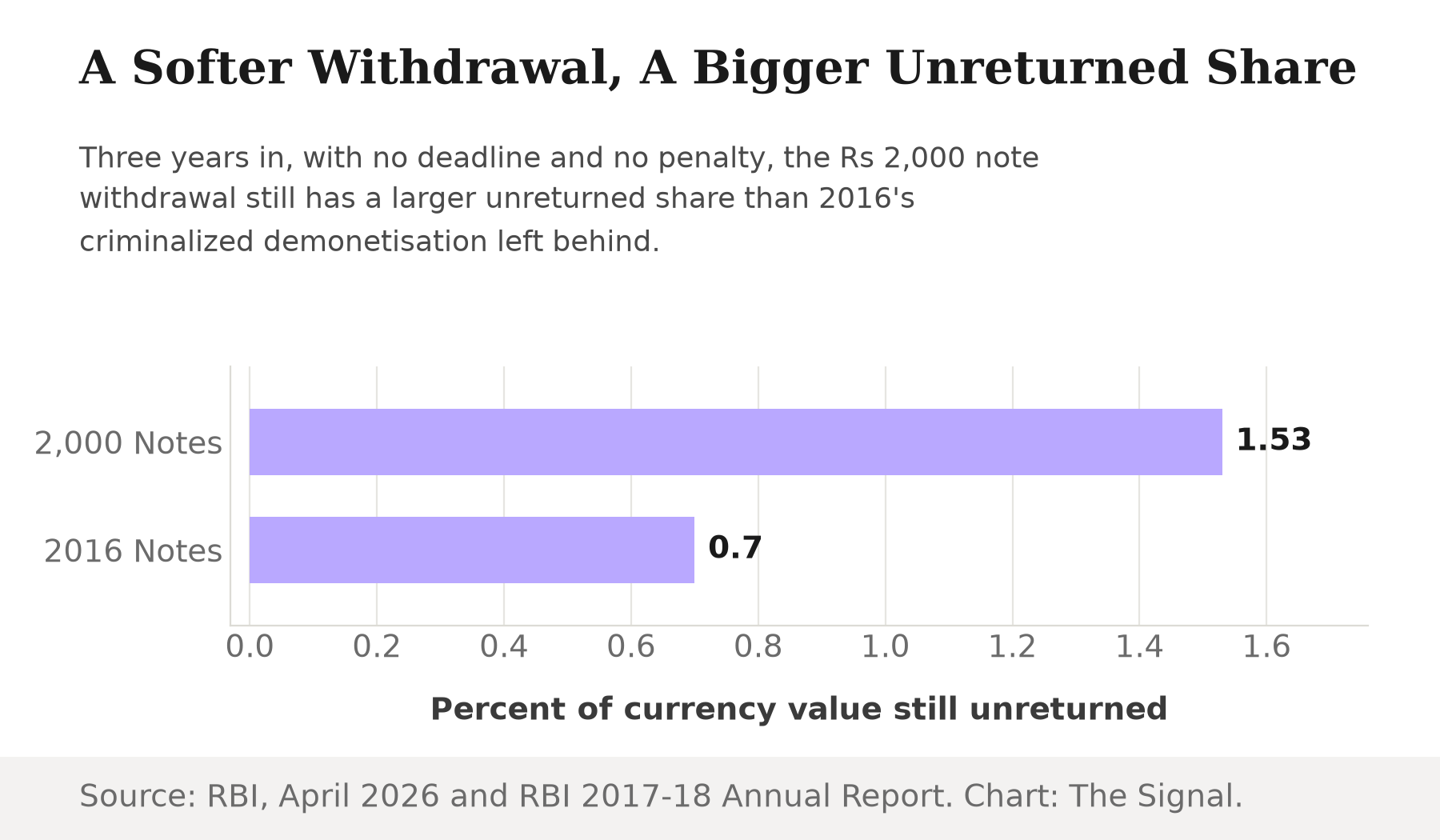
The gentler withdrawal has a larger unreturned share than the criminalized one.
RBI's 2017-18 annual report found that 99.3% of the Rs 15.41 lakh crore demonetised in 2016 had returned to the banking system, leaving 0.7% (Rs 10,720 crore) that could not be traced. Set the two return rates side by side and the direction reverses from what the softer design would predict: the Rs 2,000 note withdrawal's unreturned share, at 1.53% of its base, is more than double demonetisation's 0.7%.
The rules built to be easy to ignore
The Rs 2,000 note withdrawal was designed with almost nothing forcing compliance. When the RBI announced the withdrawal on May 19, 2023, it stated the notes would continue to be legal tender indefinitely, that banks would provide deposit or exchange facilities only until September 30, 2023, and that exchange of notes into other denominations was capped at Rs 20,000 at a time. Past that September deadline, holders could still deposit the notes into their own bank accounts with no cutoff date at all. Nobody holding a Rs 2,000 note has ever risked a fine for waiting.
That deposit route, not the deadline-bound exchange counter, is where most of the money actually came back. Six weeks into the withdrawal, RBI data collected from major banks showed about 87% of the returned notes had come in as bank deposits, versus roughly 13% exchanged over the counter for other denominations. The September 30 exchange deadline, the one piece of the design with any time pressure attached to it, handled only a small slice of the traffic; the bulk of the money simply flowed through ordinary bank deposits, a channel that was never time-limited at all.
The rules built to bite
Demonetisation ran on the opposite logic. The Specified Bank Notes (Cessation of Liabilities) Act, notified February 27, 2017, made it a criminal offence to hold old Rs 500 and Rs 1,000 notes past the deadline, punishable by a fine of up to Rs 10,000 or five times the note's face value, whichever was higher. The transition window was also far shorter and far more restrictive. The RBI's November 8, 2016 notice capped over-the-counter note exchange at Rs 4,000 per person, bank withdrawals at Rs 10,000 a day and Rs 20,000 a week, ATM withdrawals at Rs 2,000 a day, and set a hard deposit deadline of December 30, 2016, about seven weeks after the announcement.
Every lever available to a government was pulled in 2016 and barely any of them in 2023, yet the newer process still has the bigger unreturned tail.
| Feature | 2016 demonetisation | 2023-2026 Rs 2,000 withdrawal |
|---|---|---|
| Deposit deadline | December 30, 2016, about seven weeks after the announcement | None; notes remain legal tender and deposits are still accepted |
| Penalty for holding past deadline | Fine up to Rs 10,000 or five times face value | None |
| Cash access during transition | ATM capped at Rs 2,000/day; bank withdrawals capped at Rs 10,000/day, Rs 20,000/week | Exchange capped at Rs 20,000 per transaction; no withdrawal caps |
| Share of value still unreturned | 0.7% (Rs 10,720 crore) | 1.53% (Rs 5,451 crore) |
Sources: RBI, November 8, 2016; RBI FAQ on the Specified Bank Notes Act; RBI, May 19, 2023; RBI, April 2026; RBI 2017-18 Annual Report, via Business Today.
The honest objection
The strongest case against reading much into this comparison is that the two withdrawals are not measuring the same thing. The 2016 demonetisation covered Rs 15.41 lakh crore in currency value, more than four times the Rs 3.56 lakh crore covered by the Rs 2,000 note withdrawal, a far larger and more diverse pool of holders. A criminal deadline may also have pushed some holders to destroy or dispose of notes rather than risk depositing suspect cash, which would show up in RBI's tally as a smaller unreturned share without meaning the money genuinely re-entered the economy clean. On that reading, a lower unreturned percentage under coercion is not obviously a better outcome, just a differently distorted one.
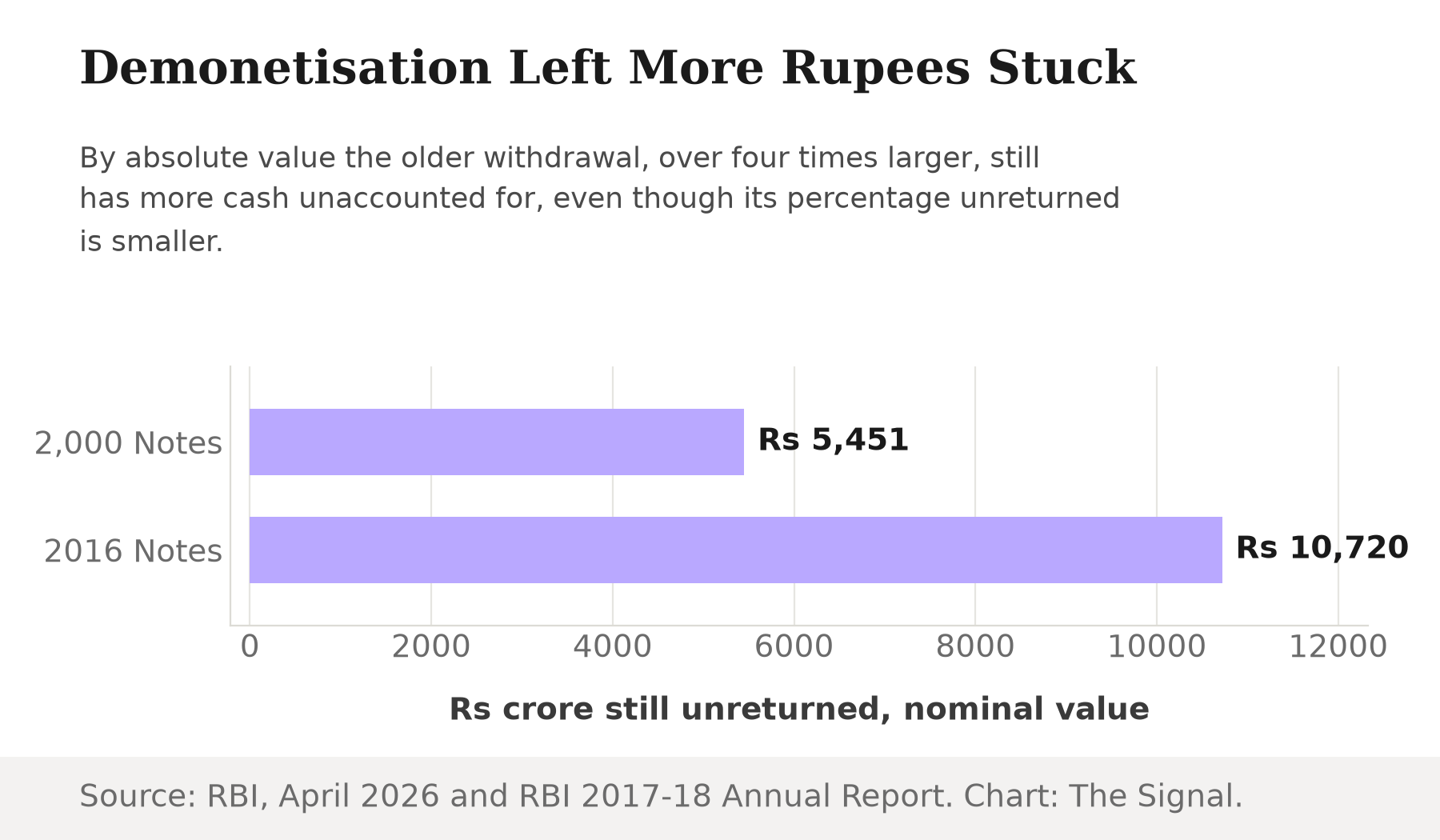
That objection cuts against reading the gap as proof demonetisation "worked better," but it does not explain away the comparison the RBI itself invites: both releases report the same metric, a percentage of currency value returned, calculated the same way, by the same institution. If criminalizing possession of old notes were the decisive lever, the coerced population should have returned a higher share by a wide margin, not by 0.83 percentage points, our calculation from the two reported rates, while working with a fraction of the time and none of the flexibility the 2023-2026 withdrawal allowed.
The Signal
Two RBI currency withdrawals, launched about seven years apart with opposite designs, landed within less than a percentage point of each other on the one number that mattered: how much cash never came back. The threat of a fine and a seven-week deadline bought demonetisation a smaller unreturned share, but not by the margin its disruption would suggest, and, as of the RBI's April 2026 count, the Rs 2,000 note withdrawal's total patience had not closed its own gap after nearly three years of running with the door open. What to watch is whether that stays true: the RBI's next update, whenever it comes, will show if the Rs 5,451 crore still outstanding keeps shrinking toward zero or has settled into a floor that time alone will not clear. If it holds flat, the number suggests a stubborn residue of currency, lost, hoarded, or simply never coming back, that policy design barely moves either way.
Reporting basis: the April 2026 Rs 2,000 note withdrawal status, the May 2023 withdrawal terms, the penalty structure under the Specified Bank Notes Act, and the November 2016 demonetisation terms are all from Reserve Bank of India press releases and FAQs. The 2016 demonetisation return rate is from the RBI's 2017-18 Annual Report, as reported by Business Today, and is the only source for that figure. The unreturned-share ratio, the percentage-point gap between the two withdrawals, and the scale comparison between their currency bases are The Signal's calculations from those RBI-sourced figures.