The consensus story about India and cattle is a ban. The Supreme Court has held that a total prohibition on cow slaughter is reasonable and valid at any age of the animal, and most state legislatures have acted on that room to legislate. As of 2019, the last full count available, cow slaughter remained legal in just eight of India's states and union territories: Kerala, West Bengal, Arunachal Pradesh, Mizoram, Meghalaya, Nagaland, Tripura and Sikkim. Everywhere else, killing a cow for meat is a criminal offense. Read only that far, and India looks like a country that has settled, almost uniformly, on protecting the animal by law.
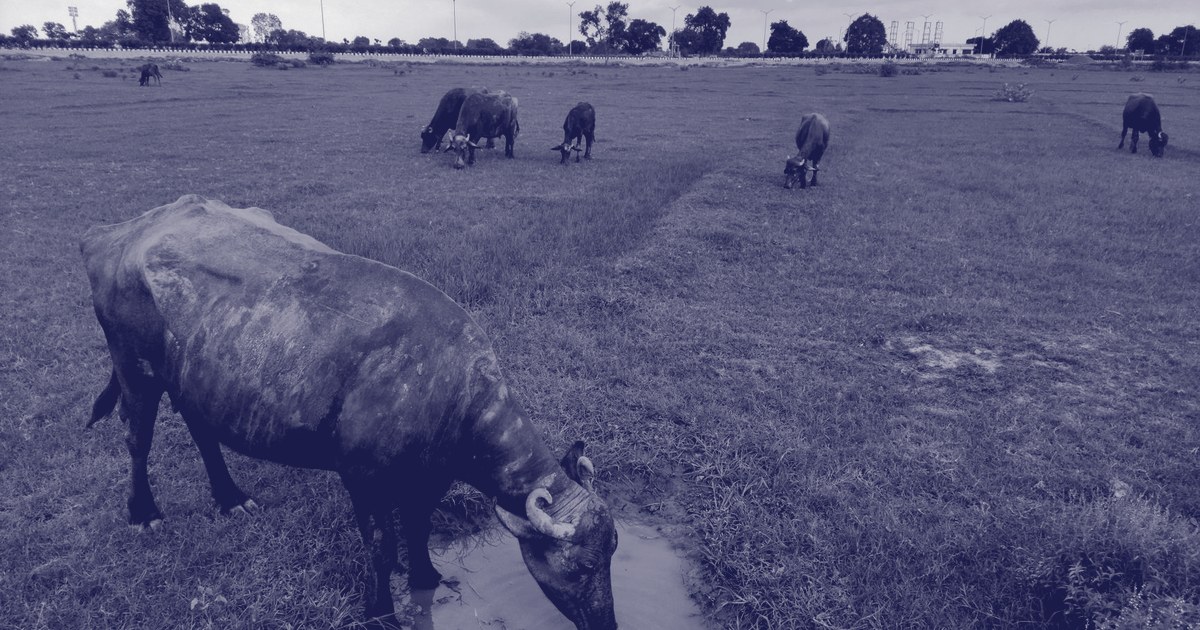
It is worth slowing down on that reading. The same Supreme Court judgment that upheld the cow ban drew a second, separate line for a different animal. She-buffaloes, bulls and working bullocks, cattle and buffalo alike, may legally be slaughtered once they are no longer useful for milk, breeding or draught work: the court found a total ban on killing them, at any age, could not be justified the way the cow ban could. A buffalo has never been a cow under Indian law, and that single distinction has grown into one of the country's largest livestock trades.
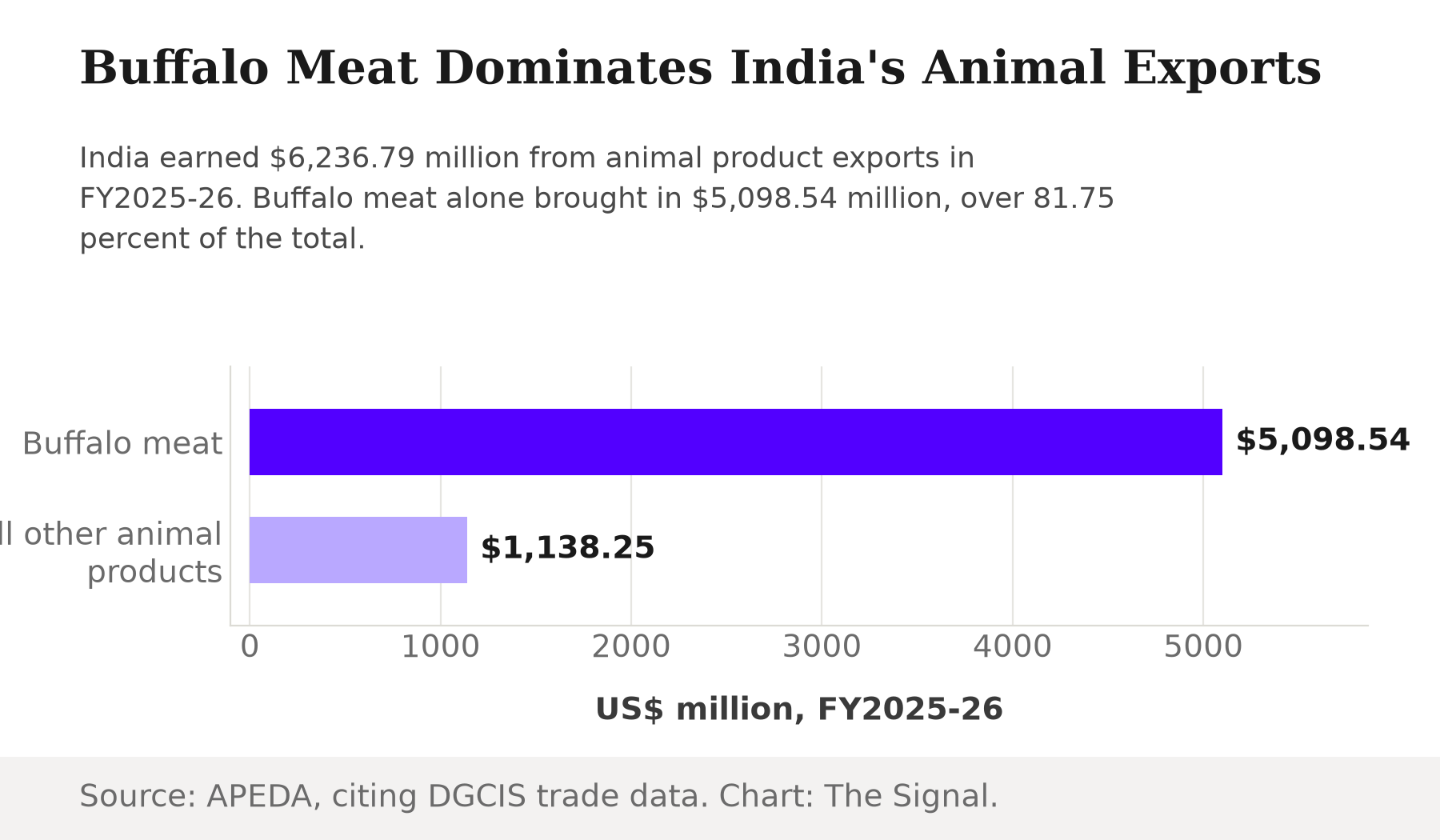
India exported over $5 billion of buffalo meat in FY2025-26, more than any other country on earth.
India shipped 14,19,650.98 tonnes of buffalo meat worth $5,098.54 million in the year to March 2026, making it the world's largest exporter of buffalo meat. That single product was more than 81.75 percent of the $6,236.79 million India earned from all animal product exports in FY2025-26. A law built to protect one bovine has coexisted, for decades, with a global export business built on a different one.
The legal seam
The distinction was written deliberately, not left as an oversight the law failed to close. In State of Gujarat v. Mirzapur Moti Kureshi Kassab Jamat (2005), reaffirming a 1958 ruling, the Supreme Court held that a total ban on cow slaughter is valid at any age, while a total ban on slaughtering she-buffaloes, bulls or bullocks cannot be supported once those animals have stopped yielding milk or working. The court treated the cow as a category worth absolute protection and the buffalo as a working and dairy animal whose economic life has a natural end. That is a considered legal boundary, drawn on purpose.
What has changed is the scale sitting on top of that boundary. A carve-out designed around individual, aging draught animals now underwrites an export industry moving over 14 lakh tonnes of buffalo meat a year. The legal reasoning has not shifted since 2005; the money resting on it has grown enormously.
An industry sized in billions
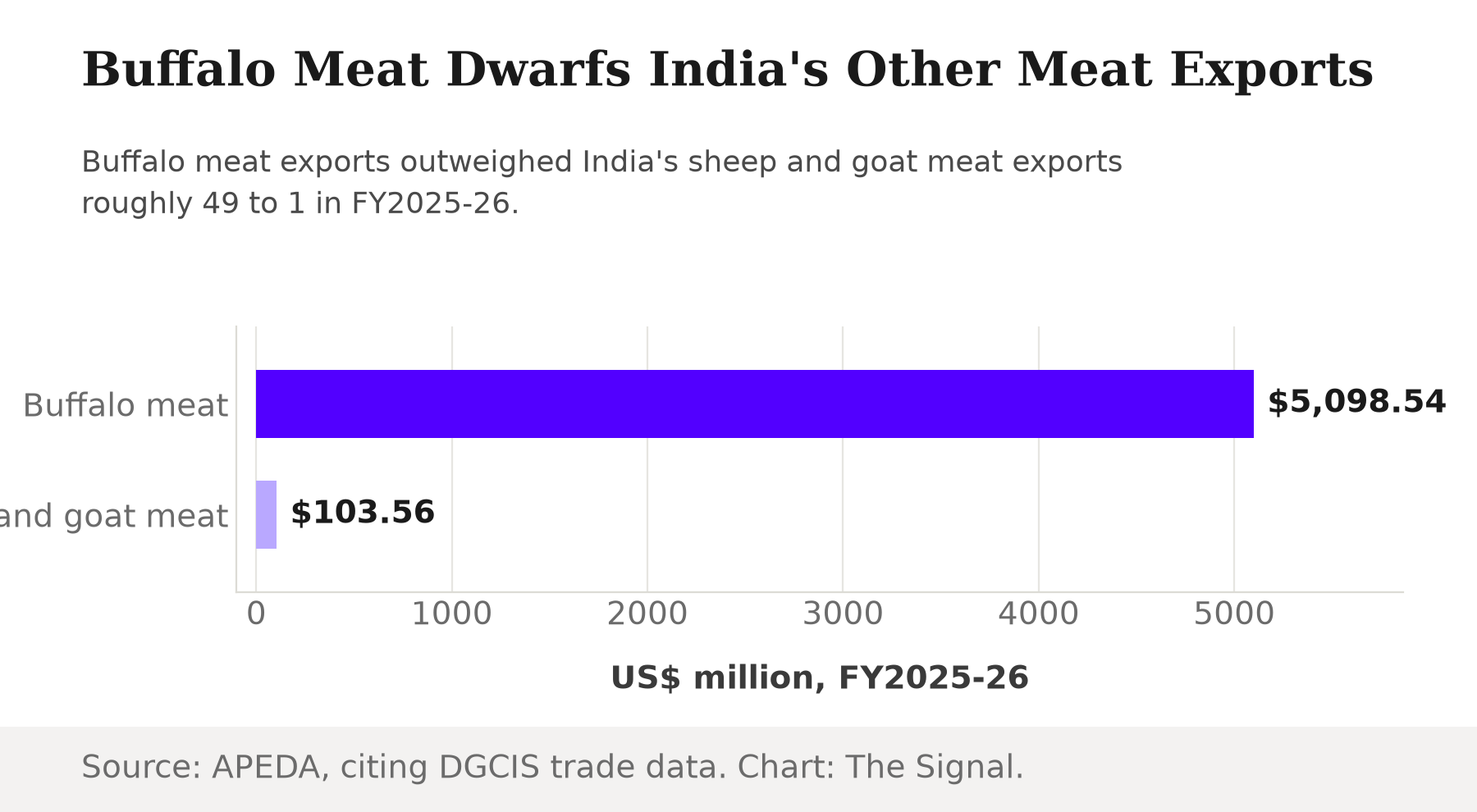
Buffalo meat is not just India's largest meat export, it dwarfs every other one. India's sheep and goat meat exports totalled just $103.56 million in FY2025-26, a fraction of what buffalo meat alone brought in the same year.
| Category | Quantity (tonnes) | Value (US$ million) |
|---|---|---|
| Buffalo meat | 14,19,650.98 | 5,098.54 |
| Sheep and goat meat | 13,340.15 | 103.56 |
Source: APEDA, Buffalo Meat exports; APEDA, Sheep and Goat Meat exports, both FY2025-26.
At $5,098.54 million against $103.56 million, buffalo meat exports ran about 49 times sheep and goat meat exports by value in FY2025-26, on a near-identical tonnage base, meaning buffalo meat sold for roughly the same weight at a far higher price per shipment. The animal the law treats as disposable once unproductive is, in the export column, the one actually driving the number.
Where the demand sits
The trade's exposure is geographic as well as legal. As of APEDA's August 2025 bovine meat dashboard, the latest available, India was the leading supplier of bovine meat to Saudi Arabia, a market whose imports grew at a 20 percent compound annual rate between market year 2020 and market year 2024, and it ranked as the third-largest meat supplier to Vietnam, with Vietnam, Egypt and the Middle East named as the trade's key demand markets. A five-billion-dollar trade built on a legal carve-out is also a trade concentrated in a short list of importing countries, most of them thousands of miles from the plants that supply them.
Where the meat is made
The processing capacity behind those exports is not spread evenly across the country. As of 24 July 2026, APEDA's export-approved list carried 83 integrated abattoir-cum-meat-processing plants, and 31 of the 83, the single largest state cluster, sit in Uttar Pradesh. More than a third of the country's export-grade meat processing capacity sits in one state.
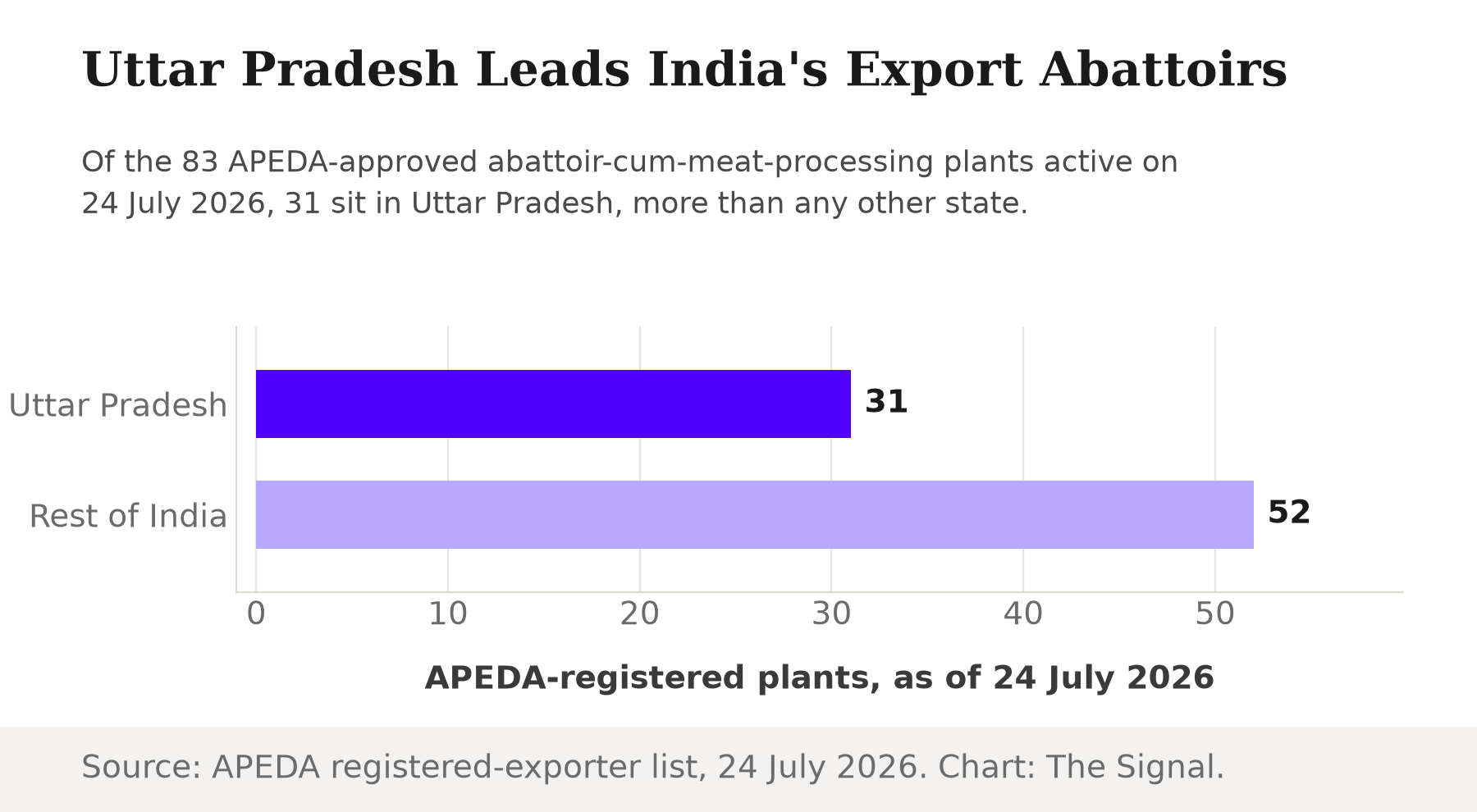
Uttar Pradesh does not appear on the eight-state list where cow slaughter remains legal. Yet by that same 31-of-83 plant count, it also hosts the country's single largest cluster of export abattoirs, built on the one animal its own ban does not cover. The same legal line that closes one door in the state keeps the biggest one open.
The honest objection
The strongest case against calling any of this an arbitrage or a workaround is that the Supreme Court's distinction was never meant to hide an industry, it was meant to be read exactly as written: a cow is protected because of what it represents, a buffalo is a productive animal whose slaughter is permitted once its working life ends. On that reading, the export numbers are simply what a permitted, regulated trade looks like at scale, no different in principle from any other agricultural export that grew as India's processing and logistics improved. Nothing about a $5,098.54 million trade is inherently suspicious just because a smaller version of the same rule existed decades before it.
That case holds for the legal reasoning. It says less about the politics resting on it now. A distinction that carried modest economic weight when it was written now carries a $5,098.54 million, world-leading trade and the export infrastructure of India's most populous state. The bigger the number sitting on a legal line, the more that line becomes a target as well as a rule, and the more a future political push to narrow it, rather than reinterpret it, would have to reckon with.
The Signal
India's cattle politics are read almost entirely through the cow: which states ban its slaughter, which do not, what the ban signals. That reading skips the animal actually carrying the trade. Buffalo meat is the largest line item in India's entire animal export book, not a footnote to the cow-slaughter story. That rests on a legal distinction the country's top court drew with working animals in mind, not an export industry of this size. The number to watch is not another state debating a cow-slaughter law. It is whether the buffalo carve-out itself ever becomes the target, because a five-billion-dollar trade concentrated this heavily in one producing state, and resting this directly on demand from Vietnam, Egypt and the Gulf, would not absorb that shock quietly.
Reporting basis: the buffalo meat, total animal product, and sheep and goat meat export figures for FY2025-26 are APEDA's own published trade data, citing DGCIS. The abattoir plant count and Uttar Pradesh's share of it are counted directly from APEDA's 24 July 2026 registered-exporter list. The destination-market figures are from APEDA's Market Intelligence Cell monthly bovine meat dashboard, compiled by Crisil Intelligence and citing ITC Trade Map data. The legal distinction between cow and buffalo slaughter is per the Supreme Court's 2005 judgment in State of Gujarat v. Mirzapur Moti Kureshi Kassab Jamat, reaffirming its 1958 ruling, as published on Indian Kanoon. The state-by-state legal status of cow slaughter is per ISignal, the successor publication to IndiaSpend, reporting a 2019 count, the most recent available. The 49-to-1 value comparison between buffalo and sheep and goat meat exports is The Signal's calculation from those APEDA figures.