On August 18, 2026, Tata Sons tried to hold its Annual General Meeting and could not, because too few people were in the room. OrissaPost reports it was called off for lack of quorum, the first time that has happened in the holding company's history. The meeting fell six days after chairman N Chandrasekaran said he will not seek reappointment and will serve out his term only until it ends in February 2027, as The News Minute reports. Read the two events side by side and the natural conclusion is a company mid-transition, absorbing one more piece of institutional churn on its way to a new chairman.
That reading treats the adjournment as incidental to the leadership change. It was not a fight over the agenda, a proxy battle, or a boardroom walkout. It was a headcount problem, and the mechanics behind that headcount problem are precise and traceable.
Five people, one reserved seat
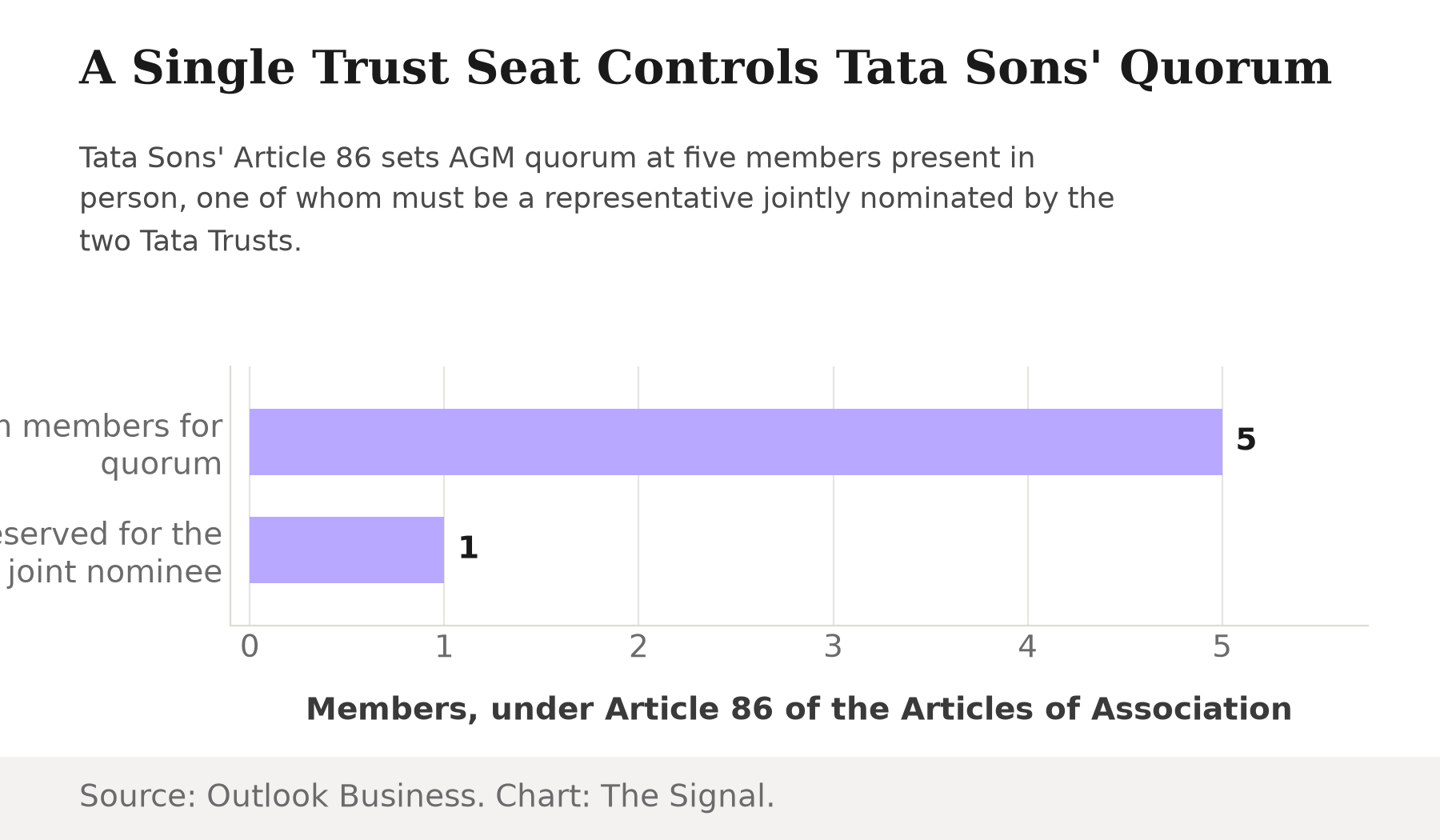
Tata Sons' Articles of Association set quorum, under Article 86, at a minimum of five members present in person, and one of those five must be a representative jointly nominated by the Sir Dorabji Tata Trust and the Sir Ratan Tata Trust, Outlook Business reports. Miss that one seat and the other four, however senior, cannot open the meeting.
That seat went unfilled because of a dispute inside the trust that is supposed to help fill it. The Maharashtra Charity Commissioner, Amogh S Kaloti, ordered on May 15, 2026 that the Sir Ratan Tata Trust defer its board meetings, alleging non-compliance with Section 30A(2) of the Maharashtra Public Trusts Act concerning the composition of the trust's board of trustees, WebIndia123 reports. A joint nominee needs both trusts' boards to act. With one trust's board meetings deferred by a state regulator, the nomination that Article 86 requires had nowhere to come from.
The composition complaint behind that order is specific. It alleges that three of the Sir Ratan Tata Trust's six trustees are permanent in nature, breaching Section 30A(2)'s cap limiting perpetual or life trustees to one-fourth of a public trust's total trustees, Tata Trusts states in response. The Trust disputes that the cap applies at all, arguing the underlying amendment took effect only on September 1, 2025 and does not reach trustees appointed before that date. Whichever reading holds, the dispute is exactly narrow enough to freeze one board without touching anything else at Tata Sons, which is what makes it capable of stalling an AGM by itself.
Two trusts, a majority stake, no nominee
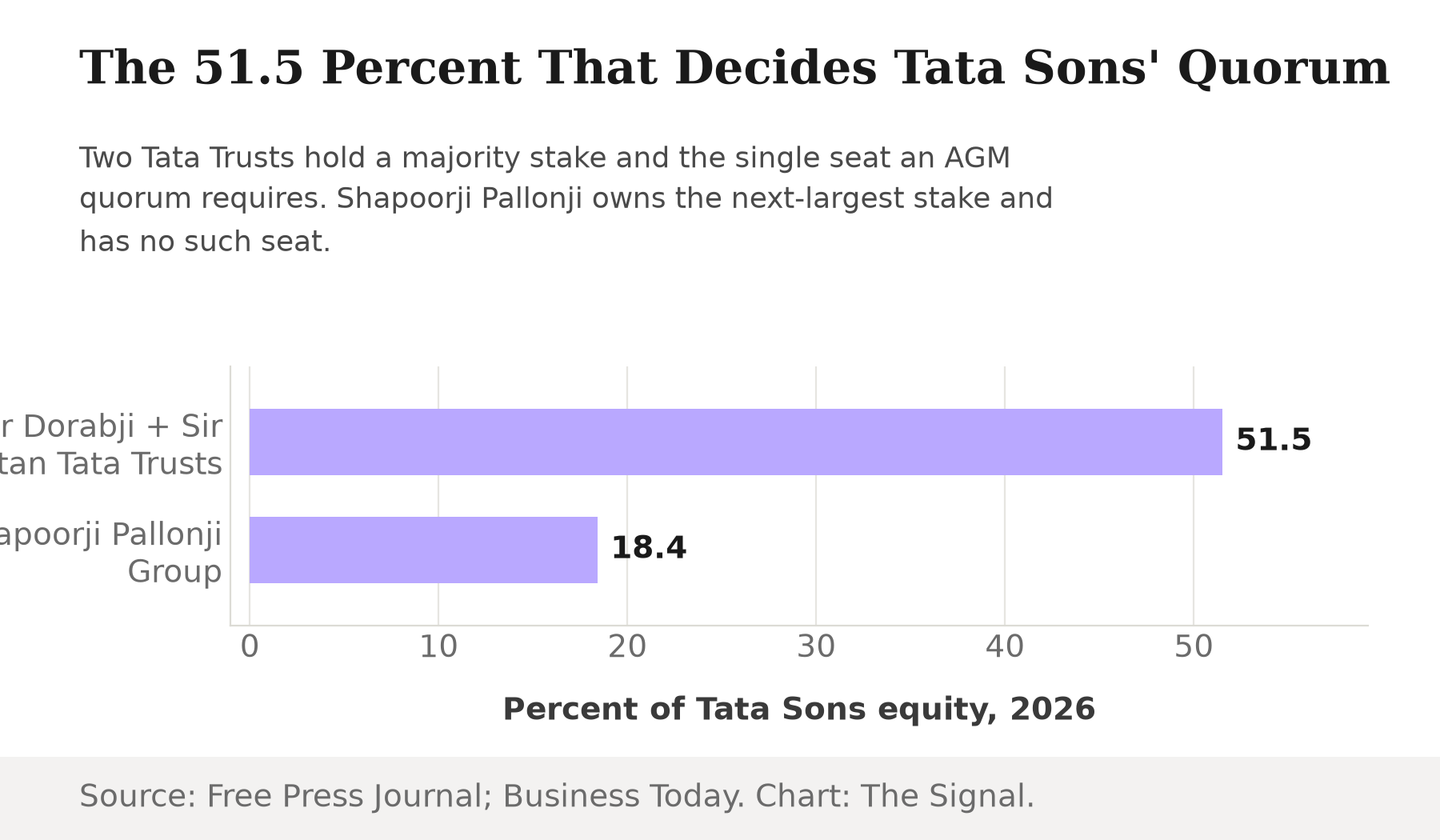
The reason this single seat carries so much weight is who sits behind it. The Sir Dorabji Tata Trust and the Sir Ratan Tata Trust together hold approximately 51.5 percent of Tata Sons, Free Press Journal reports. A majority owner failing to produce the one representative its own bylaws require is not a rounding error in the shareholder register. It is the register's largest holder missing its own meeting.
Compare that against the next-largest stake outside the trusts. Shapoorji Pallonji Group holds an 18.4 percent stake in Tata Sons, estimated to be worth about ₹3 lakh crore, Business Today reports. At 51.5 percent against 18.4 percent, the trusts' combined stake is nearly three times Shapoorji Pallonji's, and it is the trusts' stake, not Shapoorji Pallonji's, that carries the quorum-defining seat. Shapoorji Pallonji's holding is real money and no vote in the room that just failed to convene.
Six weeks, five dates, one company.
Sources: Business Today; WebIndia123; Reserve Bank of India; The News Minute; OrissaPost. Compiled by The Signal.
The market check that lapsed first
There is a second check on a company this size, separate from any trust nominee, and it also went missing well before August. Under the RBI's Scale Based Regulation framework, an NBFC identified as Upper Layer must be mandatorily listed within three years of that classification, the RBI states. Tata Sons was first classified as an RBI upper-layer NBFC in 2022, and that three-year listing deadline expired on September 30, 2025 without a listing, leaving its application to deregister as an NBFC pending instead, Business Today reports.
A listing would have brought public shareholders, SEBI disclosure rules, and an exchange full of outside eyes into Tata Sons' governance, an outside check that runs independently of any single trust nominee. That did not happen. The RBI's list of Upper Layer NBFCs for 2026-27, published August 6, 2026, still includes Tata Sons Private Limited, with the RBI noting the inclusion is without prejudice to the outcome of Tata Sons' pending deregistration application, the RBI states. Twelve days later, the one governance mechanism still fully in force at Tata Sons, the trust-nominated AGM seat, failed too.
The honest objection
The strongest case against reading crisis into this is that adjourned meetings are not rare events at large companies, and many resolve themselves within weeks without lasting consequence. A charity regulator's order concerning a trust's internal board composition is a technical compliance matter between that trust and the Maharashtra Charity Commissioner, not evidence of dysfunction at Tata Sons itself. And a company can miss a self-imposed listing deadline for years, as many NBFCs did before the RBI's framework existed, without its governance actually failing day to day. On this view, three unrelated administrative matters landed in the same six weeks by coincidence, and the sensible move is to wait for the rescheduled AGM.
That case weakens once the mechanism is laid out plainly rather than treated as separate incidents. The charity commissioner's order did not sit beside the AGM; it directly blocked the joint trustee nomination Article 86 requires for quorum, by Outlook Business's own account of the mechanics. And the listing deadline was not a distant, separate obligation: it was the one path by which an outside check could have entered Tata Sons' governance in place of the trust apparatus, and it had already closed eleven months before the AGM failed. A coincidence explains one broken mechanism. It does not explain why the only two mechanisms capable of checking Tata Sons from outside its own boardroom, an independent listing and an independent trustee, both failed in the same year.
The Signal
Tata Sons has no ticker, no quarterly disclosure to public shareholders, and, as of August 2026, no market check that the RBI's own rules were designed to force. What it has instead is a single seat at its own AGM that only two trusts can fill together, and on August 18, 2026, they could not. The company can convene a fresh AGM once the trust dispute clears the Charity Commissioner's office, and the Companies Act gives it until December 2026 to do so, Business Today reports, so the immediate mechanics have months, not days, to resolve. The structural question survives that reconvened meeting: whether Tata Sons can keep running its governance through one joint trustee nomination, now that a state regulator has shown it can freeze that nomination outright. A trust structure that insulates a company from market pressure is a feature until the one seat it depends on goes empty. Then it is the whole mechanism.
Reporting basis: the AGM adjournment is per OrissaPost. The trusts' combined shareholding is per Free Press Journal. The Article 86 quorum mechanics are per Outlook Business. The Maharashtra Charity Commissioner's order on the Sir Ratan Tata Trust is per WebIndia123. The specific composition complaint behind that order, and the Trust's response to it, is per Tata Trusts' own statement. Shapoorji Pallonji's stake and its estimated value are per Business Today. Chandrasekaran's decision not to seek reappointment is per The News Minute. The RBI's Upper Layer NBFC classification of Tata Sons, its Scale Based Regulation listing rule, and the lapsed listing deadline are per the Reserve Bank of India directly and Business Today's reporting of the same. The Companies Act deadline for reconvening an adjourned AGM is per Business Today. The ratio between the trusts' stake and Shapoorji Pallonji's stake is The Signal's calculation from those two figures.