On August 5, 2026, the Reserve Bank of India's Monetary Policy Committee did the calm, expected thing: it held the repo rate at 5.25 percent and projected FY27 real GDP growth at 6.7 percent, with CPI inflation at 5.0 percent. Read as a headline, it is a central bank confident enough in its own outlook that it saw no reason to move. The MPC also laid out how it expects growth and inflation to move quarter by quarter through the year.
RBI expects growth to slow through the year while inflation quickens.
| Quarter | Real GDP growth (FY27) | CPI inflation (FY27) |
|---|---|---|
| Q1 | 7.0% | not stated |
| Q2 | 6.4% | 4.7% |
| Q3 | 6.5% | 5.9% |
| Q4 | 6.8% | 5.5% |
| Full year | 6.7% | 5.0% |
Source: RBI Monetary Policy Committee resolution, August 2026.
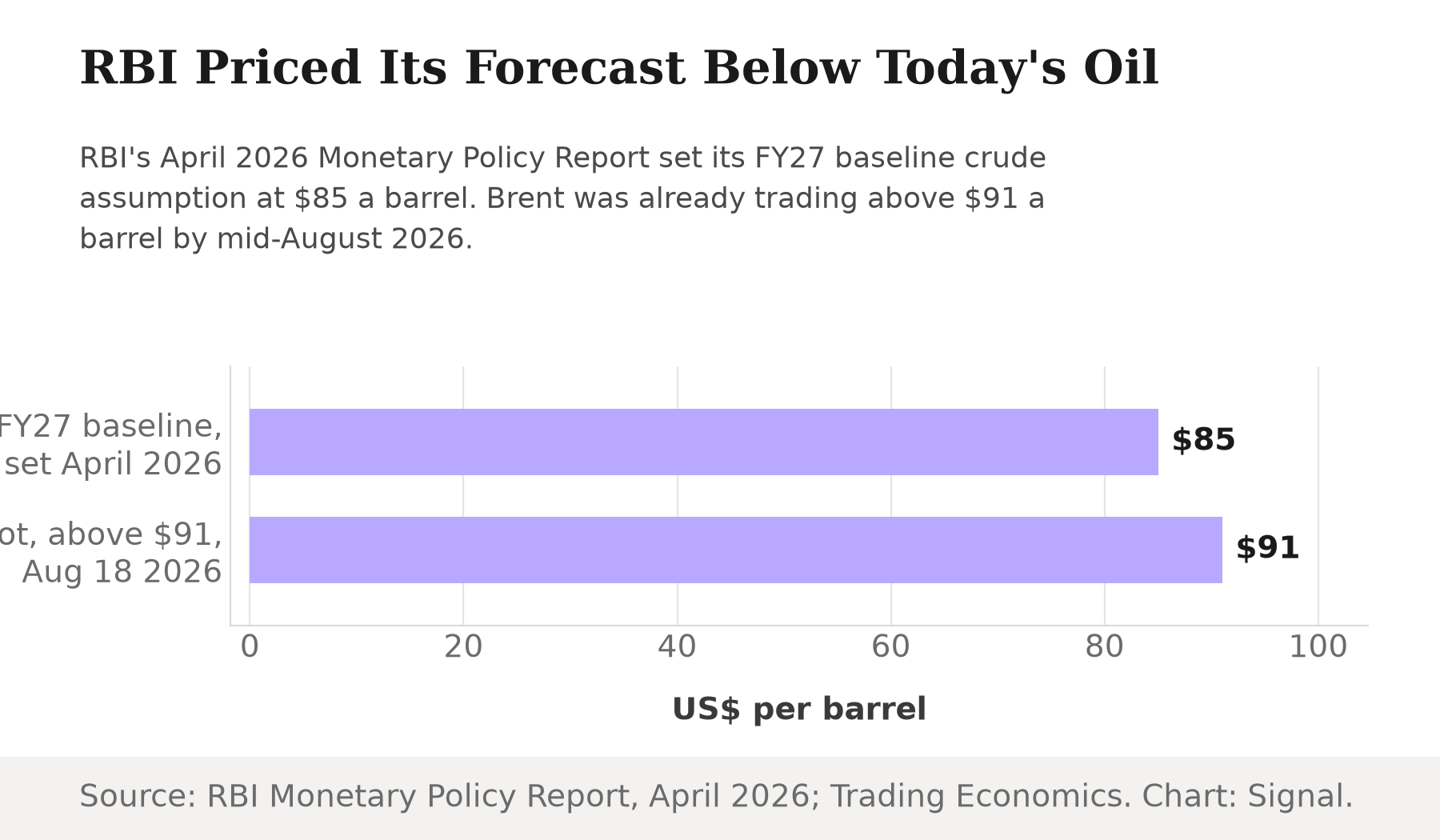
It is worth slowing down on that table. A growth and inflation forecast for an oil-importing economy is not a free-floating number. It is built on an assumption about what oil will cost, and RBI's is public: its April 2026 Monetary Policy Report set the baseline crude assumption at $85 a barrel for FY27 and $75 a barrel for FY28, in line with average Brent futures prices. That number, not the repo rate, is the load-bearing figure underneath the 6.7 percent and the 5.0 percent above. The same report also raised its baseline rupee assumption for FY27 to 94 against the US dollar, up from 88 during the second half of FY26, a weaker currency that, paired with a higher oil price, compounds the import bill if either assumption breaks.
The number that broke the baseline
Brent crude climbed above $91 a barrel by mid-August 2026, up roughly 38 percent year-on-year, rising for a third consecutive session as prospects for a new US-Iran agreement weakened. That is $91 against an $85 baseline set four months earlier, already past the line RBI's own growth math assumed for the entire fiscal year. The trigger was not demand. Shipping activity through the Strait of Hormuz slowed sharply after attacks on tankers: only five commodity vessels transited the waterway on one Saturday and none the next day, against 31 the previous weekend.
Source: Outlook Business, citing RBI's April 2026 Monetary Policy Report; Trading Economics. Chart: The Signal.
The rebound RBI already saw coming
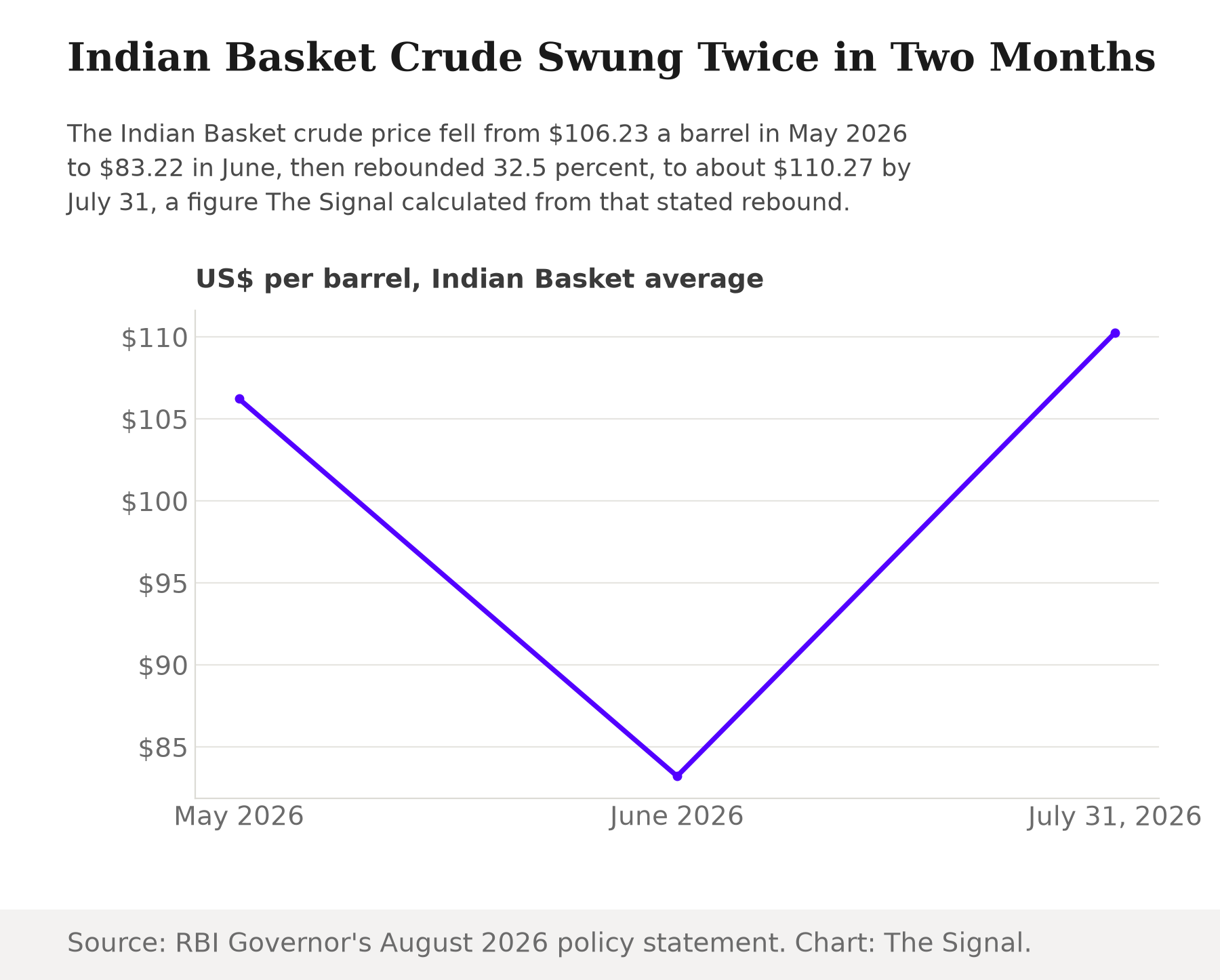
The MPC was not blindsided the day the tankers stopped moving. Its own governor's statement, published alongside the August 5 resolution, shows the Indian Basket crude price declined to average $83.22 a barrel in June from $106.23 in May, before Brent and the Indian Basket rebounded 34.5 percent and 32.5 percent respectively above end-June levels by July 31, 2026. RBI's own numbers, published the same day it held rates, already recorded a rebound of roughly a third in a single month.
Source: RBI Governor Sanjay Malhotra's August 2026 policy statement. July 31 figure is The Signal's calculation. Chart: The Signal.
That V-shape sits inside a longer swing. A separate government reply to the Lok Sabha shows the average Indian crude oil basket price eased from $114.5 a barrel in April 2026 to $77.6 a barrel by July 22, 2026, comfortably below RBI's $85 baseline, before the same rebound that the governor's statement flagged took hold. For most of the second quarter of FY27, the assumption RBI published in April was not just intact, it had room to spare. The move that broke it happened inside a few weeks, and it happened after the MPC had already met.
Why the miss matters more for India than most
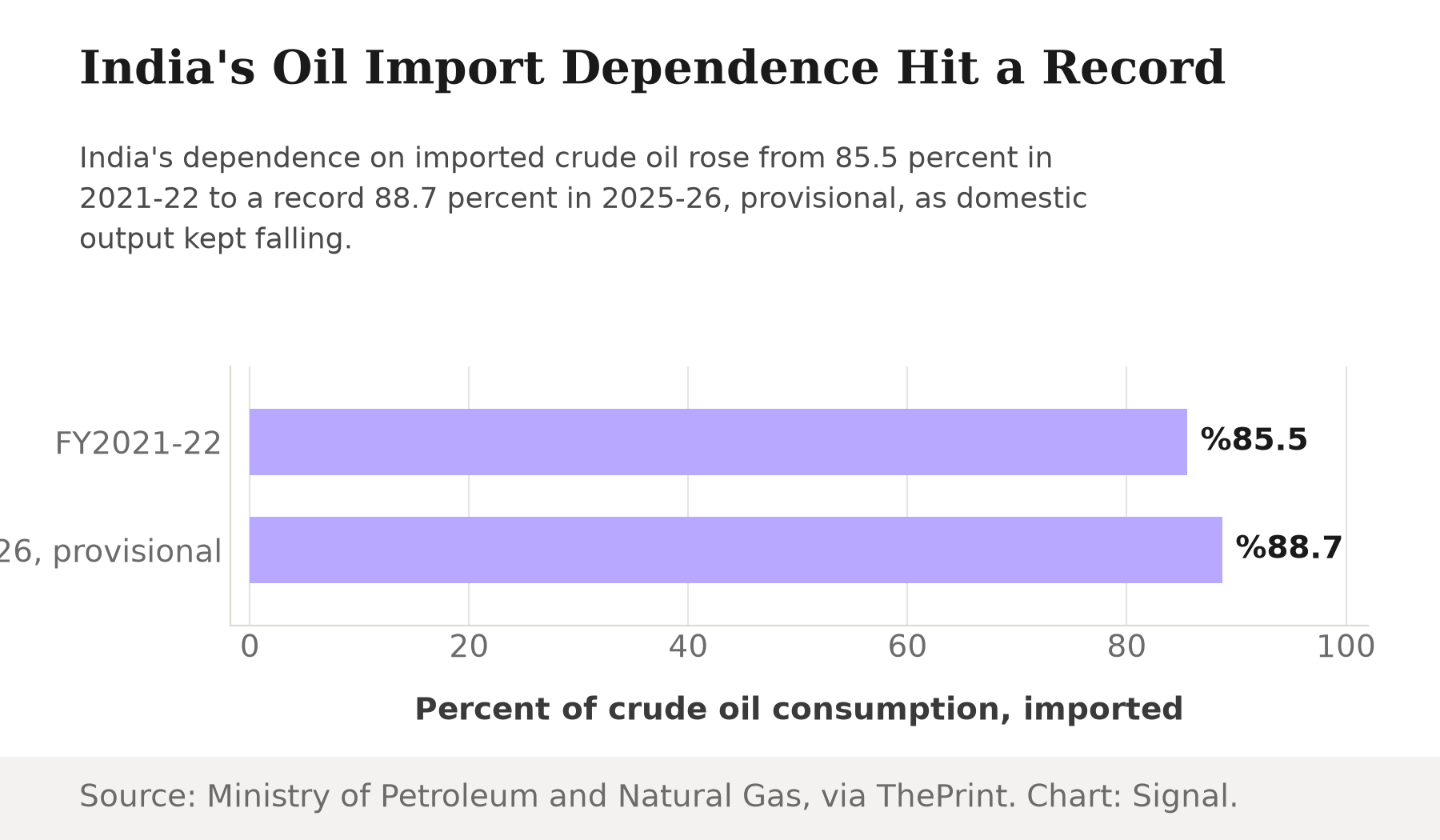
An oil-importing economy does not treat this gap as an abstraction. India's dependence on imported crude oil hit a record 88.7 percent in FY2025-26, provisional, up from 85.5 percent in FY2021-22, as domestic crude output fell from 29.7 to 28.0 million tonnes. Almost nine of every ten barrels India uses now comes from abroad, and that share has climbed every year on record. A model that gets the oil price wrong does not stay wrong at the margins; it flows straight through the trade deficit, the rupee and the inflation print that RBI itself forecasts each quarter.
Source: ThePrint, citing a Ministry of Petroleum and Natural Gas reply to the Rajya Sabha. Chart: The Signal.
The honest objection
The strongest case against reading too much into a single spot price is that forecasters do not expect it to hold. The US Energy Information Administration's Short-Term Energy Outlook, published August 11, 2026, forecasts Brent to average around $85 a barrel in the third quarter of 2026, assuming Hormuz shipments remain severely constrained through August with flows slowly increasing in September. On that reading, RBI's baseline is not broken, it is early: the same US-Iran standoff that pushed the spot price to $91 is, in the EIA's own base case, expected to ease enough that the quarterly average lands close to where RBI assumed it would.
That case is real, but it rests on a shipping disruption resolving on the schedule the EIA has assumed, not one that has already happened. RBI's own August 5 statement was written the same month a rebound it had just described as 32.5 percent kept extending toward the $91-plus level Brent reached by mid-August, faster than the central bank's own account of it suggested. An assumption that has already been overtaken twice in four months, first by a summer dip nobody built into the forecast and then by a shipping shock nobody scheduled, is not a forecasting error so much as a reminder that $85 was always a placeholder, not a prediction.
The Signal
The August 5 decision was never really about the repo rate; 5.25 percent was the least contested number in the release. RBI did not revise one number: an $85 baseline for a barrel of oil that has not traded there in weeks. If the EIA's own forecast holds and the third quarter of 2026 settles back near $85, RBI's FY27 growth and inflation path survives the scare intact. A third quarter that instead settles closer to $91 would turn the 6.7 percent growth and 5.0 percent inflation numbers in that table from a forecast into a baseline waiting for its next revision.
Reporting basis: the August 2026 repo rate decision and FY27 growth and inflation projections are from the Reserve Bank of India's Monetary Policy Committee resolution. The Indian Basket and Brent price swings through July 31, 2026 are from RBI Governor Sanjay Malhotra's accompanying policy statement, both primary RBI releases. The $85 FY27 crude baseline and the FY27 rupee assumption of 94 to the dollar are both from RBI's April 2026 Monetary Policy Report, the crude figure as reported by Outlook Business and the rupee figure as reported by The Pioneer, the same underlying report relayed by two outlets. The mid-August Brent price and the Strait of Hormuz shipping disruption are from Trading Economics market data. India's crude import dependence is from a Ministry of Petroleum and Natural Gas reply to the Rajya Sabha, as reported by ThePrint. The April-to-July Indian Basket price path is from a separate Ministry of Finance reply to the Lok Sabha, as reported by Millennium Post. The third-quarter 2026 Brent forecast is from the US Energy Information Administration's Short-Term Energy Outlook. The July 31 Indian Basket figure and the dollar gap between RBI's baseline and the spot price are The Signal's calculations from those figures.