
For four years, the story of India's post-pandemic economy has had a simple shape: a K. A handful of large, well-capitalised companies came roaring back after 2020, while smaller businesses stayed scarred, starved of both credit and customers. Consumption data seemed to confirm it, premium goods booming while mass-market demand stayed flat. The K became shorthand for the recovery itself: strength at the top, stagnation everywhere below it.
It is worth checking that shape against the firms that actually sit in the middle. A working paper from the Economic Advisory Council to the Prime Minister (EAC-PM), first reported this week, tracked the median Indian firm, not the largest ones, across the four years since the pandemic. Median capital employed rose from Rs 1,674.9 million in FY2020-21 to Rs 1,994.2 million in FY2023-24, and median revenue rose from Rs 1,943 million to Rs 2,736.5 million over the same period. Median return on assets, a measure of how efficiently a firm turns its assets into profit, improved from about 4.4 percent to 7.2 percent across the same four years.
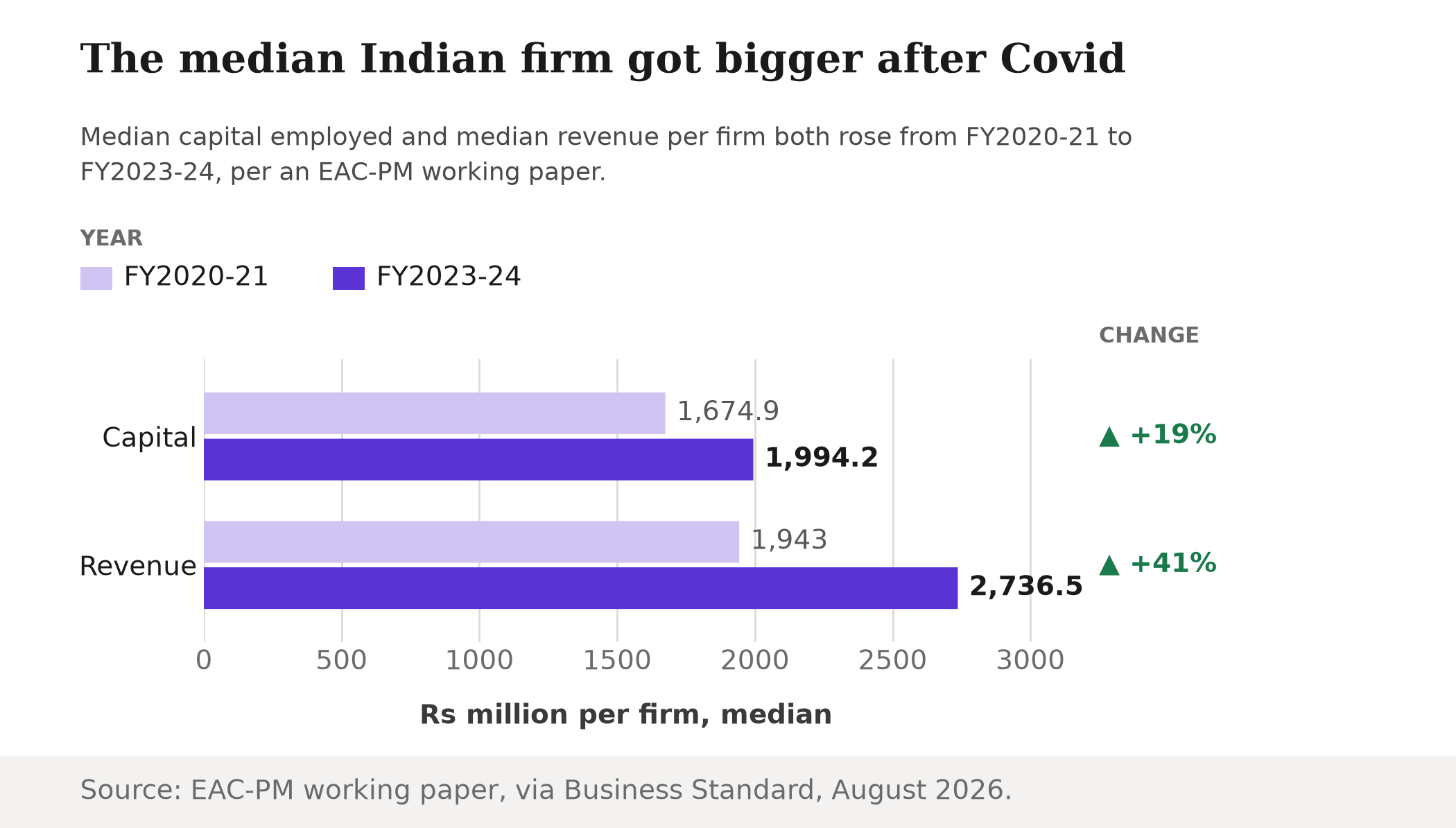
Source: Business Standard. Percentage changes are The Signal's calculation. Chart: The Signal.
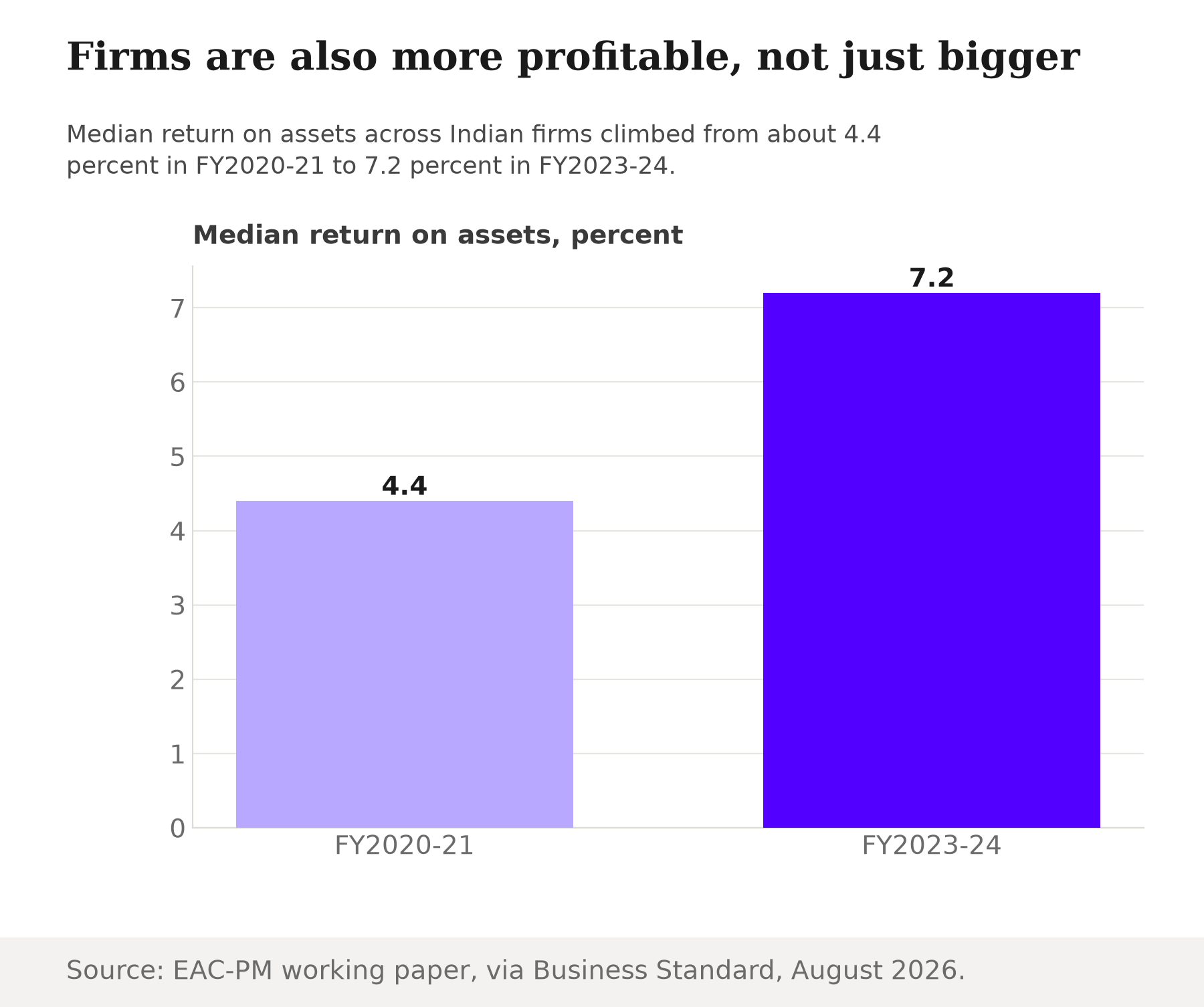
Source: Business Standard. Chart: The Signal.
Every one of those numbers moved the same way: bigger, richer, more profitable. That is not what a K-shaped recovery is supposed to produce in the middle of the size distribution.
What actually grew the middle
The paper's own explanation cuts against the two-speed story even more directly. India's FY2019-20 investment peak was driven by a narrow spike in investment intensity among large, asset-rich companies; that spike disappeared during the pandemic and never came back. The recovery since has instead come from a broad-based rise in investment intensity among firms clustered around the median of the size distribution, not a repeat performance from the same large firms that led before.
Three separate data sources point to the same underlying mechanism: formalisation, not just survival. The share of India's unincorporated establishments registered under at least one act or authority rose from 36.80 percent in the government's ASUSE 2022-23 survey to 37.20 percent in the ASUSE 2023-24 edition, the latest available, alongside a 12.84 percent rise in the total number of establishments surveyed. Bank credit to micro, small and medium industries continued to expand sharply as of January 2026, the most recent month the Reserve Bank of India has reported, while credit to large industries grew more moderately. And in a January 2024 report that itself called the K-shaped narrative "flawed" and "prejudiced," SBI Research found that about 19.5 percent of India's mostly micro-sized firms had shifted their income upward, into the small, medium or large classifications.
Put together, the picture is not one of large firms pulling away while small firms stagnate. It is one of firms moving up a formalisation ladder: more of them registered, more of them credit-worthy, more of them large enough to show up in a median calculation they might have sat below before.
The profit that isn't being reinvested
The same paper complicates the picture in a different way. Corporate profit before interest and tax grew 21.4 percent in FY2023-24, while gross fixed assets, the physical plant and machinery firms invest in, rose just 6.1 percent, a 15.3 percentage point gap between how fast firms are making money and how fast they are building capacity. Profit before interest and tax grew more than three times as fast as fixed-asset investment in the same year.
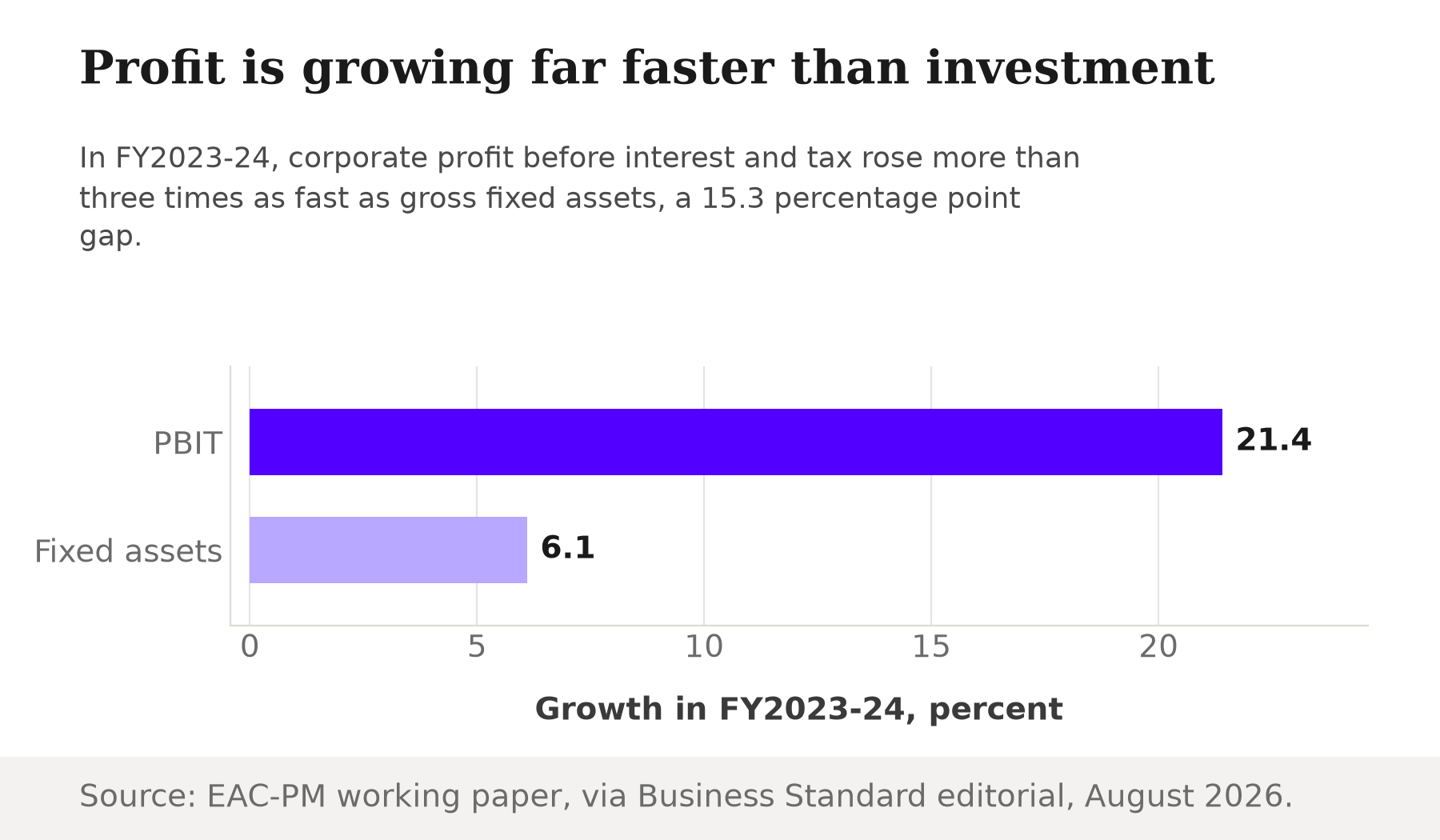
Source: Business Standard. Chart: The Signal.
That gap sits awkwardly next to the median-firm story. Firms in the middle of the distribution are getting bigger and more profitable, and the recovery in investment intensity since the pandemic has broadened out to firms near the median rather than staying concentrated among the largest, asset-heavy names, yet profit growth is still running far ahead of physical investment economy-wide. Whether that money eventually turns into new factories and hiring, or simply sits on balance sheets, is a question the median-firm numbers on their own cannot answer.
The honest objection
The strongest objection here is a general one: to show up in the sample at all, a firm has to still exist and still be filing accounts. A rising median is exactly what you would also see if the weakest firms simply exited the dataset, whether by shutting down or by never formalising at all, while the ones that remained simply got bigger. That is the ambiguity built into any median: it cannot say whether the middle actually got stronger, or whether the weakest firms simply stopped being counted. The paper's own numbers cannot fully rule either story out.
It does not fit cleanly, though. If the weakest firms were vanishing from the count, the unincorporated sector's own survey should show a shrinking or stagnant universe of establishments. Instead, ASUSE recorded a 12.84 percent rise in the total number of establishments between its 2022-23 and 2023-24 editions, alongside a rising, not falling, share of formal registration. And SBI Research's finding was about upgrading, not attrition: about a fifth of majorly micro-sized firms moved their income up into higher size classes, rather than disappearing from view. Survivorship bias would need the opposite pattern showing up almost everywhere in the data. The surrounding numbers instead show more firms entering the formal count, not fewer.
The Signal
If the K-shaped story was ever purely a matter of firm size, this paper is hard to square with it: the typical Indian firm came out of the pandemic bigger, more capitalised and more profitable, not scarred. What a median cannot show is what happened to the firms that no longer appear in any dataset at all, deregistered, shut, or too small to ever be counted. Watch two things next: whether the next ASUSE edition keeps pushing the formal registration share higher, and whether investment growth finally catches up to profit growth going forward. A median that rises because more firms are joining the formal economy is a very different recovery from one that rises because the weakest simply left the sample. Right now the surrounding data leans toward the formalisation story over the survivorship one, but a median was never built to rule the second one out entirely.
Reporting basis: the median firm-size, revenue and return-on-assets figures, the investment-intensity finding, and the profit-to-investment gap all trace to a single EAC-PM working paper, "An investigation into corporate profits and investment," as reported across three separate Business Standard articles: a news report on firm size, a separate news report on investment intensity, and a Business Standard editorial column. All three concern the same underlying paper and are counted here as one origin. The formalisation figures are from the Ministry of Statistics and Programme Implementation's Annual Survey of Unincorporated Sector Enterprises for 2023-24, via a Press Information Bureau release. The bank credit figures are from the Reserve Bank of India's Sectoral Deployment of Bank Credit release for January 2026. The finding that about a fifth of micro firms moved into higher size classes is from SBI Research, as reported by Business Standard via PTI in January 2024. The description of profit growth as running more than three times as fast as investment growth, and the year-on-year percentage changes shown in the first chart, are The Signal's calculations from the underlying figures the paper itself reported; every other figure above is quoted or paraphrased directly from the sources named.