UPI's origin story is a formalization story. India abolished the merchant discount rate on UPI and RuPay debit cards in January 2020, scrapping a fee of up to 0.30 percent that merchants had paid on UPI person-to-merchant payments, precisely to pull small daily cash transactions onto a digital rail nobody had to pay to use, Forbes India reports. Zero MDR is the policy every account of India's digital-payments boom credits: free UPI is why a shopkeeper takes a QR code as readily as cash. Read that history and the natural assumption is that cash lost the argument years ago.
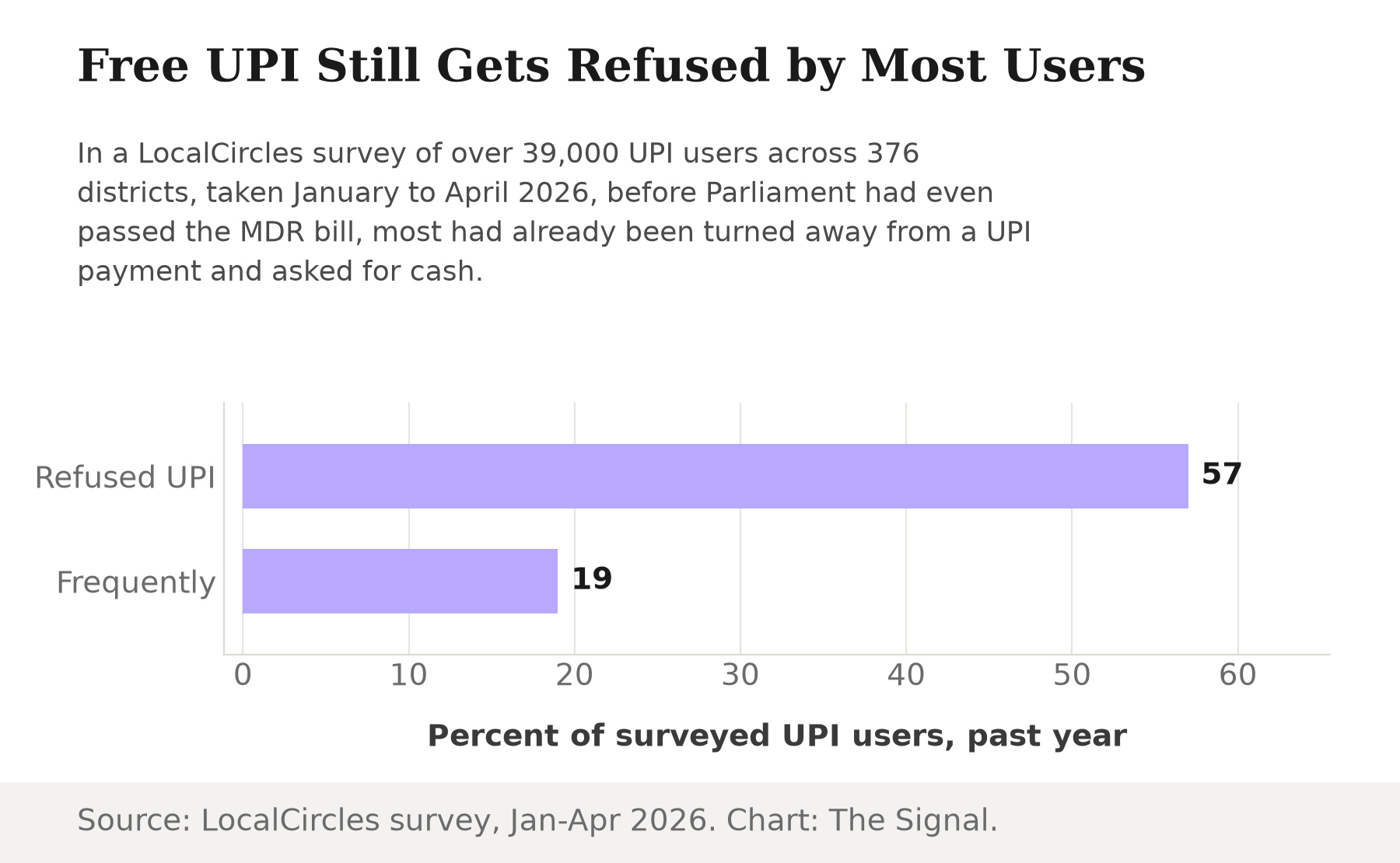
It is worth slowing down on that. In a LocalCircles survey of more than 39,000 UPI users across 376 districts, run between January and April 2026, 57 percent said they had been refused a UPI payment and asked for cash instead at least once in the past year, and 19 percent said it happens quite frequently. That is not a fringe complaint. It is a majority of UPI's own user base reporting that the free digital rail still loses to cash at the counter, months before Parliament touched the underlying law.
The record cash never gave back
The currency data reads the same way from the other side. Currency in circulation rose 11.9 percent in FY26, the year that ended in March 2026, to a record near Rs 40 lakh crore, the fastest pace of growth since FY21, even as UPI itself kept setting its own volume records. The cash-to-GDP ratio fell over that same period, to about 11.2 percent from 14.4 percent in FY21: cash is still shrinking as a share of a bigger, more digital economy, just not in the rupee amount actually sitting in people's hands.
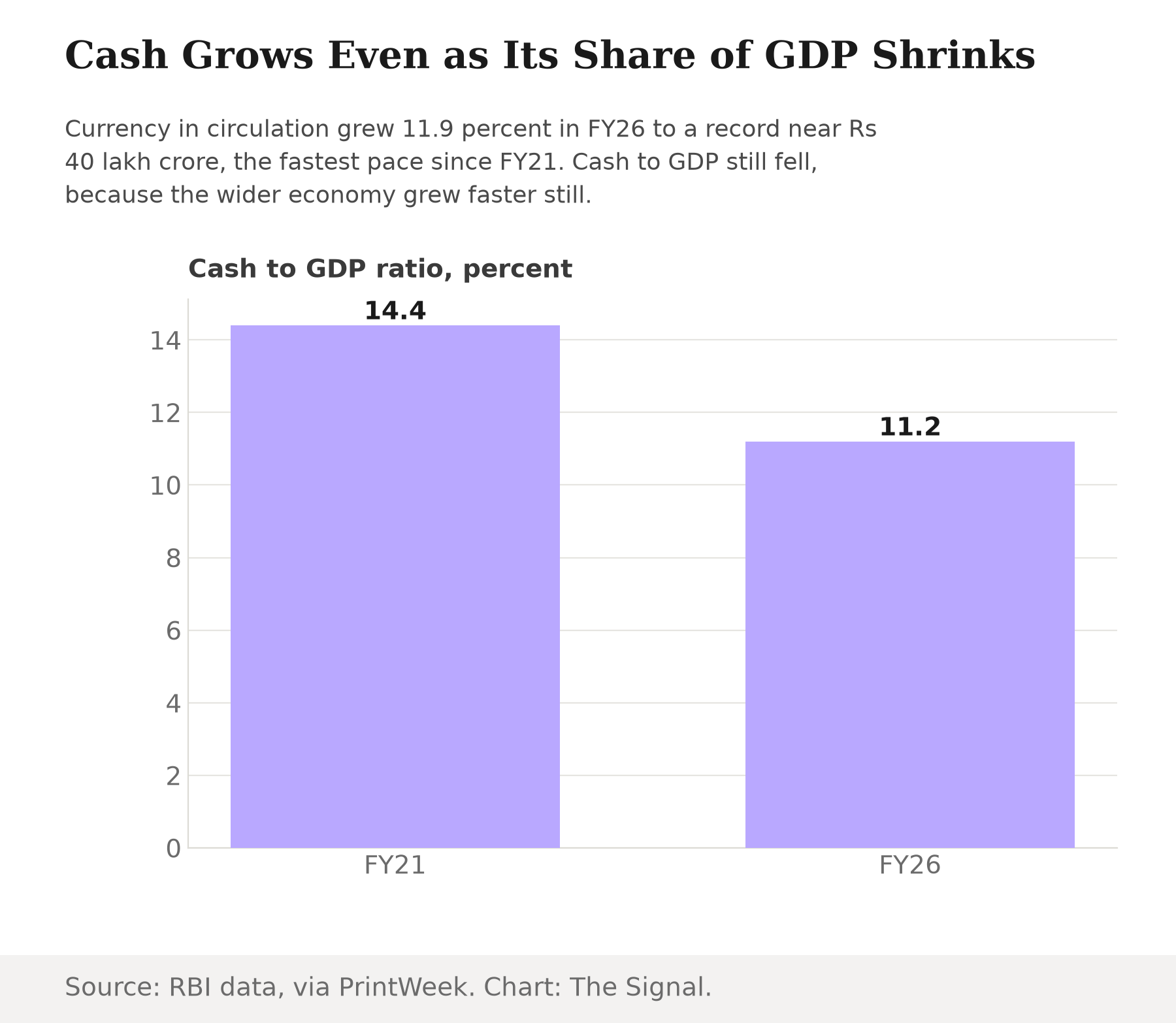
That distinction, a shrinking share versus a shrinking amount, is the whole debate in miniature. The formalization story only ever needed the ratio to fall, not cash itself to shrink, and it has not.
What Parliament actually passed
Then, on 11 August 2026, the legal ground shifted. Parliament passed the Taxation and Other Laws (Amendment) Bill, 2026, amending the Payment and Settlement Systems Act to let the government permit a merchant discount rate on UPI and other notified payment systems. Finance Minister Nirmala Sitharaman told Parliament the amendment is only an enabling provision, that it does not itself impose any charge, and that UPI will remain free for consumers, per Akashvani News.
That reassurance sits awkwardly against the government's own record. Fourteen months earlier, in June 2025, the Finance Ministry had called reports of an MDR on UPI "completely false, baseless, and misleading", not merely unlikely but denied outright.
| Date | What happened |
|---|---|
| January 2020 | India scraps the MDR on UPI and RuPay debit cards, making UPI free to use |
| 12 June 2025 | The Finance Ministry calls reports of an MDR on UPI "completely false, baseless, and misleading" |
| 11 August 2026 | Parliament passes the enabling bill; the Finance Minister says UPI stays free for now |
Source: Forbes India; Akashvani (All India Radio) News.
Users already answered the hypothetical
The same LocalCircles survey wave that found the cash-refusal number also asked users what they would do if UPI stopped being free. Seventy-five percent said they would stop using UPI altogether if a transaction fee were introduced, against just 25 percent willing to bear a fee, as reported by Storyboard18. No fee has actually been charged yet. But the enabling bill means that number is no longer a hypothetical pollsters asked for the sake of it. It is the demand curve the government just gave itself the legal room to test.
A dip too early to blame on the bill
There is one more data point, and it needs a caveat rather than a headline. NPCI's own figures for June 2026 showed UPI transaction volume down 2.1 percent and transaction value down 3.3 percent from May, even as both stayed sharply higher than a year earlier, up 23 percent and 20 percent respectively.
| Metric | Month on month (May to Jun 2026) | Year on year (Jun 2025 to Jun 2026) |
|---|---|---|
| Transaction volume | down 2.1% | up 23% |
| Transaction value | down 3.3% | up 20% |
Source: NPCI data, via Entrackr.
That June wobble in NPCI's own count happened two months before Parliament passed anything, so it cannot be read as a reaction to the new law. What it shows instead is that UPI's month-to-month growth was already capable of pausing before any fee existed, on top of a user base that was already meeting cash-only merchants at a steady clip, per the same LocalCircles survey. The bill did not create that friction. It arrived on top of it.
The honest objection
The strongest case against reading any of this as a reversal is straightforward: every wobble here predates the bill, UPI's year-on-year growth is still strongly positive, and the cash-to-GDP ratio kept falling, not rising. On that reading, India's digital-payments transition remains firmly on track, a single soft month and a survey about merchant friction are noise, and the Finance Minister's assurance that UPI stays free should be taken at face value.
That case holds for UPI's overall trajectory. It does not hold for the narrower claim this piece is actually testing, that zero-MDR UPI was quietly eliminating cash. The cash-refusal survey and the record currency-in-circulation figure both predate the bill too, which is the point: resistance to a free digital rail was already visible before the government had any legal fee to justify it. A bill that only takes effect later cannot explain data from before it existed; it can only turn the next round of that same resistance into a live policy risk instead of a survey footnote.
The Signal
Zero-MDR UPI was never actually killing cash. It was managing a stalemate: a shrinking share of a growing economy, a majority of users who had already met a merchant asking for rupees instead of a QR code, and month-to-month growth that could already stall with no fee attached. Parliament's 11 August bill does not create that stalemate. It hands the government the legal switch to test how durable it is, months after the government itself called the idea false. Watch what happens to that switch, not the fee that has not been charged yet: if it stays unused, this was a legal formality. If it is flipped even for the largest merchants, the 75 percent who told LocalCircles they would walk are the number that decides whether India's decade of free UPI ends in retreat or in cash.
Reporting basis: the UPI merchant-refusal figure and the fee-reaction figure are both from a single LocalCircles survey wave (January to April 2026), one origin reported directly by LocalCircles and, for the fee-reaction figure, also carried by Storyboard18. Currency-in-circulation and cash-to-GDP figures are Reserve Bank of India data as reported by PrintWeek. The bill's passage and the Finance Minister's remarks, and the Finance Ministry's earlier denial, are both from Akashvani (All India Radio) News. UPI's June 2026 transaction figures are National Payments Corporation of India data as reported by Entrackr. The MDR history before 2020 is per Forbes India. The fourteen-month gap between the ministry's denial and the bill's passage is The Signal's calculation from those two dates.