India's monthly jobs survey, the Periodic Labour Force Survey (PLFS) run by the National Statistics Office (part of the Ministry of Statistics and Programme Implementation, or MoSPI), landed on August 17, 2026, and the headline number was the kind every finance ministry likes to lead with: the country's overall unemployment rate for people aged 15 and above fell to 5.1 percent in July 2026, down from 5.5 percent in June. It is also the kind of number a labour economist reflexively distrusts. A falling jobless rate can mean more people found work. It can also mean discouraged workers simply stopped counting themselves as job seekers and dropped out of the labour force, shrinking the denominator rather than growing employment.
Check the second number before accepting the first, and July's data does not support the discouraged-worker read. India's labour force participation rate rose to 55.4 percent in July from 54.4 percent in June, and the worker population ratio, the share of the working-age population actually employed, rose to 52.5 percent from 51.4 percent over the same month. A full percentage point more of India's working-age population was in the labour force in July than in June, and a full point more of that population was actually working. The jobless rate did not fall because people gave up looking. It fell because employment grew faster than the labour force did.
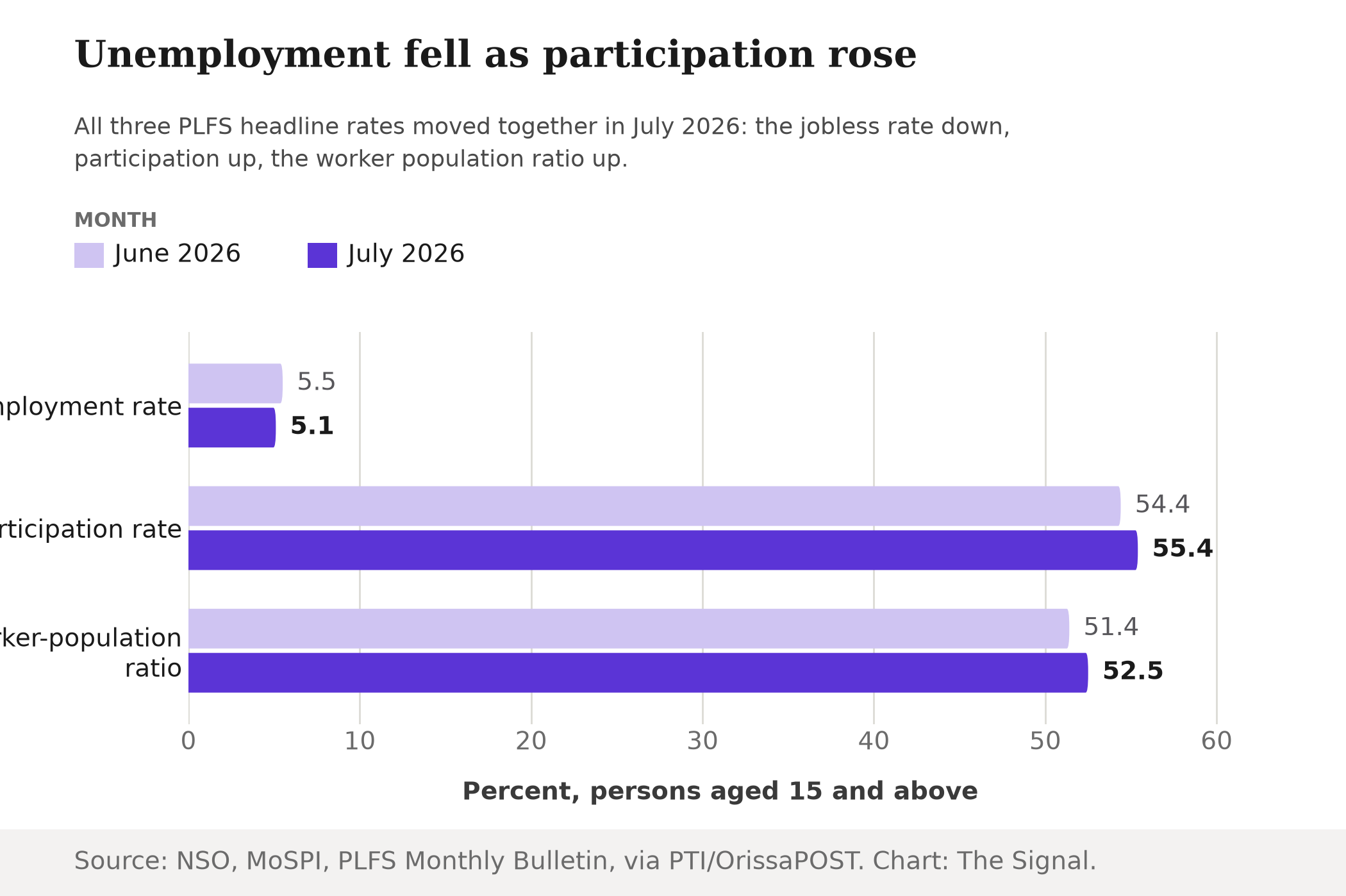
Source: OrissaPOST, citing the NSO's PLFS monthly bulletin. Chart: The Signal.
A year flat, then a jump in one month
The size of July's participation jump matters as much as its direction. India's overall labour force participation rate had barely moved before this: it stood at 54.4 percent in June 2026, unchanged from May 2026, and only 0.2 percentage points above June 2025. A rate that sat still for a year and then gained a full point in a single month is unusual enough to flag, and the published bulletin gives no explanation for it beyond the topline figures themselves. Whether that is a one-month blip or the start of a trend will not be clear until the next release. What is already clear is that the July improvement did not come from people exiting the workforce.
Rural did the work
The jobless-rate move also breaks down unevenly by geography. India's rural unemployment rate fell to 4.5 percent in July from 5.0 percent in June, while the urban rate held almost steady at 6.7 percent, up marginally from 6.6 percent. Rural India, which typically posts the lower jobless rate of the two, pulled the national average down almost on its own in July.
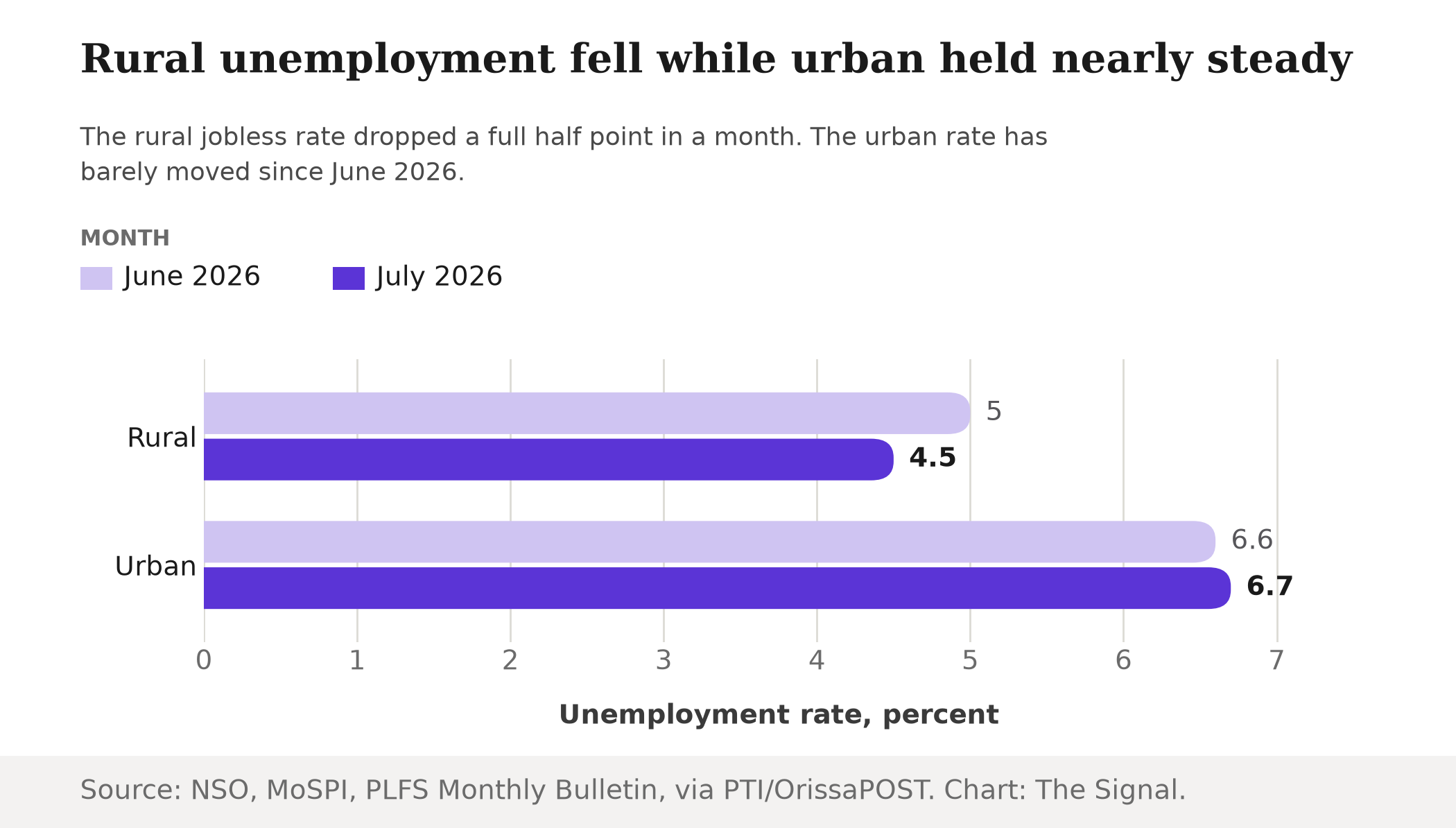
Source: OrissaPOST, citing the NSO's PLFS monthly bulletin. Chart: The Signal.
The urban rate's flatness this summer sits inside a longer decline. MoSPI's own press note on the June bulletin put the urban unemployment rate at 6.6 percent that month, down half a percentage point from 7.1 percent a year earlier in June 2025. Urban joblessness is lower than it was in 2025. It has simply stopped falling over the two most recent months while rural joblessness kept dropping.
The participation gap that did move
Not every part of the labour force had moved at the same slow pace before July. India's female labour force participation rate stood at 32.7 percent in June 2026, up 0.7 percentage points from 32.0 percent a year earlier, a real gain, but a slow one against an overall participation rate of 54.4 percent that same month, a gap of nearly 22 percentage points. July changed that pace: the female labour force participation rate jumped to 34.4 percent, a 1.7 percentage point rise in a single month, outpacing the one-point gain in the overall rate. Women's participation did not just keep up with July's broader jump. It moved faster than the overall rate did.
The honest objection
There is a reasonable case for not reading too much into a single month of survey data. Monthly labour force surveys carry sampling noise, and the overall participation rate had not moved at all in the two months before July, so one point of movement could partly reverse in August. It is also fair to ask whether the government's own budget commitments assume a weaker labour market than July's print shows. India's FY2026-27 budget set aside 95,692 crore rupees for the Viksit Bharat Guarantee for Rozgar and Ajeevika Mission (Gramin), a rural jobs-guarantee scheme, plus a separate 30,000 crore rupees for the existing MGNREGA rural employment guarantee, together nearly 1.26 lakh crore rupees committed to guaranteeing rural work in the same year rural unemployment turns out to be the stronger side of the labour market.
That tension is real, but it mostly dissolves once the mechanics of the two schemes are considered. MGNREGA and its newer counterpart are legal guarantees a household can claim on demand: work is available whenever a rural household asks for it, whatever the national jobless rate reads that month, so the budget line is an entitlement households can draw on, not a forecast that rural India's job market is failing. A falling rural unemployment rate does not make a legal work guarantee redundant. If anything, it should reduce how much of the budgeted amount actually gets drawn down over the year.
| Scheme | FY2026-27 allocation | What it guarantees |
|---|---|---|
| Viksit Bharat G-RAM-G | ₹95,692 crore | Rural employment guarantee mission |
| MGNREGA | ₹30,000 crore | Legal right to rural work on demand |
Source: Ministry of Rural Development, via News on Air.
The Signal
July's jobs data is not the shrinking-labour-force illusion that a falling unemployment rate usually invites suspicion of. Participation and employment both rose while the jobless rate fell, not despite each other. But the gains are not evenly spread: rural India carried most of the improvement while urban India's rate has been flat since June, and female participation, though it jumped faster than the overall rate in July, is still far behind the overall reading. Watch the next two bulletins for whether July's one-point jump in participation holds or partly reverts, and whether urban joblessness ever follows rural's lead down. One good month is a data point. A second one would be a trend.
Reporting basis: the July 2026 unemployment, participation, worker-population and female-participation figures, and the rural-urban split, are from the National Statistics Office's PLFS monthly bulletin, as reported by PTI and carried by OrissaPOST. The June 2026 figures and the year-on-year urban comparison are from the NSO's own press note on the same bulletin series, released via the Press Information Bureau. Those two sets of figures share a single origin, the NSO's PLFS monthly bulletin, relayed through different channels for different months. The rural jobs-guarantee budget figures are as the Ministry of Rural Development told Parliament, reported by News on Air, the government's official radio news service. The combined rural-scheme total and the percentage-point gaps between female and overall labour force participation are The Signal's calculations from those figures.