India's private space industry tells its own story in decade-scale numbers. In August 2025 remarks at India Mobile Congress, the government pointed to more than 300 space startups formed in the preceding five years, part of a sector the government expects to grow roughly five-fold from an $8.4 billion valuation in 2022 to $44 billion by 2033. Launch cadence is up, satellite manufacturing rules have loosened, and the count of companies keeps climbing. Read only the headline figures and this looks like a market investors are racing into.
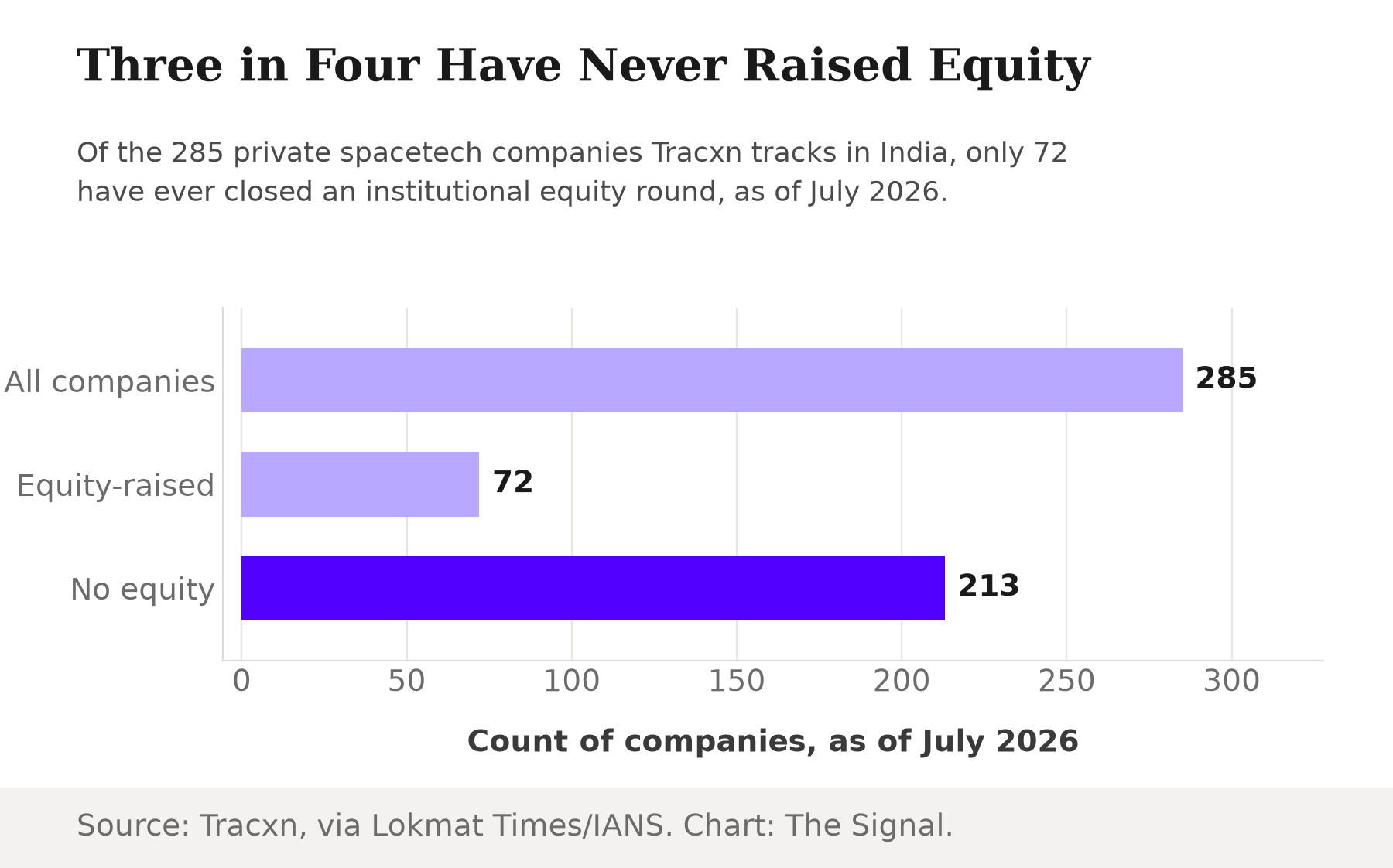
It is worth slowing down on that count. Of the 285 private spacetech companies Tracxn tracks in India, only 72 have ever closed an institutional equity round, as of July 2026, according to a Tracxn report carried by Lokmat Times and IANS. That leaves roughly 213 companies, about three in four, that have never raised a rupee of institutional equity. Cumulative equity funding across the whole ecosystem stands at $871 million spread over 241 rounds through July 2026, under $3.6 million a round on average, our calculation.
Source: Tracxn, via Lokmat Times/IANS. Chart: The Signal.
Financed by everything except equity
That does not mean the sector runs on nothing. The government runs three separate non-equity channels for early-stage space startups: a Rs 1,000 crore venture capital fund operationalised with the Small Industries Development Bank of India, a Rs 500 crore Technology Adoption Fund, and a seed scheme granting up to Rs 1 crore per startup, DD News reported, on top of the ISRO contracts many of these companies already service. Contracts, grants and seed capital are real money. They are also not the same thing as an investor pricing a company's future and buying a stake in it, which is what an equity round is and what the sector's 213 unfunded companies have never had.
The fund built to fix this hasn't spent a rupee
The most direct government answer to that gap is also the most awkward one for the government. The same Rs 1,000 crore space-sector venture capital fund, approved by the Cabinet in October 2024, had disbursed nothing as of early 2026, and the Space Minister told Parliament it is expected to begin investing only from April 2027, WION reported from his written Lok Sabha reply. That is two and a half years between Cabinet approval and a first rupee committed, and as of this writing the fund is still roughly eight months from that promised start. The pipeline is not literally empty, to be fair: as of April 2026, four spacetech proposals had already advanced through Pre-Investment Committee approval and were undergoing third-party due diligence, Daily Excelsior reported from the same minister's written reply. Four proposals in diligence after two and a half years is still a long way from a fund actually investing.
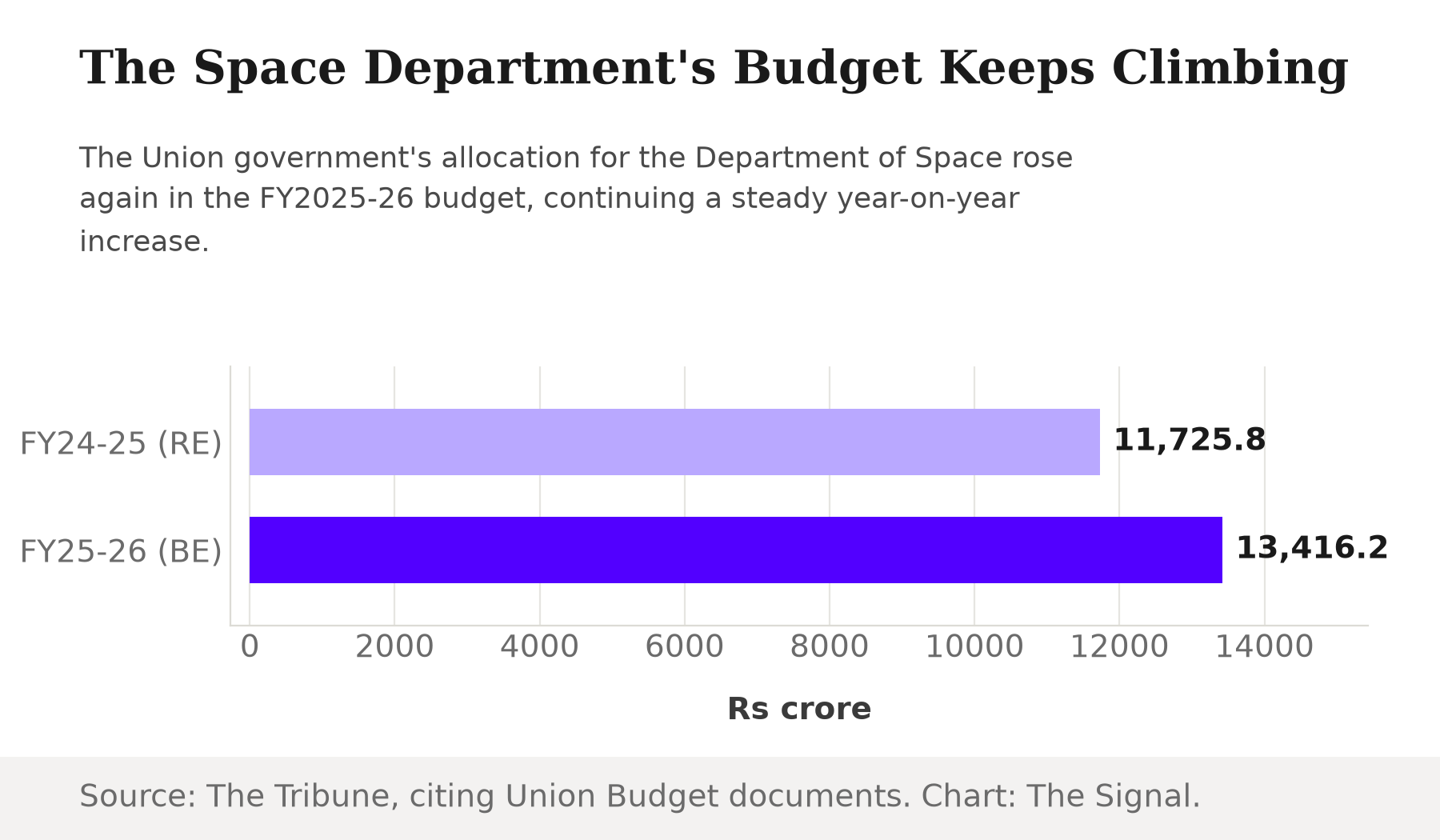
That idle fund sits inside a department whose overall budget keeps climbing regardless. The Department of Space's budget rose from Rs 11,725.75 crore, the revised estimate for FY2024-25, to Rs 13,416.20 crore in FY2025-26, a Union Budget increase of about 14 percent, The Tribune reported. The money for the sector is growing, but the specific instrument meant to put that money into equity stakes is not.
Source: The Tribune, citing Union Budget documents. Chart: The Signal.
Registered is not the same as authorised
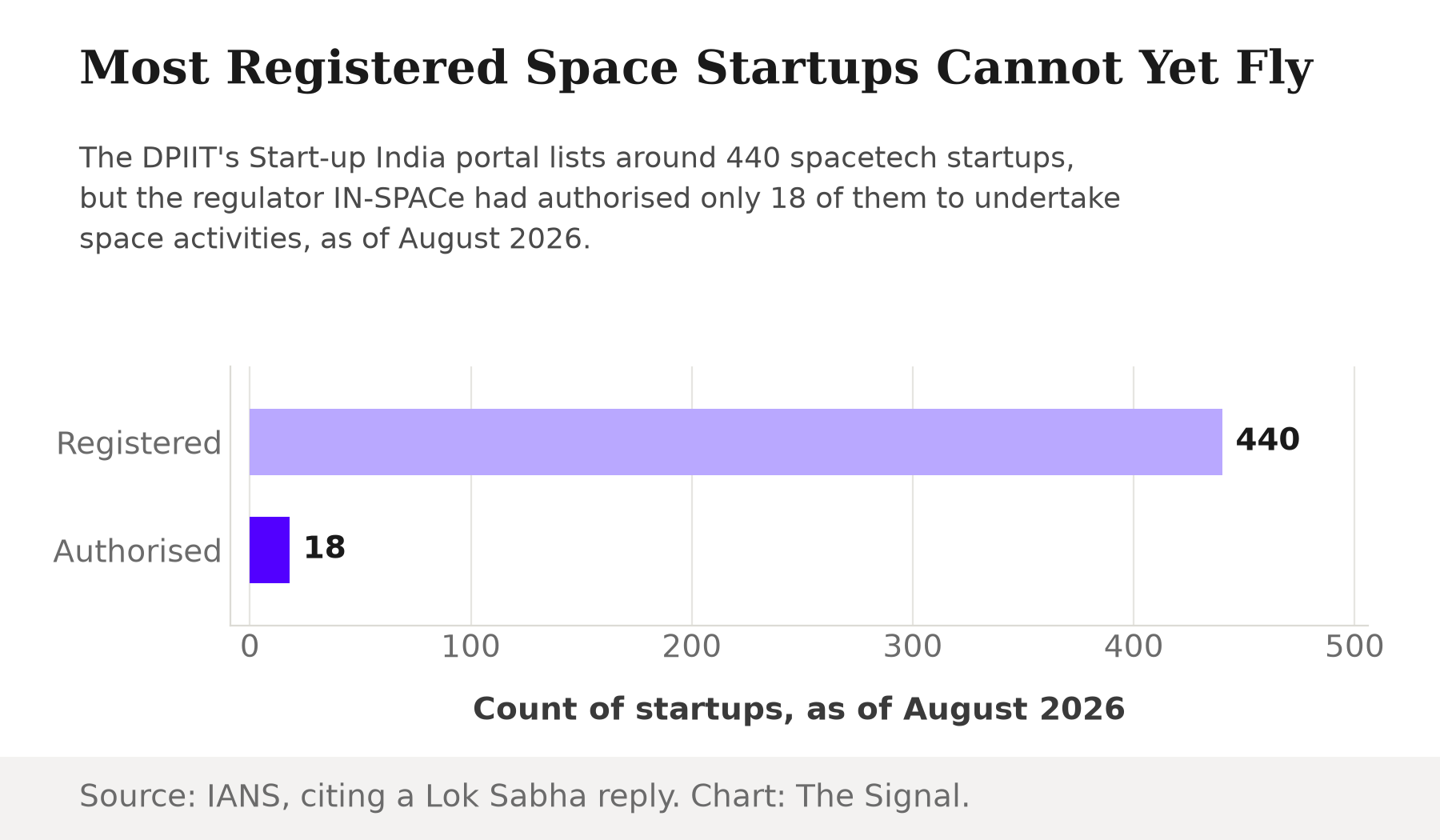
The gap between headline counts and operating reality shows up a second way, in who is even allowed to fly. The DPIIT's Start-up India portal lists around 440 registered spacetech startups, but IN-SPACe, the regulator that licenses actual space activity, had authorised only 18 of them to undertake space activities as of August 2026, part of just 113 authorisations issued to 52 non-government entities in total, IANS reported from the government's Lok Sabha reply. A startup can register on a government portal in an afternoon. Getting IN-SPACe's authorisation to actually operate, and getting an investor to actually fund you, both take a great deal longer, and most of the 440 have cleared neither bar.
Source: IANS, citing a Lok Sabha reply. Chart: The Signal.
The door is open. The capital has not walked through it
None of this is because foreign capital is legally locked out. Since a gazette notification effective 16 April 2024, India permits up to 100 percent foreign direct investment via the automatic route for manufacturing satellite components, systems and sub-systems, India Briefing reported, though satellite operation and launch vehicles carry lower automatic-route caps that need government approval beyond them.
Foreign investment is least restricted for the segment investors are most likely to actually fund.
| Segment | Automatic-route FDI cap |
|---|---|
| Satellite manufacturing, components and sub-systems | 100% |
| Satellite operation | 74% |
| Launch vehicles and spaceports | 49% |
Source: India Briefing, April 2024. Investment above these caps requires government approval.
The honest objection
The strongest case against calling this a financing gap is that Indian space investment is climbing fast, and equity naturally trails the anchor contracts a young deep-tech sector lives on first. The government's own tracker puts cumulative private investment in the space sector at $618.5 million by 31 March 2026, a nearly six-fold rise from $100.5 million in FY2021-22, with $348.5 million reached by FY2023-24, Devdiscourse reported from the minister's Rajya Sabha statement. On that reading, 72 equity-funded companies out of 285 is simply where a young ecosystem sits before the market catches up, and the FDI rules already let the capital in whenever it is ready. The stage-by-stage trend backs that reading up to a point: seed-stage funding rose from $7 million in 2022 to $62 million in 2025, while late-stage funding only appeared for the first time in 2025, at $17 million, before reaching $53 million in 2026, IANS reported from the same Tracxn data. Growth-stage capital is arriving, not absent, which is the strongest version of the "still early" case.
That case survives the growth trend but not the specific instrument the government itself pointed to as the fix. If the equity gap were closing on its own at the pace the investment tracker implies, a Rs 1,000 crore fund approved in October 2024 would not still be sitting at zero with its first investment penciled in for eight months from now. Fast growth in the tracked total and an empty flagship fund can both be true at once. What that combination says is that even the government's own near-term confidence in equity flow left room for a vehicle it does not expect to need for years.
The Signal
India's space-sector story is told in the numbers that flatter it: startups registered, budgets approved, a target set for 2033. Equity-funded companies, authorised operators, and a venture fund with an actual investment on its books are the smaller, slower numbers that actually discipline it. Growing the sector roughly five-fold from its $8.4 billion 2022 valuation to $44 billion by 2033 needs investors underwriting risk that a contract or a grant cannot absorb by design, because a supplier only gets paid for work already delivered while an equity investor is betting on work not yet done. Watch two numbers to see whether that gap is closing: whether Tracxn's next count moves the 72 funded companies up in a way that outpaces new registrations, and whether the Rs 1,000 crore fund actually invests before April 2027 slips into another deferral. Until one of those two numbers moves, India's space boom is being financed by everyone except the investors it will eventually need.
Reporting basis: the equity-funding count, company total and cumulative funding figures are per Lokmat Times' report of Tracxn's data, also carried by IANS, whose own writeup of the same report carries the seed- versus late-stage funding trend. The non-equity funding channels and the sector's growth target are from Ministry of Science and Technology, Department of Space statements carried by DD News, the government's own broadcaster. The delayed venture capital fund and the IN-SPACe authorisation count are each from separate written government replies in Parliament, as reported by WION and IANS respectively; the fund's Pre-Investment Committee pipeline is from the same minister's reply, as reported by Daily Excelsior. The Department of Space's budget figures are from Union Budget documents, as reported by The Tribune. The private-investment tracker is from a separate Rajya Sabha statement, as reported by Devdiscourse. The FDI policy detail is India Briefing's summary of the April 2024 gazette notification. The average equity round size, the budget's percentage increase, and the time elapsed since the venture fund's 2024 approval are The Signal's calculations from those figures.