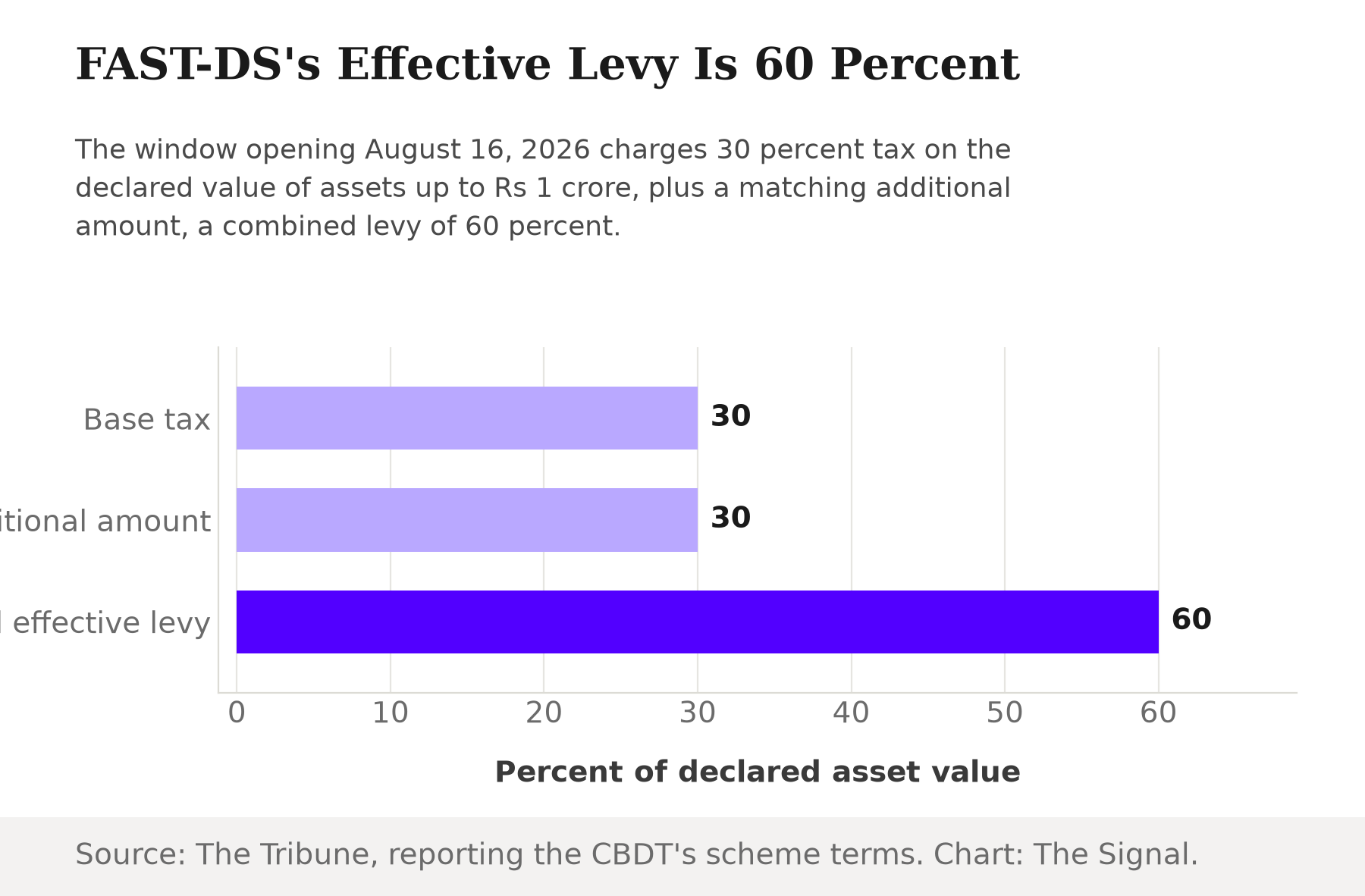
Tomorrow, the Central Board of Direct Taxes opens the Foreign Assets of Small Taxpayers-Disclosure Scheme, or FAST-DS, announced in the 2026-27 Budget and taking effect August 16, 2026. A taxpayer can regularise up to Rs 1 crore of undisclosed foreign assets or income by paying a combined levy of 60 percent, 30 percent tax plus an additional amount equal to the tax, with online declarations open until December 31, 2026. The coverage reads like every one-time compliance window before it: a chance to come clean on relatively favourable terms, before the taxman comes looking.
It is worth slowing down on the word "chance." A chance implies the department does not yet know what it is being offered a look at. On CBDT's own numbers, in a great many cases, it already does. Since July 16, 2026, CBDT has been displaying foreign asset and income data it receives under the Automatic Exchange of Information framework directly inside taxpayers' Annual Information Statement on the e-filing portal. That is not a policy promise. It is a taxpayer logging into their own account and finding the foreign account the department already knows about, sitting there. The reach behind that portal feature is broad: India has activated exchange relationships with 111 jurisdictions for receiving foreign financial account information, and 86 for sending it, under the same Automatic Exchange of Information framework, a far wider data net than existed when the last one-time window opened in 2015.
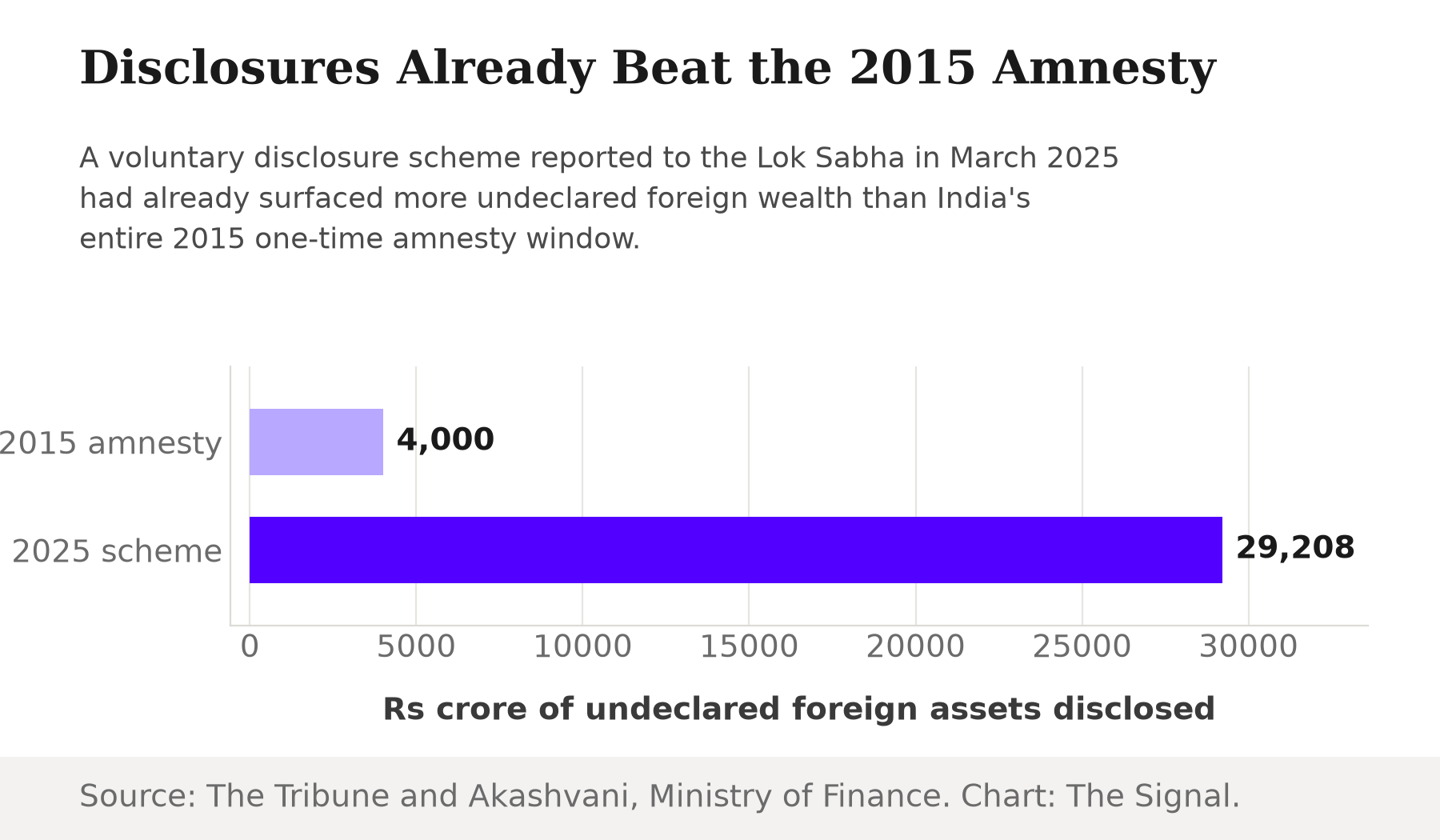
That visibility is not new dressed up as a headline for this scheme. A year before FAST-DS existed even as a Budget line, a separate voluntary disclosure scheme had already pulled far more out of the same pool of hidden foreign wealth. Finance Minister Nirmala Sitharaman told the Lok Sabha in March 2025 that the scheme had uncovered Rs 29,208 crore of undeclared foreign assets and Rs 1,089 crore of foreign income from 30,161 taxpayers. Compare that with the last time India ran a real one-time amnesty: the 2015 Black Money Act's three-month window drew 648 declarations disclosing more than Rs 4,000 crore, between July and September that year. Rs 29,208 crore against just over Rs 4,000 crore is more than seven times as much, pulled in without any statutory amnesty backing it.
A voluntary disclosure scheme already surfaced more hidden wealth than the entire 2015 amnesty.
The gap in people is even starker.
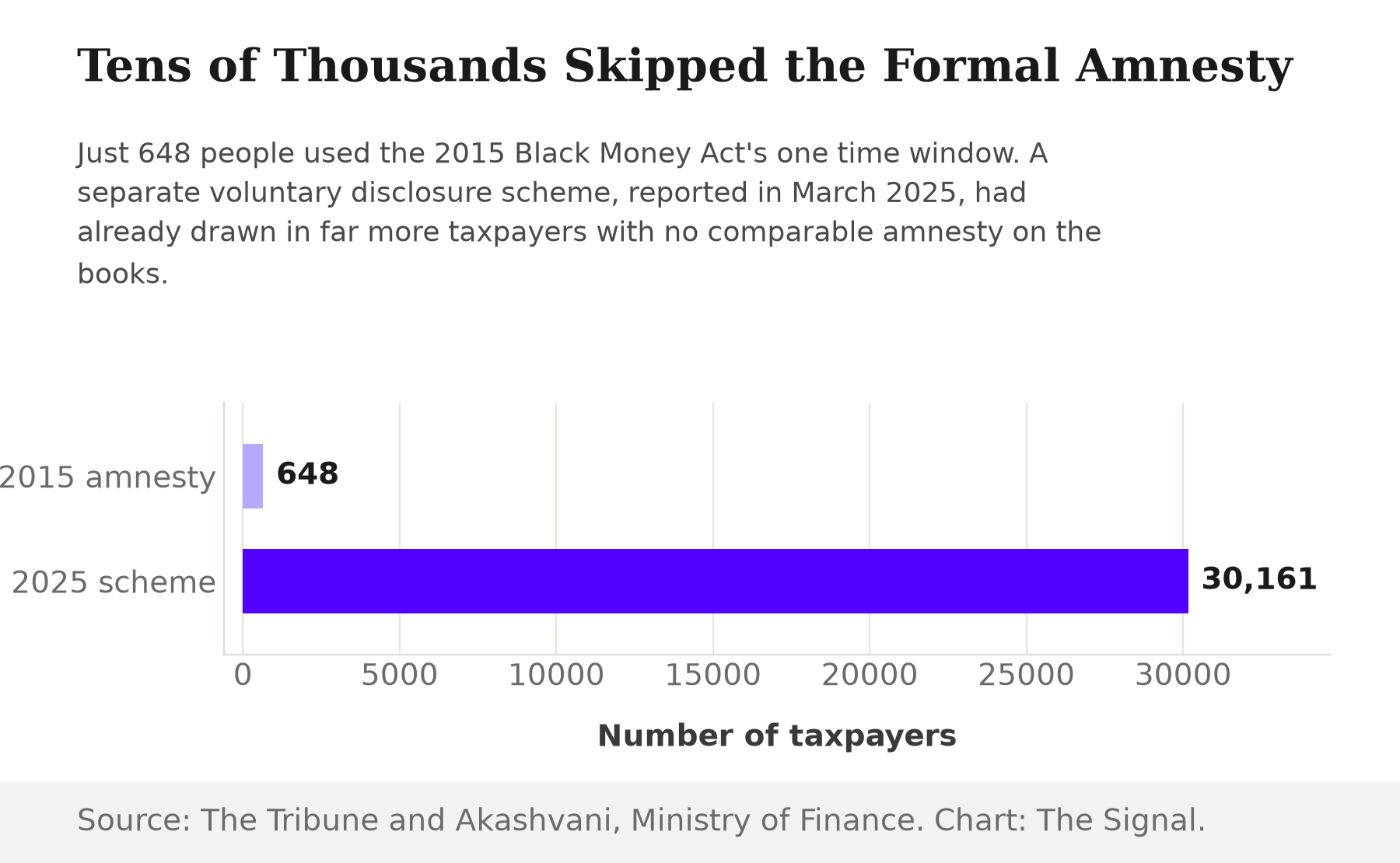
Nearly 47 times as many taxpayers came forward under the 2025 disclosure scheme as used the 2015 amnesty, our calculation.
A narrower scheme following a broader one
FAST-DS is a much narrower instrument than 2015, not a repeat of it at the same scale. Where the 2015 Black Money Act window carried no stated cap on the value of assets a declarant could disclose, FAST-DS applies only to combined undisclosed foreign assets or income up to Rs 1 crore, true to its name: a scheme for small taxpayers. The 2015 window ran three months; this one runs more than four and a half, from August 16 to December 31, 2026.
| 2015 Black Money Act window | FAST-DS (2026) | |
|---|---|---|
| Dates | July to September 2015 | August 16 to December 31, 2026 |
| Eligible value | No stated cap | Up to Rs 1 crore, combined |
| Levy | Not disclosed in these terms | 30% tax plus a matching additional amount: 60% total |
| Result | 648 declarations, more than Rs 4,000 crore | Window opens tomorrow |
FAST-DS targets a much smaller slice of foreign wealth than the amnesty it is compared against, and it is not cheap.
Comparison built from the CBDT's FAST-DS terms and the Ministry of Finance's account of the 2015 window, both cited above.
A levy of 60 percent on a declared asset's value is a steep price for coming forward voluntarily. It is also, on the scheme's own terms, the whole offer.
What skipping it actually risks
Declaring under FAST-DS is cheaper than the alternative, and it is a clean break from it too. A taxpayer who makes a valid declaration and pays the prescribed levy receives full statutory immunity from penalty and prosecution under the Black Money Act, granted automatically by operation of law rather than left to an assessing officer's discretion. The alternative to declaring is not neutral. Under Section 43 of the Black Money Act, an Assessing Officer can impose a flat Rs 10 lakh penalty for failing to disclose a foreign asset in a return of income, a provision that does not apply to foreign bank accounts with an aggregate balance up to Rs 5 lakh. For someone willfully evading tax on undisclosed foreign income or assets, the exposure goes well beyond a penalty: Section 51(1) provides for rigorous imprisonment of three to ten years, plus a fine, for wilful attempts to evade tax, penalty or interest under the Act.
Set against a department that already shows some taxpayers their own foreign accounts on the AIS portal, that penalty and prosecution framework is a real alternative to the 60 percent levy, not a hypothetical backstop, for anyone whose foreign holdings are already sitting in a data feed the CBDT receives automatically. The disclosure window closes December 31, 2026. The visibility behind it does not.
The honest objection
The strongest case against reading FAST-DS as a deadline dressed as an offer is that one large voluntary disclosure number, reported once to the Lok Sabha, is not proof the department has comprehensive visibility into every taxpayer's foreign holdings. Outreach campaigns can pull in disproportionately cautious, already-compliant people rather than the genuinely hidden money; a single reported figure says nothing about how much remains undetected. On that reading, FAST-DS is simply what it says it is: a discounted, capped opportunity for small taxpayers to fix a filing gap, no more urgent than any other compliance push.
That case would be stronger if the visibility were only a policy claim. It is not. CBDT's own AIS feature, live since July 16, 2026, puts the AEOI data directly in front of the individual taxpayer it concerns, not in an aggregate press statement. A taxpayer weighing whether to use the next four and a half months has a way to check, on their own portal, whether the department already has their number.
The Signal
FAST-DS will be judged, fairly, on how many small taxpayers use it before December 31, 2026. But the more interesting number is the one that already happened: a voluntary disclosure scheme, with no statutory amnesty behind it, out-earned the entirety of India's last real one-time amnesty by more than seven times, a year before this new scheme was even proposed. That is not evidence of a generous government leaving money on the table. It is evidence that the automatic data feed did most of the work before the paperwork caught up. The 60 percent levy is a real cost, and the deadline is real. What is not on offer is secrecy the department no longer has to give up.
Reporting basis: the FAST-DS scheme terms, its effective date and its Rs 1 crore cap are as carried by The Tribune, on the CBDT's rollout of the scheme announced in the 2026-27 Budget. The Rs 29,208 crore and 30,161-taxpayer disclosure figures are as carried by The Tribune, on Finance Minister Nirmala Sitharaman's March 2025 statement to the Lok Sabha. The CBDT's AIS display feature is as described in CBDT's own statement, carried by Akashvani/News on AIR. The 111/86-jurisdiction CRS/AEOI exchange-relationship count is from an RSM India analysis, as carried by Business Today. The 2015 Black Money Act window's 648 declarations and more than Rs 4,000 crore are from a Ministry of Finance account, also carried by Akashvani/News on AIR. Section 43 and Section 51(1) of the Black Money Act are the statute's own text, via Indian Kanoon. The FAST-DS immunity-from-prosecution terms are as described by ClearTax's analysis of the Finance Bill 2026 clauses, a single secondary interpretation rather than the primary Finance Bill text. The sevenfold and roughly 47-times comparisons between the 2025 disclosure figures and the 2015 window are The Signal's calculations from those figures.