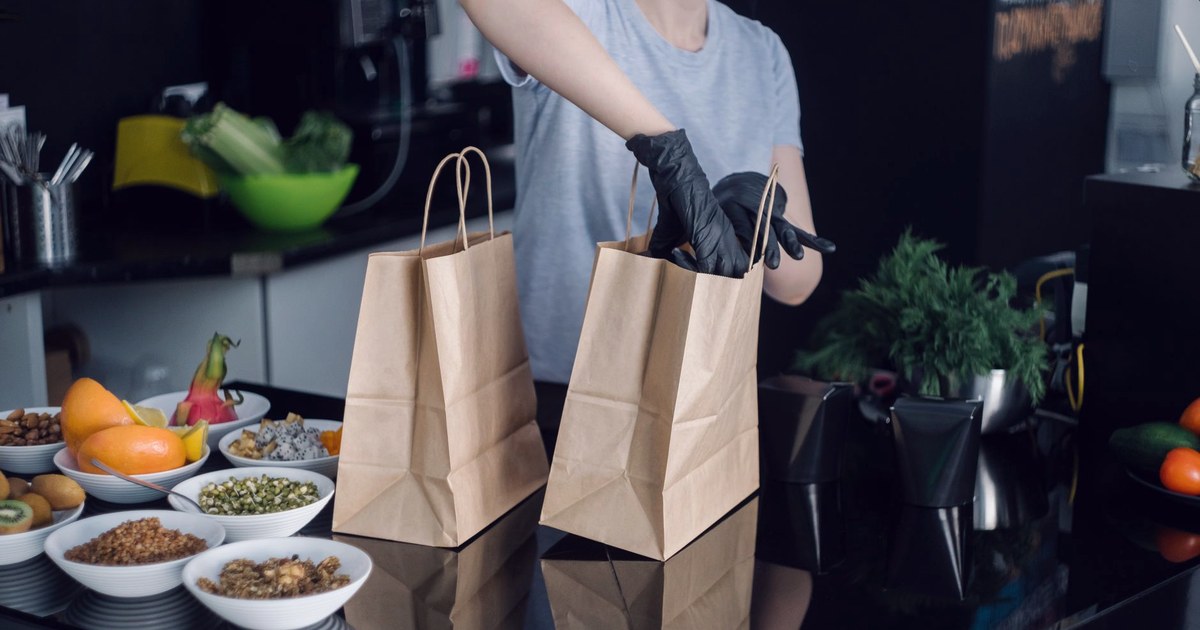
Blinkit, Zepto and Swiggy Instamart built their business on one promise: order groceries on an app, and a dark store, a small warehouse the shopper never sees, gets it to the door in minutes. That promise did not survive a hygiene check. Maharashtra's Food and Drug Administration inspected 86 quick commerce dark stores in a special drive it reported in August 2026 and suspended food licences at 14 of them, five each belonging to Blinkit and Zepto and two to Instamart, after finding cockroach infestations, expired food and other violations.
The instinct is to read that as a large sweep. It was not, next to what these chains have actually built. Blinkit alone runs 2,443 dark stores nationwide, after adding 200 net new stores in a single quarter, and Swiggy Instamart runs 1,171 more across 131 cities, both as of the end of June 2026. Leave Zepto out of the count entirely and Blinkit and Instamart alone still run 3,614 dark stores between them, a network one 86-store drive in one state had barely begun to reach. Zepto adds a network of its own on top of that: the company reported 1,139 dark stores nationwide as of the close of FY26, which puts the true three-chain network, and the drive's real denominator, well north of 4,700 stores.
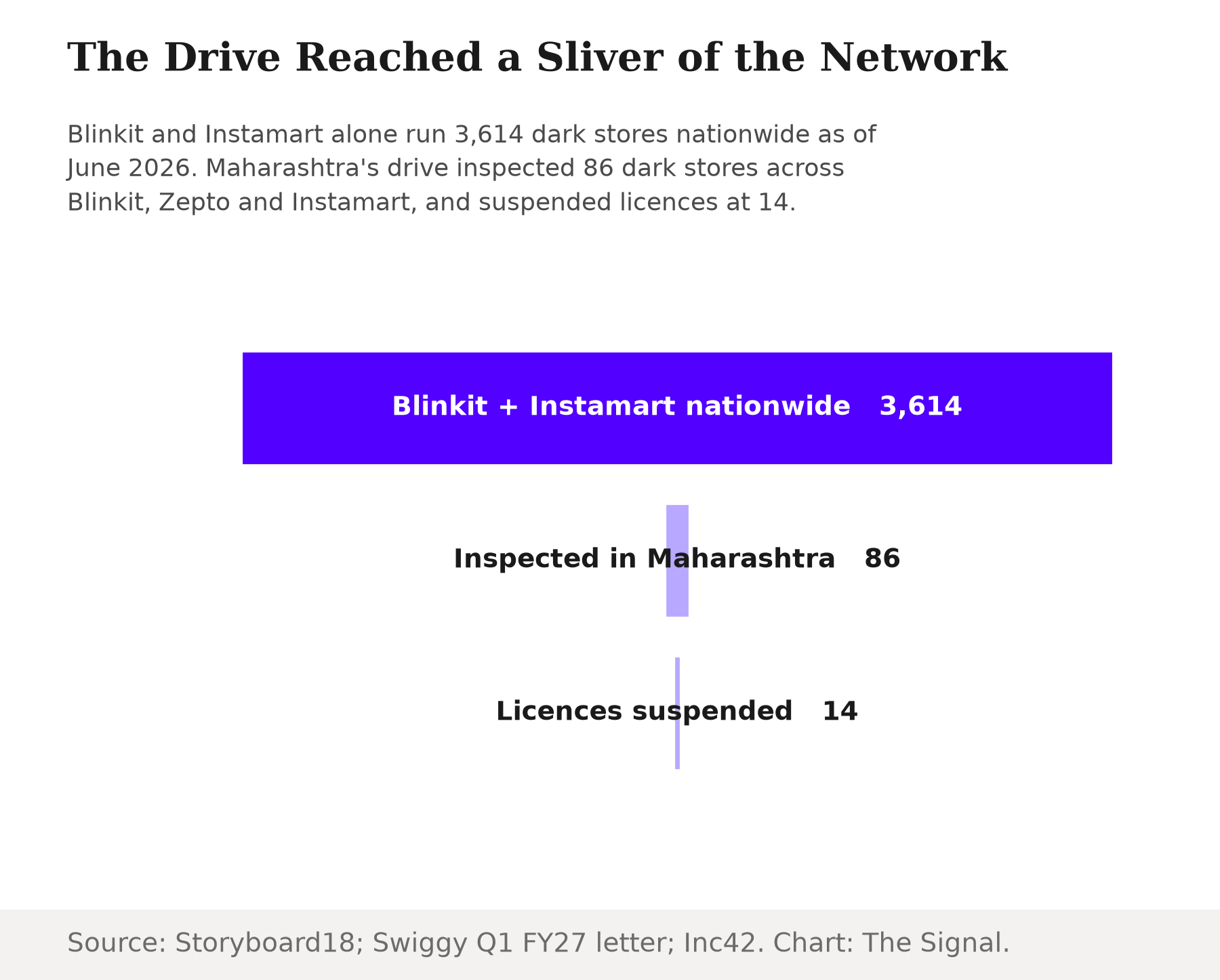
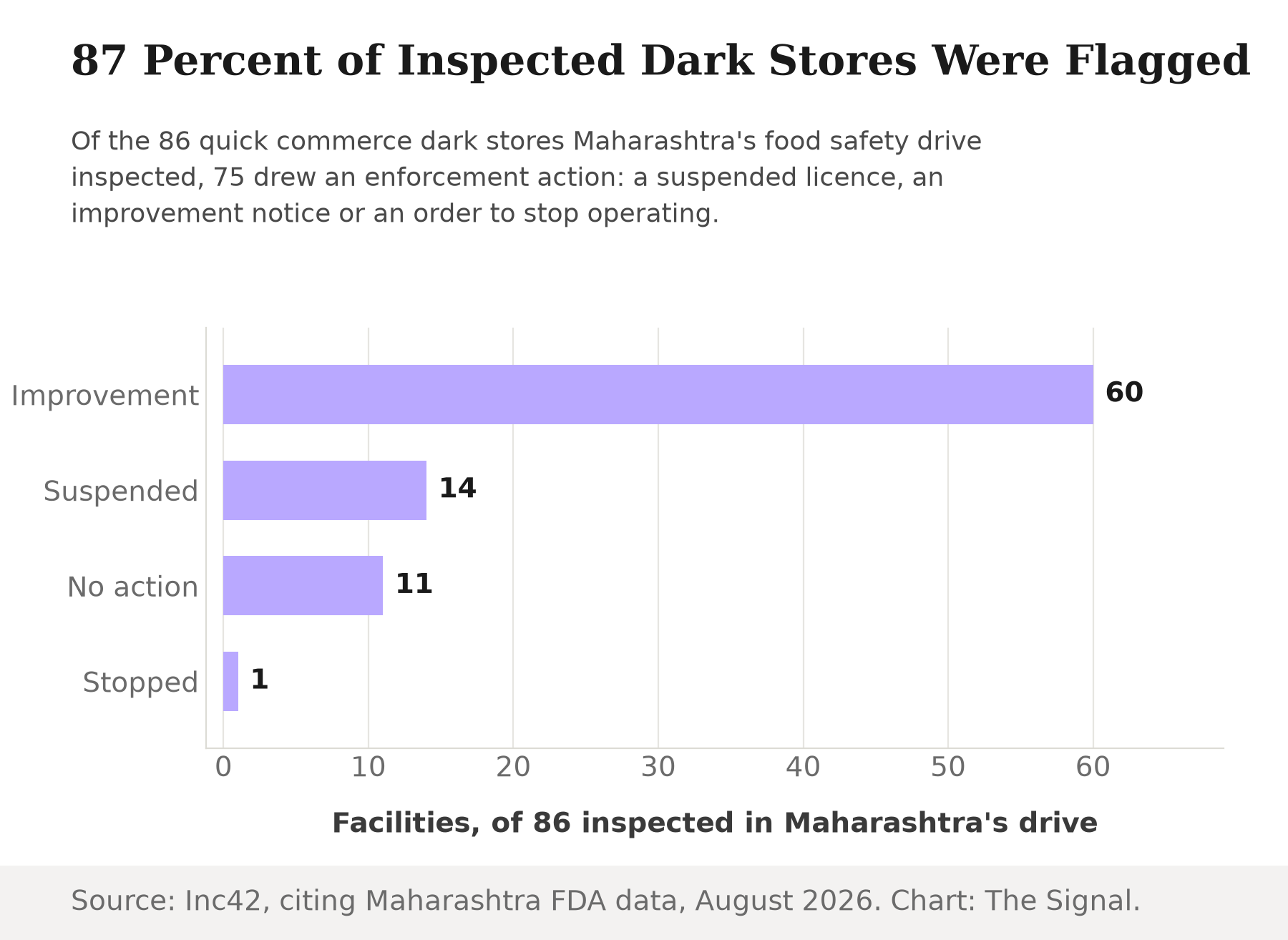
Slow down on that 86, though, because the strike rate inside it is the sharper number. Of the stores the drive actually reached, 14 lost their licences, 60 more drew improvement notices and one was ordered to stop operating altogether: 75 stores in all, or 87 percent of everything inspected, flagged for some violation (our calculation, summing and dividing the FDA's own tally). A regulator that reached barely 2 percent of just two chains' national footprint (86 of 3,614, our calculation) still found a problem at nearly nine in ten addresses it actually visited.
What the licence actually requires
The angle worth checking is whether a dark store sits under a lighter regulatory tier than the kirana shop on the corner, precisely because it is digital-first plumbing rather than a storefront. The record does not support that theory. Under FSSAI's rules, an e-commerce food operator's central licence covers its platform, but each of its warehouses and dark stores needs its own separate licence to store, distribute or sell food from that address, a Cyril Amarchand Mangaldas legal analysis of the sector noted in August 2024. A dark store is not covered by head-office paperwork. It needs its own licence, on top of the platform's.
What changed instead, four months before Maharashtra's drive, was the threshold that decides how heavy that paperwork is. FSSAI raised its turnover bands effective 1 April 2026: the lightest tier, Registration, now covers turnover up to Rs 1.5 crore, up from Rs 12 lakh; the State Licence band moved to Rs 1.5 crore to Rs 50 crore, up from Rs 12 lakh to Rs 20 crore; and a Central Licence is now required only above Rs 50 crore, up from Rs 20 crore.
| Licence tier | Turnover band before 1 April 2026 | Turnover band from 1 April 2026 |
|---|---|---|
| Registration | Up to Rs 12 lakh | Up to Rs 1.5 crore |
| State Licence | Rs 12 lakh to Rs 20 crore | Rs 1.5 crore to Rs 50 crore |
| Central Licence | Above Rs 20 crore | Above Rs 50 crore |
Source: Chambers and Partners.
A single dark store's own turnover, separate from its platform's, is not disclosed, so it is not possible to identify which tier applies to any specific Blinkit or Zepto address. What is verifiable is the structure: a dark store needs its own licence at some tier regardless, and the lightest tier just got wider for every food business in the country, quick commerce included, not narrower.
Not an isolated signal
The cockroaches were not the first sign of trouble at these platforms. Zepto drew 5,774 complaints and Blinkit 5,102 on India's National Consumer Helpline in 2025, among the highest of any e-commerce platform, according to data the government shared in the Lok Sabha. Those complaints span the full range of shopping grievances, not food safety specifically, but they show both platforms already sat near the top of complaint volume for 2025, the year before the FDA's August 2026 report. A hygiene lapse an inspector confirms after the fact is not arriving on a platform with a clean prior record.
Regulators had seen this before. Telangana's Food Safety Commission raided a Blinkit warehouse in Hyderabad in June 2024 and found the premises disorganised, unhygienic and dusty at the storage racks, more than a year before Maharashtra's own drive. The format's hygiene problem was not discovered in August 2026. It was already on the record, in a different state, and it kept recurring.
The honest objection
The strongest case against reading this as a design failure is that quick commerce should be the easier sector to police, not the harder one. India's unincorporated retail trade sector had an estimated 1.99 crore establishments nationwide in FY2023-24, overwhelmingly small, owner-run shops, a base no state food regulator can realistically inspect store by store. Quick commerce, by contrast, concentrates food handling into a few thousand identifiable, corporate-owned addresses, exactly the kind of target a special drive can actually reach. On paper, oversight should be simpler here than almost anywhere else in Indian retail.
That argument holds for reach. It does not hold for what the reach found. The typical unincorporated retail establishment with no hired staff, the model closest to a kirana shop, generated an estimated Rs 746,950 in annual gross value added in FY2023-24, a business too small individually to justify a state chasing it door to door. Quick commerce dark stores are the opposite case: concentrated, corporate, and by that same logic supposed to be the easy wins on an inspector's calendar. When the easy wins turn up violations at an 87 percent clip in the one drive that actually happened, concentration has not yet delivered the oversight it should make possible.
The Signal
None of this proves quick commerce runs dirtier stores than the kirana shop it is replacing. Nobody has audited India's unincorporated retailers at anything close to this intensity, so that comparison cannot be made from this record. What it does show is narrower and still uncomfortable: the one time a regulator looked closely at quick commerce's dark-store format, the overwhelming majority of what it checked turned up a problem, on a network that had already logged unusually large consumer-complaint volumes the year before. Blinkit added more stores in a single quarter than Maharashtra's sweep managed to inspect in total, ever. Scale arrived first. The audits are still catching up, and so far, wherever they land, they are finding something.
Reporting basis: the Maharashtra FDA's inspection and suspension counts, and the National Consumer Helpline complaint figures relayed via the Lok Sabha, are both as reported by Inc42. Blinkit's dark store count is per Storyboard18's citation of Eternal's quarterly results; Swiggy Instamart's is from Swiggy's own Q1 FY2027 shareholder letter; Zepto's is per Entrackr's report on its FY26 network expansion. The Telangana warehouse raid is per Outlook Business's report on the Food Safety Commission's June 2024 inspection. The FSSAI turnover threshold change is per Chambers and Partners' summary of the amended regulations; the dark store licensing structure is per a Cyril Amarchand Mangaldas legal analysis published in August 2024. The retail establishment count and the per-establishment gross value added figure are both from the Ministry of Statistics and Programme Implementation's Annual Survey of Unincorporated Sector Enterprises for 2023-24. The 87 percent flagged share, the 3,614 combined store count and the roughly 2 percent inspection coverage are The Signal's calculations from those figures.