Read Nasscom's Annual Strategic Review 2026, published in December 2025, and Indian IT sounds like an industry managing its own disruption rather well. Providers have re-engineered their revenue models, the review finds, moving away from FTE (full-time-equivalent) delivery billing toward outcome-based, risk-sharing pricing constructs as AI-driven productivity gains materialise. The review credits the shift to GCC (global capability centre) expansion and BFSI demand, and says mid-tier firms are outpacing top-tier peers on sharper niche positioning. That is the language of a sector retooling on its own terms, not one being repriced by its clients.
It is worth slowing down on that framing. Reinvention is not landing evenly, and the results that have since come in for the fiscal year to March 2026, and the June 2026 quarter beyond it, show exactly how unevenly.
Forbes India reports, citing TCS's FY26 results, that the company's dollar revenue declined for the first time in its history, down 0.5 percent year-on-year to $30,017 million, and down 2.4 percent in constant currency terms. That is the number that carries this story. India's largest IT services company, the one whose growth curve has defined the sector for two decades, shrank in dollar terms for a full year. In the same window, two much smaller rivals did the opposite.
The math behind the billing model
The industry's core contract has always been the per-FTE-hour: a client pays for a defined number of engineers, billed by the hour, for a defined scope of work. AI-assisted coding and testing cut the hours a given piece of work takes. Bill by the hour and that is a revenue problem even when the client got more value, because the invoice shrinks with the hours. Outcome-based, risk-sharing pricing, the model Nasscom's review says the sector is reinventing toward, tries to fix this by billing the deliverable instead of the hour. But renegotiating that model into a legacy book of thousand-seat contracts, the kind TCS, Infosys and Wipro run, is slow. A smaller firm signing new-logo deals can simply price the new model in from day one.
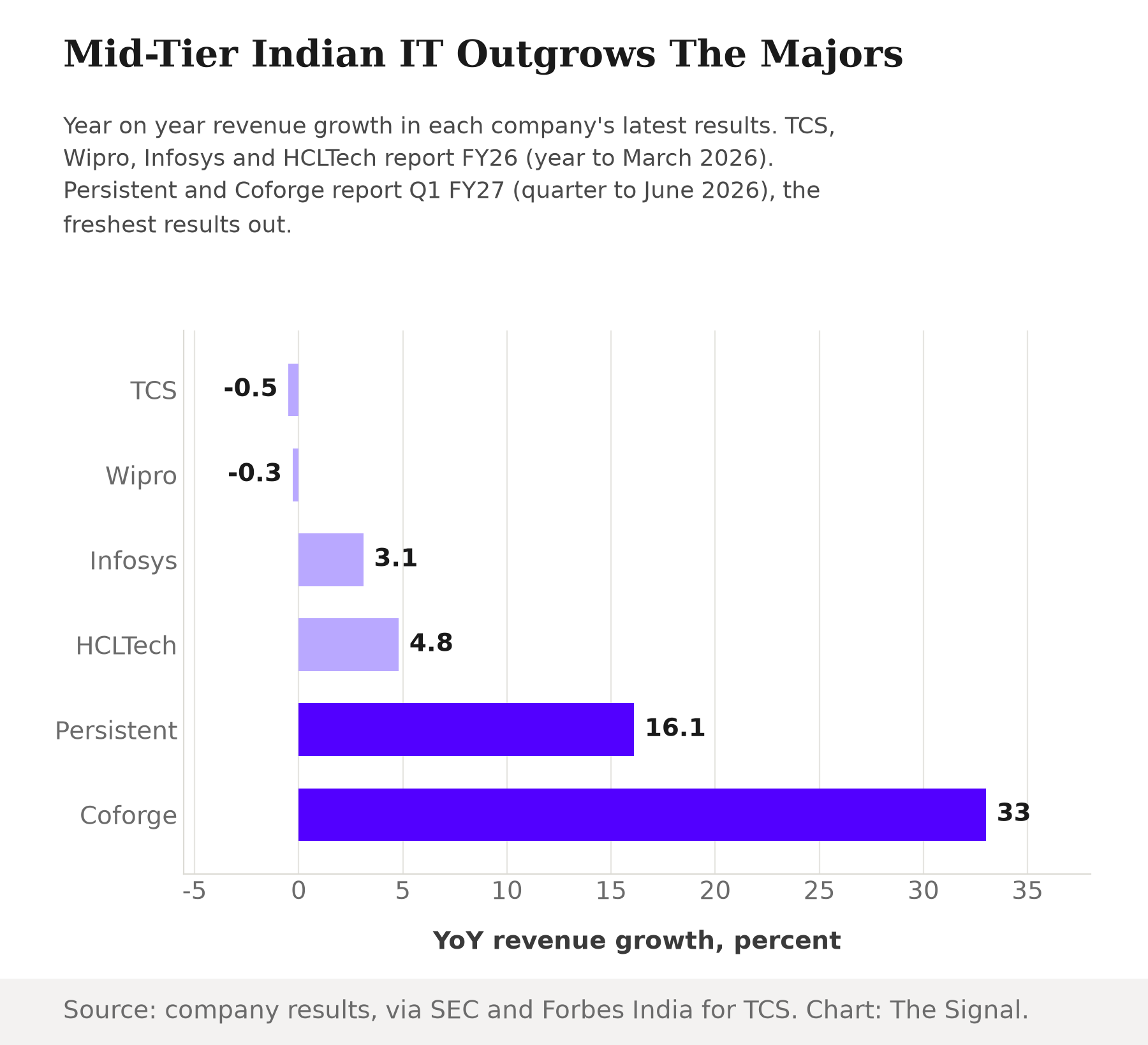
That split shows up cleanly in the numbers each company has actually published. Wipro's own FY26 results press release reports IT services segment revenue of $10,478.1 million for the year to March 2026, a decrease of 0.3 percent year-on-year in reported terms and 1.6 percent in constant currency. Infosys's own FY26 results press release, filed with the U.S. SEC, reports $20,158 million in FY26 revenue, growth of 3.1 percent in constant currency, and FY27 guidance of just 1.5 to 3.5 percent constant-currency growth. Set against that, in the quarter to June 2026, the freshest results available, Persistent Systems' own Q1 FY27 results press release reports revenue of $452.4 million, up 16.1 percent year-on-year, and Coforge's own Q1 FY27 results press release reports revenue of $592.2 million for the same quarter, up 33 percent year-on-year in dollar terms and 49 percent in rupee terms. Persistent and Coforge are reporting a later quarter than the majors' FY26 figures, but it is the only fresh read available, and the pattern it shows matches the annual one: growth concentrated away from the largest billing books.
| Company | Tier | Period reported | Revenue | YoY growth |
|---|---|---|---|---|
| TCS | Major | FY26 (year to Mar 2026) | $30,017 million | -0.5% (reported) |
| Wipro | Major | FY26 (year to Mar 2026) | $10,478.1 million (IT services) | -0.3% (reported) |
| Infosys | Major | FY26 (year to Mar 2026) | $20,158 million | +3.1% (constant currency) |
| HCLTech | Major | FY26 (year to Mar 2026) | Services +4.8% CC; $620M annualised AI revenue | +4.8% (constant currency) |
| Persistent Systems | Mid-tier | Q1 FY27 (quarter to Jun 2026) | $452.4 million | +16.1% (reported) |
| Coforge | Mid-tier | Q1 FY27 (quarter to Jun 2026) | $592.2 million | +33% (reported) |
Infosys's own guidance shows the majors do not expect the gap to close soon.
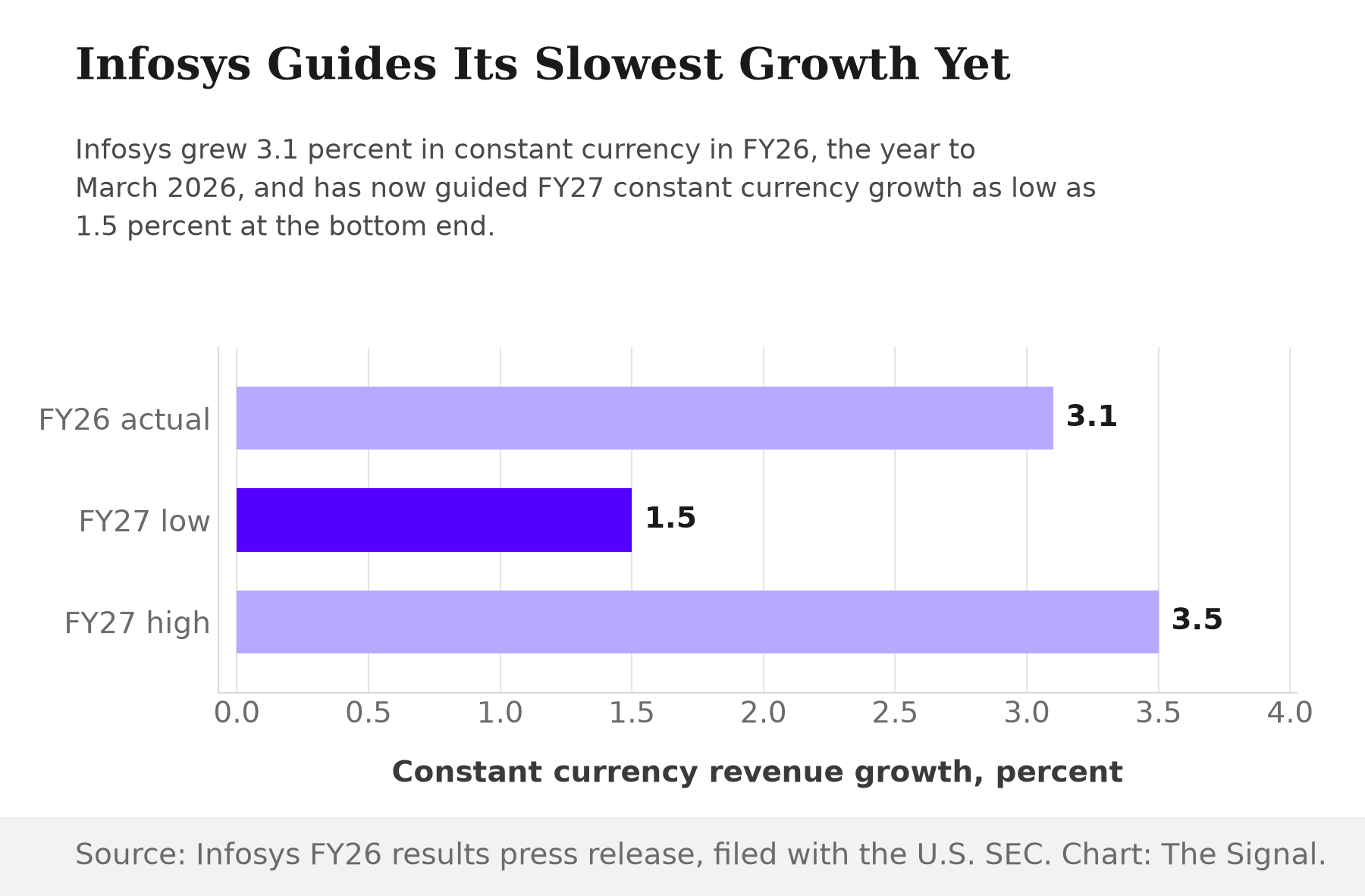
A company whose FY26 constant-currency growth of 3.1 percent is now guided down to as little as 1.5 percent for FY27 is not describing a one-quarter wobble. It is describing a floor that keeps moving down while a smaller rival two rungs below it on the league table posts double-digit and 30-percent-plus growth in the same season.
HCLTech shows a way out, not just a warning
Not every major is stuck. HCLTech's own FY26 results press release reports annualised Advanced AI revenue of $620 million, FY26 services revenue up 4.8 percent in constant currency, and total contract value of new deal wins at $9.3 billion. That 4.8 percent is the best constant-currency growth of the four majors here, and it sits alongside a standalone AI revenue line built outside the legacy per-hour book rather than carved out of it. The distinction matters: HCLTech is not repricing old contracts, it is selling a new product line and letting the old one grow at its own modest pace. That is closer to what Persistent and Coforge are doing structurally, on a bigger balance sheet.
The honest objection
The strongest case against reading this as a billing-model story is scale. Coforge's $592.2 million quarterly revenue and Persistent's $452.4 million are a fraction of TCS's $30,017 million annual revenue; a small company posting 33 percent growth is adding a few hundred million dollars, while TCS losing 0.5 percent is losing a much larger sum on a far bigger base. Percentage growth off a small base is mechanically easier than off a giant one, and macro softness in discretionary technology spending, not billing mechanics specifically, could explain most of the majors' weakness on its own.
That case is real, but HCLTech complicates it. HCLTech is a major, competing for the same large enterprise contracts as TCS, Infosys and Wipro, in the same macro environment, and it still posted the group's best constant-currency growth while standing up a nine-figure AI revenue line. If macro softness alone explained the split, size should have flattened HCLTech's results the same way it flattened TCS's. It did not. Scale explains part of the gap; how fast a firm can move off per-hour billing explains the rest.
There is a second objection worth naming: if per-hour billing were really breaking, margins should be the first thing to show it, and they have not collapsed. Infosys's FY26 operating margin held at 21 percent, and the company guided FY27 operating margin to a range of 20 to 22 percent, stable, not shrinking, even as its revenue growth guidance kept sliding. But stability is not the same as room to keep absorbing discounts. S&P Global Ratings says Indian IT firms' margins, currently above the industry average, have limited room to improve, citing a shift toward fixed-price contracts and pressure on the labour-cost advantages that traditionally supported profitability. Read together, the two data points describe a lag rather than a contradiction: the majors have so far protected margin by holding cost discipline while growth stalls, but the mechanism S&P flags, fixed-price deals replacing hourly ones, is the same billing shift this piece is tracking. If it keeps spreading, margin is next.
The Signal
Forbes India's deep-dive on AI-led pricing deflation reports that an estimated 12 to 15 percent of Indian IT sector revenue faces direct AI-driven displacement risk. That is not a forecast about the whole industry shrinking. It is a forecast about which slice of every contract, the slice priced by the hour, is the part that breaks first. Watch the next two quarters for whether TCS, Infosys and Wipro can show outcome-based and AI-linked revenue growing as a share of the book, the way HCLTech already has, or whether they keep discounting the old book to hold on to clients while GCCs, BFSI demand and niche mid-tier players pull growth further away from them. The firms that reprice fastest, not the firms with the most engineers, are the ones setting the industry's growth rate now.
Reporting basis: the industry-wide reinvention and mid-tier outperformance claims are from Nasscom's Annual Strategic Review 2026, published December 2025. TCS's FY26 revenue figures are as reported by Forbes India, citing TCS's own results, and the AI displacement risk figure comes from analysts cited in a separate Forbes India deep-dive on pricing deflation; both pieces share Forbes India as their reporting origin. Wipro's, HCLTech's, Persistent Systems' and Coforge's FY26 and Q1 FY27 figures are each from that company's own results press release. Infosys's FY26 results and FY27 guidance are from its results press release as filed with the U.S. Securities and Exchange Commission; its FY26 and FY27 margin figures are as reported by Forbes India, citing the same results. The S&P Global Ratings view on margin headroom is as reported by Forbes India.