
On August 12, 2026, Bank of America and Reliance's Jio Financial Services announced a deal that reads, on the surface, like Wall Street buying into India's shadow-banking boom in scale. Bank of America will invest up to ₹18,268 crore, about $1.9 billion, for up to 49.9% of Jio Credit Limited, structured as a preferential allotment of equity shares and warrants. Jio Financial Services took the news well: its shares closed 0.83% higher, at ₹255 on the BSE, the day the deal was announced. One of the largest banks in the United States, buying up to half of a fast-growing Indian lender: that is the headline version of this story.
It is worth slowing down on the words "up to." The transaction initially gives Bank of America only a 26.5% equity interest in Jio Credit, a stake that climbs to the full 49.9% only if Bank of America later exercises the warrants attached to the deal. Nothing in the announced structure takes Bank of America past 49.9%, and simple arithmetic on that same number means Reliance's Jio Financial Services keeps more than half of Jio Credit under any version of this deal.
Bank of America's stake stops just short of a majority, and only reaches its ceiling if the bank chooses to exercise its own warrants.
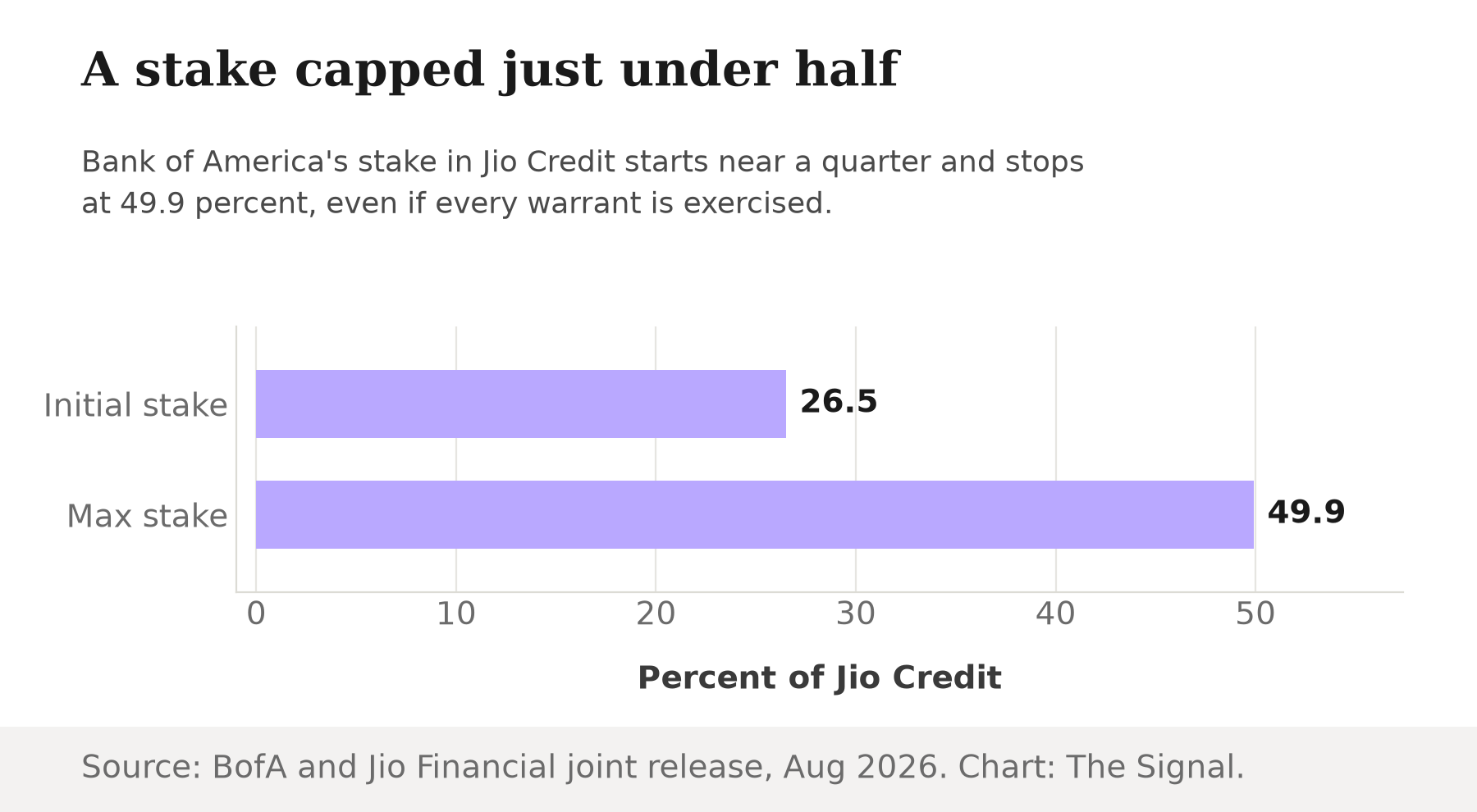
That is an unusual way to structure a marquee foreign investment into a young Indian lender. A bank with Bank of America's balance sheet does not lack the capital to buy control outright. The stake was built to stop just under half.
The 50% line is not arbitrary. Under India's Consolidated FDI Policy, a company is legally considered "owned" by resident Indian citizens only if more than 50% of its capital is beneficially held by them, directly or through Indian companies they ultimately own and control, according to the Department for Promotion of Industry and Internal Trade. Cross that line and Jio Credit would no longer be classifiable as an Indian-owned company by that same definition. A stake capped at 49.9% is a stake engineered to leave that classification untouched.
A lender built in two years
The asset drawing this much foreign capital is young. Jio Credit built assets under management of ₹30,667 crore, about $3.2 billion, as of June 30, 2026, within just two years of starting operations, a pace that put it among India's fastest-growing non-bank finance companies (NBFCs) before Bank of America ever showed up. The deal is not a foreign bank rescuing or consolidating a mature lender. It is a foreign bank buying into growth that Reliance already engineered on its own, at a price capped below a majority.
The boom Bank of America is buying into
The timing lines up with a broader shift in where Indian credit is actually growing. Bank credit to India's services sector, lifted by NBFCs, grew 21.4% year on year in the fortnight ended June 30, 2026, up from 8.8% in the same fortnight a year earlier, according to the Reserve Bank of India. That was not a sudden spike. Six months earlier, in the fortnight ended January 31, 2026, the same series had already accelerated to 15.5% year on year, up from 12.3% a year before that, with the RBI again flagging NBFCs as a driver. Two RBI readings, six months apart, both show the same NBFC-driven segment of Indian credit speeding up, not just growing.
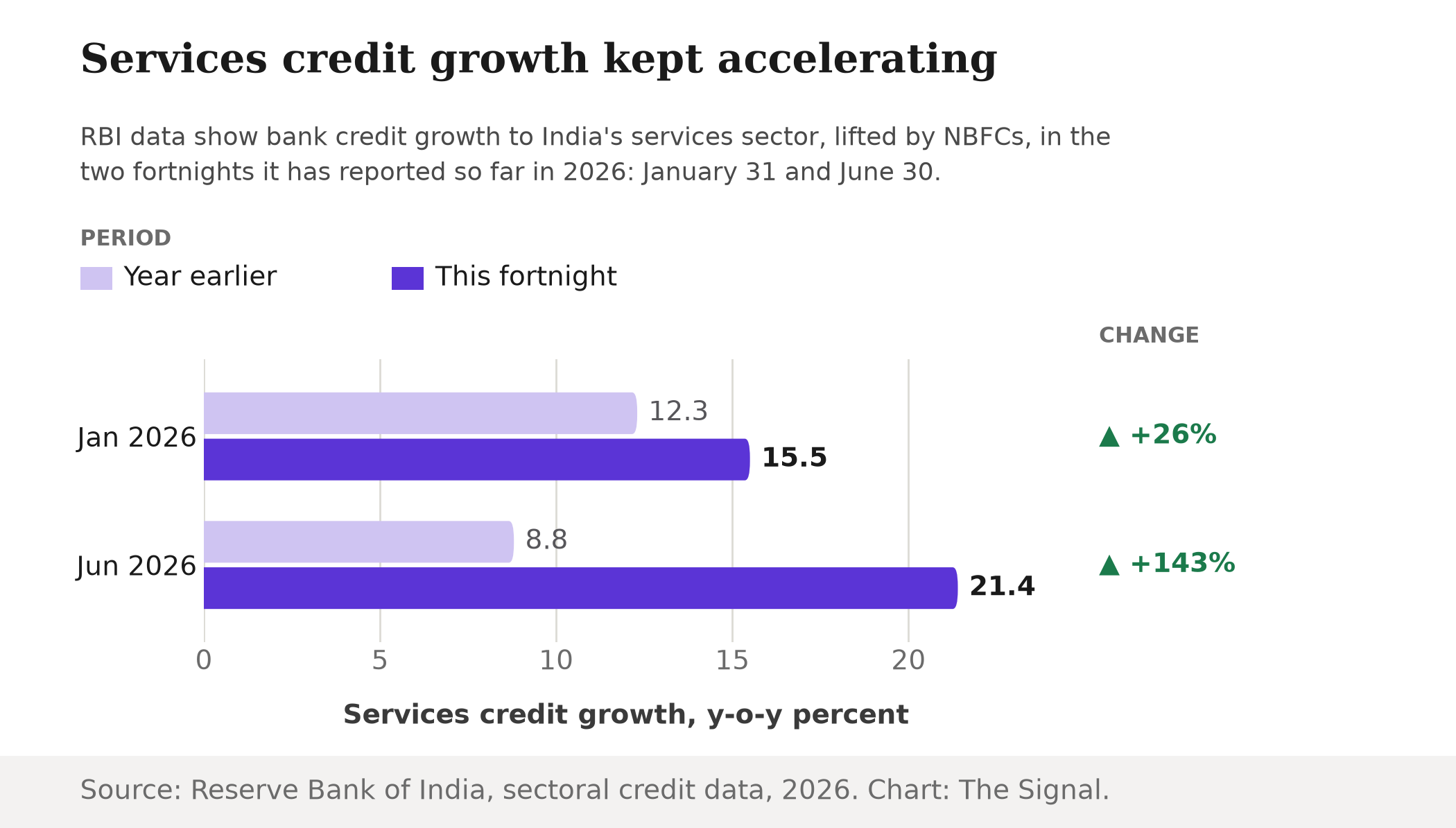
Jio Credit is one lender inside a sector that the RBI's own data says is accelerating. A foreign bank buying exposure to that segment, without taking on the operating and regulatory weight of running an Indian NBFC outright, is a coherent trade even before Jio Credit's specific growth numbers enter the picture.
A sliver of Bank of America's own balance sheet
For Reliance, up to $1.9 billion is a landmark validation. For Bank of America, it barely registers. Bank of America's own balance sheet stood at $3,496 billion in total assets as of March 31, 2026, against which the maximum $1.9 billion Jio Credit commitment is a fraction of one percent.
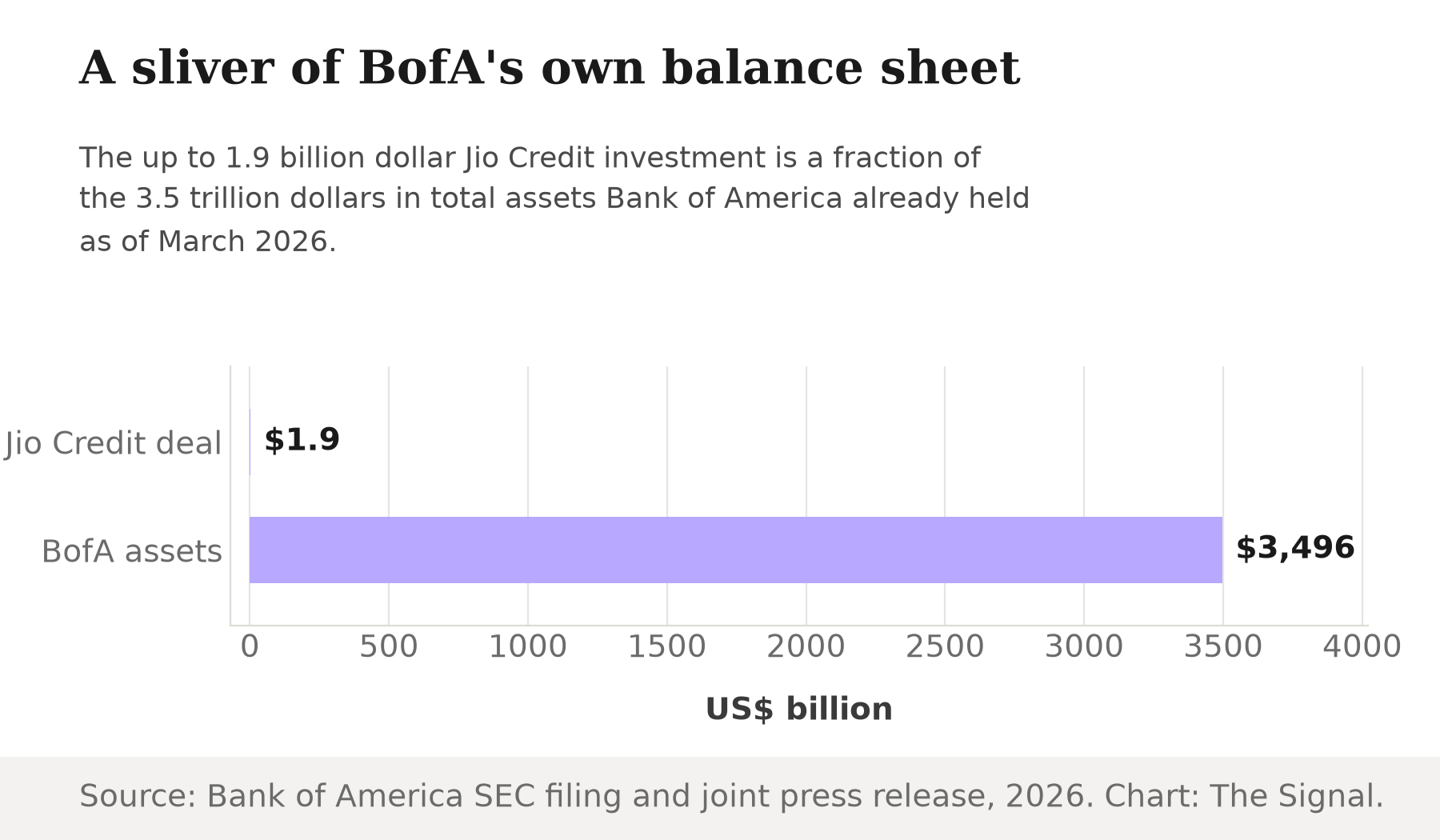
That gap matters for reading the deal correctly. This is not Bank of America placing a bet it needs to win, but a large bank taking a capped, optional position in a fast-growing market, sized so that even a disappointing outcome would not move its own numbers.
The same playbook, a second time
Jio Financial Services has run something close to this structure before. In July 2023, Jio Financial Services and BlackRock each committed $150 million to a 50:50 joint venture to enter India's asset-management industry, rather than either side taking control of the other. The Bank of America deal is larger and the ownership split is not identical, but the shape repeats: a marquee global financial name, a shared stake capped short of a takeover, and Jio Financial Services retaining the majority position in its own subsidiary. This looks less like a one-off negotiating outcome and more like a template Reliance has used twice now to bring in global capital and expertise without ceding the lender itself.
The honest objection
The strongest case against reading much into the exact ownership threshold is that a stake this large is close to control in every way that matters economically, whatever the number on paper. A shareholder holding just under half, with warrants that can be exercised later, has real influence over financing terms, governance and strategy long before a shareholder vote ever settles the question of formal control. On that view, the precise cutoff is a technicality dressed up as a finding.
That case has force, but it does not explain why the initial stake is only 26.5%, not 49.9%, with the rest contingent on Bank of America choosing to exercise warrants it does not have to exercise. If Bank of America wanted maximum influence from day one, the deal could have been written to hand over the full 49.9% immediately; instead, Bank of America starts smaller and keeps the option to grow into the position only if Jio Credit's performance justifies it. That is optionality, not a seat at the table Bank of America plans to use immediately.
The Signal
Two numbers tell this story better than the $1.9 billion headline does: 26.5, and 49.9. This is optional, capped exposure to India's NBFC growth, not an acquisition of Jio Credit: sized so small against Bank of America's own balance sheet that a poor outcome costs it little, and structured so that Reliance's Jio Financial Services keeps the lender inside its own consolidated structure regardless of how the warrants play out. Watch what Bank of America does with the option it just bought. If it exercises the warrants and pushes toward its full stake as Jio Credit's growth continues, this was a bet on India's NBFC boom that BofA wanted to size up. If it never does, the deal was never about control in the first place: it was about renting exposure to a market Bank of America was not prepared to own.
Reporting basis: the deal terms and initial and maximum stake are from Bank of America and Jio Financial Services' own joint press release, distributed via PR Newswire and republished by StockTitan, with Jio Credit's assets under management also carried in Bank of America's own newsroom announcement. The share-price move is per Inc42's account of BSE trading data. The two sectoral credit growth readings are from the Reserve Bank of India's press release for the fortnight ended June 30, 2026 and its release for the fortnight ended January 31, 2026. Bank of America's total assets figure is from the bank's own SEC-filed investor presentation for the quarter ended March 31, 2026. The 2023 joint venture with BlackRock is per BlackRock's own announcement. The 50%-ownership threshold is from India's Consolidated FDI Policy, issued by the Department for Promotion of Industry and Internal Trade. The comparison of the Jio Credit deal size against Bank of America's total assets, and the year-on-year jump in the services-sector credit growth rate between the two RBI readings, are The Signal's calculations from those figures.